---
title: Natural satellite
canonical_url: https://paxabyssi.com/wiki/Natural_satellite
markdown_url: https://paxabyssi.com/wiki/Natural_satellite.md
type: wiki-page
revision_id: 58
revision_view: stable
last_updated: 2026-09-27
license: CC BY-SA 4.0
license_url: https://creativecommons.org/licenses/by-sa/4.0/
science_status:
- observed
- model
- sim
summary: A moon, a natural body orbiting a planet, dwarf planet or asteroid. The Solar System's planets have more than 430 known moons, from kilometre-sized captured fragments to Ganymede, which is larger than Mercury.
categories:
- Moons
- Moon types
- Moons of the Solar System
- Planetary systems
aliases:
- Moon types
- Moons
- Satellite
- Regular moon
- Irregular moon
- Exomoon
infobox:
type: moon_class
name: Natural satellite (moon)
largest: Ganymede, 2,631 km radius, 0.025 Earth masses
examples:
- the Moon
- Io
- Europa
- Ganymede
- Callisto
- Titan
- Enceladus
- Triton
- Charon
- Phobos
exomoons: None confirmed as of September 2026; Kepler-1625 b-i and Kepler-1708 b-i are disputed candidates
sim_types:
- code: M0-B1
name: Barren rocky
analogue: the Moon
- code: M0-B2
name: Iron-rich
analogue: none known
- code: M1-A
name: Ancient ice
analogue: Callisto
- code: M1-C
name: Cryovolcanic ice
analogue: Enceladus
- code: M1-E
name: Exotic nitrogen and CO ice
analogue: Triton
- code: M1-M
name: Mixed ice and rock
analogue: Ganymede
- code: M2-V
name: Volcanic
analogue: Io
- code: M2-M
name: Magma ocean
analogue: none known
- code: M3-A
name: Captured asteroid
analogue: Phobos
- code: M3-K
name: Captured Kuiper belt object
analogue: Phoebe
- code: M3-R
name: Roche-disrupting
analogue: Phobos in its final tens of millions of years
- code: M4-A
name: Thick atmosphere
analogue: Titan
- code: M4-O
name: Subsurface ocean
analogue: Europa
- code: M4-T
name: Thin atmosphere
analogue: none known
- code: M5-G, M5-H, M5-W
name: Super-moons of very massive giants
analogue: none known (speculative)
definition: A natural body in a bound orbit around a planet, dwarf planet or smaller body, inside its host's Hill sphere and outside its Roche limit.
size_range_km:
max: 5262
min: 1
note: kilometre-scale irregular moons to Ganymede (diameter)
formation_channels:
- circumplanetary disk accretion
- giant impact
- capture
solar_system_count:
Mars: 2
note: Counts rise as surveys find more small irregular moons; always date them
Earth: 1
Venus: 0
as_of: 2026-09
Saturn: 293
Uranus: 29
Jupiter: 115
Mercury: 0
Neptune: 16
total_planetary: 456
regular_vs_irregular: Regular moons orbit close in, prograde, on near-circular orbits near the planet's equator, and formed with it. Irregular moons orbit far out on eccentric, inclined and often retrograde orbits, and were captured. More than 90 percent of Jupiter's and Saturn's known moons are irregulars a few kilometres across.
satellite_mass_fraction: about 1e-4 of the planet for the regular moons of gas and ice giants (Jupiter 2.1e-4, Saturn 2.5e-4, Uranus 1.0e-4); Earth's Moon 0.012; Charon 0.12 of Pluto
related:
- https://paxabyssi.com/wiki/Sol.md
- https://paxabyssi.com/wiki/Asteroid_belt.md
- https://paxabyssi.com/wiki/Orbit.md
- https://paxabyssi.com/wiki/Planetary_system_archetypes.md
- https://paxabyssi.com/wiki/Habitable_zone.md
- https://paxabyssi.com/wiki/Star_system_generation.md
---
# Natural satellite
> Source: https://paxabyssi.com/wiki/Natural_satellite
>
> Licence: [CC BY-SA 4.0](https://creativecommons.org/licenses/by-sa/4.0/). Text by Pax Abyssi Wiki contributors; history at https://paxabyssi.com/wiki/Natural_satellite/history
>
> Revision 58, 27 September 2026
A **natural satellite**, or **moon**, is a body that orbits a planet, a dwarf planet or even an asteroid. As of September 2026 the Solar System's eight planets have 456 known moons, 408 of them around Jupiter and Saturn alone [1] [2]. They range from captured fragments a kilometre or two across to Ganymede, whose 5,262 km diameter exceeds Mercury's [3]. Some of the most promising places to look for life beyond Earth are moons, and so are the most volcanically active world known and the only moon with a thick atmosphere.
## How moons form
Moons come from three main routes, and a moon's orbit usually says which one it took.
**Growing in a disk around the planet.** A young giant planet is surrounded by a disk of gas and dust, a small version of the disk around the young Sun, and solid material in it gathers into moons. These are the **regular moons**: they orbit prograde (in the direction the planet spins), on nearly circular orbits close to the planet's equator. The four large moons of Jupiter, Saturn's major moons and the five large moons of Uranus are regular. Canup and Ward showed that the total mass of such a system settles at about one ten-thousandth of the planet's mass, because moons that grow too large spiral into the planet through the gas and are replaced by new ones [4]. The real numbers bear this out: Jupiter's regular moons hold $2.1 \times 10^{-4}$ of its mass, Saturn's $2.5 \times 10^{-4}$ and Uranus's $1.0 \times 10^{-4}$ [3].
**A giant impact.** Earth's Moon is thought to have formed from debris thrown out when a Mars-sized body struck the young Earth [5], and Pluto's large moon Charon from a similar collision [6]. Impact-made moons can be large relative to their hosts: the Moon has 1.2 percent of Earth's mass and Charon 12 percent of Pluto's, far above the giant planets' one part in ten thousand.
**Capture.** The **irregular moons** orbit far from their planets on eccentric, steeply inclined and often retrograde orbits. They are captured bodies, and more than 90 percent of Jupiter's and Saturn's known moons are irregulars only a few kilometres across, many of them fragments of a few captured parents broken up by later collisions [7]. The largest captured moon is Neptune's Triton, 2,705 km across, which circles Neptune backwards on an orbit inclined 157 degrees. The favoured explanation is that Triton was one half of a binary pair that passed too close to Neptune: the planet kept Triton and flung its partner away [8]. The origin of Mars's two small moons, Phobos and Deimos, is still argued. Their dark, asteroid-like surfaces suggest capture, but their near-circular, equatorial orbits suggest they accreted from debris after an impact on Mars [9].
## Where a moon can orbit
A moon must stay inside its planet's **Hill sphere**, the region where the planet's gravity outweighs the star's tidal pull, of radius $r_H \approx a\,(m/3M)^{1/3}$ (see [Orbit](https://paxabyssi.com/wiki/Orbit.md)). Only the inner part is stable over long times. Numerical experiments put the limit at about half the Hill radius for prograde moons and about 0.93 of it for retrograde ones, which is why the most distant irregular moons tend to orbit backwards [10]. At the inner edge sits the **Roche limit**, inside which tides pull a moon apart; material there stays as a ring.
Planets close to their stars have small Hill spheres, and tides between planet and moon then drive the moon either into the planet or out of the Hill sphere. Barnes and O'Brien found that a hot Jupiter cannot keep a sizeable moon for the age of its system [11], and Kane showed that most planets in compact systems such as TRAPPIST-1 have too little room between the Roche limit and the Hill sphere for moons at all [12].
## Tides: locked faces, heat and slow drift
Tides raised by a planet slow a moon's spin until one face always points at the planet; close moons lock quickly, because the despinning time grows as the sixth power of distance [13]. The Moon, the Galilean moons and most regular moons are locked.
The tides a moon raises on its planet change the orbit too. Earth spins faster than the Moon orbits, so the tidal bulge runs ahead of the Moon and tows it outward: lunar laser ranging to reflectors left by the Apollo astronauts shows the Moon receding by about 3.8 cm a year [14]. Phobos orbits Mars faster than Mars spins, so the drag works the other way. Phobos is spiralling inward and is expected to break apart within 20 to 40 million years, leaving Mars a ring [15].
A moon on an eccentric orbit is squeezed and relaxed once per orbit, and the flexing heats its interior. The heating rate is
$$
\dot E = \frac{21}{2}\,\frac{k_2}{Q}\,\frac{G M_p^2 R^5\, n\, e^2}{a^6}
$$
where $M_p$ is the planet's mass, $R$ the moon's radius, $n$ its mean motion, $e$ its eccentricity and $a$ its orbital distance; $k_2$ and $Q$ describe how readily the moon deforms and how much of that energy it turns into heat [16]. Because $n$ itself falls as $a^{-3/2}$, heating drops as $a^{-15/2}$: halve the distance and the heat rises about 180-fold. Tides would circularise the orbit and switch the heating off, unless something keeps pumping the eccentricity. At Jupiter, the orbital periods of Io, Europa and Ganymede lock in the ratio 1:2:4, and the repeated tugs keep Io's orbit eccentric. Peale, Cassen and Reynolds used this to predict volcanoes on Io just before Voyager 1 found them in 1979 [17]. Io now radiates about 100 terawatts of internal heat, some 2 to 2.5 watts per square metre, which is 20 to 30 times Earth's average heat flow, and astrometry of the Galilean moons over more than a century confirms that tides supply it [18].
## The kinds of moon
| Kind | Solar System example | Radius (km) | Density (g/cm³) | What defines it |
| ---------------------- | -------------------- | ----------- | --------------- | ----------------------------------------------------------- |
| Airless rocky | The Moon | 1,737 | 3.34 | Cratered highlands, dark lava plains, no atmosphere |
| Volcanic | Io | 1,821 | 3.53 | Tidal heating, hundreds of active volcanoes, sulfur surface |
| Subsurface ocean | Europa | 1,561 | 3.01 | Ice shell over a global salt-water ocean |
| Mixed ice and rock | Ganymede | 2,631 | 1.94 | Largest moon; its own magnetic field; buried ocean |
| Ancient ice | Callisto | 2,410 | 1.83 | Saturated with craters; little internal activity |
| Thick atmosphere | Titan | 2,575 | 1.88 | 1.5 bar nitrogen air, methane rain, hydrocarbon lakes |
| Cryovolcanic | Enceladus | 252 | 1.61 | Jets of ocean water from its south pole |
| Captured, nitrogen ice | Triton | 1,353 | 2.06 | Retrograde; nitrogen geysers seen by Voyager 2 |
| Captured small body | Phobos | 11 | 1.87 | Irregular shape, dark surface, low density |
Radii and densities from JPL [3].
Titan's tidal flexing, measured by Cassini, is too large for a solid interior and points to a global ocean of liquid water beneath its ice [19]. Enceladus's jets carry salty ice grains that Cassini sampled directly: they contain large organic molecules [20] and phosphates, the form of phosphorus that life on Earth uses, at concentrations well above those in Earth's oceans [21].
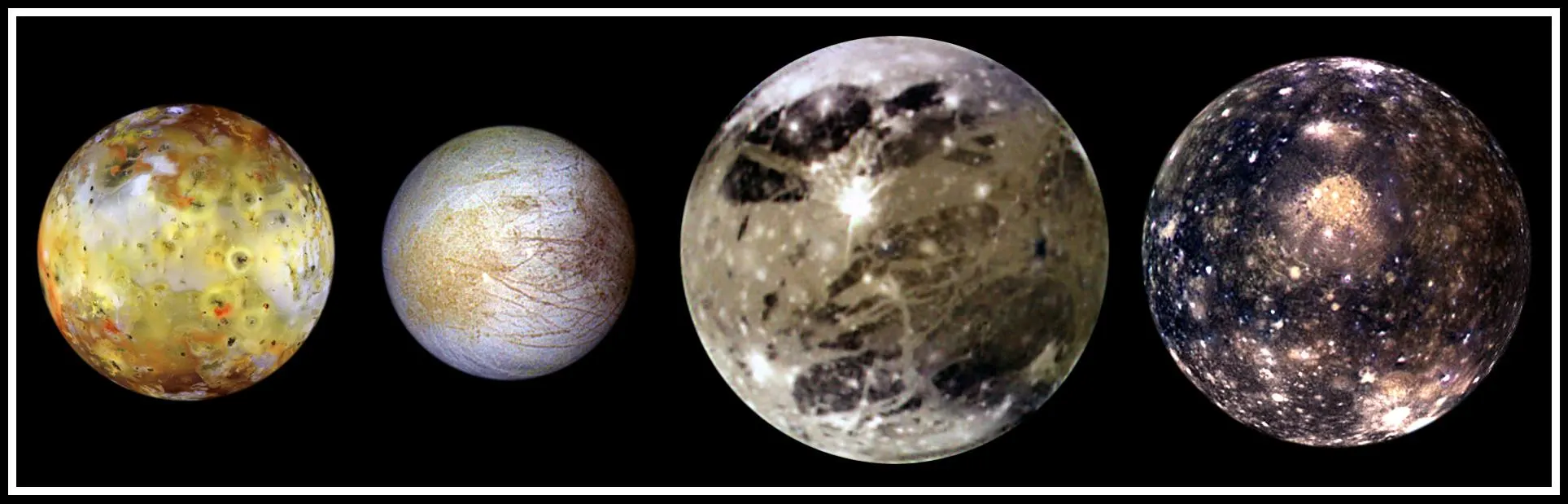
*Figure 1.* Observation: Jupiter's four large moons to scale, from Galileo spacecraft images. Io and Europa are rocky; Ganymede and Callisto are about half ice. Credit: NASA/JPL/DLR. Licence: Public domain (NASA).
## How many moons, and why the number keeps changing
| Planet | Known moons (as of September 2026) |
| -------------- | ---------------------------------- |
| Mercury, Venus | 0 |
| Earth | 1 |
| Mars | 2 |
| Jupiter | 115 |
| Saturn | 293 |
| Uranus | 29 |
| Neptune | 16 |
NASA lists 115 moons of Jupiter recognised by the International Astronomical Union and 293 confirmed moons of Saturn [1] [2]; as recently as March 2026, after the IAU's Minor Planet Center confirmed four and eleven new moons, the counts stood at 101 and 285 [22]. Neptune reached 16 in 2024 [23], and Uranus 29 after the James Webb Space Telescope found a moon about 10 km across in 2025 [24]. Almost all new discoveries are small irregular moons found by deep, repeated imaging, so the totals measure survey depth as much as anything about the planets. The number of large moons changes very little: Jupiter has eight regular moons, four small inner ones and the four Galilean moons, and the rest are captures.
## Moons around other planets
No moon outside the Solar System has been confirmed as of September 2026. The two leading candidates, Kepler-1625 b-i and Kepler-1708 b-i, are each suggested by transits of a Jupiter-sized planet and would be moons about the size of Neptune [25] [26]. Both are disputed: a reanalysis in 2024 found that the Kepler-1625 signal can be explained by how the star's brightness varies across its disk, and that models without a moon fit Kepler-1708 as well as models with one [27]. Earlier claims based on transit timing alone did not survive independent tests [28]. A moon as small as Io or the Moon is beyond current transit sensitivity.
(Image pending: A grey, heavily cratered moon seen from orbit, half lit, with dark smooth plains filling several round basins)
*Figure 2.* Sim render: Halden Mare, an airless moon of a gas giant in Pax Abyssi, drawn to the Moon's measured albedos and crater statistics.
> **In Pax Abyssi**
>
> Moons in generated systems are chosen by the type of their parent planet. A cold gas giant gets three to eight major moons, about five on average, and an ice giant two to six. Rocky planets and small super-Earths get none in just over half of cases and up to three otherwise; super-Earths above six Earth masses have only a one-in-ten chance of a single small moon. Gas giants within 0.1 AU of their star or with years shorter than 30 days get none, and neither do lava worlds or mini-Neptunes. Close-in planets of small red dwarfs lose some or all of their moons.
>
> Each system's moons share a mass budget of one to three ten-thousandths of the planet's mass, after Canup and Ward. Orbits step outward in period ratios between 1.5 and 2.1, beginning just outside the Roche limit, and anything beyond a third of the Hill radius is dropped. A snow line in the planet's formation disk at about 12 planet radii separates rocky inner moons from icy outer ones, and captured moons get inclined orbits, a third to a half of them retrograde. The simulation has about 15 moon types, from airless rock and volcanic moons to ocean moons and hazy Titans, plus speculative super-moons for giants above about five Jupiter masses. The generated systems hold 7,495 moons.
>
> The game models major moons only: the hundreds of kilometre-sized irregulars around real giants are not generated. Sol carries its 28 best-known moons, each on elements fitted to JPL Horizons ephemerides and referenced to its planet's equator; tidally locked moons keep one face to their planet.
## See also
- [Orbit](https://paxabyssi.com/wiki/Orbit.md)
- [Sol](https://paxabyssi.com/wiki/Sol.md)
- [Gas giant](https://paxabyssi.com/wiki/Gas_giant.md)
- [Ice giant](https://paxabyssi.com/wiki/Ice_giant.md)
- [Subsurface ocean world](https://paxabyssi.com/wiki/Subsurface_ocean_world.md)
- [Volcanic world](https://paxabyssi.com/wiki/Volcanic_world.md)
- [Ice world](https://paxabyssi.com/wiki/Ice_world.md)
- [Planetary system archetypes](https://paxabyssi.com/wiki/Planetary_system_archetypes.md)
- [Asteroid belt](https://paxabyssi.com/wiki/Asteroid_belt.md)
## References
1. NASA. Jupiter Moons. NASA Science.
2. NASA. Saturn Moons. NASA Science.
3. JPL Solar System Dynamics. Planetary Satellite Physical Parameters.
4. Canup, R. M. and Ward, W. R. (2006). A common mass scaling for satellite systems of gaseous planets. Nature 441, 834-839.
5. Canup, R. M. and Asphaug, E. (2001). Origin of the Moon in a giant impact near the end of the Earth's formation. Nature 412, 708-712.
6. Canup, R. M. (2005). A Giant Impact Origin of Pluto-Charon. Science 307, 546-550.
7. Jewitt, D. and Haghighipour, N. (2007). Irregular Satellites of the Planets: Products of Capture in the Early Solar System. Annual Review of Astronomy and Astrophysics 45, 261-295.
8. Agnor, C. B. and Hamilton, D. P. (2006). Neptune's capture of its moon Triton in a binary-planet gravitational encounter. Nature 441, 192-194.
9. Rosenblatt, P. et al. (2016). Accretion of Phobos and Deimos in an extended debris disc stirred by transient moons. Nature Geoscience 9, 581-583.
10. Domingos, R. C., Winter, O. C. and Yokoyama, T. (2006). Stable satellites around extrasolar giant planets. Monthly Notices of the Royal Astronomical Society 373, 1227-1234.
11. Barnes, J. W. and O'Brien, D. P. (2002). Stability of Satellites around Close-in Extrasolar Giant Planets. The Astrophysical Journal 575, 1087-1093.
12. Kane, S. R. (2017). Worlds without Moons: Exomoon Constraints for Compact Planetary Systems. The Astrophysical Journal Letters 839, L19.
13. Gladman, B. et al. (1996). Synchronous Locking of Tidally Evolving Satellites. Icarus 122, 166-192.
14. Williams, J. G. and Boggs, D. H. (2016). Secular tidal changes in lunar orbit and Earth rotation. Celestial Mechanics and Dynamical Astronomy 126, 89-129.
15. Black, B. A. and Mittal, T. (2015). The demise of Phobos and development of a Martian ring system. Nature Geoscience 8, 913-917.
16. Murray, C. D. and Dermott, S. F. (1999). Solar System Dynamics. Cambridge University Press.
17. Peale, S. J., Cassen, P. and Reynolds, R. T. (1979). Melting of Io by Tidal Dissipation. Science 203, 892-894.
18. Lainey, V. et al. (2009). Strong tidal dissipation in Io and Jupiter from astrometric observations. Nature 459, 957-959.
19. Iess, L. et al. (2012). The Tides of Titan. Science 337, 457-459.
20. Postberg, F. et al. (2018). Macromolecular organic compounds from the depths of Enceladus. Nature 558, 564-568.
21. Postberg, F. et al. (2023). Detection of phosphates originating from Enceladus's ocean. Nature 618, 489-493.
22. International Astronomical Union (2026). IAU Minor Planet Center Confirms New Moons of Saturn and Jupiter. IAU announcements.
23. Carnegie Science (2024). New moons of Uranus and Neptune announced.
24. ESA/Webb (2025). New moon of Uranus.
25. Teachey, A. and Kipping, D. M. (2018). Evidence for a large exomoon orbiting Kepler-1625b. Science Advances 4, eaav1784.
26. Kipping, D. et al. (2022). An exomoon survey of 70 cool giant exoplanets and the new candidate Kepler-1708 b-i. Nature Astronomy 6, 367-380.
27. Heller, R. and Hippke, M. (2024). Large exomoons unlikely around Kepler-1625 b and Kepler-1708 b. Nature Astronomy 8, 193-206.
28. Kipping, D. (2020). An Independent Analysis of the Six Recently Claimed Exomoon Candidates. The Astrophysical Journal Letters 900, L44.
## Infobox (moon class)
| Field | Value |
| --- | --- |
| Name | Natural satellite (moon) |
| Largest | Ganymede, 2,631 km radius, 0.025 Earth masses |
| Examples | the Moon, Io, Europa, Ganymede, Callisto, Titan, Enceladus, Triton, Charon, Phobos |
| Exomoons | None confirmed as of September 2026; Kepler-1625 b-i and Kepler-1708 b-i are disputed candidates |
| Definition | A natural body in a bound orbit around a planet, dwarf planet or smaller body, inside its host's Hill sphere and outside its Roche limit. |
| Formation channels | circumplanetary disk accretion, giant impact, capture |
| Regular vs irregular | Regular moons orbit close in, prograde, on near-circular orbits near the planet's equator, and formed with it. Irregular moons orbit far out on eccentric, inclined and often retrograde orbits, and were captured. More than 90 percent of Jupiter's and Saturn's known moons are irregulars a few kilometres across. |
| Satellite mass fraction | about 1e-4 of the planet for the regular moons of gas and ice giants (Jupiter 2.1e-4, Saturn 2.5e-4, Uranus 1.0e-4); Earth's Moon 0.012; Charon 0.12 of Pluto |
## Related pages
- [Sol](https://paxabyssi.com/wiki/Sol.md): The Sun and its planetary system, the one star system in Pax Abyssi built entirely from measurement, with nine planets including Pluto and 28 moons on orbits fitted to JPL ephemerides.
- [Asteroid belt](https://paxabyssi.com/wiki/Asteroid_belt.md): A ring of rocky and icy bodies left over from planet formation, shaped by the resonances of nearby giant planets. The Sun's Main Belt, between Mars and Jupiter, holds about 3 percent of the Moon's mass spread through a volume so large that its asteroids are millions of kilometres apart.
- [Orbit](https://paxabyssi.com/wiki/Orbit.md): The path one body follows around another under gravity. For two bodies alone it is an ellipse, fixed by Kepler's three laws and described by six orbital elements.
- [Planetary system archetypes](https://paxabyssi.com/wiki/Planetary_system_archetypes.md): The recurring ways a star's planets are arranged, from tightly packed chains of small worlds to lone giants far out, and the 24 templates Pax Abyssi builds its star systems from.
- [Habitable zone](https://paxabyssi.com/wiki/Habitable_zone.md): The band of distances from a star where an Earth-like planet could keep liquid water on its surface, bounded by the runaway greenhouse on the inside and the maximum greenhouse on the outside.
- [Star system generation](https://paxabyssi.com/wiki/Star_system_generation.md): How Pax Abyssi builds the planets, moons, rings and belts of every star system except our own, from a star's catalogue row, published occurrence rates and planetary physics, the same way every time.
Categories: [Moons](https://paxabyssi.com/wiki/Category:Moons.md), [Moon types](https://paxabyssi.com/wiki/Category:Moon_types.md), [Moons of the Solar System](https://paxabyssi.com/wiki/Category:Moons_of_the_Solar_System.md), [Planetary systems](https://paxabyssi.com/wiki/Category:Planetary_systems.md)