A space simulation of a whole galaxy, built on the real sky
Pax Abyssi is a first-person space simulation for Windows PC on Unreal Engine 5. Its galaxy is the whole Milky Way at true scale, real where astronomers have measured it, its physics is Newton's, and its ship is a place you live in, with a crew. This site is its first public look.
The galaxy is the Milky Way at its full count: 111 billion stars from a published model of our galaxy. Where astronomers have measured a star it is the real one, 119,626 of them from the HYG database, corrected against Gaia DR3, Hipparcos and the Washington Double Star Catalog; everywhere else the simulation generates the stars Earth has not catalogued. Every star has a system the moment you pick it: planets on Keplerian orbits, moons, rings inside the Roche limit, belts at the resonances of the giants, stations at the Lagrange points. Distances are true: Neptune is 4.5 billion kilometres from the Sun, and you cross that on your own drive. Past the Milky Way are 43,000 real galaxies and an endless procedural universe, and the jump drive takes you to any of them.
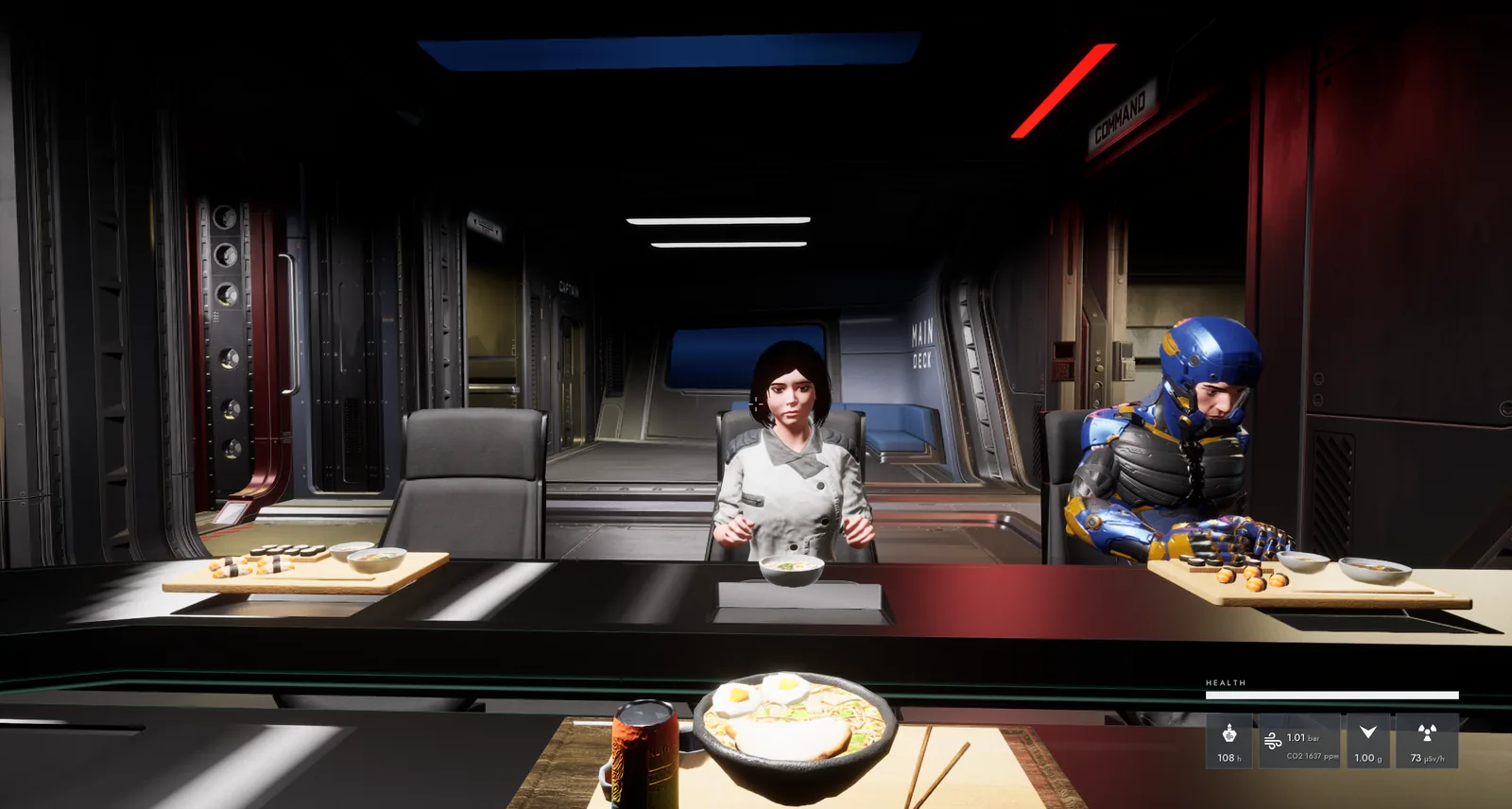
The ship is a place. The Calliope has two decks you walk in flight and a crew of seven who live aboard: they keep a watch bill, cover each other's posts, sleep in their bunks and eat together at the wardroom table. Her reactor, power bus, fuel and life support are live systems you read off the overhead panel. Fly her on a Thrustmaster Warthog with true Newtonian physics, stand up from the helm mid-cruise, and the planets keep sliding past the canopy. Her water is her propellant and her radiation shield, and the dose model behind the cabin readout agrees with flown dosimeters within a factor of two.
The worlds are whole. Procedural planets and moons you land on and walk to the horizon, thousands of them in the catalogue systems alone, gas giants whose weather is grown for each planet from its own seed and whose cloud decks you can dive into, moons checked against photographs of our own Moon, and black holes and neutron stars drawn from their physics along closed-form Kerr geodesics, bending the real stars behind them. On the ground there is a war to fight at Vennik Flat, neon cities and ancient ruins to explore, and a moonbase being furnished.
Underneath is the simulation behind the game, our own model of the galaxy, which generates every system from a 107-type planetary science corpus, in C++ inside the engine. The fiction is set in 2538 in the Freeholds, a ragged chain of independent worlds on the rim of human space.
- Engine
- UE 5.8
- Unreal Engine, unmodified
- Stage
- Pre-alpha
- no release date yet
- Platform
- Windows
- tuned on an RTX 4060 laptop
- Since 28 September
- 470commits
- 2026-09-28 to 10-06
Why the full name ends in II
The game's full name is Pax Abyssi: Star Battles II. The first Star Battles ran on a Commodore VIC-20 in 1983.
1983
Star Battles on the VIC-20
Our lead developer wrote Star Battles in 1983 for the Commodore VIC-20. It needed the 16 KB memory expansion, a fairly exotic add-on then, so most VIC-20 owners could not run it. Copies went round the Melbourne computer clubs, which was how a lot of software travelled in those years.
It was a capital ship battle game in about 19.5 kilobytes: two teams of three ships, a galaxy map of stars to warp between, and a close model of ship systems and damage, where one system failing drags others down with it. You could warp to any star on the map, as our ships do now. The graphics were minimal, but it asked real tactical questions. Can a small ship beat a far heavier class? Damaged, do you warp out to repair before the next hit takes your warp drive? People enjoyed it, and our lead developer remembered it fondly.
Our own engine
The modern simulator
Years later, our lead developer set out to rebuild that capital ship game for modern computers. A love of astronomy and a deep interest in astrophysics took it somewhere else: a scientifically real galaxy to explore. We mean to bring capital ship combat back.
The simulator grew over a couple of years on our own custom engine, and the procedural galaxy you fly through was first built there.
2026
Unreal Engine 5
To draw a galaxy as well as it can be drawn, we wanted the best engine in the world, so in 2026 we moved the simulation to Unreal Engine 5. We had worried that an off-the-shelf engine could not carry a serious, galaxy-scale simulation the way our own engine could. It carries the whole Milky Way.
The game on this site is the result. The galaxy and its systems are now generated in C++ inside the engine, and we keep bringing features across from our own engine and building new ones as we go.
One day we would love to let you play the 1983 original in your browser.
What the team holds itself to
The Pax Abyssi team
The game is made by the Pax Abyssi team, a small independent group. The state of every part is on the game page, the method on the science page, and the week's work in the devlog.