Stars and the catalogue
Spectral classes, the HYG corrections, star sheets.
Every system in Pax Abyssi starts as published astronomy: a real catalogue, real masses and spins, published models with the paper named. This is where the game is strongest, and this page shows the working.
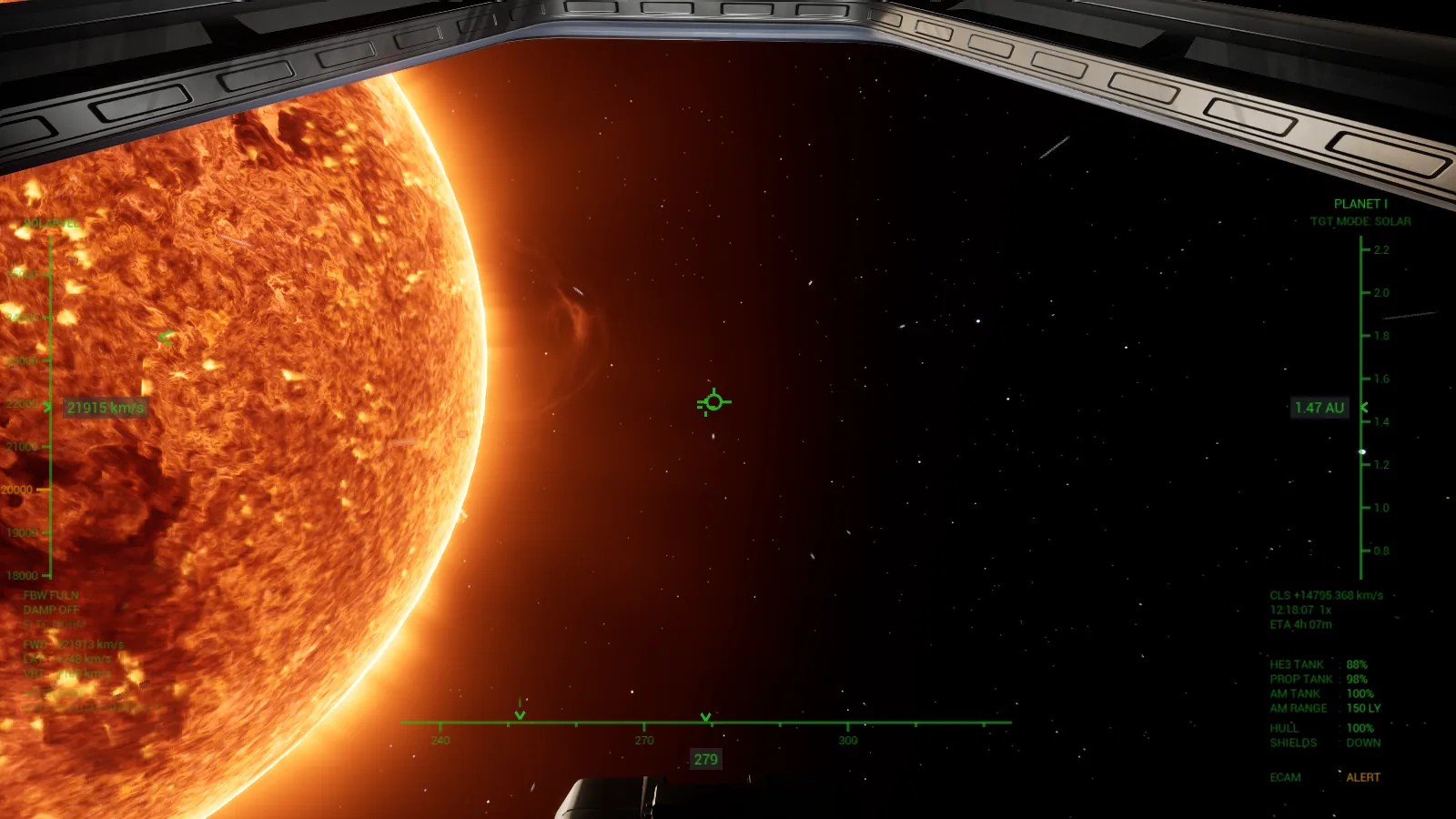
The catalogue began as the public HYG database and now holds 119,626 stars in 77 columns. Corrections from XHIP, Gaia DR3, Hipparcos and the Washington Double Star Catalog live in override columns beside the originals, with a corrected spectral type on 75,529 rows, spectral types on 97.5 percent of rows, and a Gaia DR3 distance on 81.9 percent. These are the stars with the best data, close to complete within about 25 parsecs, and they are where the galaxy begins.
Supergiant radii were fixed against the literature this year: Betelgeuse to 764 solar radii after Joyce 2020, Antares to 680 after Ohnaka 2013, and the Garnet Star to 762 where it had read 4,021. 2,860 of 5,164 star sheets were regenerated, with 115 checks and no failures.
The galaxy map adds 4,881 known compact objects: 4,393 pulsars from the ATNF Pulsar Catalogue, 113 known black holes and 375 more neutron stars. Every real object we know of is in the sim. 7,304 real star clusters are on the map, after Hunt and Reffert 2023, Vasiliev and Baumgardt 2021, Harris 2010 and Wright 2020.
We began with the 119,626 stars that astronomers have measured. The rest of the Milky Way, 111 billion stars from a published model of our galaxy, is generated by the same science, and it is arriving next. The model: 1.11 x 10^11 stars, 2.2 x 10^10 brown dwarfs, 8.4 x 10^8 neutron stars and 8.7 x 10^7 black holes, in a thin disk and a thick disk, a bar and bulge at 28 degrees after Sormani 2022 and Portail 2017, a nuclear disk and cluster with 3.4 million stars in its densest cube, and an Einasto halo, with spiral arms after Reid 2019, the warp after Chen 2019 and dust after Drimmel and Spergel 2001. The Sun sits 8,275 parsecs from the centre (GRAVITY 2021) and 20.8 parsecs above the midplane (Bennett and Bovy 2019).
The rule is that the count is the true population, never a budget: no cap removes an object, and there is no height ceiling. The galaxy fills in around the real stars, not over them: each cell draws its true count, subtracts the catalogue stars already there, and generates the rest as the stars Earth would not have catalogued. The model runs in C++ in the engine and agrees with the reference simulation to one part in a billion; the first whole-galaxy view draws 143,165 stars from 30 kiloparsecs out.
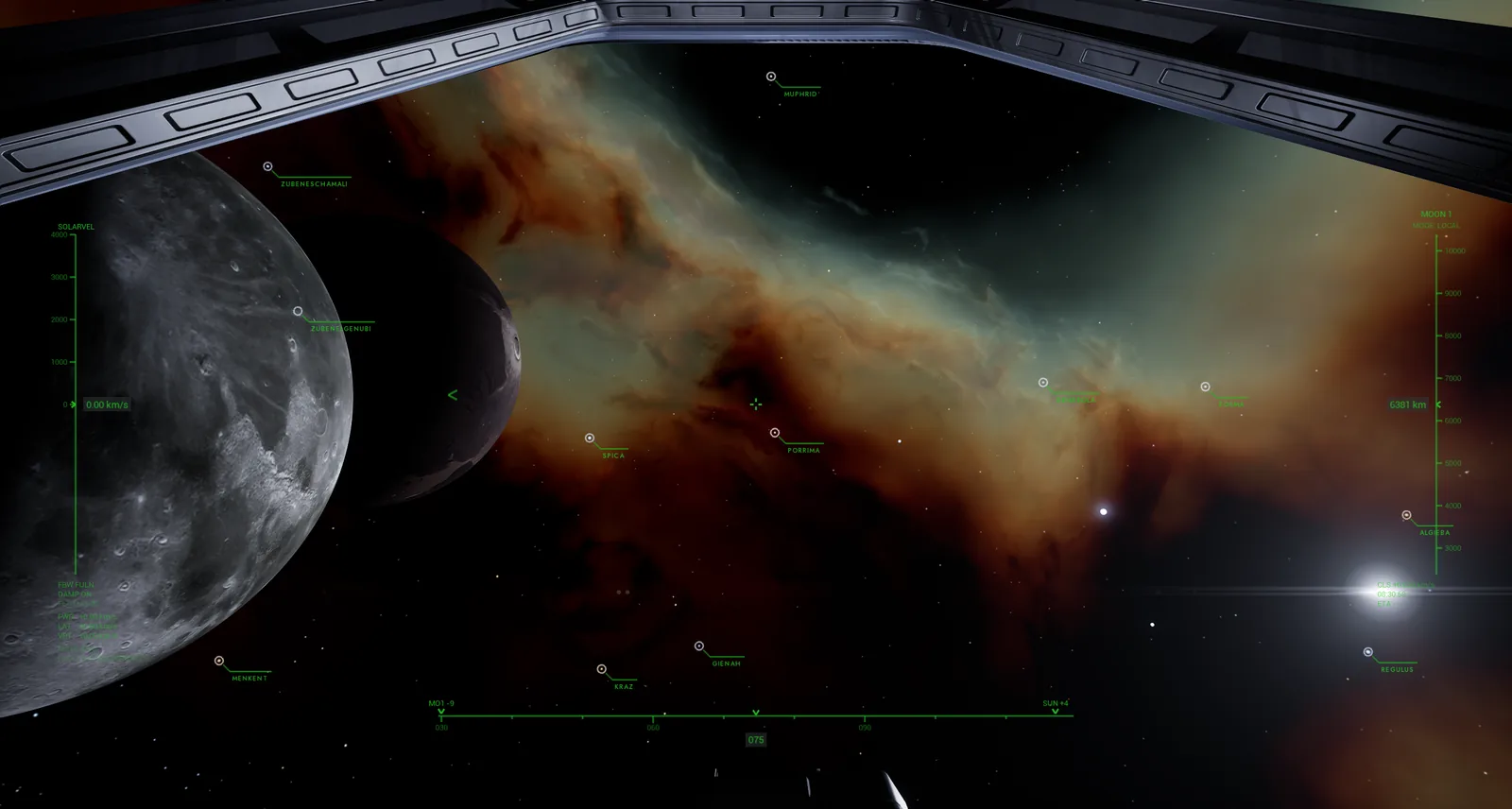
Every star you can fly to has a generated system: over 5,000 sheets, with 8,000 planets and 7,000 moons, solved for the first of January 2538. The same catalogue id and seed give the identical system, and there is one generator by law. Eighteen documented architectures decide the layout; Titius-Bode is one option in 137 systems, not the rule.
Stellar physics follows Torres et al. 2010 for mass and luminosity, Pecaut and Mamajek 2013 for temperature by spectral type, and Haywood 2013 for metallicity and age. Planet occurrence by class follows four literature reviews (M dwarfs 0.96, G stars 0.90, O stars 0.03 to 0.06). Companions follow Offner 2023 and Moe and Di Stefano 2017. Six frost lines are drawn: water, ammonia, methane, carbon monoxide, nitrogen and soot. 971 systems have a planet above the habitability score's floor; the site says scored as potentially habitable, never habitable.
Gas and ice giants come in 75 subtypes across five classes. Their bands are stirred through a wind field built for each planet over forty steps: zonal jets after Ingersoll 2004 with zones anticyclonic and belts cyclonic, Von Karman vortex streets, Saturn's hexagon as a polar wave of order six, and Juno-style polar cyclones. Ammonia ice sits at about 0.7 bar over ammonium hydrosulfide at about 2 bar; limb darkening follows Minnaert under a Henyey-Greenstein haze, and the terminator fades as it does in Cassini's frames. Hot giants lock one face to their star where Gladman 1996 says they must. The C++ matches the Python on 264 golden vectors, and on approach the texel reaches 0.21 kilometres on a Jupiter.
Rings take Saturn's optical depths from Cassini occultations, C ring to A ring with the Cassini Division and the Encke and Keeler gaps, at 8.4 kilometres a texel, and sit inside the icy Roche limit: 687 bodies are ringed, and hot giants never. Rocky worlds from orbit are judged against Artemis photographs: maria at albedo 0.075, highlands at 0.14, maria covering 16.8 percent of the sphere against the Moon's 16, and a crater size-frequency slope of minus 1.99 and minus 2.01 against a target of minus two.
The Schwarzschild pass uses Bruneton's 2020 precomputed beam tracing, with the shadow edge at 2.598 Schwarzschild radii. When the hole spins, the closed-form Kerr ray of Gralla and Lupsasca (2020) is solved per pixel and lands within 0.013 pixels of the offline oracle at the 99th percentile; a Runge-Kutta march is 4 to 78 pixels off. The disk is a thin Shakura-Sunyaev disk; the received light is a blackbody at the shifted temperature, so colour and the fourth-power brightness change come from one formula, and the first two photon subrings are drawn. The hole bends the real star field seen from its true position.
Cygnus X-1 is drawn at 17.5 solar masses with a 29 solar mass donor after Ramachandran et al. 2025, inclination 27.5 degrees, period 5.599829 days. Its spin is contested in the literature, from 0.1 to above 0.998; the game draws 0.9. V404 Cygni: 9.0 solar masses, spin above 0.92 (Walton et al. 2017). Gaia BH1: 9.62 solar masses, no disk, a pure lens at 480 parsecs (El-Badry et al. 2023). Sagittarius A*: 4.297 million solar masses (GRAVITY 2022), a hot flow rather than a thin disk.
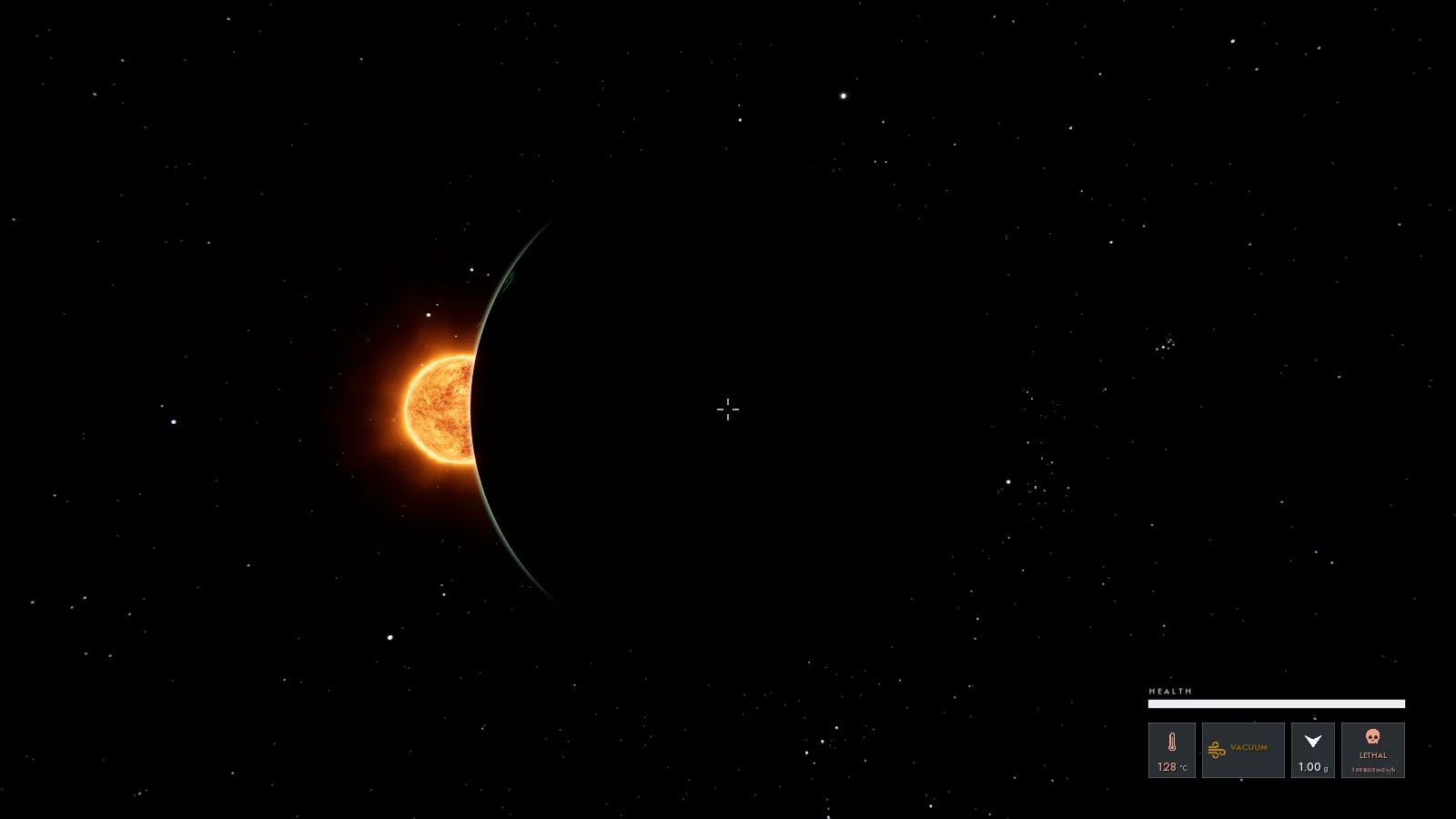
Neutron stars default to a 12 kilometre radius after Rutherford et al. 2024, cool on a table through the observed stars after Potekhin 2020, and bend their own light: a 1.4 solar mass star shows about 76 percent of its surface at once (Beloborodov 2002). Polar caps take Goldreich-Julian angles; the Crab turns at 33.39 milliseconds with a field of 3.79 x 10^12 gauss, and SGR 1806-20 carries 1.96 x 10^15.
| Object | Mass (M_sun) | Source |
|---|---|---|
| Cygnus X-1 | 17.5 | Ramachandran et al. 2025 |
| V404 Cygni | 9.0 | Walton et al. 2017 |
| Gaia BH1 | 9.62 | El-Badry et al. 2023 |
| Sagittarius A* | 4,297,000 | GRAVITY 2022 |
| Seven neutron stars | 1.27 to 2.35 | You 2025; the Crab, Vela, Geminga and four more |
One engine unit is 2,000 kilometres; an astronomical unit is 74,798.94 of them. With the ship pinned at the origin and doubles carrying about 16 significant digits, precision is a metre at Neptune and under a millimetre at Pluto in a system frame, and a test in the build proves it. Orbits use J2000 elements and a Kepler solve that agrees with the original simulation within 0.8 millimetres across nine bodies. Sol has 37 bodies with true heliocentric positions.
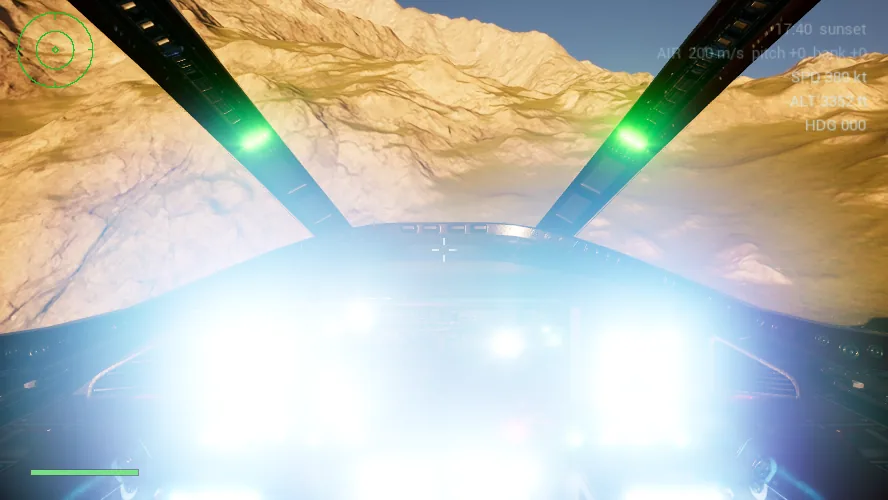
The orrery plans a real Earth-to-Mars Hohmann transfer: burns of 2.94 and 2.65 kilometres per second, 259 days, a 44 degree phase angle, a 780-day synodic period. Its overlays draw the melt line, Hill spheres, Eggleton Roche lobes, magnetopause scaling, binary barycentres, exact Lagrange points and burn-and-flip times. The atmospheric scout flies on NASA's published F-16 wind-tunnel tables (NASA TP-1538), and the radiation model in the ship uses NIST constants and the NCRP 132 hazard ladder and agrees with every measured case within a factor of two.
Every wiki page and figure says what kind of claim it makes, so a reader always knows what was measured, what was modelled, what the simulation approximates and what is the setting.
Data licences and machine access are on the developers page.