A first-person space simulation of a whole galaxy
Fly true Newtonian physics on a HOTAS, walk your ship while she flies, land on procedural worlds, skim gas giants with their own weather, fly to black holes drawn by their physics, and hold the wire at Vennik Flat. Thirteen features, each with what is in the game and what comes next.
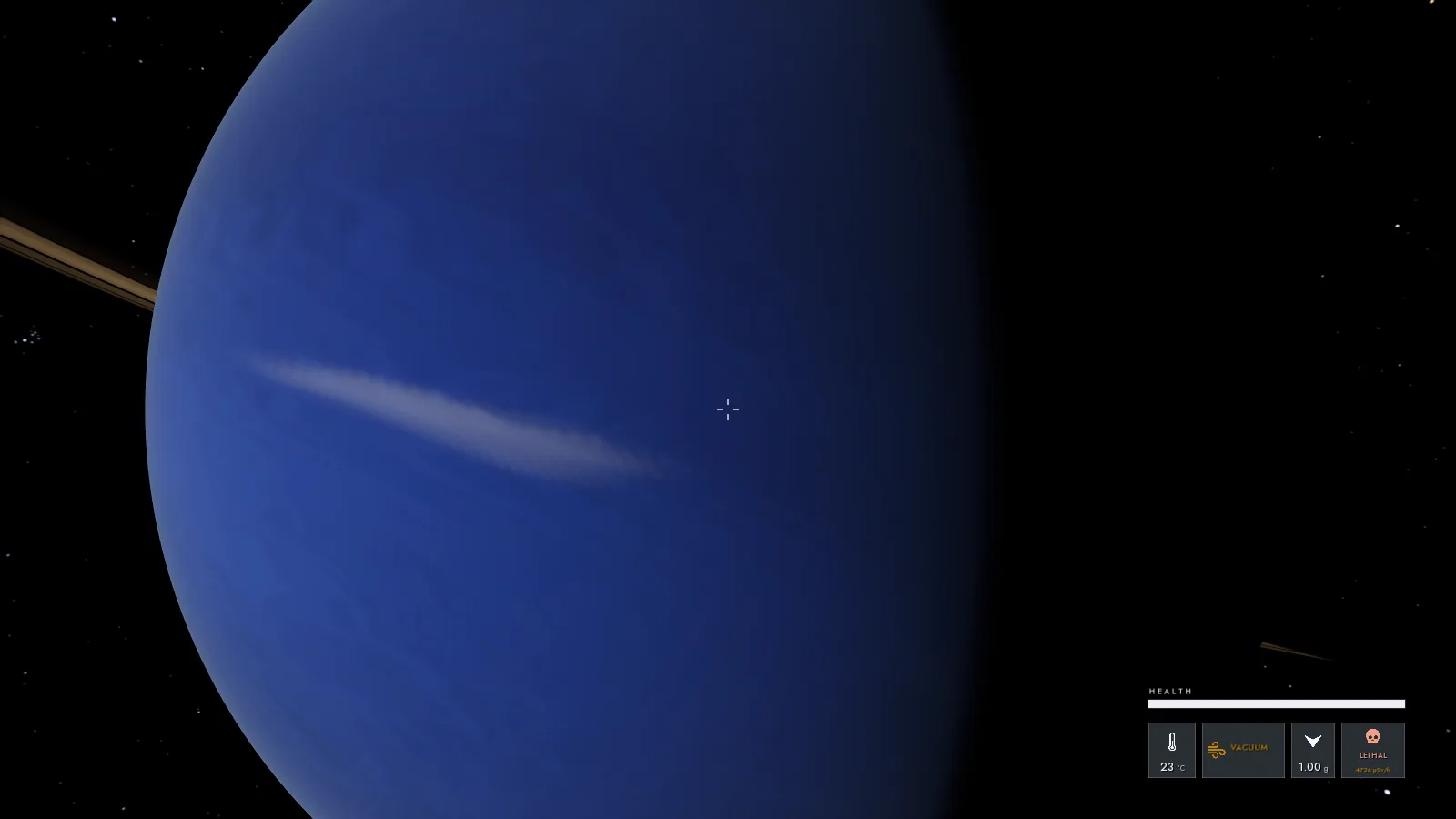
True Newtonian flight
Every thrust is force over mass, and nothing stops the ship but you. Six degrees of freedom on a fixed 60 Hz physics tick, with the ship at the origin of a double-precision universe: Neptune orbits 4.5 billion kilometres out and the numbers hold to under a millimetre at Pluto. No body is inflated and no distance is compressed.
Four flight modes sit on the selector: full fly-by-wire, in which the ship stops itself; heavy fly-by-wire; damped Newtonian; and full Newtonian, the default. The Calliope has two engines, left and right, each with its own start, fuel and failure. Lose one and you get half the thrust and a yaw, and AUTOTRIM trims it out and shows THRUST ASM CTRL on the ECAM. Time runs from x1 to x1024, and a COURSE CRCT autopilot cruises at 100 kilometres a second.
Between stars: lock a star, arm the drive, fly from rest to light speed by hand in about fifteen seconds, and the jump fires at 1.0c. You arrive in the target system with its planets already moving on their orbits.
| Part | Status |
|---|---|
| Six-degree-of-freedom Newtonian flight at 60 Hz | In the game |
| Four flight modes | In the game |
| Two engines, differential thrust, AUTOTRIM | In the game |
| Time acceleration to x1024, the COURSE CRCT autopilot | In the game |
| The interstellar jump, from lock to arrival | In the game |
| Docking and the approach ritual | Planned |
HOTAS, Warthog profiles, gamepad, drift dampers, and a HUD you tune
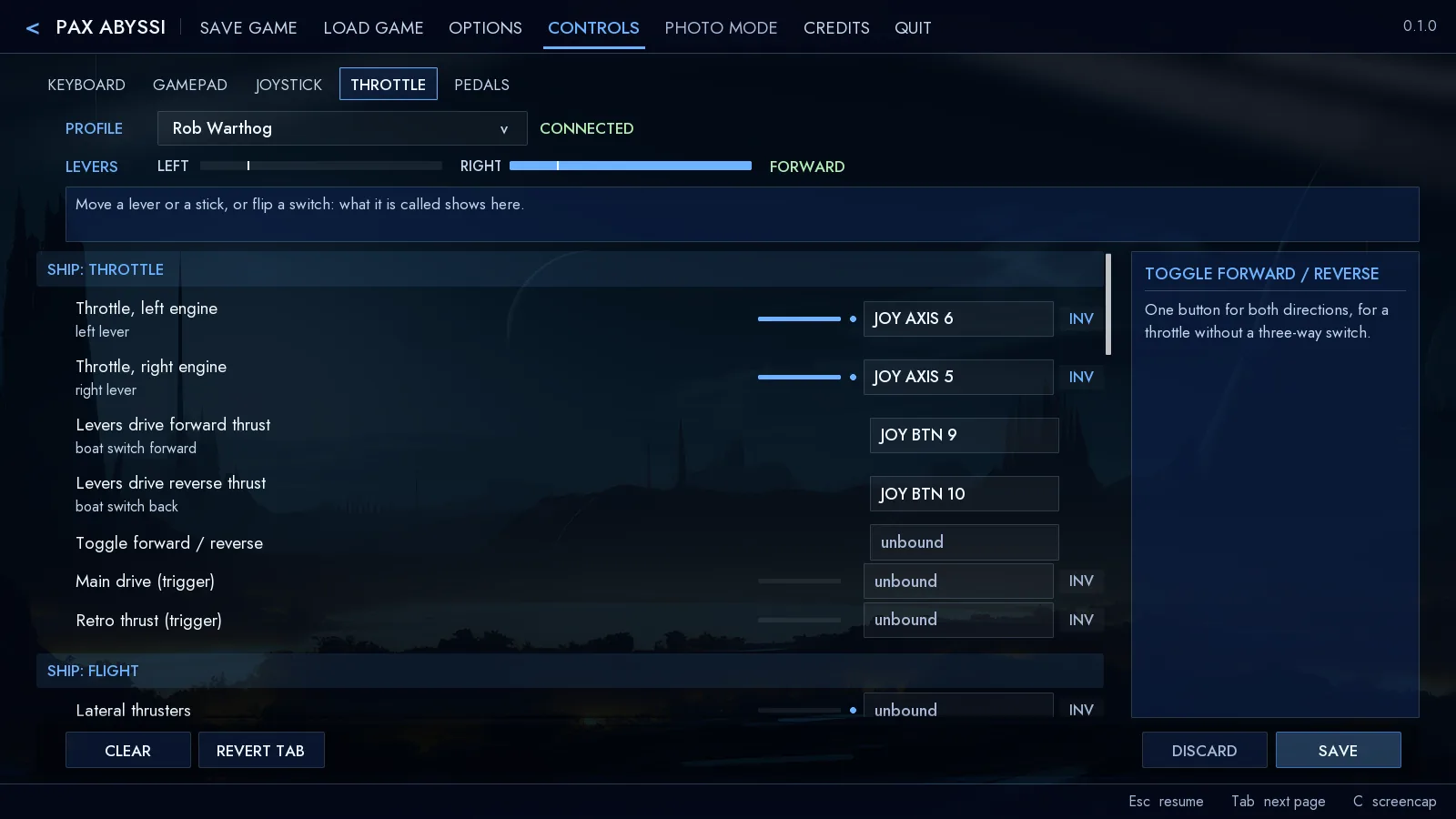
Plug in a Thrustmaster Warthog and fly. The CONTROLS tab has KEYBOARD, GAMEPAD, JOYSTICK, THROTTLE and PEDALS pages: click a control, press a key or button, and it binds. Named profiles hold a whole layout from keyboard to pedals, and every axis has invert, a dead band and a ZERO button that sets its centre. The Warthog throttle profile reads five axes and 32 buttons live off the hardware: the left lever drives the port engine, the right the starboard, analogue reverse sits behind a 20 percent gate, and the four flight modes are on the engine switches. Warthog stick and T.16000M presets load themselves when the stick is plugged in.
Drift dampers are why a stick pilot can fly true Newtonian physics without fighting it. Switch them on and the ship keeps its speed along the nose and bleeds every other part of its motion, so it goes where you point it. The physics is unchanged; the flight computer does the tidying. Gamepad players get a full layout with analogue thrust and rumble on landing, and the remote helm hands the pad to the ship so you can fly her standing anywhere aboard.
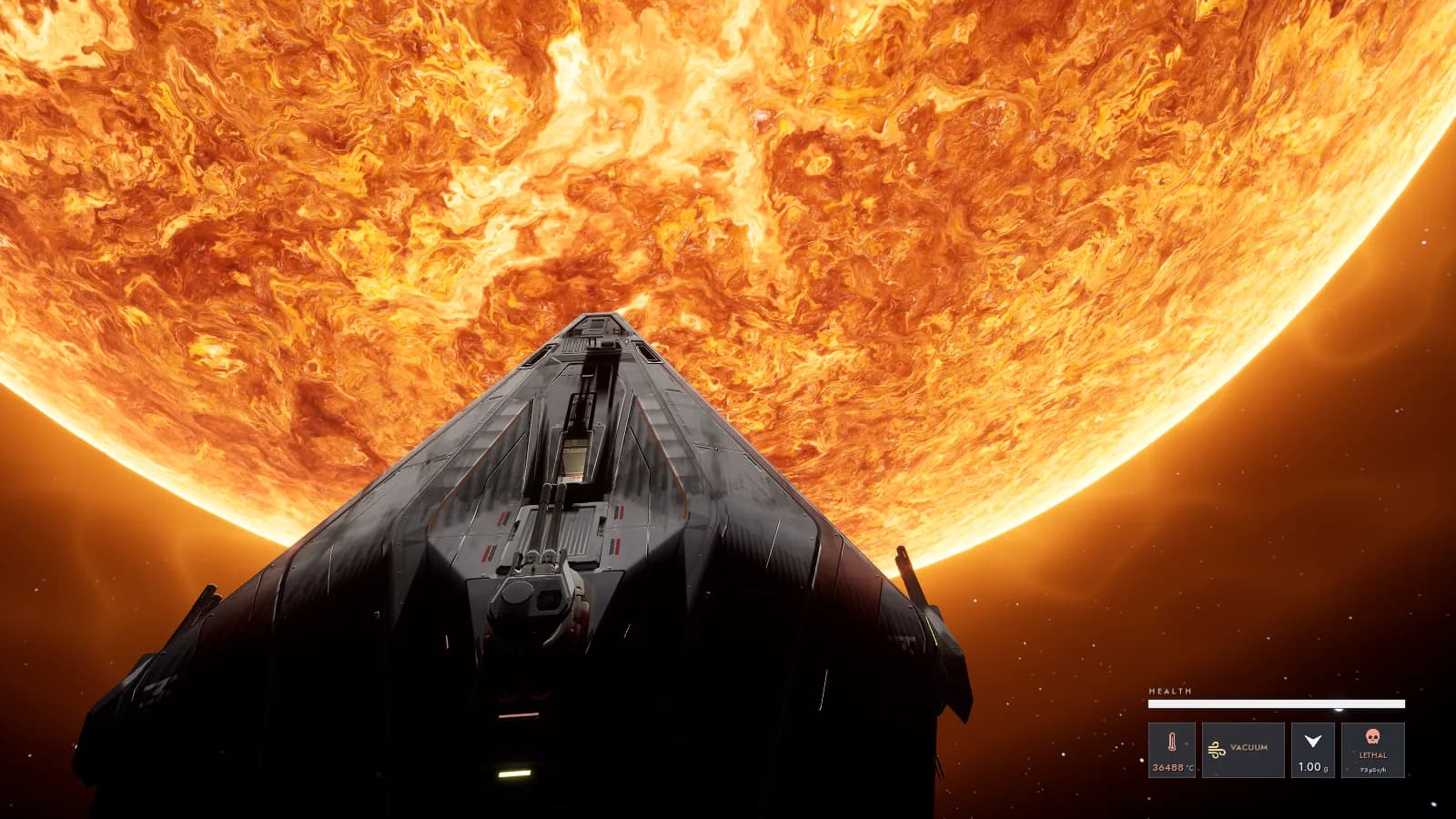
The HUD has three modes, STD, THRM for star approaches and CMBT, with four environment tiles (temperature, air, gravity, hazard), a status block from fuel to ECAM, closing rate and ETA to a star, and a CCIP intercept circle solved in heliocentric coordinates. Pick your own boresight from five, your velocity marker from four, and your colour; presets are sci-fi blue, green CRT and amber. Twenty seconds into a star's orange zone the ship calls it, targets the star and switches to THRM. On a station approach an outer marker ring appears at the 1,000 kilometre Station Zone and a voice calls it.
| Part | Status |
|---|---|
| The control binder: five pages, named profiles | In the game |
| Thrustmaster Warthog throttle profile | In the game |
| Drift dampers | In the game |
| Gamepad layout | In the game |
| HUD modes, environment tiles, boresights, presets | In the game |
| Warthog stick and T.16000M presets | In development |
| The remote helm | In development |
| Rudder pedals as a second device | Planned |
A ship you walk while she flies
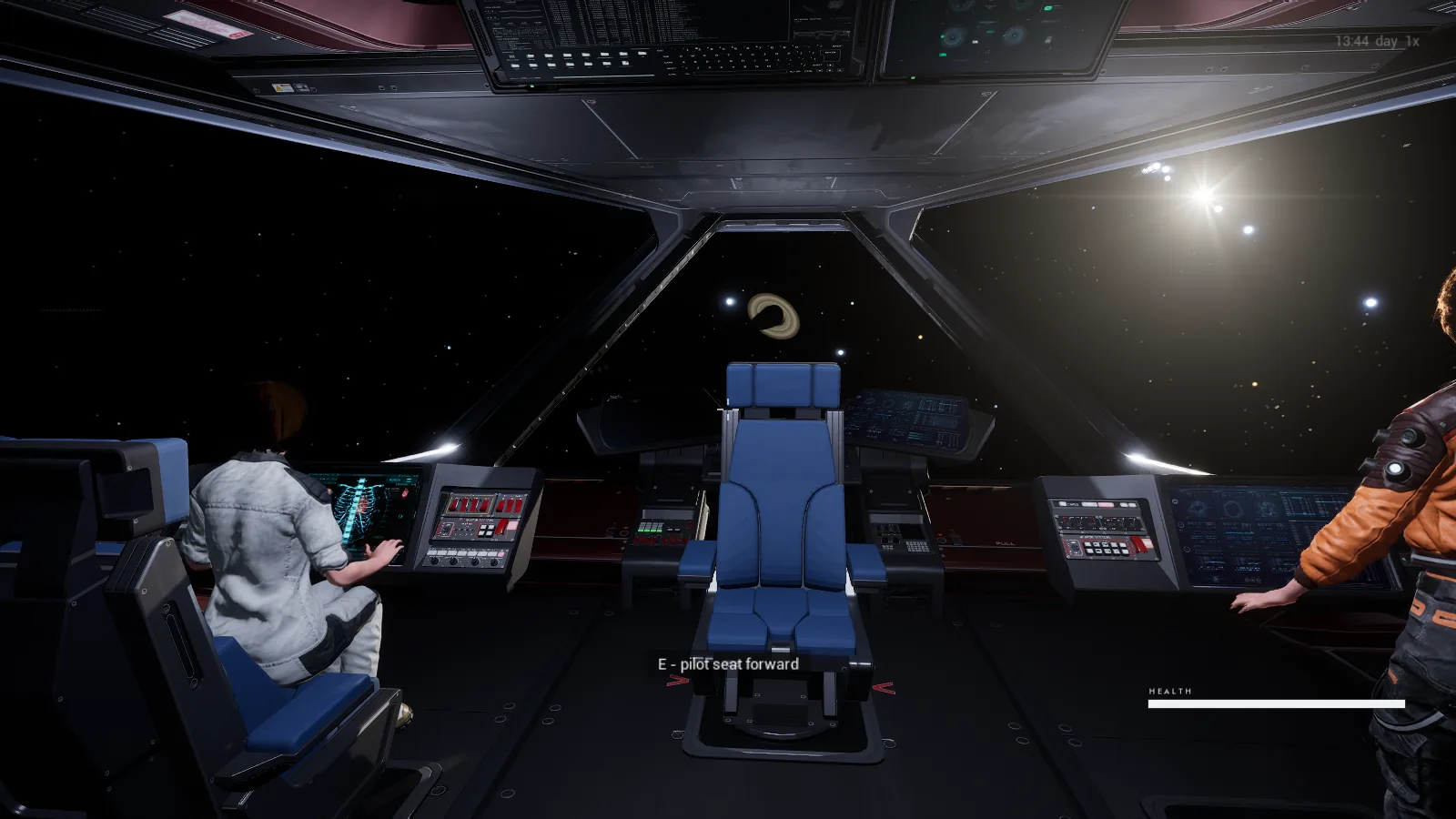
The Calliope has two decks and ten rooms, walkable in flight. Stand up mid-cruise and walk aft while the planets slide past the canopy. Her crew of seven, Arien Sarhavi at navigation, Cassie, Kade, Corso, Ellis, Odile and Talos, a bronze robot deck hand, keep a watch bill and eat at the table, with 280 motion-capture clips each. Her doors, ramp, holotable, chairs, tablets, shower and screens all answer to E.
Her systems are live: reactor, power bus, helium-3, life support, cabin air, cabin heat, and water as both propellant and radiation shield, a 20 tonne jacket. The dose model behind the cabin readout agrees with flown dosimeters, from the ISS to Curiosity, within a factor of two. The ship can kill you: a hull breach, a cabin that warns, counts down, dims the view and muffles the sound, and a reactor that can be pushed past SCRAM INHIBIT at the risk of an explosion, with ten recorded computer-voice lines on the way.
The Aporia is the second playable hull, a frigate, walkable and flyable from any of her four bridge seats. Behind them is a sky fleet of 82 hulls: freighters, frigates, destroyers, dreadnoughts, carriers, interceptors, bombers, a liner, a scout and 27 landers. Over Luna they fly as traffic: up to four flyovers and two landers at once over two pads, with the Calliope parked on pad 1. Landers cruise in from 3.8 kilometres, fly a glide slope at 32 metres a second from 110 metres up and touch down at about four metres a second. Every hull flies real physics and banks steeper in the Moon's gravity, and a ship you are watching is never despawned.
| Part | Status |
|---|---|
| Walking the Calliope in flight | In the game |
| Live systems, reactor to life support | In the game |
| The radiation model, solar particle events, flares | In the game |
| The Aporia, flyable from four bridge seats | In the game |
| NPC traffic over Luna | In the game |
| The Aporia's interactive interior | In development |
| Traffic around stations and over the cities | Planned |
Eight whole procedural worlds you land on
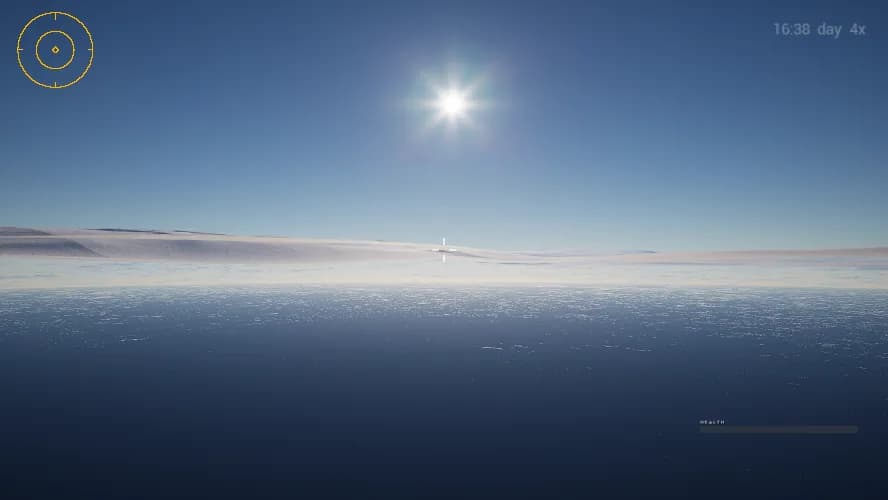
Whole round planets, generated while you play, that you walk from the landing site to the horizon. Gravity pulls toward the centre and ground detail reaches about 0.7 metre triangles on a 3,000 kilometre world. Each is tied to a real body in the galaxy for its gravity and air. Arrival flies you in and settles you on the first ground the generator builds; several worlds also start in orbit at 400, 1,500 and 8,000 kilometres, so you can come down from space by stages.
Fernrock is a cold brine world of ocean, desert and forest, 6 kilometres of relief at 0.81 g. Marnfell is an ocean world with an Earth-like sky, the Garrick works on its coast, an offshore rig, and the Tallis, an Age of Sail ship of the line riding the swell at anchor with every deck walkable. Vennik Flat is a dry red world at Mars's radius with a fortified company town. Halcott Basin is the snow world and Hollis Sands the desert, at 74 degrees. Halden Mare is an airless moon built to the Moon's own numbers, 1,737.4 kilometres and 0.1654 g. Carrow Maria is the first world made from a galaxy-map body, HYG 98924 IV at Delta Pavonis, 7,092.8 kilometres in radius with two giant lava seas. Merrin Rupes, an iron-rich moon of 30 Mu Cassiopeiae cut by scarps, is being installed now.
The sea is a JONSWAP wave spectrum on a four-cascade FFT, and the CPU reads the wave height, which is what floats the Tallis. Filtered air needs a breathing mask rather than a full suit on 17 of 33 worlds. Every barren world type in the galaxy already has its procedural look designed: the flat planet pictures on the galaxy map are becoming worlds you walk on, a few at a time.
| Part | Status |
|---|---|
| Seven procedural worlds, landable | In the game |
| Oceans, swimming, the Tallis at anchor | In the game |
| Breathing masks on filtered-air worlds | In the game |
| Merrin Rupes | In development |
| The move from texture planets to procedural worlds | In development |
| Walking the Tallis's decks; the biome and flora passes | In development |
| Flying at any body in the space map and coming down on it | Planned |
| Sailing the Tallis; volcanic biomes | Planned |
Gas giants with weather of their own
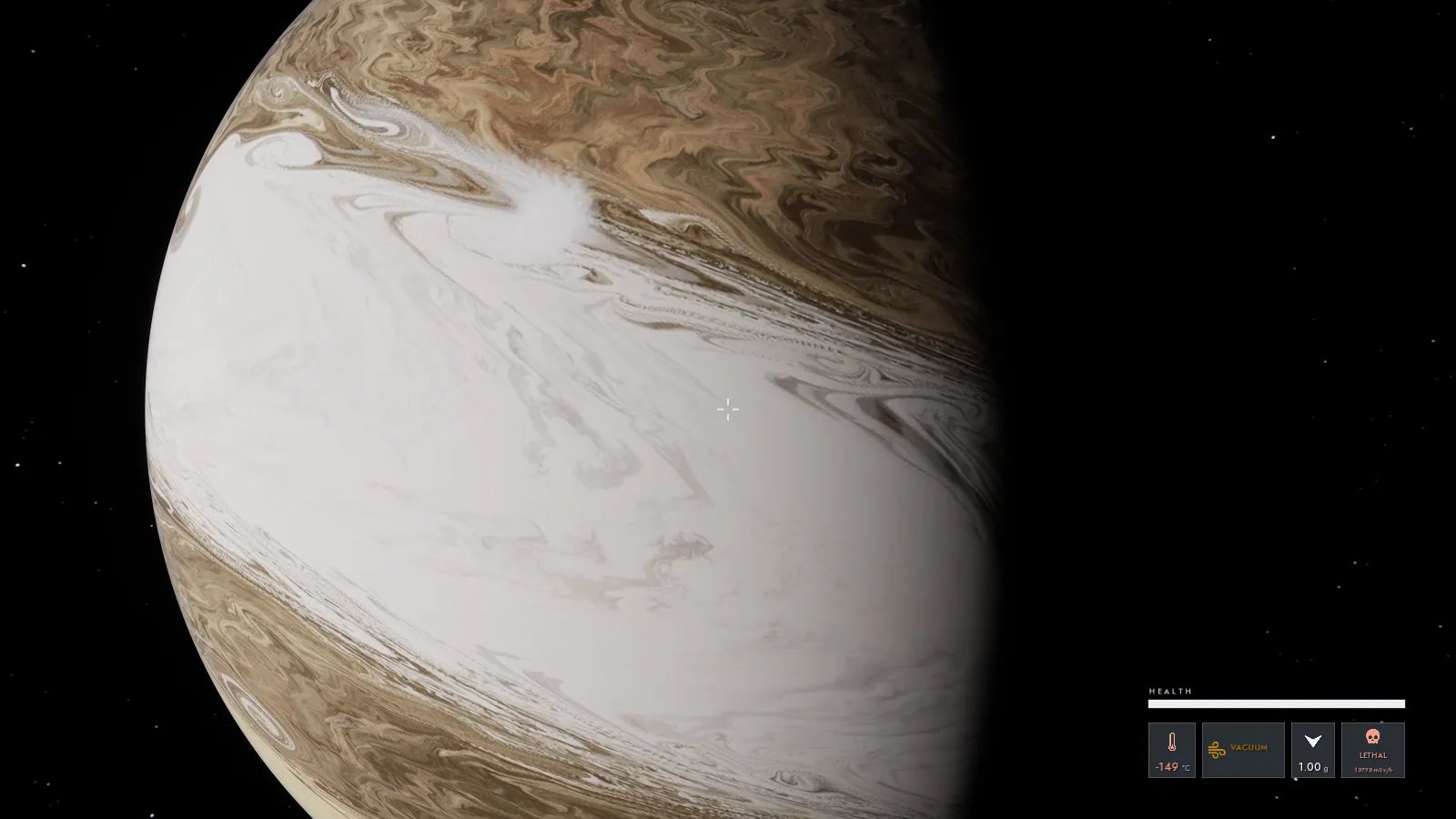
Every gas giant in the galaxy wears the project's own procedural weather, each with its own seed: cloud bands stirred through a wind field built for each planet over forty steps, zonal jets after Ingersoll 2004, vortex streets, named storms, a straight-sided hexagon at the pole, Juno-style polar cyclones, ammonia ice over the ammonium hydrosulfide deck, haze with multiple scattering, and a night-side glow on the hottest giants. 88 looks cover every giant subtype the simulation generates, and all 1,965 giants in the galaxy carry one.
Fly down and skim the cloud tops: close patches hold 0.21 kilometres a texel on a Jupiter, and a 4096 map bakes in 0.37 seconds. The day side fades toward night across the disc as it does in Cassini's frames, and hot giants lock one face to their star where the physics says so. Rings take Saturn's optical depths from Cassini occultations, 687 bodies are ringed, and fly into a ring and it becomes ice: 19,696 pieces in Saturn's B ring.
| Part | Status |
|---|---|
| Procedural weather on every giant, 1,965 of them | In the game |
| Five flyable giant stops | In the game |
| Rings, and flying into them | In the game |
| The rim haze's final colour and edge polish | In development |
| Volumetric cloud tops; weather that changes over time | Planned |
Moons and barren worlds, checked against photographs of our own Moon
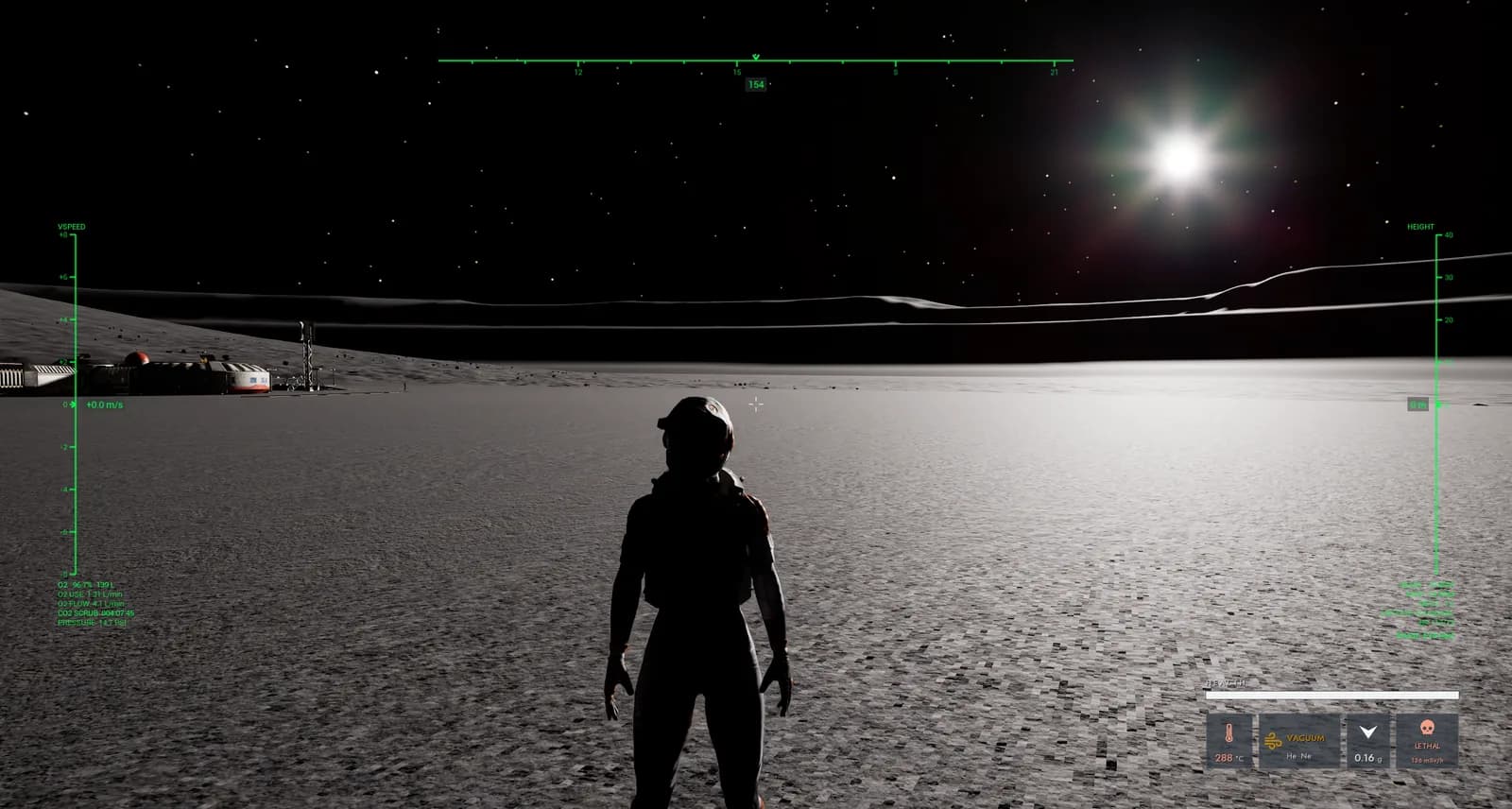
Grey moons, iron worlds and lava plains, drawn by the science. The galaxy holds 39 barren world types across 5,092 bodies, and every one now has a procedural look, 54 in all. Halden Mare is the reference, judged side by side with Artemis photographs: maria at albedo 0.075 against highlands at 0.14, maria covering 16.8 percent of the sphere against the Moon's 16, and crater size-frequency slopes of -1.99 and -2.01 against the target of -2. It has a connected, Procellarum-style lava sea, wrinkle ridges and graben, and young craters of the Tycho and Copernicus kind with broad ray systems.
Moons have phases, go dark in eclipse and orbit their parent's equator. The crater floor on Halden Mare renders in 15 milliseconds on an RTX 4060 laptop.
| Part | Status |
|---|---|
| Halden Mare and Carrow Maria, landable | In the game |
| Moon phases, eclipses, equatorial orbits | In the game |
| Merrin Rupes | In development |
| The other 52 barren looks becoming worlds, a few at a time | In development |
Black holes and neutron stars, drawn by their physics
Fly to Cygnus X-1 and watch it bend the real stars behind it. The Schwarzschild case uses Bruneton's 2020 precomputed beam tracing; when the hole spins, the closed-form Kerr ray of Gralla and Lupsasca (2020) is solved per pixel and lands within 0.013 pixels of the offline oracle. The shadow is black to the last pixel, the photon ring is smooth, nearby stars stretch into arcs, and the thin disk carries gravitational and Doppler shift together, so its colour and brightness come out of one formula.
Twelve stops are flyable: Cygnus X-1, Gaia BH1, V404 Cygni and Sagittarius A*, with masses and spins from the literature, and seven neutron stars with hot lensed surfaces and turning polar caps: the Crab, Vela, Geminga, RX J1856.5-3754, PSR J0437-4715, Hercules X-1 and SGR 1806-20. Each hole sits at its true distance from its companion star, every compact stop lends the ship a Level 12 Experimental Heat Shield, and a speed regime scaled to the hole, LOCALVEL-BH, keeps the approach flyable.
| Part | Status |
|---|---|
| Twelve flyable stops: five black-hole stops, seven neutron stars | In the game |
| The Kerr path and the real sky from the hole | In the game |
| The photon ring's anti-aliasing; Sagittarius A*'s exposure | In development |
| Black holes as galaxy-map destinations; pulsar wind nebulae | Planned |
The real sky, the galaxy map and the orrery
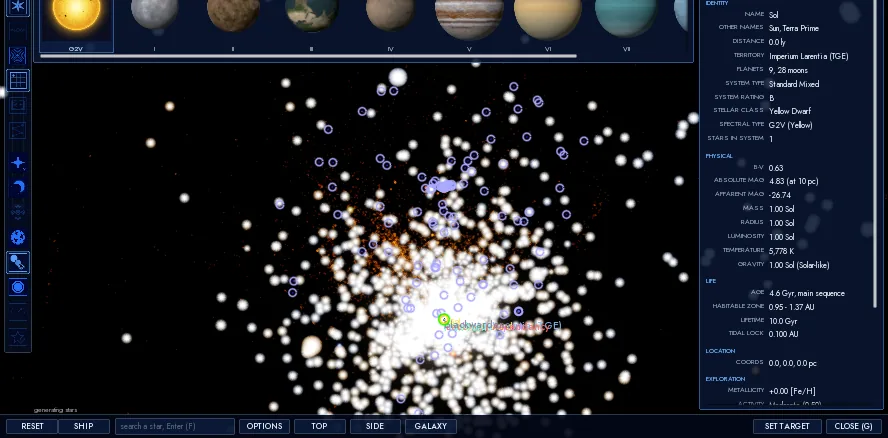
Every star in the sky is a real measured star: 119,626 of them in 77 columns, begun from the HYG database and corrected against XHIP, Gaia DR3, Hipparcos and the Washington Double Star Catalog, every correction kept in its own column. The cockpit sky draws the 5,070 stars at magnitude 6.0 or brighter; click any of them for its star sheet. Press G and the galaxy map holds all 119,624 mapped stars, 6,631 of them named, plus 4,881 known compact objects, 7,304 real star clusters and faction territories as 3D cubes you can slice, and sets a target straight into the drive.
We began with the stars that have the best data. The rest of the Milky Way, 111 billion stars from a published model of our galaxy, is generated by the same science and arrives next: first you see the whole galaxy on the map, then you fly to it. Around the catalogue stars, over 5,000 systems with 8,000 planets and 7,000 moons are already solved for the year 2538, the same system every time from the same star.
Press O and the orrery charts any system at its own date, from real time to ten million times, with the habitable zone, six frost lines, Hill spheres, exact Lagrange points, binary barycentres and a live Hohmann transfer with its launch window and burn-and-flip times: Earth to Mars in eleven minutes under thrust. Out in the system, fly into an asteroid cluster of 20,000 rocks or the Veinbreaker mining platform in the Main Belt, and fly close to a star for a corona of our own, flares by GOES class, particle storms with warnings, and heat zones that burn the hull.
| Part | Status |
|---|---|
| The catalogue drawn as the sky, with star sheets | In the game |
| The galaxy map: compact objects, clusters, territories, set target | In the game |
| The orrery, with transfers and Lagrange points | In the game |
| Asteroid clusters, belt stops, stars up close | In the game |
| The generated Milky Way on the galaxy map | In development |
| Arriving at a generated star and finding its planets | Planned |
The ground war at Vennik Flat
Hold a fortified company town against droid assaults, with tanks at the wire and a gatling in your hands. The base is 36 buildings on a 280 metre levelled pad on a Mars-sized desert world, behind 1,531 metres of concrete: 889 jersey barriers, 34 sandbag strongpoints, three gates and 18 fighting positions with 60 to 97 metres of open pad between them, so an attack can come from any bearing.
Six tanks sit hull-down at the wire, from the MX1 main battle tank with its 105 mm gun to the MX2 heavy with 150 mm HEAT and a roof minigun, the MX3 with twin lasers and a missile rack, and the MPV-35 with twelve tubes. Each turret picks a target, tracks it and fires when it has the shot, on the same solver the starships' turrets use. Armour is its own target kind: small arms land five percent, a tank's rear carries a fifth of its front armour, so infantry flank. Open the scenario window and it shows YOUR FORCES against OPPOSING FORCES with the seed on screen. HEAVY WEAPONS gives you one to three tanks against two to four enemy tanks behind a droid line; DROID ASSAULT sends eight to sixteen droids at you alone. After a few seconds of calm the enemy arrives through a tear in the sky, a gate, or by beaming in, and they hold, press, flank, take cover and throw grenades.
Nine weapons sit on keys 1 to 9, among them the Rotary Cannon, a gatling firing 1,200 rounds a minute from a 100-round magazine and smoking after thirty, and the cargo tractor grabs, stacks and throws crates at 22 metres a second. When the last droid falls the victory music plays and the After-action Report opens: order of battle, battle damage assessment and own losses, your units by spoken callsign, experience on a first-edition tabletop scale, six honorary ranks per faction and 24 medals, among them the Corona Aurea and The Grey Wolf.
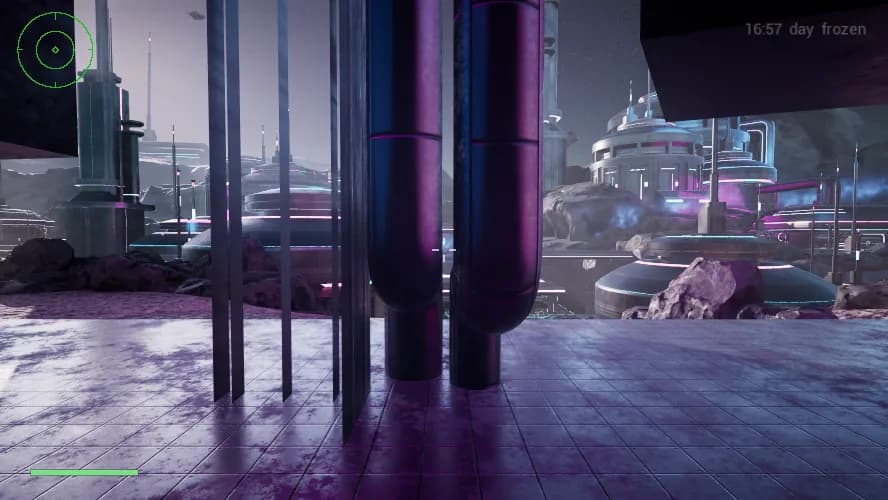
| Part | Status |
|---|---|
| The base, its wire and 18 fighting positions | In the game |
| Six tanks with tracking turrets | In the game |
| HEAVY WEAPONS and DROID ASSAULT | In the game |
| The After-action Report, ranks and medals | In the game |
| Nine weapons, the cargo tractor, 72 monster species | In the game |
| The scenario as a front-door game mode | In development |
| Driving the tanks; anti-tank rounds for infantry; holding the south gate | Planned |
Hero levels: neon cities, ancient temples, ruins full of things that bite
Some planets reward going all the way down. Populated worlds are sci-fi cities on the border of human space, where the story's people live: the neon cities of Neon Quarter and Cyber Alley. Ancient worlds were built by a vanished precursor species and are home to monsters: Eternity City and Jungle Ruins. Wild worlds are landable for their own sake. Nineteen hero levels are in the game today, among them The Sci-Fi City, New Thalos, The Standing City, The Geothermal City, Borvo Station, The Megastructure, The Monolith, The Sun Temple, The City of Gods, The Evil Planet, The White Desert, Mahuika, Ochre Run, Thawline and Port Hallow, an airless moon under a ringed giant. Below ground: Alien Cave, Desert Dig, The Crystal Cave and Aurora Laboratories.
Walk them, loot them, and fight the monster wave ladders: six waves on The Evil Planet, three at Borvo Station, two on Mahuika. An ancient world's sky stays empty by design.
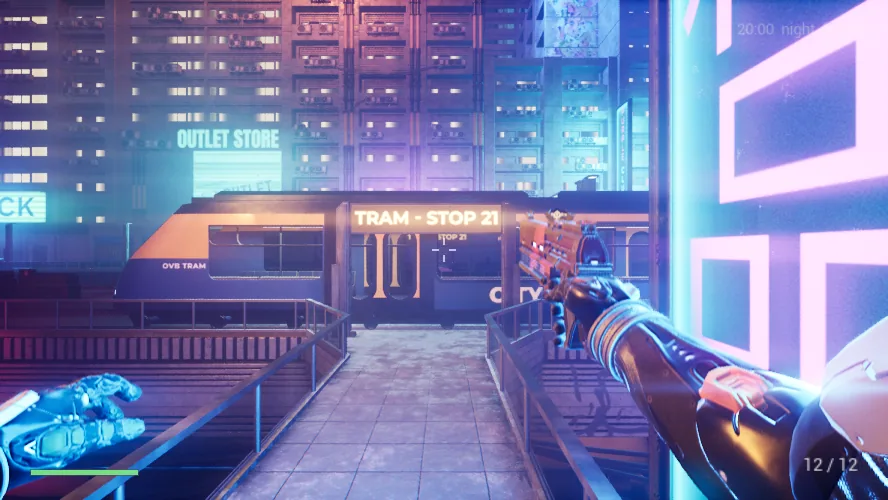
| Part | Status |
|---|---|
| Nineteen hero levels and four interiors | In the game |
| Monster wave ladders and loot | In the game |
| Traffic over the neon cities; city people; surveillance drones | Planned |
| Contracts on these worlds | Planned |
The Lunar Base on Halden Mare
Cycle the airlock, take off your helmet, and step into a furnished moonbase. The site is at 77.77 north on Halden Mare, on a 250 metre pad cut dead level at the shore of the lava sea. Its atrium is a 120 metre glazed dome with a deck, a promenade, four pavilions and 136 plants, inside a nineteen-piece base cluster. The medical and crew habitat and the workshop are furnished, with real windows, working airlocks at all four entrances with a sealed dwell and door interlock, terminals, task lighting and habitat displays.
Four astronaut suits are in the game, and Cassie follows you out and takes Stay, Follow, Scout and radio orders. Luna's Crater Base, with its traffic overhead, is already open.
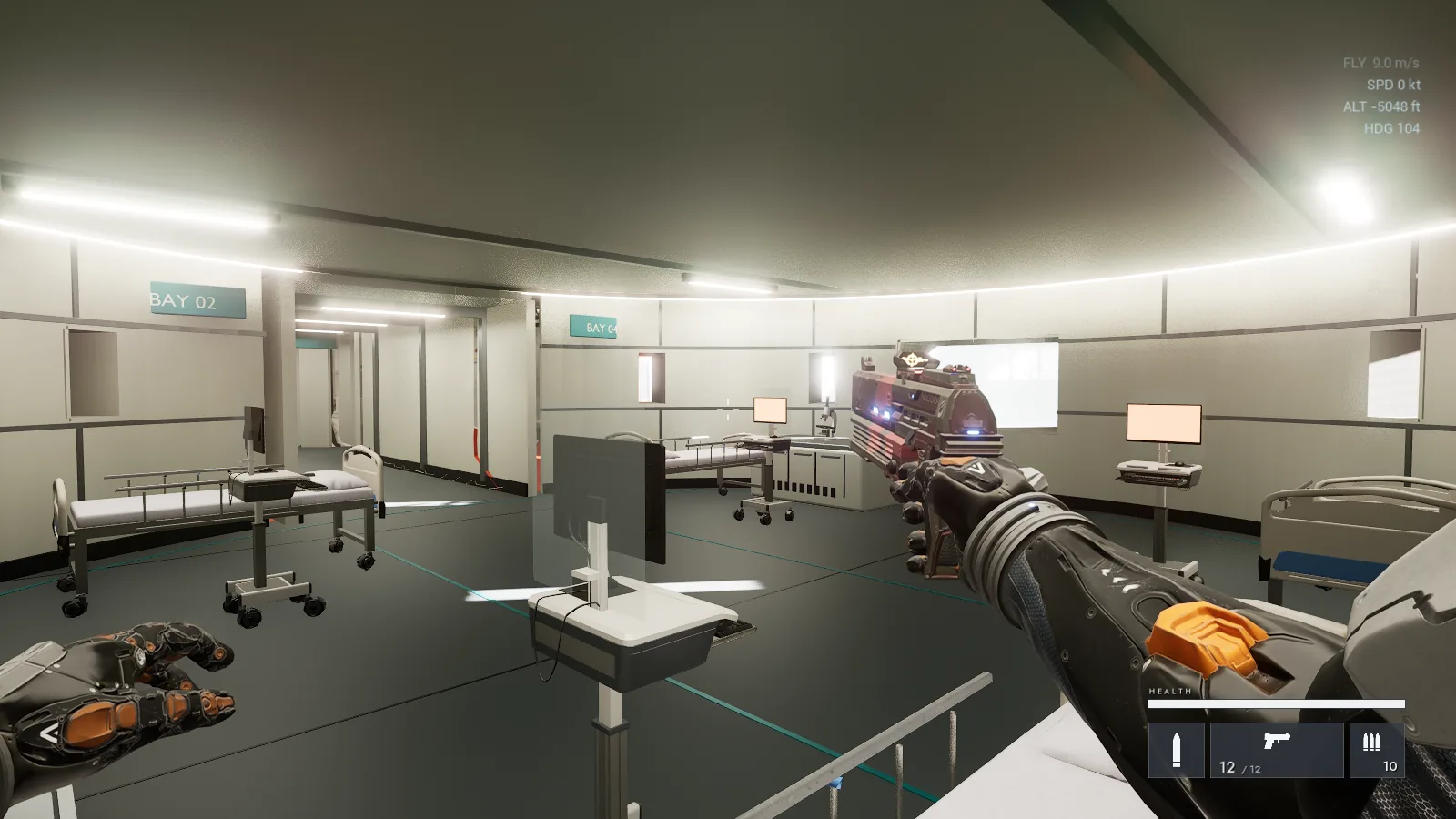
| Part | Status |
|---|---|
| Luna Crater Base and its traffic | In the game |
| Astronaut suits; Cassie's orders | In the game |
| The habitat, workshop and airlocks | In development |
2,457 stations, and every one has people with names and faces
Stations are placed by rule in every system: at the star, at the giants' L4 and L5 points, and a derelict in one empty system in eight, 2,457 of them across 618 systems. Six are stops in the fast-travel menu. Nereid Station at Neptune is walkable, eleven rooms and 25 doors with a market aboard, as is the Jupiter Station deck; boarding any other station takes you into a generated interior of two to four decks with a hangar and an atrium. Ships that strike a station bounce off and take damage.
The market carries 78 commodities in twelve categories over a live economy of 1,068 markets, where your trades dent a price that heals over about thirty days. The PEOPLE tab pages through a station's whole headcount: 51,338 unique station crew from 615 portraits.
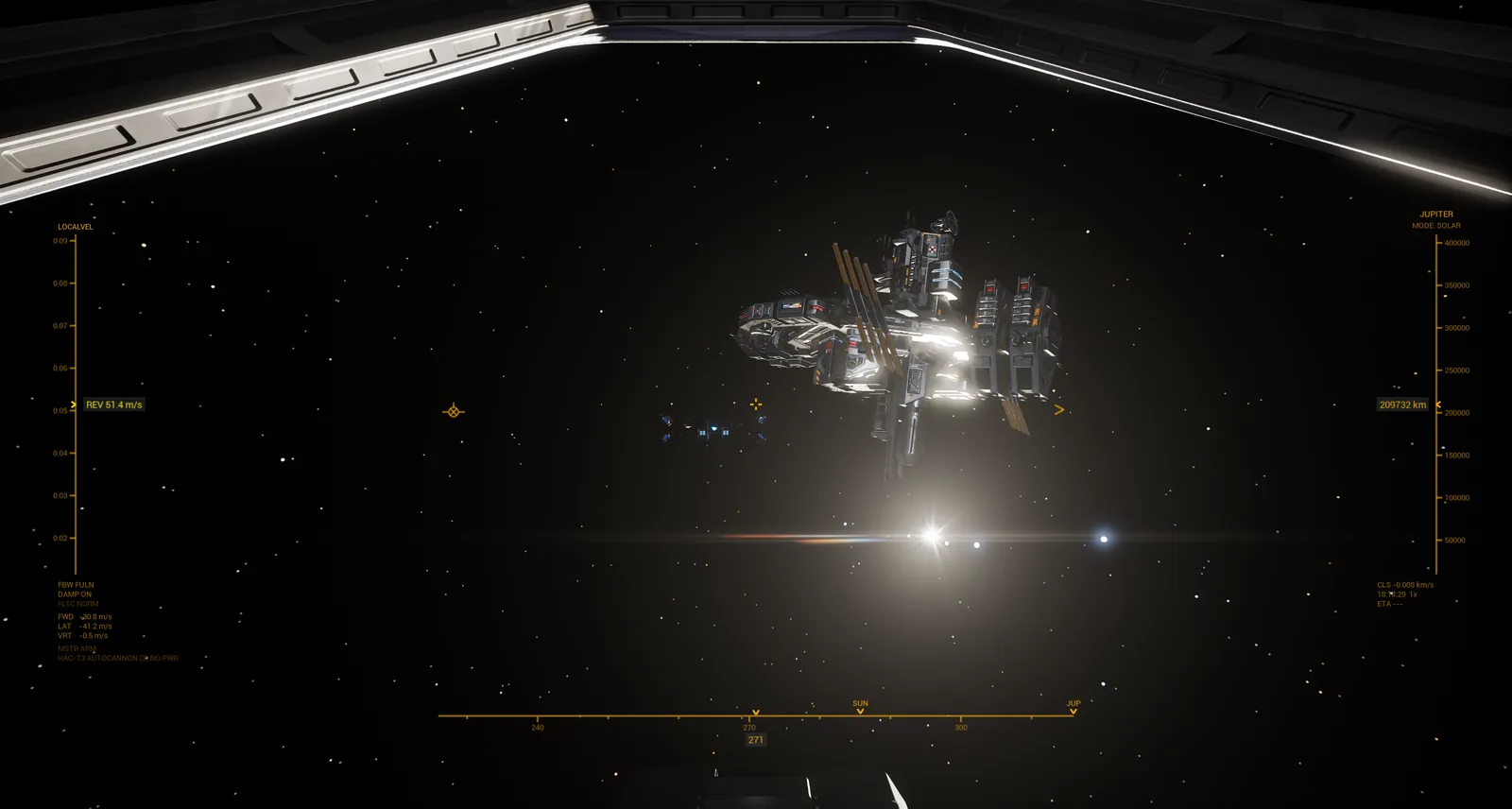
| Part | Status |
|---|---|
| Placement, spin and six station stops | In the game |
| The market and the economy | In the game |
| PEOPLE: 51,338 crew with faces | In the game |
| Nereid Station and the Jupiter Station deck, walkable | In the game |
| Boarding generated stations | In development |
| Docking; talking to and hiring crew; station traffic | Planned |
An atmospheric scout on a real F-16 flight model, and a Boeing 737
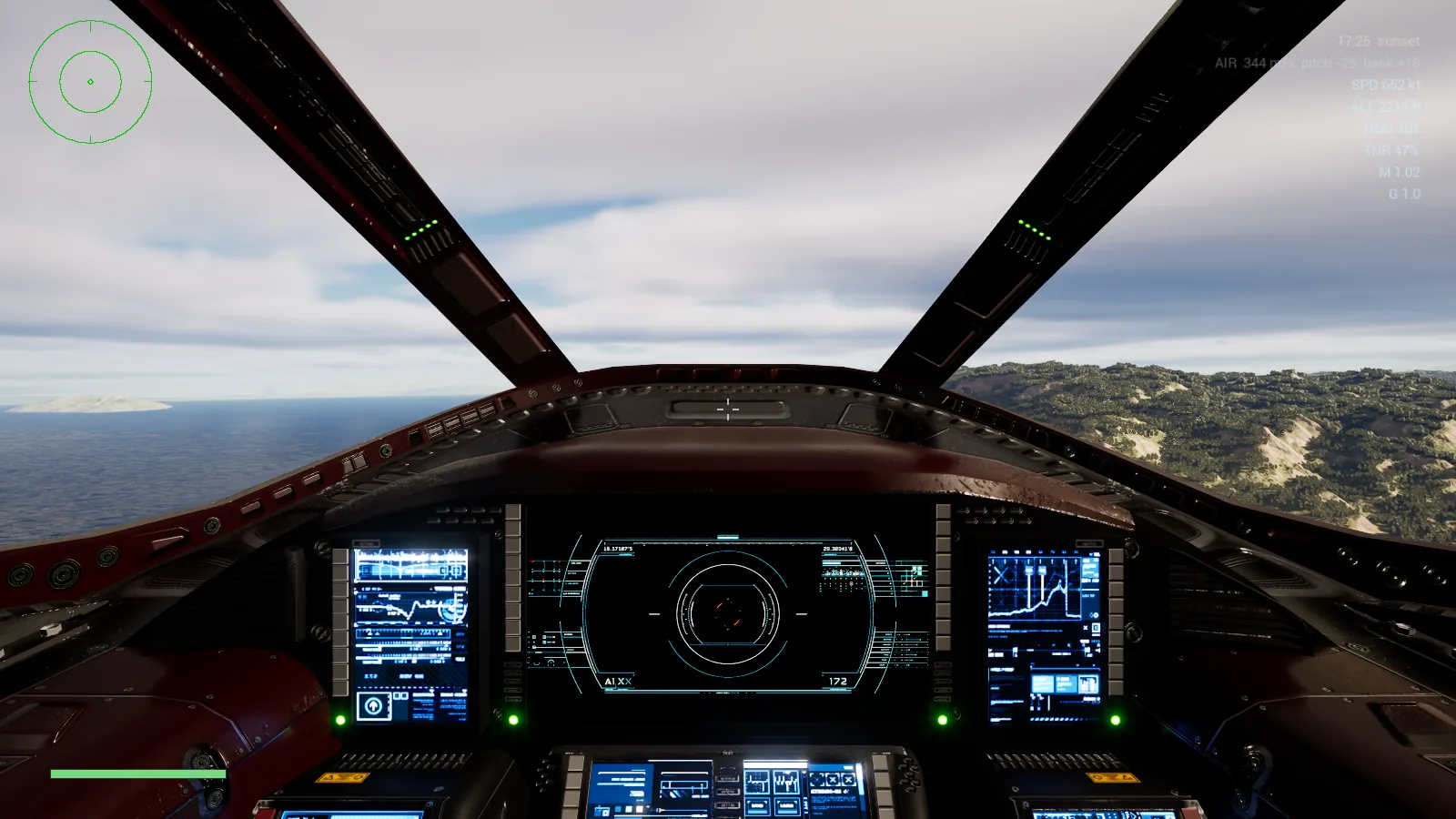
The planetary scout flies on NASA's F-16 wind-tunnel data (NASA TP-1538, Nguyen et al., 1979): full coefficient tables, mass and inertia, and an afterburning engine. A 9 g limiter and a 25 degree angle-of-attack ceiling; full-stick rolls at up to 324 degrees a second; real stalls and spins, recovered with rudder; Mach 1.285 at sea level and 1.98 at altitude. Because it is an exploration vehicle it has vectored thrust with five nozzle detents and an autohover, a speedbrake, a moving map and a primary flight display, in a cockpit that reads as the Calliope's own. It flies over Fernrock today.
And because we could: a Boeing 737 flight deck over a procedural planet. Start in the captain's seat at 10,000 feet and 283 knots, trimmed hands-off, with nine tonnes of Jet A-1. It is not fly-by-wire: a real stabiliser and trim, engine thrust that pitches the nose up, and a phugoid, with aerodynamics worked from first principles and published Boeing figures and drag within two to five percent of an established open model. A three-tank fuel system, captain's and first officer's primary flight displays, and a 69-key flight computer keypad. The same 737 is the model for the Calliope's overhead panel.
| Part | Status |
|---|---|
| The scout on the F-16 flight model, over Fernrock | In the game |
| Vectored thrust and autohover | In the game |
| The 737 flight deck | In the game |
| 737 takeoff and landing, autopilot and flight management | Planned |
Five centuries of history behind every name
It is 2538 in the Freeholds, an independent chain of worlds on the rim of human space, and six powers are arriving at once. The fiction is in the game as the faction territories on the galaxy map, the faction-owned markets and crews, and the names of every world, station and item. The story itself, with its contracts and claimants, comes next.