- On this page
- 2
- figures
- 2
- tables
- 2
- panels
- 27
- references
Redirected from Stellar black hole
Black hole
Black hole
ContentsShow
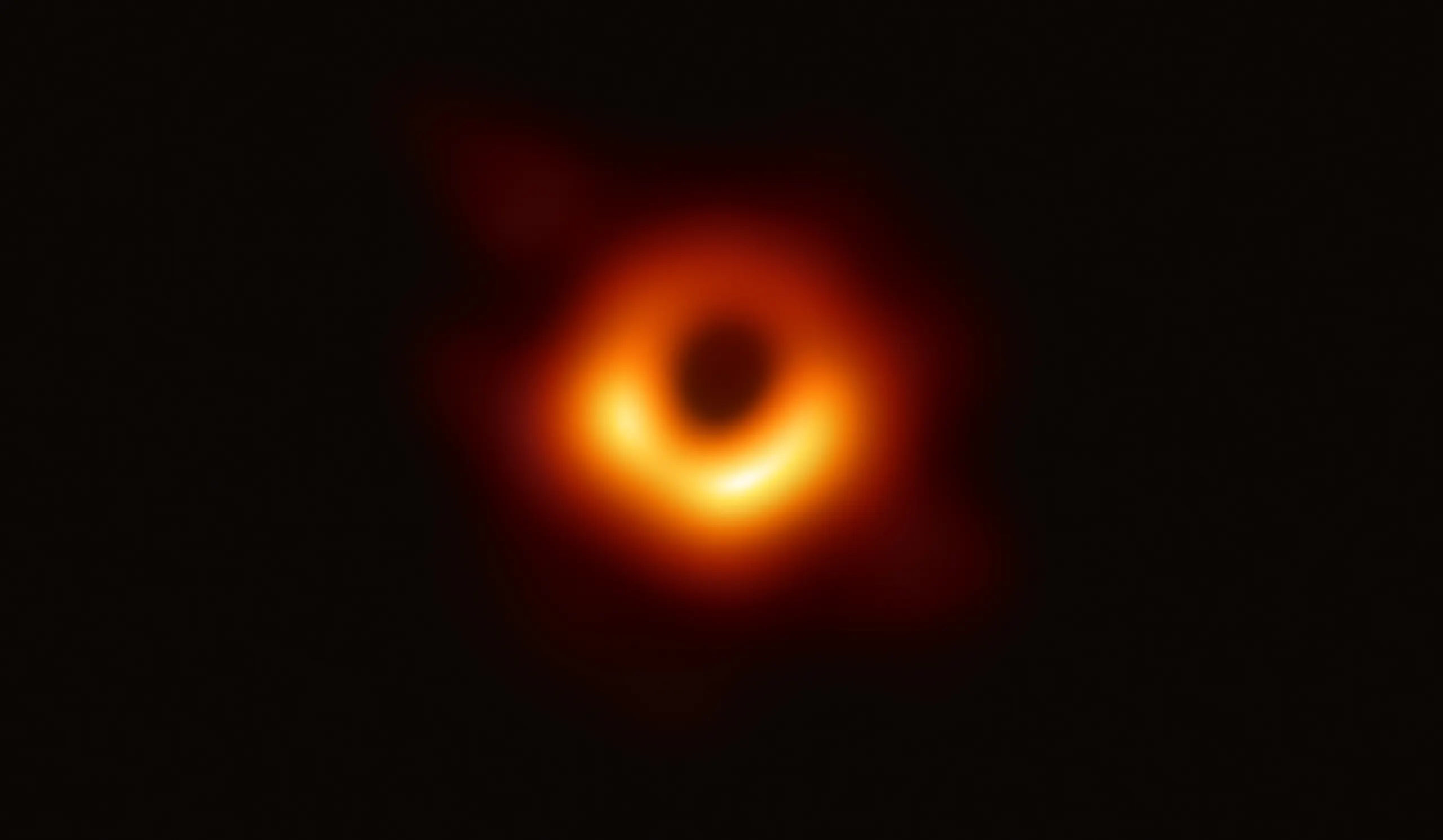
A black hole is a region of spacetime where gravity is so strong that nothing that crosses its boundary, light included, can come back out. That boundary, the event horizon, is a feature of the geometry of space and time, a point of no return with nothing solid there. Black holes form when the cores of very massive stars collapse, and giant ones, millions to billions of times the mass of the Sun, sit at the centres of most large galaxies, including our own (Sagittarius A*). Once theoretical curiosities, they are now weighed by the stars that orbit them and detected by the gravitational waves they send out when they merge. Two have been photographed against the glowing gas around them.
In Pax Abyssi you can fly to four real black holes, Cygnus X-1, V404 Cygni, Gaia BH1 and Sagittarius A*, and every one is built on its physics: the path of each ray of light is solved through the curved spacetime around the hole, so the shadow, the photon ring, the glowing disk and the bent stars behind it all come out of general relativity. On top of that we are adding an artist's vision, a stronger lens with the star field pulled into arcs, the black hole people picture. It will be the default, and one setting steps back to the exact physics.
How Pax Abyssi draws a black hole
The game draws a black hole with its own light-bending pass, written for the purpose. For every pixel of sky near the hole it asks where that ray of light came from before gravity bent it into your eye, and what it hit on the way. This is the scientific setting, and every look the game offers is built on it.
- The ray. Around a hole that does not spin, the pass reads precomputed light-bending tables. Around a spinning hole it solves the ray through the Kerr geometry in closed form, after Gralla and Lupsasca 1, so each pixel knows where its light ends without stepping along it. The edge of the shadow agrees with Bardeen's analytic outline.
- The shadow and the photon ring. Rays that pass too close are captured, and they leave a disc of perfect black about 2.6 times the width of the horizon, edged by the thin ring of light that skimmed the photon sphere.
- The disk, only where something feeds it. A disk is drawn only where the science says there is one. Its temperature follows the thin-disk law from the hole's mass and feeding rate 2, and each patch of gas is coloured as a black body at the temperature you would actually see, shifted by gravity and by its orbital motion. The side of the disk coming towards you is brighter and bluer (Doppler beaming) because the physics makes it so. The far side is lifted over the top of the shadow and down under it.
- The real sky, bent. The stars behind the hole are our own catalogue and Milky Way model, rebuilt as seen from the hole's true position in the Galaxy. At Cygnus X-1, 2.2 kiloparsecs away, that is 375 catalogue stars and 31,124 generated ones.
The inner edge of a stellar black hole's disk completes an orbit in a few thousandths of a second, which on any screen is a smooth blur. We draw it turning once every few seconds, so you can watch the gas move.
The physics, and an artist's vision
How strongly a black hole bends the sky behind it is fixed by its mass and your distance from it, and the scientific setting draws exactly that amount. The true lensing is subtle from a distance: it folds the stars close round the shadow into the doubled arcs astronomers predict and leaves the wider sky almost untouched. The black hole most people carry in their heads is bolder, so the game will draw that by default: an artist's vision with a stronger lens and the star field drawn out into arcs round the shadow. Step back to the scientific setting and every pixel shows general relativity again. That is how we work everywhere: full scientific realism, always there as an option.
IN THE GAME. The light-bending pass, the scientific setting, with the shadow, photon ring, disk and bent sky solved from general relativity at every stop.
IN DEVELOPMENT. The artist's vision as the default look, and the player setting that switches between the two. Black holes arrived in the game this week, and both looks already render in the engine; drag the dividers to compare.
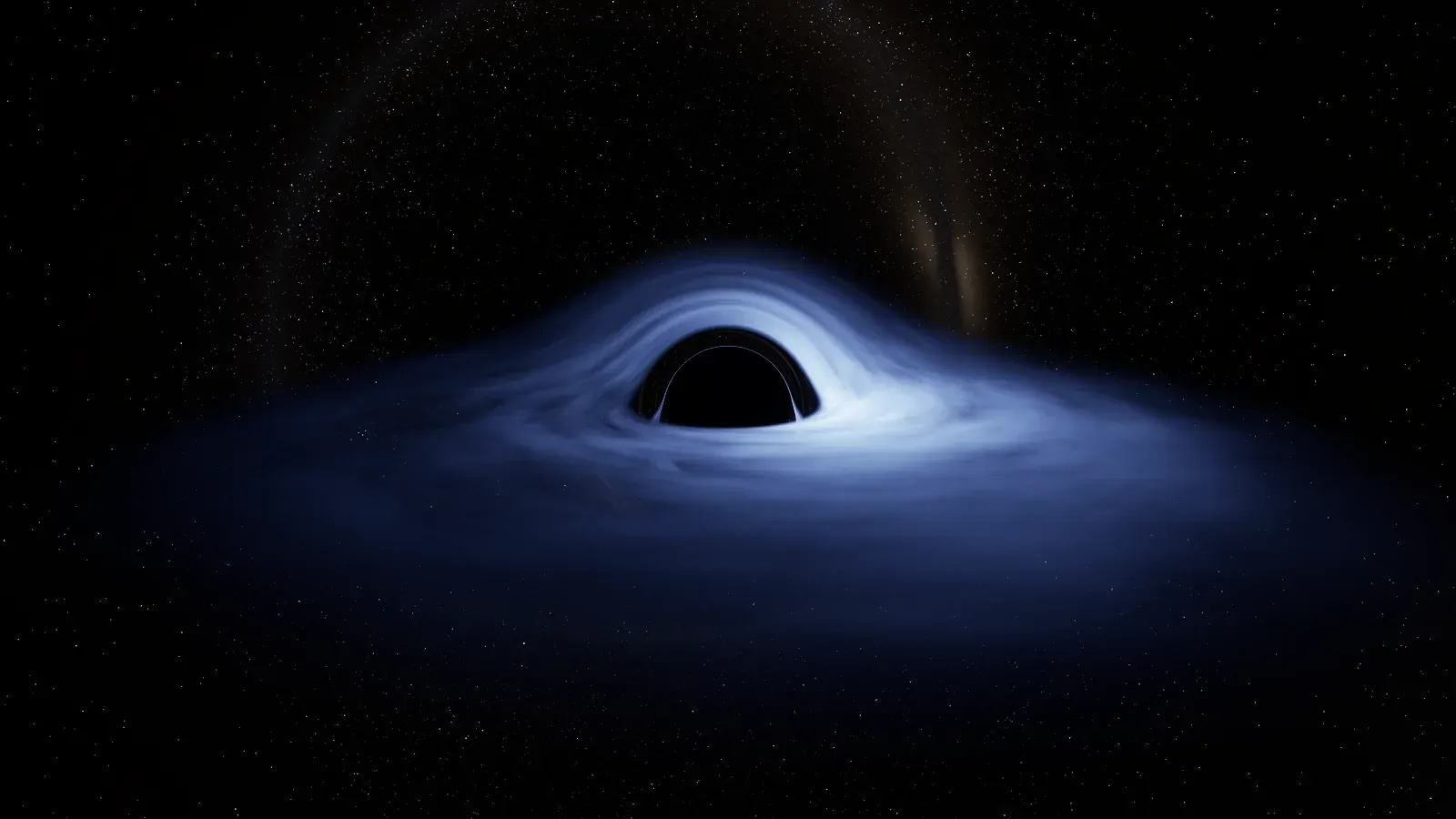
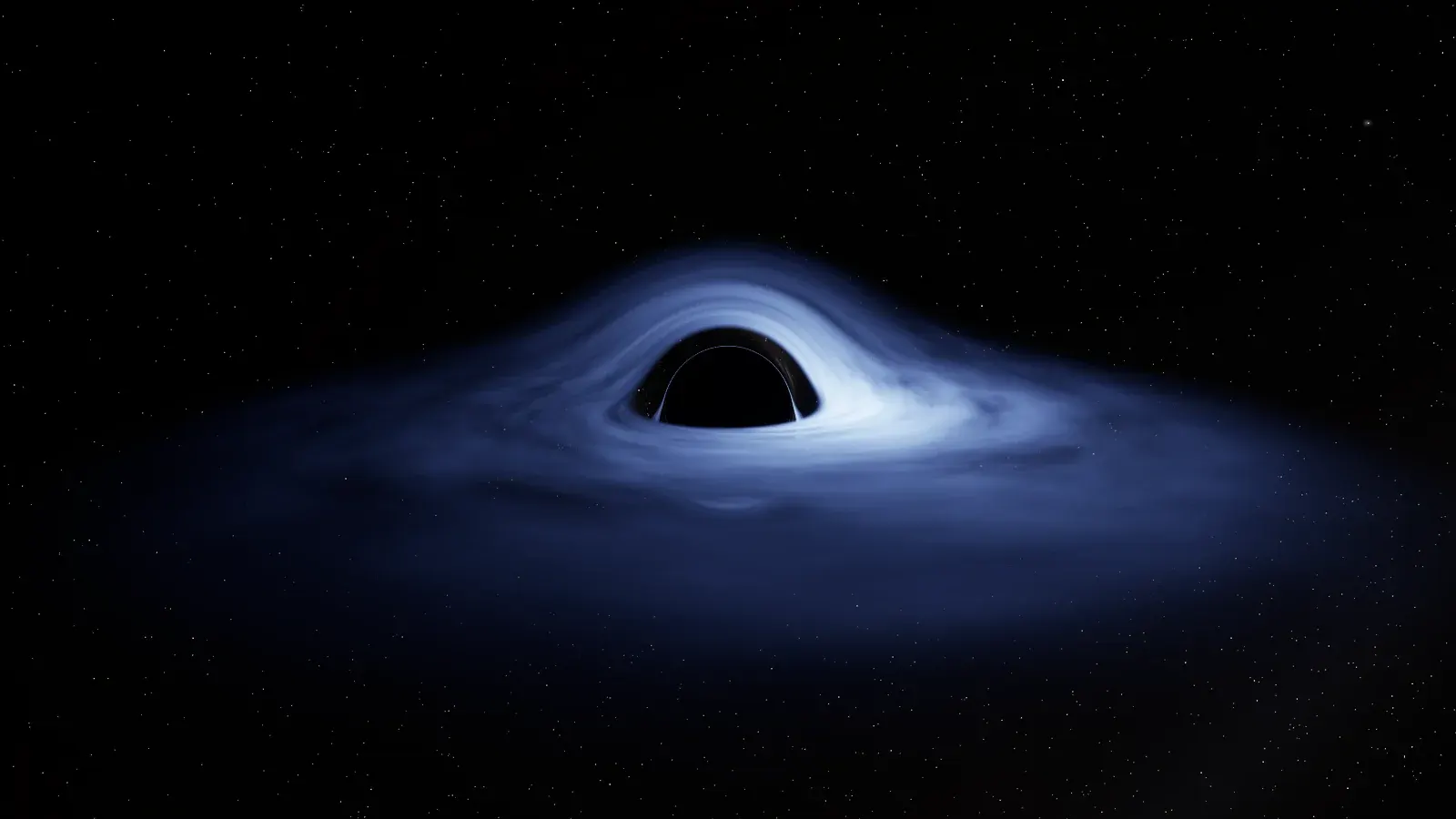
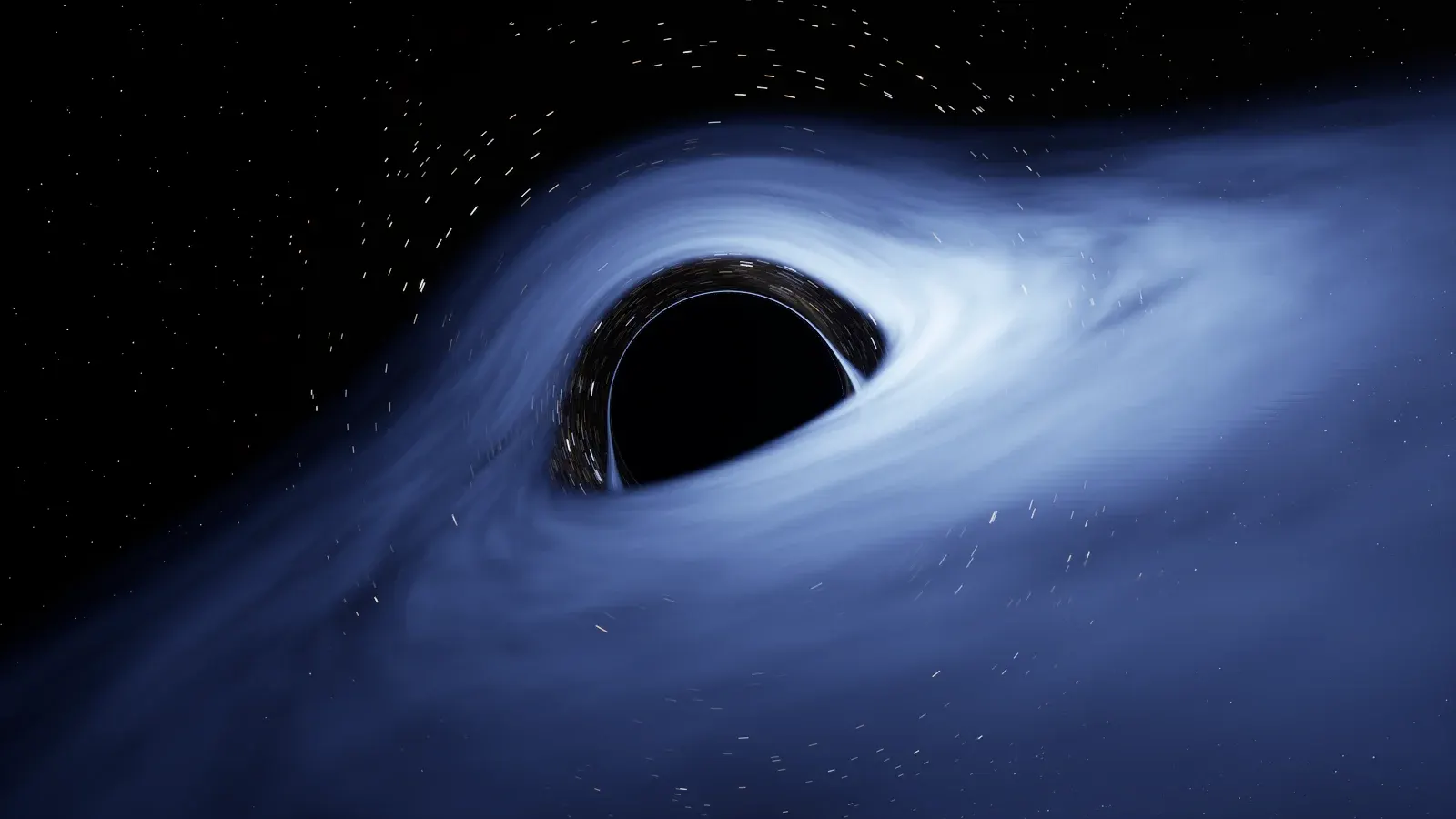
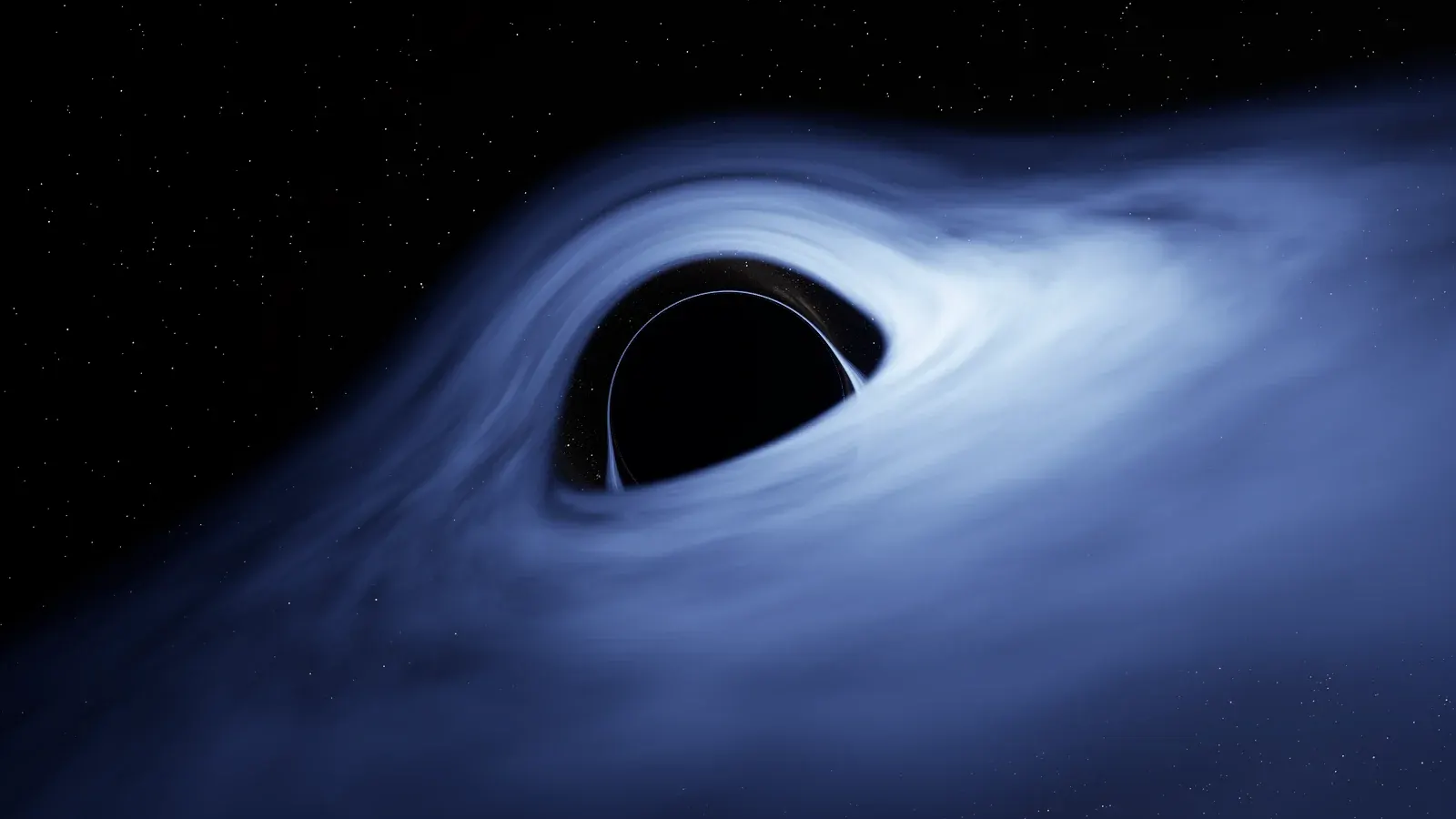
The geometry of a black hole
Size: the Schwarzschild radius
The size of a non-spinning black hole is set by its mass alone. Karl Schwarzschild found the solution of Einstein's equations for a point mass in 1916; its horizon lies at the Schwarzschild radius
where is the gravitational constant, the speed of light and the mass of the Sun. Squeeze the Sun into a ball 5.9 km across and it would be a black hole; Earth would need to fit inside a marble 18 mm wide. A typical stellar black hole of 10 solar masses has a horizon about 59 km across, the length of a long commute.
Three more radii, all fixed multiples of for a non-spinning hole, decide what a visitor would see 3:
- The photon sphere, at , is where light itself can orbit, unstably. A photon nudged inward falls in; nudged outward, it escapes.
- The shadow is the dark patch a distant observer sees. Rays that pass the hole with an impact parameter below are captured, so the shadow looks about 2.6 times wider than the horizon: gravity magnifies its own hole.
- The innermost stable circular orbit (ISCO), at (), is the closest a particle can circle without spiralling in. It marks the inner edge of a thin accretion disk.
Spin: the Kerr solution
Real black holes spin, because the stars that made them did. In 1963 Roy Kerr found the exact solution for a rotating mass 4, and it is the one astronomers expect every astrophysical black hole to follow. Spin is written as a dimensionless number , where is the angular momentum; it runs from 0 (not spinning) to just below 1 (the fastest rotation a horizon allows). A spinning hole drags spacetime round with it, and the radii that matter move:
| Spin | Horizon | Prograde ISCO | Photon orbits (with / against the spin) | Disk efficiency |
|---|---|---|---|---|
| 0 | 1.5 / 1.5 | 5.7 per cent | ||
| 0.5 | 8.2 per cent | |||
| 0.9 | 0.779 / 1.955 | 15.6 per cent | ||
| 1 (limit) | 0.5 / 2.0 | 42 per cent |
The ISCO values follow the formula of Bardeen, Press and Teukolsky 3; the efficiency is the fraction of the rest-mass energy of infalling gas that a thin disk radiates before the gas reaches the ISCO 2. That last column is why accreting black holes are the most efficient engines in nature: hydrogen fusion in the Sun releases 0.7 per cent of the fuel's mass as energy, while gas spiralling into a fast-spinning hole can release more than twenty times as much.
Mass, spin and electric charge are the only properties a black hole keeps. Charge is quickly neutralised by surrounding plasma, so in practice two numbers, and , describe any black hole in the sky.
Tides and spaghettification
Near a black hole, gravity pulls harder on the near side of an object than on the far side. A star of radius and mass is torn apart inside the tidal disruption radius
For a Sun-like star and a 10 solar-mass hole, is about 2.2 solar radii (1.5 million km), some 50,000 times the horizon's radius. For a hole of 4.3 million solar masses it is about 160 solar radii (0.76 AU), roughly nine times the horizon. Because grows only as the cube root of the hole's mass while grows in direct proportion, the two meet near solar masses: a hole heavier than that swallows a Sun-like star whole, and one lighter shreds it first, producing a months-long flare called a tidal disruption event 5.
Hawking radiation
Quantum mechanics lets a black hole radiate faintly, at a temperature 6, about 60 billionths of a kelvin for one solar mass. Every known black hole is far colder than the 2.7 K cosmic microwave background, so all of them are absorbing more energy than they emit. Hawking radiation has never been observed.
Kinds of black hole
Stellar black holes form when the core of a very massive star, typically one born with more than about twenty times the Sun's mass, collapses at the end of its life. Those weighed in the Milky Way range from about 4 to 33 solar masses. Population models put about 130 million of them in the Galaxy, some 7 per cent in binary systems 7, but almost all are invisible: a black hole shows itself only when something falls in or orbits it.
Intermediate-mass black holes, from about a hundred to a hundred thousand solar masses, have been hard to find. The strongest case in our Galaxy is in the globular cluster Omega Centauri, where seven stars moving faster than the cluster's escape speed require a central mass of at least 8,200 solar masses 8. Gravitational-wave detectors have caught mergers that build them: GW190521 left a remnant of about 142 solar masses 9, and GW231123 merged holes of about 137 and 101 solar masses, both spinning fast 10.
Those merger masses matter because stellar theory predicts a pair-instability gap: stars whose cores would make holes of roughly 60 to 130 solar masses are expected to blow themselves apart instead, leaving nothing. GW231123's heavier component sits in or above that gap, which suggests it grew from earlier mergers 10.
Supermassive black holes, from about to solar masses, sit in galactic nuclei. How they grew so large so early in cosmic history is an open question. The two imaged so far are Sagittarius A* and M87*, the 6.5 billion solar-mass hole at the heart of the galaxy Messier 87 11.
How we know
X-ray binaries. In 1972 two teams showed that the X-ray source Cygnus X-1 orbits a blue supergiant every 5.6 days, and that the unseen partner was too heavy to be a neutron star 12 13. The method still anchors the field: measure the visible star's orbital speed, and Kepler's laws give a minimum mass for its companion. A compact object above about 3 solar masses, the most a neutron star can hold (see Neutron star), is taken to be a black hole.
Dormant binaries. Most black holes in binaries are not feeding. The Gaia spacecraft finds them by the wobble they give their companion star on the sky. Gaia BH1, a 9.62 solar-mass hole circled by a Sun-like star every 185.6 days, is 480 parsecs away, the nearest black hole known 14; Gaia BH2 has a red giant partner in a 1,277-day orbit 15; Gaia BH3, at 32.70 solar masses, is the heaviest stellar black hole known in the Galaxy 16.
Microlensing. A black hole passing in front of a distant star bends and brightens its light, and shifts its apparent position. The lens of the event OGLE-2011-BLG-0462 emits no light and weighs 7.15 ± 0.83 solar masses: the first isolated stellar black hole, drifting alone 1.52 kiloparsecs away 17.
Gravitational waves. On 14 September 2015 the LIGO detectors recorded the merger of two holes of about 36 and 29 solar masses, which radiated about three solar masses of energy as ripples in spacetime 18. Merging black holes are now observed routinely, and their masses and spins form the largest black hole sample we have.
Images of the shadow. The Event Horizon Telescope links radio dishes across the Earth into a telescope the size of the planet. In 2019 it resolved M87* as a bright ring 42 ± 3 microarcseconds across around a dark centre, as general relativity predicts 19.
 , open full size
Spin is the hardest property to measure. Astronomers fit the X-ray spectrum of the inner disk, or the shape of an iron emission line smeared by relativity, and both depend on models of the disk 20. Cygnus X-1 shows the problem: the same data give a spin of about 0.9 with one plausible disk model and 0.1 or less with another 21.
Notable black holes
| Name | Class | Mass (solar masses) | Distance | Found by | Note |
|---|---|---|---|---|---|
| Gaia BH1 | stellar | 9.62 ± 0.18 | 480 pc | astrometry | nearest known; no X-rays 14 |
| Gaia BH2 | stellar | 8.9 ± 0.3 | 1.16 kpc | astrometry | red giant companion 15 |
| Gaia BH3 | stellar | 32.70 ± 0.82 | about 590 pc | astrometry | heaviest stellar hole in the Galaxy 16 |
| Cygnus X-1 | stellar | 21.2 ± 2.2, or 12.7 to 17.8 | 2.22 kpc | X-ray binary | first black hole identified; the mass depends on the analysis 22 23 |
| V404 Cygni | stellar | 9.0 (+0.2 / -0.6) | 2.39 kpc | X-ray binary | spin probably above 0.92; outbursts in 1989 and 2015 24 25 26 |
| OGLE-2011-BLG-0462 | stellar | 7.15 ± 0.83 | 1.52 kpc | microlensing | isolated, no companion 17 |
| Omega Centauri | intermediate | at least 8,200 | 5.4 kpc | stellar motions | in a globular cluster 8 |
| Sagittarius A* | supermassive | 4.30 million | 8.28 kpc | stellar orbits, imaging | centre of the Milky Way |
| M87* | supermassive | 6.5 billion | 16.8 Mpc | imaging, gas and stars | first black hole imaged 11 |
What a black hole looks like up close
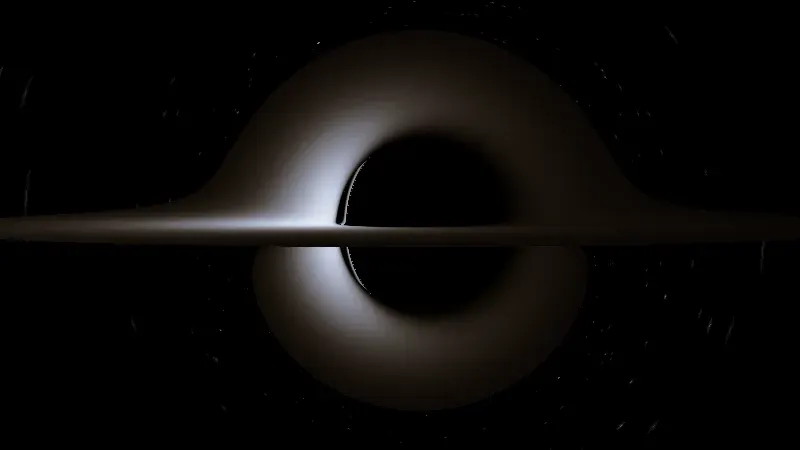
A black hole with nothing around it is still visible, because it bends the light of every star behind it. The shadow appears as a black disc, and around it the background sky is folded into rings and arcs: each distant star appears twice, once on each side, stretched along the edge. Closer to the shadow the images crowd together into an infinite series of ever-thinner rings, the photon subrings.
If gas is falling in, it settles into a disk whose inner edge is the ISCO. Gas there moves at a large fraction of the speed of light, so the side coming towards you is brighter and bluer (Doppler beaming) and the receding side dimmer and redder, while the whole disk is reddened by climbing out of the hole's gravity. The disk's far side is lensed up over the top of the shadow and down under it, which is why a black hole seen nearly edge-on seems to wear a halo.
 , open full size
Things we haven't modelled yet
Black holes are brand new in Pax Abyssi, and we are aiming, as everywhere, at full scientific realism, always available as an option. Next on the list:
- Tides that bite. Gravity pulls harder on the near end of a ship than the far end. A thousand kilometres from a 10 solar-mass hole the difference across a 20 metre hull is more than 5,000 g, far outside the horizon, while at the horizon of Sagittarius A* the same stretch is about a thousandth of a g. Fly too close to a stellar hole and the tides will tear the ship apart.
- Holes that orbit their stars. Cygnus X-1 and its supergiant circle each other every 5.6 days 12, V404 Cygni and its companion every 6.5 days 24, and Gaia BH1 and its Sun-like star every 185.6 days 14. Each hole will move along its real orbit.
- Stars torn apart. A star that strays inside the tidal disruption radius is shredded, and the debris that falls back lights a flare that lasts for months 5.
- Nebulae bent by the lens. Gas and dust clouds behind a hole folded into arcs and doubled images, the same way the stars are.
- The ring nebula of Cygnus X-1. The hole's jet has blown a shell of glowing gas about 5 parsecs across, seen in radio and in the red light of glowing hydrogen 27.
- The disk at its true pace. An option to run the inner disk at its real orbital period, a few thousandths of a second, beside the slowed turn we draw now so the eye can follow it.
See also
References
- 1Gralla, S. E. and Lupsasca, A. (2020). Null geodesics of the Kerr exterior. Physical Review D 101, 044032. doi:10.1103/PhysRevD.101.044032
- 2Page, D. N. and Thorne, K. S. (1974). Disk-Accretion onto a Black Hole. Time-Averaged Structure of Accretion Disk. The Astrophysical Journal 191, 499. doi:10.1086/152990
- 3Bardeen, J. M., Press, W. H. and Teukolsky, S. A. (1972). Rotating Black Holes: Locally Nonrotating Frames, Energy Extraction, and Scalar Synchrotron Radiation. The Astrophysical Journal 178, 347. doi:10.1086/151796
- 4Kerr, R. P. (1963). Gravitational Field of a Spinning Mass as an Example of Algebraically Special Metrics. Physical Review Letters 11, 237-238. doi:10.1103/PhysRevLett.11.237
- 5Rees, M. J. (1988). Tidal disruption of stars by black holes of 10^6-10^8 solar masses in nearby galaxies. Nature 333, 523-528. doi:10.1038/333523a0
- 6Hawking, S. W. (1974). Black hole explosions?. Nature 248, 30-31. doi:10.1038/248030a0
- 7Olejak, A. and et al. (2020). Synthetic catalog of black holes in the Milky Way. Astronomy & Astrophysics 638, A94. doi:10.1051/0004-6361/201936557
- 8Häberle, M. and et al. (2024). Fast-moving stars around an intermediate-mass black hole in ω Centauri. Nature 631, 285-288. doi:10.1038/s41586-024-07511-z
- 9Abbott, R. and et al. (LIGO Scientific Collaboration and Virgo Collaboration) (2020). GW190521: A Binary Black Hole Merger with a Total Mass of 150 solar masses. Physical Review Letters 125, 101102. doi:10.1103/PhysRevLett.125.101102
- 10LIGO Scientific Collaboration, Virgo Collaboration and KAGRA Collaboration (2025). GW231123: A Binary Black Hole Merger with Total Mass 190-265 solar masses. The Astrophysical Journal Letters 993, L25. doi:10.3847/2041-8213/ae0c9c
- 11Event Horizon Telescope Collaboration (2019). First M87 Event Horizon Telescope Results. VI. The Shadow and Mass of the Central Black Hole. The Astrophysical Journal Letters 875, L6. doi:10.3847/2041-8213/ab1141
- 12Webster, B. L. and Murdin, P. (1972). Cygnus X-1: a Spectroscopic Binary with a Heavy Companion?. Nature 235, 37-38. doi:10.1038/235037a0
- 13Bolton, C. T. (1972). Identification of Cygnus X-1 with HDE 226868. Nature 235, 271-273. doi:10.1038/235271b0
- 14El-Badry, K. and et al. (2023). A Sun-like star orbiting a black hole. Monthly Notices of the Royal Astronomical Society 518, 1057-1085. doi:10.1093/mnras/stac3140
- 15El-Badry, K. and et al. (2023). A red giant orbiting a black hole. Monthly Notices of the Royal Astronomical Society 521, 4323-4348. doi:10.1093/mnras/stad799
- 16Gaia Collaboration, Panuzzo, P. and et al. (2024). Discovery of a dormant 33 solar-mass black hole in pre-release Gaia astrometry. Astronomy & Astrophysics 686, L2. doi:10.1051/0004-6361/202449763
- 17Sahu, K. C. and et al. (2025). OGLE-2011-BLG-0462: An Isolated Stellar-mass Black Hole Confirmed Using New HST Astrometry and Updated Photometry. The Astrophysical Journal 983, 104. doi:10.3847/1538-4357/adbe6e
- 18Abbott, B. P. and et al. (LIGO Scientific Collaboration and Virgo Collaboration) (2016). Observation of Gravitational Waves from a Binary Black Hole Merger. Physical Review Letters 116, 061102. doi:10.1103/PhysRevLett.116.061102
- 19Event Horizon Telescope Collaboration (2019). First M87 Event Horizon Telescope Results. I. The Shadow of the Supermassive Black Hole. The Astrophysical Journal Letters 875, L1. doi:10.3847/2041-8213/ab0ec7
- 20Reynolds, C. S. (2021). Observational Constraints on Black Hole Spin. Annual Review of Astronomy and Astrophysics 59, 117-154. doi:10.1146/annurev-astro-112420-035022
- 21Zdziarski, A. A. and et al. (2024). What Is the Black Hole Spin in Cyg X-1?. The Astrophysical Journal Letters 967, L9. doi:10.3847/2041-8213/ad43ed
- 22Miller-Jones, J. C. A. and et al. (2021). Cygnus X-1 contains a 21-solar mass black hole: Implications for massive star winds. Science 371, 1046-1049. doi:10.1126/science.abb3363
- 23Ramachandran, V. and et al. (2025). Comprehensive UV and optical spectral analysis of Cygnus X-1: Stellar and wind parameters, abundances, and evolutionary implications. Astronomy & Astrophysics 698, A37. doi:10.1051/0004-6361/202554184
- 24Khargharia, J., Froning, C. S. and Robinson, E. L. (2010). Near-infrared Spectroscopy of Low-mass X-ray Binaries: Accretion Disk Contamination and Compact Object Mass Determination in V404 Cyg and Cen X-4. The Astrophysical Journal 716, 1105-1117. doi:10.1088/0004-637X/716/2/1105
- 25Miller-Jones, J. C. A. and et al. (2009). The First Accurate Parallax Distance to a Black Hole. The Astrophysical Journal 706, L230-L234. doi:10.1088/0004-637X/706/2/L230
- 26Walton, D. J. and et al. (2017). Living on a Flare: Relativistic Reflection in V404 Cyg Observed by NuSTAR during Its Summer 2015 Outburst. The Astrophysical Journal 839, 110. doi:10.3847/1538-4357/aa67e8
- 27Gallo, E. and et al. (2005). A dark jet dominates the power output of the stellar black hole Cygnus X-1. Nature 436, 819-821. doi:10.1038/nature03879