- On this page
- 2
- figures
- 1
- table
- 1
- panel
- 28
- references
Planet class · GGH · G2-H
Hot Jupiter
ContentsShow
A hot Jupiter is a gas giant that orbits its star in less than about ten days, typically at a twentieth of the Earth-Sun distance or less. At that range the star fills a large part of the planet's sky, the planet's dayside is heated to 1,000 to more than 4,000 K, and tides have locked it with one face permanently towards the star. The first planet found around a Sun-like star, 51 Pegasi b in 1995, was a hot Jupiter, and nobody had expected giants so close 1. They are rare, orbiting fewer than one Sun-like star in a hundred, but they are large, hot and frequently transit their stars, so they are the exoplanets whose atmospheres are best known.
Characteristics
Locked, lopsided and windy
A hot Jupiter's orbit is so tight that the star's tides have long since slowed its spin to match its orbit: its day equals its year, and one hemisphere never sees night. That fixed pattern of heating drives the atmosphere hard. Models predict a broad jet that blows eastward around the equator at kilometres per second, a phenomenon called superrotation 2, and the observations agree. The Spitzer Space Telescope followed HD 189733 b through half an orbit and found its brightest point 16 ± 6 degrees east of the point facing the star, the heat carried downwind by the jet, with infrared brightness temperatures ranging from about 970 K on the cooler side to 1,210 K on the hotter 3.
Puffed-up planets
Many hot Jupiters are larger than any model of a cooling giant allows. The extra size appears only above an orbit-averaged stellar flux of about 2 × 10⁸ erg s⁻¹ cm⁻², roughly an equilibrium temperature of 1,000 K 4, so something must be carrying a small share of the starlight deep into the interior. An analysis of 281 giants found that the share needed rises to about 2.5% of the incoming energy near 1,500 K and falls again at higher temperatures, the pattern expected if currents induced in the partly ionised atmosphere dissipate heat inside the planet (Ohmic heating) 5. The most inflated hot Jupiters reach about twice Jupiter's radius with less than Jupiter's mass, lower in density than Saturn.
Dark worlds
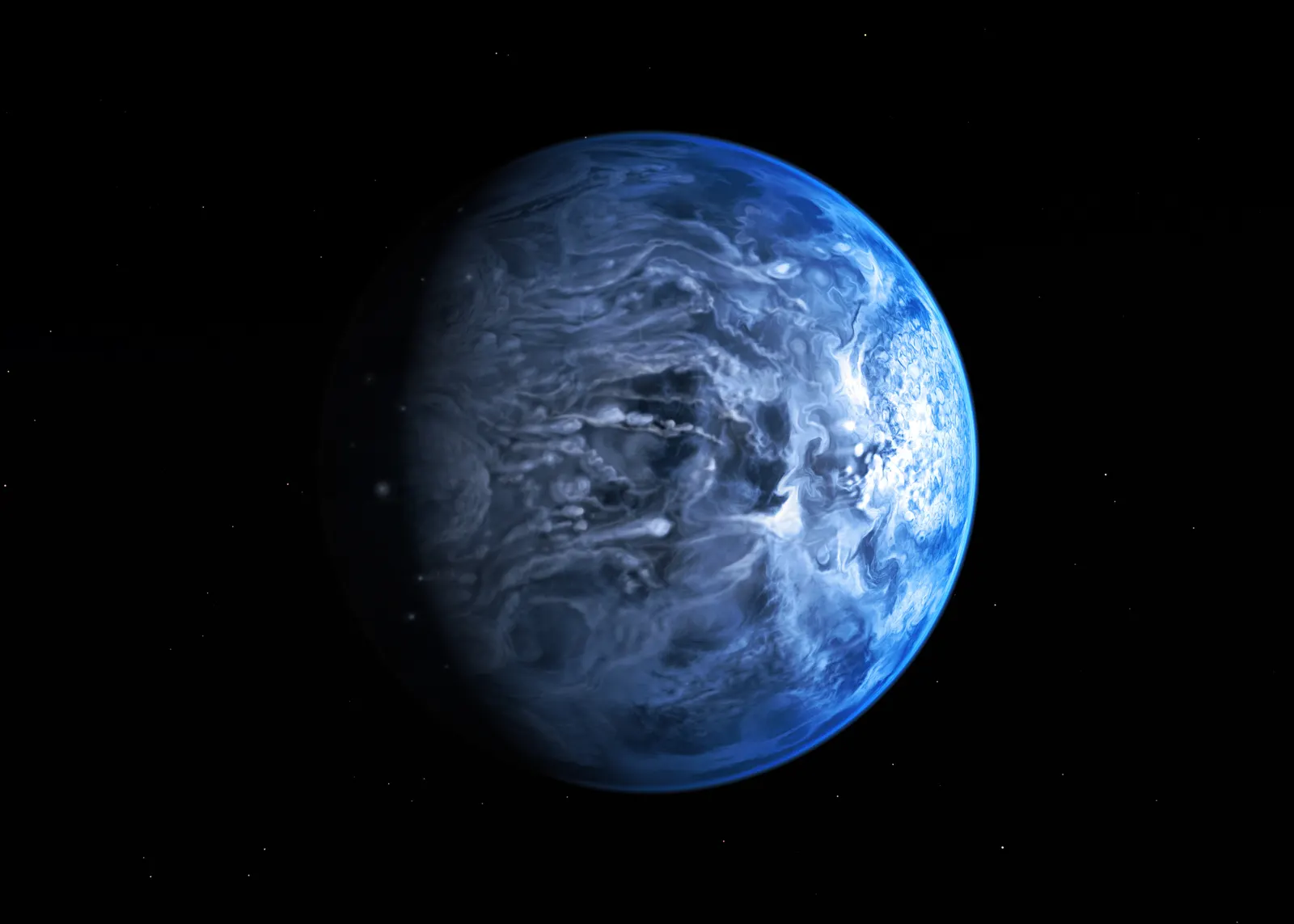
Hot Jupiters are, for the most part, very dark. Sodium and potassium atoms and molecules such as water absorb most of the visible and near-infrared light that reaches them, as the Sudarsky classification predicted for its Class IV planets 6. TrES-2 b reflects less than a few per cent of the light that falls on it, darker than coal 7, and most hot Jupiters observed by Kepler have geometric albedos below 0.25 8. Clouds make a few brighter. Kepler-7 b has a geometric albedo of 0.35, with its brightest point on the western, morning side, where cooler air lets reflective clouds condense 9. HD 189733 b reflects blue light and absorbs red, which would make it look deep blue to the eye 10.
Chemistry from warm to ultra-hot
The atmosphere changes with temperature. In the cooler hot Jupiters, below about 1,000 K, methane still holds some of the carbon and clouds of sulfides and salts can form; hotter, carbon monoxide takes over and clouds of silicate rock and iron condense at depth and on the cooler nightside. Above an equilibrium temperature of about 2,000 K, the ultra-hot Jupiters have daysides too hot for any cloud: water molecules are broken apart, hydrogen partly dissociates, and the negative hydrogen ion becomes a major source of opacity 11 12. Gases such as titanium oxide, which absorb strongly in the visible, can heat the upper atmosphere into a temperature inversion, a stratosphere 13 14. On the ultra-hot WASP-76 b, iron vapour from the dayside condenses as it crosses to the night, so iron probably rains out on the planet's night side 15.
KELT-9 b is the extreme case: its dayside is near 4,600 K, hotter than many stars, and its host star's intense ultraviolet light is thought to be driving gas off the planet 16.

Losing mass and falling in
Starlight also heats the uppermost atmosphere enough for gas to escape. Hydrogen streaming away from HD 209458 b was detected in 2003 as an absorption signal far larger than the planet itself 17. The planet's own pull on its star raises tides that slowly drain its orbit. WASP-12 b, on a 1.09-day orbit, is the first planet whose orbit is known to be shrinking: the time between its transits is decreasing by 29 milliseconds a year, and it will spiral into its star in a few million years 18.
Formation
Nobody thinks hot Jupiters form as giants where they are now, and the question of how they got there is one of the oldest in exoplanet science. Three routes are discussed: formation in place from a large core, migration inward through the gas disc while the planet was young, and high-eccentricity migration, in which another body flings the giant onto an elongated orbit that tides raised at each close pass then shrink and circularise. No single route explains everything; disc migration and high-eccentricity migration together probably account for most 19. Two clues point to a violent history for many. Hot Jupiters almost never have small planets on nearby orbits, unlike warm Jupiters 20, and about half have a massive companion farther out, between 1 and 20 AU, that could have done the flinging 21.
How common are they?
Hot Jupiters orbit about 0.4% of the stars Kepler watched 22 and about 1.2% of nearby Sun-like stars in radial-velocity surveys 23; the difference may reflect the metal-richer stars of the solar neighbourhood. Like other giants they are much more common around metal-rich stars: the chance that a star hosts a giant rises roughly with the square of its iron abundance 24.
How we know
Hot Jupiters are the easiest planets to detect. Their mass pulls their stars into a fast, large wobble, found by radial velocities 1, and their short orbits make transits frequent: HD 209458 b was the first planet seen to transit, in 1999 25. Transits made hot Jupiters the first planets with measured atmospheres. Sodium in HD 209458 b in 2001 was the first detection of an exoplanet atmosphere 26, and JWST made the first clear detection of carbon dioxide, in WASP-39 b in 2022 27, along with sulfur dioxide made by photochemistry high in the same planet's atmosphere 28. Phase curves, which follow the planet's brightness round its orbit, map its day-night contrast and hot spot.
Notable examples
| Planet | Period | Notes |
|---|---|---|
| 51 Pegasi b | 4.23 days | First planet found around a Sun-like star, 1995 1 |
| HD 209458 b | 3.5 days | First transit (1999) and first atmosphere (2001); escaping hydrogen 25 26 17 |
| HD 189733 b | 2.2 days | Hot spot 16 degrees east; deep blue in reflected light 3 10 |
| WASP-12 b | 1.09 days | Orbit shrinking by 29 ms a year 18 |
| WASP-39 b | 4.1 days | First clear carbon dioxide and sulfur dioxide, with JWST 27 28 |
| WASP-76 b | 1.8 days | Iron condensing on the night side 15 |
| WASP-121 b | 1.3 days | Ultra-hot, with a stratosphere 14 |
| KELT-9 b | 1.5 days | Dayside near 4,600 K 16 |
| TrES-2 b | 2.5 days | Darker than coal 7 |
See also
- Gas giant
- Temperate gas giant
- Sudarsky classification
- Hot Neptune desert
- Atmospheric escape
- Exotic worlds
- Planet occurrence
References
- 1Mayor, M. and Queloz, D. (1995). A Jupiter-mass companion to a solar-type star. Nature 378, 355-359. doi:10.1038/378355a0
- 2Showman, A. P. and Polvani, L. M. (2011). Equatorial Superrotation on Tidally Locked Exoplanets. The Astrophysical Journal 738, 71. doi:10.1088/0004-637X/738/1/71
- 3Knutson, H. A. et al. (2007). A map of the day-night contrast of the extrasolar planet HD 189733b. Nature 447, 183-186. doi:10.1038/nature05782
- 4Demory, B. O. and Seager, S. (2011). Lack of Inflated Radii for Kepler Giant Planet Candidates Receiving Modest Stellar Irradiation. The Astrophysical Journal Supplement Series 197, 12. doi:10.1088/0067-0049/197/1/12
- 5Thorngren, D. P. and Fortney, J. J. (2018). Bayesian Analysis of Hot-Jupiter Radius Anomalies: Evidence for Ohmic Dissipation?. The Astronomical Journal 155, 214. doi:10.3847/1538-3881/aaba13
- 6Sudarsky, D., Burrows, A. and Pinto, P. (2000). Albedo and Reflection Spectra of Extrasolar Giant Planets. The Astrophysical Journal 538, 885-903. doi:10.1086/309160
- 7Kipping, D. M. and Spiegel, D. S. (2011). Detection of visible light from the darkest world. Monthly Notices of the Royal Astronomical Society Letters 417, L88-L92. doi:10.1111/j.1745-3933.2011.01127.x
- 8Esteves, L. J., De Mooij, E. J. W. and Jayawardhana, R. (2015). Changing Phases of Alien Worlds: Probing Atmospheres of Kepler Planets with High-Precision Photometry. The Astrophysical Journal 804, 150. doi:10.1088/0004-637X/804/2/150
- 9Demory, B. O. et al. (2013). Inference of Inhomogeneous Clouds in an Exoplanet Atmosphere. The Astrophysical Journal Letters 776, L25. doi:10.1088/2041-8205/776/2/L25
- 10Evans, T. M. et al. (2013). The Deep Blue Color of HD 189733b: Albedo Measurements with Hubble Space Telescope/Space Telescope Imaging Spectrograph at Visible Wavelengths. The Astrophysical Journal Letters 772, L16. doi:10.1088/2041-8205/772/2/L16
- 11Arcangeli, J. et al. (2018). H- Opacity and Water Dissociation in the Dayside Atmosphere of the Very Hot Gas Giant WASP-18b. The Astrophysical Journal Letters 855, L30. doi:10.3847/2041-8213/aab272
- 12Parmentier, V. et al. (2018). From thermal dissociation to condensation in the atmospheres of ultra hot Jupiters: WASP-121b in context. Astronomy & Astrophysics 617, A110. doi:10.1051/0004-6361/201833059
- 13Fortney, J. J. et al. (2008). A Unified Theory for the Atmospheres of the Hot and Very Hot Jupiters: Two Classes of Irradiated Atmospheres. The Astrophysical Journal 678, 1419-1435. doi:10.1086/528370
- 14Evans, T. M. et al. (2017). An ultrahot gas-giant exoplanet with a stratosphere. Nature 548, 58-61. doi:10.1038/nature23266
- 15Ehrenreich, D. et al. (2020). Nightside condensation of iron in an ultrahot giant exoplanet. Nature 580, 597-601. doi:10.1038/s41586-020-2107-1
- 16Gaudi, B. S. et al. (2017). A giant planet undergoing extreme-ultraviolet irradiation by its hot massive-star host. Nature 546, 514-518. doi:10.1038/nature22392
- 17Vidal-Madjar, A. et al. (2003). An extended upper atmosphere around the extrasolar planet HD209458b. Nature 422, 143-146. doi:10.1038/nature01448
- 18Yee, S. W. et al. (2020). The Orbit of WASP-12b Is Decaying. The Astrophysical Journal Letters 888, L5. doi:10.3847/2041-8213/ab5c16
- 19Dawson, R. I. and Johnson, J. A. (2018). Origins of Hot Jupiters. Annual Review of Astronomy and Astrophysics 56, 175-221. doi:10.1146/annurev-astro-081817-051853
- 20Huang, C., Wu, Y. and Triaud, A. H. M. J. (2016). Warm Jupiters Are Less Lonely than Hot Jupiters: Close Neighbors. The Astrophysical Journal 825, 98. doi:10.3847/0004-637X/825/2/98
- 21Knutson, H. A. et al. (2014). Friends of Hot Jupiters. I. A Radial Velocity Search for Massive, Long-period Companions to Close-in Gas Giant Planets. The Astrophysical Journal 785, 126. doi:10.1088/0004-637X/785/2/126
- 22Fressin, F. et al. (2013). The False Positive Rate of Kepler and the Occurrence of Planets. The Astrophysical Journal 766, 81. doi:10.1088/0004-637X/766/2/81
- 23Wright, J. T. et al. (2012). The Frequency of Hot Jupiters Orbiting Nearby Solar-type Stars. The Astrophysical Journal 753, 160. doi:10.1088/0004-637X/753/2/160
- 24Fischer, D. A. and Valenti, J. (2005). The Planet-Metallicity Correlation. The Astrophysical Journal 622, 1102-1117. doi:10.1086/428383
- 25Charbonneau, D. et al. (2000). Detection of Planetary Transits Across a Sun-like Star. The Astrophysical Journal 529, L45-L48. doi:10.1086/312457
- 26Charbonneau, D. et al. (2002). Detection of an Extrasolar Planet Atmosphere. The Astrophysical Journal 568, 377-384. doi:10.1086/338770
- 27JWST Transiting Exoplanet Community Early Release Science Team et al. (2023). Identification of carbon dioxide in an exoplanet atmosphere. Nature 614, 649-652. doi:10.1038/s41586-022-05269-w
- 28Tsai, S. M. et al. (2023). Photochemically produced SO2 in the atmosphere of WASP-39b. Nature 617, 483-487. doi:10.1038/s41586-023-05902-2