- On this page
- 1
- figure
- 1
- table
- 1
- panel
- 34
- references
Redirected from Pulsars
Neutron star
Neutron star
ContentsShow
A neutron star is the collapsed core of a massive star: typically more massive than the Sun, yet only about 24 km across, the size of a city. Its matter is packed as tightly as the inside of an atomic nucleus. Neutron stars are born in supernova explosions, spin up to hundreds of times a second, carry the strongest magnetic fields known, and cool over millions of years from a million degrees. Astronomers meet them in several guises: as radio pulsars whose beams sweep past Earth like a lighthouse's, as millisecond pulsars that keep time as well as atomic clocks, as magnetars that erupt in flares of gamma rays, and as X-ray pulsars fed by a companion star. The ATNF Pulsar Catalogue lists 4,393 pulsars in its version 2.8.1 1.
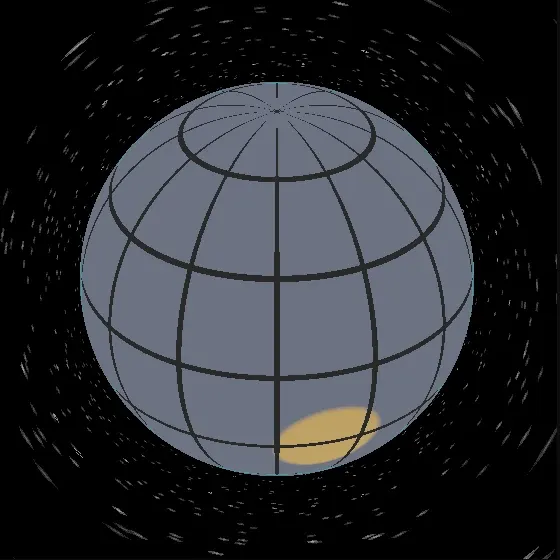
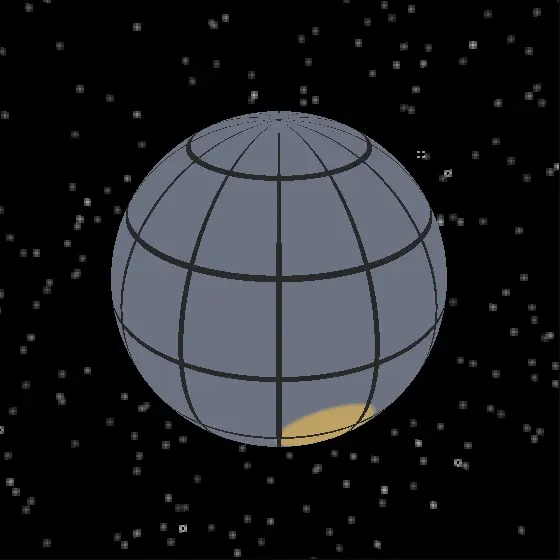
Pax Abyssi has seven real neutron stars you can fly to, from the Crab Pulsar to the magnetar SGR 1806-20. Each is a 12 km ball of million-degree surface drawn in the same light-bending pass as the game's black holes, so it looks larger than it is and shows you more than half of itself, and each is built from what the catalogues measure about that star: its spin, its slow-down, its field and its age.
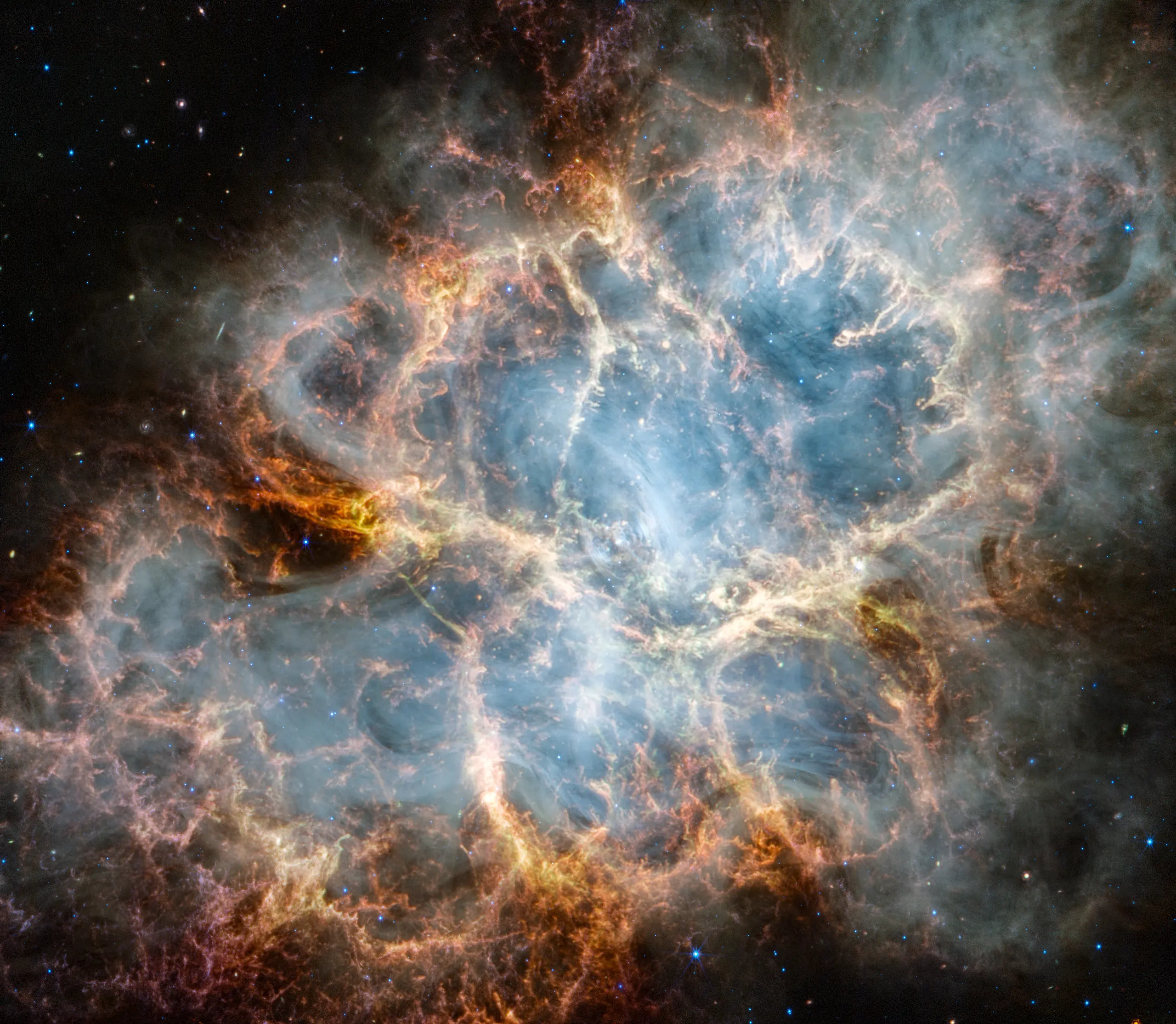 , open full size
What a neutron star is
When the iron core of a massive star exceeds what electron pressure can hold up, it collapses in under a second. Electrons are forced into protons, making neutrons, and the fall stops only when the neutrons are packed to nuclear density and resist further squeezing. The outer layers rebound and are blown off as a supernova; what remains is the neutron star.
Its numbers are hard to picture. Combining radius measurements from NASA's NICER X-ray telescope with gravitational-wave data and nuclear theory gives a radius of about 12.0 km for a star of 1.4 solar masses, with a 95 per cent range of about 11.3 to 12.6 km 2. That puts the mean density near kg/m³: a teaspoon would weigh about two billion tonnes. Surface gravity is about m/s², a hundred billion times Earth's, and the escape speed is about 60 per cent of the speed of light.
The outer kilometre or so is a solid crust of neutron-rich nuclei in a lattice; below it, nuclei dissolve into a fluid of neutrons with a few per cent of protons and electrons. What happens in the centre, at several times nuclear density, is one of the open questions of physics, and a neutron star's mass and radius are the main way to test the answers.
How heavy can one be?
Heavier neutron stars are slightly smaller, and above some maximum mass nothing can stop collapse to a Black hole. That ceiling is not yet pinned down. The pulsar PSR J0740+6620 weighs 2.08 ± 0.07 solar masses, measured from the delay its radio pulses suffer passing its companion 3. The "black widow" pulsar PSR J0952-0607, whose companion it is slowly evaporating, weighs 2.35 ± 0.17 solar masses, which places the ceiling above about 2.2 solar masses at one standard deviation 4. The combined NICER and gravitational-wave analysis predicts a maximum of about 2.1 to 2.2 solar masses, with uncertainties near 0.2 2.
Bent light
A neutron star of 1.4 solar masses and 12 km radius is only 2.9 times its own Schwarzschild radius, so gravity bends its light strongly. A distant observer sees about 76 per cent of its surface at once, and the star looks larger than it is 5. That bending is what lets NICER measure radii: the way X-rays from hot spots near the magnetic poles brighten and fade as the star turns depends on how compact it is 6 7.
Heat
A newborn neutron star is hotter than a billion kelvin inside. It cools first by emitting neutrinos from its core and later, after about 100,000 years, mainly by radiating from its surface. The Vela pulsar, about 20,000 years old, has a surface near 660,000 K; stars around a million years old are below 300,000 K 8. At these temperatures the surface glows in X-rays and ultraviolet, and what little visible light it emits is a pale blue.
Pulsars
In 1967 Jocelyn Bell, a graduate student at Cambridge working with Antony Hewish, found a radio source that pulsed every 1.34 seconds with clockwork regularity 9. It was a spinning neutron star. A neutron star's magnetic axis is usually tilted from its spin axis, and beams of radio waves stream out above the magnetic poles; each time a beam sweeps across Earth we see a pulse. The beams are radio waves, invisible to the eye.
A pulsar slows as it spins, radiating away its rotational energy through its magnetic field and a wind of particles 10. Measure the period and how fast it lengthens, , and three standard estimates follow:
the magnetic field at the equator (in gauss, with in seconds), the characteristic age, and the spin-down power, with the moment of inertia usually taken as g cm². The field estimate assumes a spinning magnet in a vacuum, and the age assumes the star was born spinning much faster than now; both are estimates.
The Crab pulsar shows how well they work. It spins every 33.39 milliseconds and slows by seconds each second 1. That gives a field of gauss, a characteristic age of about 1,260 years (the true age, from the supernova Chinese astronomers recorded in 1054, is 972 years) and a spin-down power of about erg/s, more than 100,000 times the Sun's luminosity. That power keeps the Crab Nebula glowing.
Pulsar periods span an extraordinary range. The fastest known, PSR J1748-2446ad, turns 716 times a second 11. The slowest radio pulsar confirmed as a neutron star, PSR J0901-4046, takes 76 seconds 12, and radio sources that repeat every 18 minutes or more have been found whose nature, neutron star or white dwarf, is still debated 13.
Clocks in orbit
In 1974 Russell Hulse and Joseph Taylor found a pulsar in a 7.75-hour orbit around another neutron star 14. Over four decades of timing, its orbit has shrunk exactly as general relativity predicts for a system losing energy to gravitational waves: the measured decay is 0.9983 ± 0.0016 times the prediction, and the two stars weigh 1.438 and 1.390 solar masses 15. In 2017 the LIGO and Virgo detectors caught two neutron stars merging, GW170817, the first such event seen in both gravitational waves and light 16.
Millisecond pulsars
Pulsars spinning every few milliseconds are old neutron stars "recycled" by a companion star. Gas flowing onto the neutron star carries angular momentum that spins it up to hundreds of turns a second, while its field decays to or gauss 17. The first, PSR B1937+21, was found in 1982 spinning every 1.56 ms 18. With weak fields they slow very little, so they tick for billions of years with a steadiness rivalling atomic clocks. Pulsar timing arrays watch dozens of them for tiny, correlated shifts in arrival times; in 2023 the NANOGrav collaboration reported evidence of a background of gravitational waves with periods of years, probably from pairs of supermassive black holes 19.
PSR J0437-4715, 157 parsecs away, is the nearest and brightest millisecond pulsar. NICER and radio timing give it 1.418 ± 0.037 solar masses and a radius of 11.4 km (+1.0 / -0.6 km) 20.
Magnetars
Magnetars are young neutron stars with fields of to gauss, a hundred to a thousand times those of ordinary pulsars and up to a thousand trillion times the field at Earth's surface 21. They shine mostly by the decay of that field, which stresses the crust until it cracks, and they spin slowly, once every few seconds. About thirty are known 22 23.
On 27 December 2004 the magnetar SGR 1806-20 released the brightest flash ever recorded from outside the Solar System. The discovery paper, assuming a distance of 15 kiloparsecs, calculated that in its first fifth of a second the flare emitted as much energy as the Sun radiates in a quarter of a million years 24. Later measurements put the star at about 8.7 kiloparsecs 25, which lowers that energy by a factor of three. In 2020 another magnetar, SGR 1935+2154, emitted a millisecond radio burst of the kind seen from distant galaxies as fast radio bursts, tying at least some of those bursts to magnetars 26.
X-ray pulsars
A neutron star in a close binary can pull gas from its companion. If its field is strong, the field channels the gas down onto the magnetic poles, where it lands at a good fraction of the speed of light and heats spots of the surface to tens of millions of kelvin. The X-rays pulse as the star turns. The first such accreting X-ray pulsars, Centaurus X-3 and Hercules X-1, were found by the Uhuru satellite in 1971 and 1972 27 28. When the inflow is heavy, the gas piles into a column above each pole, held up by its own radiation 29.
Absorption lines in these X-ray spectra, caused by electrons spiralling in the magnetic field, give the most direct measurement of a neutron star's field. The first, found in Hercules X-1 in 1976, implies several gauss at the pole; about 35 accreting pulsars now show such lines 30.
Quiet neutron stars
Most neutron stars in the Galaxy are old, cold and silent, their beams long faded or pointed away from us. A few isolated ones are close enough to see by the glow of their surfaces. The nearest known, RX J1856.5-3754, is 123 parsecs away 31: one of the "Magnificent Seven", slowly spinning neutron stars seen only by their thermal X-rays. Others, the central compact objects, sit as hot, faint X-ray sources inside young supernova remnants.
Notable neutron stars
| Name | Kind | Period | Field (G) | Distance | Note |
|---|---|---|---|---|---|
| Crab Pulsar (PSR B0531+21) | pulsar | 33.39 ms | 3.8e12 | 2.0 kpc | remnant of the 1054 supernova 1 |
| Vela Pulsar (PSR B0833-45) | pulsar | 89.33 ms | 3.4e12 | 280 pc | surface near 660,000 K 1 8 |
| Geminga (PSR J0633+1746) | pulsar | 237.1 ms | 1.6e12 | about 190 to 250 pc | pulses in gamma rays, radio quiet toward Earth 1 |
| RX J1856.5-3754 | thermal isolated | 7.055 s | 1.5e13 | 123 pc | nearest known 31 |
| PSR J0437-4715 | millisecond | 5.757 ms | 5.8e8 | 157 pc | 1.418 solar masses, 11.4 km 20 |
| PSR B1913+16 | binary pulsar | 59.03 ms | 2.3e10 | several kpc | first binary pulsar 15 |
| PSR J0740+6620 | millisecond | 2.89 ms | 1.14 kpc | 2.08 solar masses 3 | |
| PSR J0952-0607 | millisecond (black widow) | 1.41 ms | 6e7 | 2.35 solar masses 4 | |
| PSR J1748-2446ad | millisecond | 1.40 ms | Terzan 5 cluster | fastest known, 716 Hz 11 | |
| PSR J0901-4046 | pulsar | 76 s | slowest confirmed radio neutron star 12 | ||
| SGR 1806-20 | magnetar | 7.55 s | about 2e15 | 8.7 kpc | 2004 giant flare 23 25 |
| Hercules X-1 | accreting pulsar | 1.24 s | several e12 | about 7 kpc | 1.7-day orbit; first cyclotron line 30 |
Things we haven't modelled yet
Neutron stars are new in Pax Abyssi, and the aim is the one we hold everywhere: full scientific realism, always available as an option. Next:
- The Crab's visible pulses. The Crab is one of the few pulsars whose beams carry visible light as well as radio, two flashes every turn, found in 1969 32. From inside that beam you would see it.
- The Crab Nebula, and pulsar wind nebulae. The wind of particles a young pulsar blows out lights the nebula round it: the Crab's glowing haze, its ring and its jet, and Vela's smaller wind nebula 33.
- Tides. At 75 km from a 1.4 solar-mass star the difference in pull across a body two metres long is more than 100,000 g. Fly that close and the star will pull the ship apart.
- Fields and radiation. Above about gauss a magnetic field squeezes atoms into thin needles along the field lines 34, and a magnetar's field is a million times stronger than that. Its field and a hot surface's X-ray glare will both reach your ship.
- Each star's measured tilt. The angle between a pulsar's magnetic axis and its spin axis, from the stars where it has been measured.
See also
References
- 1Manchester, R. N. et al. (2005). The Australia Telescope National Facility Pulsar Catalogue. The Astronomical Journal 129, 1993-2006. doi:10.1086/428488
- 2Rutherford, N. and et al. (2024). Constraining the Dense Matter Equation of State with New NICER Mass-Radius Measurements and New Chiral Effective Field Theory Inputs. The Astrophysical Journal Letters 971, L19. doi:10.3847/2041-8213/ad5f02
- 3Fonseca, E. and et al. (2021). Refined Mass and Geometric Measurements of the High-mass PSR J0740+6620. The Astrophysical Journal Letters 915, L12. doi:10.3847/2041-8213/ac03b8
- 4Romani, R. W. et al. (2022). PSR J0952-0607: The Fastest and Heaviest Known Galactic Neutron Star. The Astrophysical Journal Letters 934, L17. doi:10.3847/2041-8213/ac8007
- 5Beloborodov, A. M. (2002). Gravitational Bending of Light Near Compact Objects. The Astrophysical Journal 566, L85-L88. doi:10.1086/339511
- 6Riley, T. E. and et al. (2019). A NICER View of PSR J0030+0451: Millisecond Pulsar Parameter Estimation. The Astrophysical Journal Letters 887, L21. doi:10.3847/2041-8213/ab481c
- 7Miller, M. C. and et al. (2019). PSR J0030+0451 Mass and Radius from NICER Data and Implications for the Properties of Neutron Star Matter. The Astrophysical Journal Letters 887, L24. doi:10.3847/2041-8213/ab50c5
- 8Potekhin, A. Y. et al. (2020). Thermal luminosities of cooling neutron stars. Monthly Notices of the Royal Astronomical Society 496, 5052-5071. doi:10.1093/mnras/staa1871
- 9Hewish, A. et al. (1968). Observation of a Rapidly Pulsating Radio Source. Nature 217, 709-713. doi:10.1038/217709a0
- 10Goldreich, P. and Julian, W. H. (1969). Pulsar Electrodynamics. The Astrophysical Journal 157, 869. doi:10.1086/150119
- 11Hessels, J. W. T. and et al. (2006). A Radio Pulsar Spinning at 716 Hz. Science 311, 1901-1904. doi:10.1126/science.1123430
- 12Caleb, M. and et al. (2022). Discovery of a radio-emitting neutron star with an ultra-long spin period of 76 s. Nature Astronomy 6, 828-836. doi:10.1038/s41550-022-01688-x
- 13Hurley-Walker, N. and et al. (2022). A radio transient with unusually slow periodic emission. Nature 601, 526-530. doi:10.1038/s41586-021-04272-x
- 14Hulse, R. A. and Taylor, J. H. (1975). Discovery of a pulsar in a binary system. The Astrophysical Journal 195, L51. doi:10.1086/181708
- 15Weisberg, J. M. and Huang, Y. (2016). Relativistic Measurements from Timing the Binary Pulsar PSR B1913+16. The Astrophysical Journal 829, 55. doi:10.3847/0004-637X/829/1/55
- 16Abbott, B. P. and et al. (LIGO Scientific Collaboration and Virgo Collaboration) (2017). GW170817: Observation of Gravitational Waves from a Binary Neutron Star Inspiral. Physical Review Letters 119, 161101. doi:10.1103/PhysRevLett.119.161101
- 17Alpar, M. A. et al. (1982). A new class of radio pulsars. Nature 300, 728-730. doi:10.1038/300728a0
- 18Backer, D. C. et al. (1982). A millisecond pulsar. Nature 300, 615-618. doi:10.1038/300615a0
- 19Agazie, G. and et al. (NANOGrav Collaboration) (2023). The NANOGrav 15 yr Data Set: Evidence for a Gravitational-wave Background. The Astrophysical Journal Letters 951, L8. doi:10.3847/2041-8213/acdac6
- 20Choudhury, D. and et al. (2024). A NICER View of the Nearest and Brightest Millisecond Pulsar: PSR J0437-4715. The Astrophysical Journal Letters 971, L20. doi:10.3847/2041-8213/ad5a6f
- 21Duncan, R. C. and Thompson, C. (1992). Formation of very strongly magnetized neutron stars: Implications for gamma-ray bursts. The Astrophysical Journal 392, L9. doi:10.1086/186413
- 22Kaspi, V. M. and Beloborodov, A. M. (2017). Magnetars. Annual Review of Astronomy and Astrophysics 55, 261-301. doi:10.1146/annurev-astro-081915-023329
- 23Olausen, S. A. and Kaspi, V. M. (2014). The McGill Magnetar Catalog. The Astrophysical Journal Supplement Series 212, 6. doi:10.1088/0067-0049/212/1/6
- 24Hurley, K. and et al. (2005). An exceptionally bright flare from SGR 1806-20 and the origins of short-duration gamma-ray bursts. Nature 434, 1098-1103. doi:10.1038/nature03519
- 25Bibby, J. L. et al. (2008). A downward revision to the distance of the 1806-20 cluster and associated magnetar from Gemini Near-Infrared Spectroscopy. Monthly Notices of the Royal Astronomical Society Letters 386, L23-L27. doi:10.1111/j.1745-3933.2008.00453.x
- 26CHIME/FRB Collaboration (2020). A bright millisecond-duration radio burst from a Galactic magnetar. Nature 587, 54-58. doi:10.1038/s41586-020-2863-y
- 27Giacconi, R. and et al. (1971). Discovery of Periodic X-Ray Pulsations in Centaurus X-3 from UHURU. The Astrophysical Journal 167, L67. doi:10.1086/180762
- 28Tananbaum, H. and et al. (1972). Discovery of a Periodic Pulsating Binary X-Ray Source in Hercules from UHURU. The Astrophysical Journal 174, L143. doi:10.1086/180968
- 29Basko, M. M. and Sunyaev, R. A. (1976). The Limiting Luminosity of Accreting Neutron Stars With Magnetic Fields. Monthly Notices of the Royal Astronomical Society 175, 395-417. doi:10.1093/mnras/175.2.395
- 30Staubert, R. and et al. (2019). Cyclotron lines in highly magnetized neutron stars. Astronomy & Astrophysics 622, A61. doi:10.1051/0004-6361/201834479
- 31Walter, F. M. and et al. (2010). Revisiting the Parallax of the Isolated Neutron Star RX J185635-3754 Using HST/ACS Imaging. The Astrophysical Journal 724, 669-677. doi:10.1088/0004-637X/724/1/669
- 32Cocke, W. J., Disney, M. J. and Taylor, D. J. (1969). Discovery of Optical Signals from Pulsar NP 0532. Nature 221, 525-527. doi:10.1038/221525a0
- 33Hester, J. J. (2008). The Crab Nebula: An Astrophysical Chimera. Annual Review of Astronomy and Astrophysics 46, 127-155. doi:10.1146/annurev.astro.45.051806.110608
- 34Lai, D. (2001). Matter in strong magnetic fields. Reviews of Modern Physics 73, 629-662. doi:10.1103/RevModPhys.73.629