- On this page
- 3
- figures
- 2
- panels
- 18
- references
Redirected from SgrA*
Black hole
Sagittarius A*
ContentsShow
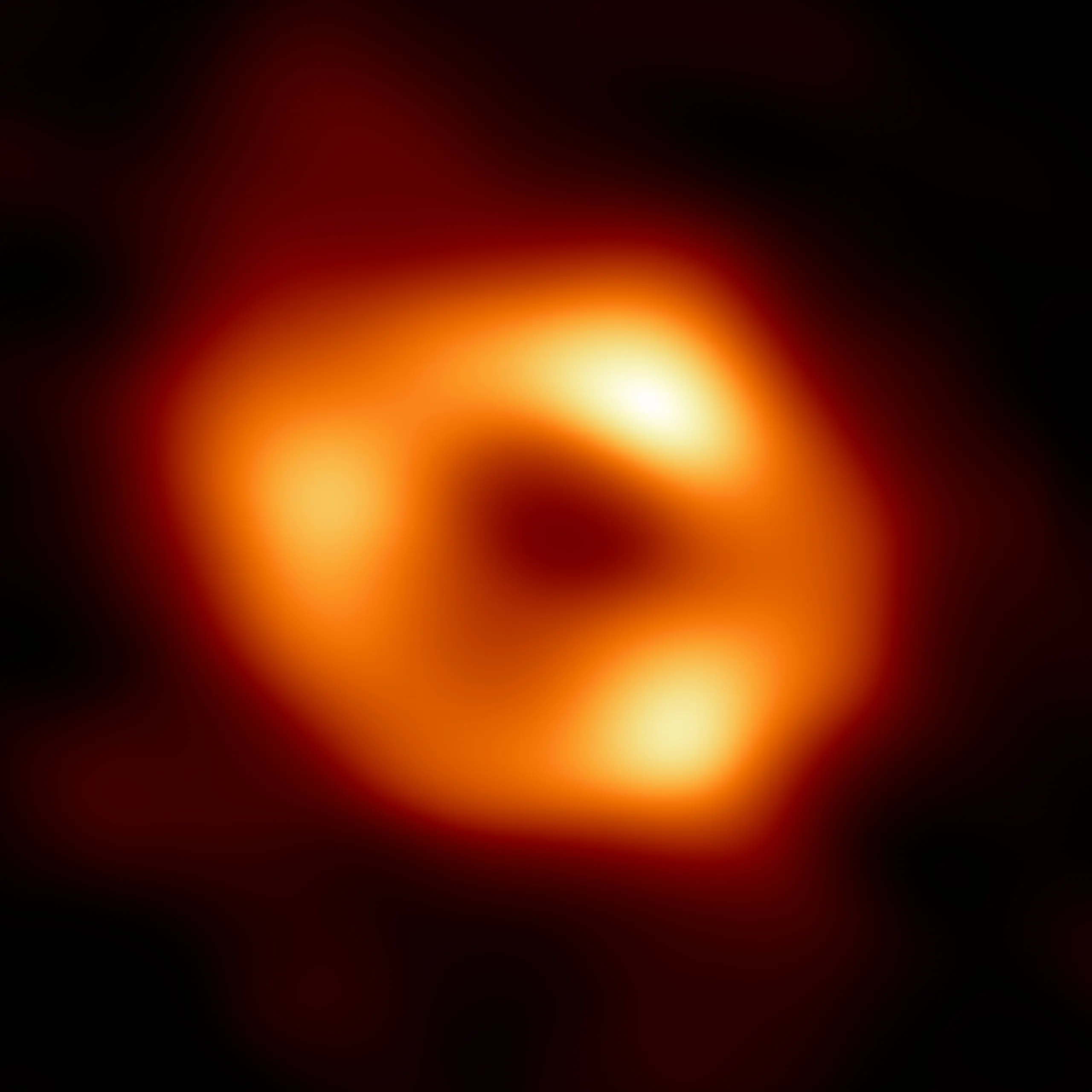
Sagittarius A*, usually written Sgr A*, is the supermassive black hole at the centre of the Milky Way. It holds about 4.3 million times the mass of the Sun in a region smaller than the orbit of Mercury, and it lies about 8.3 kiloparsecs (27,000 light years) away in the direction of the constellation Sagittarius. It is the nearest supermassive black hole to Earth, which makes it the one astronomers can study in the most detail: its mass is known to better than one per cent from the orbits of individual stars, and in 2022 it became the second black hole ever imaged 1 2.
In Pax Abyssi, Sagittarius A* is a place you can fly to. The game draws it as the science says it would look from close by: a black shadow about ten degrees across, with no bright disk, because the real hole has almost nothing to eat, hung in the densest star field in the Galaxy, whose light the hole bends round its edge. The star S2 swings round it on its measured 16-year orbit.
 , open full size
Discovery
In 1974 Bruce Balick and Robert Brown used a radio interferometer in West Virginia to find a bright, extremely compact radio source at the dynamical centre of the Galaxy 3. It is the object now called Sgr A*. A compact radio source alone did not prove a black hole: dust in the Galactic plane dims visible light from the centre by a factor of about a trillion, so nobody could see what surrounded it 4.
The proof came from infrared light, which passes through the dust. From the early 1990s two teams, one led by Reinhard Genzel in Germany and one by Andrea Ghez in the United States, tracked the stars closest to Sgr A* year after year, using adaptive optics to undo the blurring of Earth's atmosphere. Their stars move on tight Keplerian orbits around an invisible point 5 6. The two leaders shared half of the 2020 Nobel Prize in Physics "for the discovery of a supermassive compact object at the centre of our galaxy" 7.
Weighing a black hole with a star
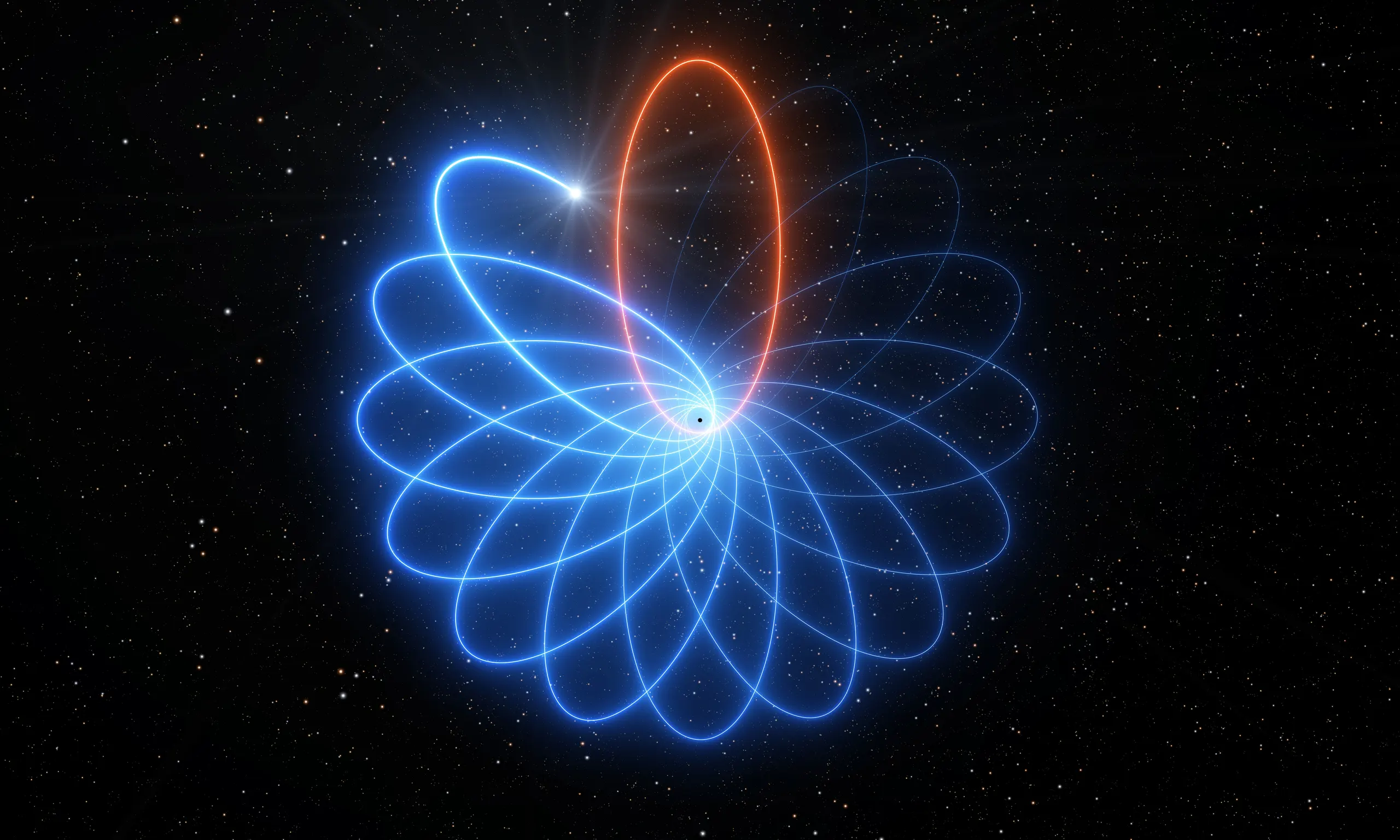
The star S2 is the best clock around Sgr A*. It is a young B-type star of about 14 solar masses 8 that circles the black hole every 16.05 years on an orbit with eccentricity 0.88. At its closest, in May 2018, it passed 120 AU from the hole, about 1,400 Schwarzschild radii, moving at about 7,650 km/s, or 2.5 per cent of the speed of light 9.
That orbit is enough to weigh the hole. Kepler's third law, written in solar-system units, says that the total mass in solar masses equals the cube of the semi-major axis in astronomical units divided by the square of the period in years:
Fitting the orbits of S2 and three other stars measured with the GRAVITY instrument, which combines the four 8-metre telescopes of ESO's Very Large Telescope, gives solar masses with a statistical uncertainty of about 0.3 per cent, and a distance of parsecs 1. Any extra matter spread through S2's orbit, such as a cloud of faint stars or dark matter, can add at most about 1,200 solar masses 10. Nothing but a black hole can pack so much mass into so small a space for long.
General relativity in the orbit of a star
S2 is also a test of Einstein's theory. Near pericentre its light is shifted to the red by about 200 km/s more than Newton's gravity predicts, the combined effect of the hole's gravitational redshift and the star's time dilation, exactly as general relativity requires 9. Its orbit also turns slowly in its own plane. General relativity predicts a periapsis shift per orbit of
which for S2 is about 12 arcminutes per orbit. GRAVITY measured it in 2020 11. For comparison, the same formula gives Mercury's famous relativistic precession of 43 arcseconds per century, about a tenth of an arcsecond per Mercury orbit: S2's orbit swings about seven thousand times further each lap.
The image of the shadow
A black hole of this mass has a Schwarzschild radius of about 12.7 million km (0.085 AU, some 18 times the Sun's radius). General relativity predicts that its shadow, seen from Earth, spans about 53 microarcseconds. That is the width of a 10 cm doughnut lying on the Moon, seen from Earth.
The Event Horizon Telescope reached that resolution by linking eight radio telescopes at six sites, from Hawaii to the South Pole, observing at a wavelength of 1.3 mm in April 2017. The team found a bright, thick ring 51.8 ± 2.3 microarcseconds across around a dimmer centre 2. The ring's size matches the prediction for a Kerr black hole of the mass measured from the stars to within about 10 per cent, and a star-like object with a hot surface is ruled out 12. The image took five years longer than that of M87* partly because Sgr A* changes within the hour: gas near its inner edge orbits in about half an hour, while the matching timescale for M87*, 1,500 times heavier, is weeks.
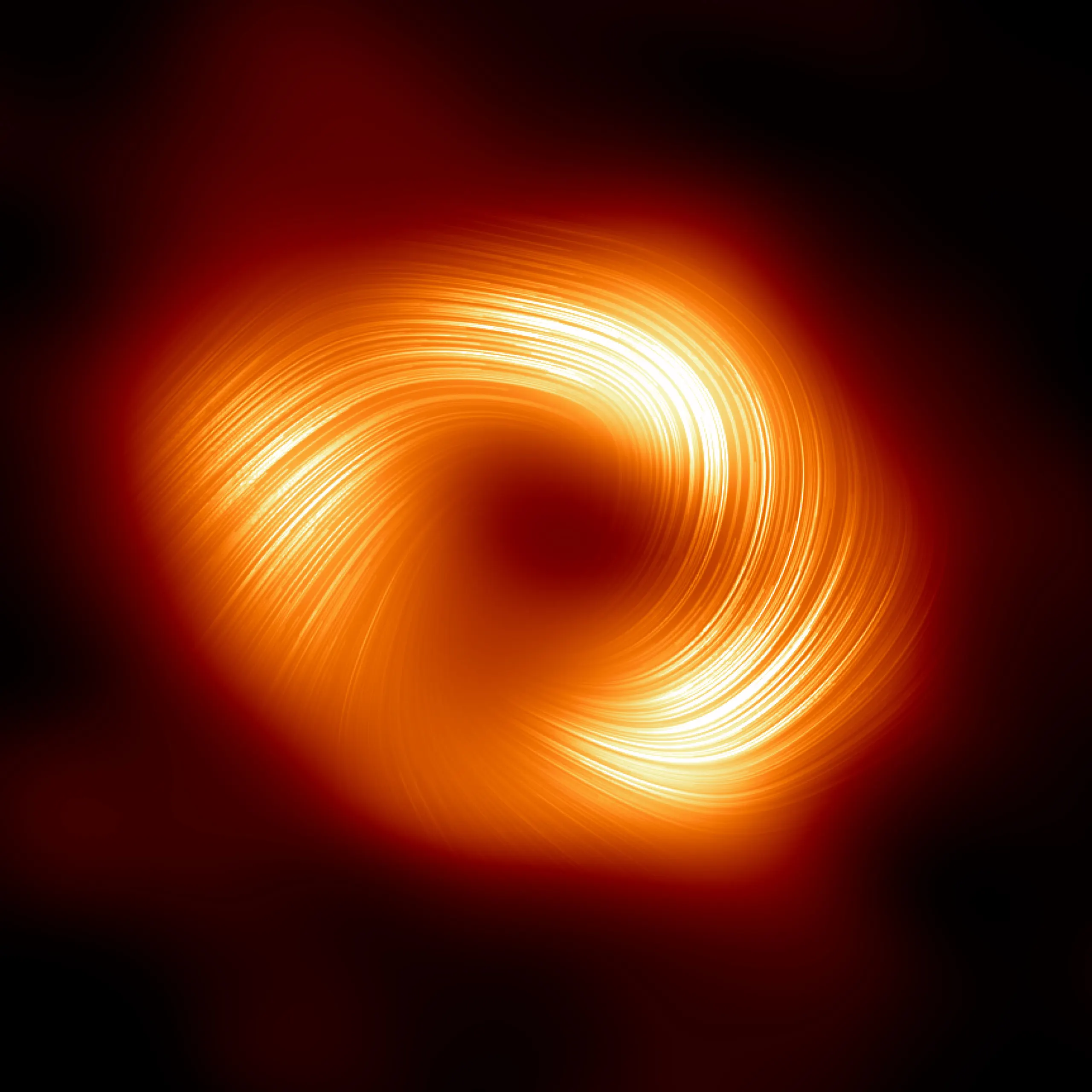
In 2024 the collaboration published the ring in polarised light. It is strongly polarised, up to about 40 per cent, in a spiral pattern that traces an ordered magnetic field threading the hot gas 13.
 , open full size
What the image says about spin
Sgr A*'s spin is not measured. The collaboration compared its images and light curves with a large library of computer simulations. Models of a non-spinning hole, of gas orbiting against the hole's spin, and of a hole seen at more than about 50 degrees from its axis all fit poorly 2. The most promising cluster of models has a strongly magnetised flow seen within 30 degrees of face-on, but every model fails at least one of the eleven tests, most often the observed variability 14. Any single spin value quoted for Sgr A* is a model preference.
A starving black hole
Sgr A* is astonishingly faint for its size. The favoured models have it swallowing about 5 to 10 billionths of a solar mass a year, one Moon's worth of gas every four to seven years, and shining at under erg/s, about 200 times the Sun's output 14. Measurements of how the polarised radio light is twisted on its way out limit the inflow near the hole to between about and solar masses a year 15. That is a billion times below the Eddington limit, the brightness at which radiation pressure would halt the inflow. The gas forms a hot, tenuous, puffed-up flow that radiates mainly in radio and submillimetre waves. No jet has been confirmed.
It is not quiet. X-ray flares, in which the source brightens by tens of times within an hour, were discovered in 2000 and recur often 16. In the near infrared, GRAVITY has watched flares whose light moves in a loop on the sky with a period of about 45 minutes, as a hot spot orbiting at six to ten gravitational radii, just outside the innermost stable orbit, would 17.
Neighbourhood
Sgr A* sits at the heart of the Galaxy's nuclear star cluster, the densest stellar system in the Milky Way, with millions of stars within a few parsecs. The S-stars, S2 among them, crowd within a few hundredths of a parsec; a disk of young, massive stars circles further out; streamers of ionised gas called the minispiral fall towards the centre, and a ring of molecular gas lies beyond, a few parsecs from the hole 4.
A Sun-like star that strayed too close would be torn apart. For Sgr A* the tidal disruption radius, , is about 160 solar radii or 0.76 AU, nine times the Schwarzschild radius, so the star would be shredded well outside the horizon and part of its gas would light up as a flare lasting months 18. No such event has been seen from Sgr A*.
 , open full size
Things we haven't modelled yet
Our aim at the centre of the Galaxy is the same as everywhere: full scientific realism, always available as an option. Next:
- The flares. Sagittarius A* brightens tens of times in X-rays within an hour 16, and in the near infrared a hot spot circles it about every 45 minutes 17. We want you to watch one go round.
- The S-stars in motion. S2 and its neighbours swinging round the hole on their measured orbits, S2 passing within 120 AU of it every 16 years 9.
- The glow of the hot flow, the faint ring the Event Horizon Telescope saw, as an option for eyes that see beyond visible light.
- Stars torn apart. A star strayed inside 0.76 AU, shredded, and the months-long flare that follows 18.
See also
References
- 1GRAVITY Collaboration (2022). Mass distribution in the Galactic Center based on interferometric astrometry of multiple stellar orbits. Astronomy & Astrophysics 657, L12. doi:10.1051/0004-6361/202142465
- 2Event Horizon Telescope Collaboration (2022). First Sagittarius A* Event Horizon Telescope Results. I. The Shadow of the Supermassive Black Hole in the Center of the Milky Way. The Astrophysical Journal Letters 930, L12. doi:10.3847/2041-8213/ac6674
- 3Balick, B. and Brown, R. L. (1974). Intense sub-arcsecond structure in the galactic center. The Astrophysical Journal 194, 265. doi:10.1086/153242
- 4Genzel, R., Eisenhauer, F. and Gillessen, S. (2010). The Galactic Center massive black hole and nuclear star cluster. Reviews of Modern Physics 82, 3121-3195. doi:10.1103/RevModPhys.82.3121
- 5Schödel, R. and et al. (2002). A star in a 15.2-year orbit around the supermassive black hole at the centre of the Milky Way. Nature 419, 694-696. doi:10.1038/nature01121
- 6Ghez, A. M. and et al. (2008). Measuring Distance and Properties of the Milky Way's Central Supermassive Black Hole with Stellar Orbits. The Astrophysical Journal 689, 1044-1062. doi:10.1086/592738
- 7Nobel Prize Outreach (2020). The Nobel Prize in Physics 2020: summary. NobelPrize.org. www.nobelprize.org/prizes/physics/2020/summary/
- 8Habibi, M. and et al. (2017). Twelve Years of Spectroscopic Monitoring in the Galactic Center: The Closest Look at S-stars near the Black Hole. The Astrophysical Journal 847, 120. doi:10.3847/1538-4357/aa876f
- 9GRAVITY Collaboration (2018). Detection of the gravitational redshift in the orbit of the star S2 near the Galactic centre massive black hole. Astronomy & Astrophysics 615, L15. doi:10.1051/0004-6361/201833718
- 10GRAVITY Collaboration (2024). Improving constraints on the extended mass distribution in the Galactic Center with stellar orbits. Astronomy & Astrophysics 692, A242. doi:10.1051/0004-6361/202452274
- 11GRAVITY Collaboration (2020). Detection of the Schwarzschild precession in the orbit of the star S2 near the Galactic centre massive black hole. Astronomy & Astrophysics 636, L5. doi:10.1051/0004-6361/202037813
- 12Event Horizon Telescope Collaboration (2022). First Sagittarius A* Event Horizon Telescope Results. VI. Testing the Black Hole Metric. The Astrophysical Journal Letters 930, L17. doi:10.3847/2041-8213/ac6756
- 13Event Horizon Telescope Collaboration (2024). First Sagittarius A* Event Horizon Telescope Results. VII. Polarization of the Ring. The Astrophysical Journal Letters 964, L25. doi:10.3847/2041-8213/ad2df0
- 14Event Horizon Telescope Collaboration (2022). First Sagittarius A* Event Horizon Telescope Results. V. Testing Astrophysical Models of the Galactic Center Black Hole. The Astrophysical Journal Letters 930, L16. doi:10.3847/2041-8213/ac6672
- 15Marrone, D. P. et al. (2007). An Unambiguous Detection of Faraday Rotation in Sagittarius A*. The Astrophysical Journal 654, L57-L60. doi:10.1086/510850
- 16Baganoff, F. K. and et al. (2001). Rapid X-ray flaring from the direction of the supermassive black hole at the Galactic Centre. Nature 413, 45-48. doi:10.1038/35092510
- 17GRAVITY Collaboration (2018). Detection of orbital motions near the last stable circular orbit of the massive black hole SgrA*. Astronomy & Astrophysics 618, L10. doi:10.1051/0004-6361/201834294
- 18Rees, M. J. (1988). Tidal disruption of stars by black holes of 10^6-10^8 solar masses in nearby galaxies. Nature 333, 523-528. doi:10.1038/333523a0