- On this page
- 3
- figures
- 1
- table
- 31
- references
Redirected from Supergiant star
Star class · BSP, BWP, WSP, YWP, YSP, OGP, RSP (blue to red supergiants), with hypergiant classes above them
Supergiant
ContentsShow
A supergiant is a massive star in a late stage of its life, so luminous that it is given its own luminosity class, I, in the MK system of stellar classification. Supergiants are born with at least about eight times the Sun's mass and shine with tens of thousands to hundreds of thousands of times its light. They span every spectral type: blue supergiants such as Rigel are hot and compact for their class, while red supergiants such as Betelgeuse and Antares are cool, swollen to hundreds or more than a thousand times the Sun's radius, and among the largest stars known. Their lives are short, a few million to a few tens of millions of years, and most end in core-collapse supernovae.
Characteristics
Classes and colours
Supergiants are graded Ia (luminous), Iab and Ib (less luminous); the most extreme, with luminosity class 0 or Ia+, are hypergiants, such as the yellow hypergiants that lie near the upper edge of stellar brightness 1. By temperature they run from blue (O and B types, above about 10,000 K) through white and yellow (A, F and G) to red (K and M, down to about 3,400 K). The spread is mostly one of size: a massive star keeps roughly the same luminosity as it moves across the Hertzsprung-Russell diagram after leaving the main sequence, so as its surface cools from blue to red its radius must grow by tens of times to radiate the same energy.
How bright a star can be
There is an upper boundary to the luminosity of cool supergiants. Humphreys and Davidson found in 1979 that stars cooler than about 15,000 K do not exceed a bolometric absolute magnitude of about -9.5 to -10, about 500,000 to 800,000 times the Sun's luminosity, and attributed the limit to mass loss that strips the most massive stars before they can become red supergiants 2. A modern census of the Magellanic Clouds places the limit for cool supergiants lower, at about 320,000 solar luminosities 3.
Winds, cells and pulsations
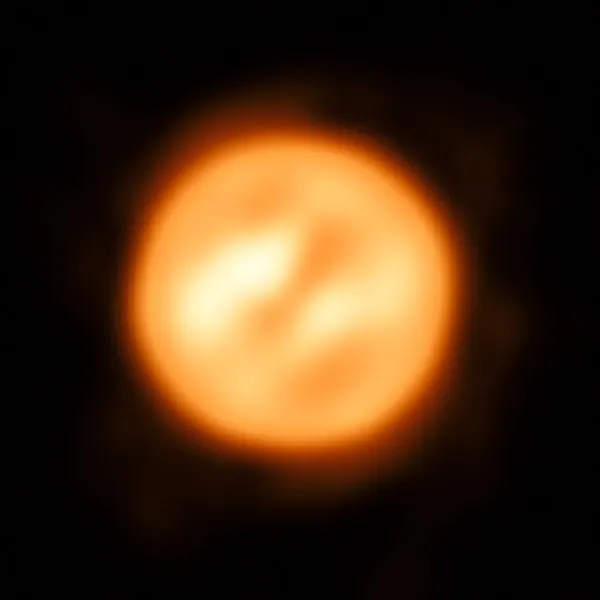
Red supergiants lose mass rapidly in slow, dusty winds, and their surfaces are dominated by a few enormous convection cells. Interferometric maps of Antares show turbulent gas rising and falling at up to 20 km/s in an atmosphere extending to about 1.7 times the star's radius 4. Betelgeuse pulsates with a period of about 400 days 5. Blue supergiants drive fast winds with the pressure of their own light.
Betelgeuse
Betelgeuse, the red supergiant at the shoulder of Orion, is the best-studied example. Combining its evolution, pulsations and hydrodynamics, Joyce et al. (2020) estimated a present mass of 16.5 to 19 solar masses, a radius of 764 solar radii and a distance of 168 parsecs (548 light years) 5; other methods give distances up to about 220 parsecs 6, so its true size and luminosity remain uncertain by tens of per cent. It is burning helium in its core and is expected to explode as a supernova, probably not for about a hundred thousand years 5.
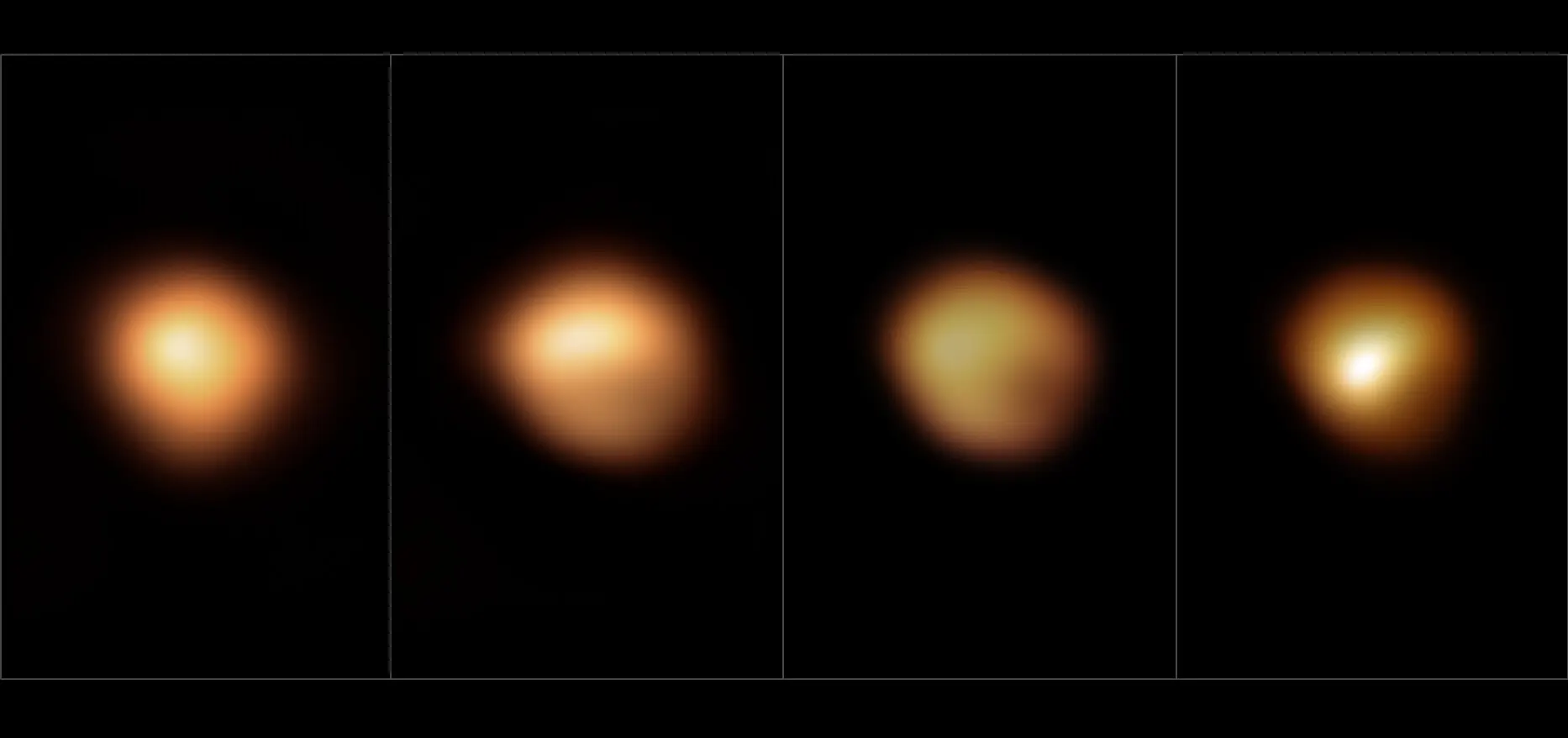
Between late 2019 and early 2020 Betelgeuse faded by more than a magnitude, its Great Dimming. Images from the Very Large Telescope showed the southern half of the star darkened about tenfold, explained by a cloud of dust that formed over a cooler patch of the surface 6; the star's temperature fell too little to explain the fading on its own 7. Ultraviolet and optical spectra point to a large surface mass ejection as the cause, after which the star's 400-day pulsation disappeared for more than two years 8.
 , open full size
A companion
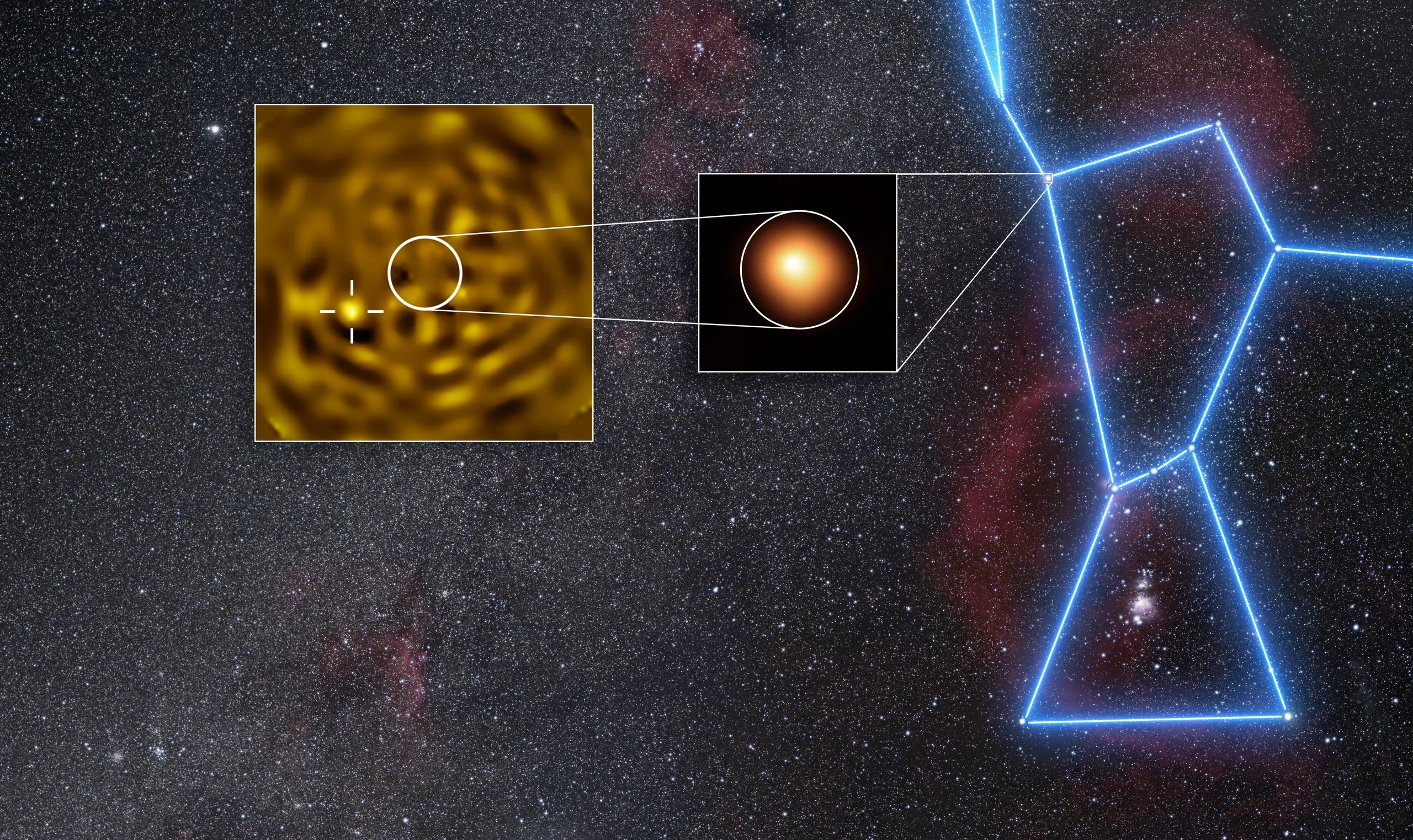
Betelgeuse also brightens and fades on a long secondary period of about 2,100 days. In 2024 and 2025 two teams argued that this is caused by a companion star orbiting just outside the supergiant, of about one solar mass or less 9 10. A speckle-imaging search with the Gemini North telescope then reported a probable detection, 52 milliarcseconds from Betelgeuse and about six magnitudes fainter in blue light 11, and the companion has been given the name Siwarha by the International Astronomical Union 12. The Hubble Space Telescope saw no ultraviolet light from it, which rules out certain kinds of companion 13. On 28 July 2026 ESO announced the strongest evidence yet: images from the VLT's SPHERE instrument taken on 6 December 2024 show a source at a separation of 52.3 milliarcseconds, detected at more than six standard deviations 14 15. If it is a young star of the same age as Betelgeuse, its brightness implies 2.6 to 3.1 solar masses, above the dynamical estimates, and the authors describe it as a candidate whose confirmation awaits a second epoch of observation 15.
 , open full size
Other notable supergiants
| Star | Type | Distance | Notes |
|---|---|---|---|
| Betelgeuse | M1-M2Ia-Iab | 168 to 220 pc | 764 solar radii, 16.5 to 19 solar masses; candidate companion 5 15 |
| Antares | M1.5Iab | about 170 pc | 680 solar radii (3.2 AU), 3,660 K 16 |
| Rigel | B8Ia | about 260 pc | About 120,000 solar luminosities; a nearby future supernova 17 18 |
| Deneb | A2Ia | uncertain | 8,525 K; about 200,000 solar luminosities if at the larger distance estimates 19 |
| Polaris | F8Ib | Pole Star; a pulsating Cepheid of 5.1 solar masses in a 30-year binary orbit 20 | |
| VY Canis Majoris | M5Iae | 1.2 kpc | About 1,420 solar radii, among the largest stars known 21 22 |
| WOH G64 | red supergiant (LMC) | 50 kpc | First close-up image of a star in another galaxy 23 |
WOH G64, in the Large Magellanic Cloud, shows how fast a supergiant can change. After the VLT Interferometer produced the first close-up image of a star outside the Milky Way in 2024 23, one team reported that its spectrum had changed between 2013 and 2014 from a red supergiant's to that of a hotter yellow hypergiant 24, while another found titanium oxide bands, the signature of a red supergiant, at every epoch from late 2024 to 2025 and argued that it may never have stopped being one 25. The question is open.
The end of a supergiant
Stars above about eight solar masses end with a collapsing iron core. Red supergiants are the progenitors of the commonest core-collapse supernovae, Type II-P; blue and yellow supergiants and stripped stars make other kinds; and the most massive may collapse to black holes, with or without an explosion 26. Archival images of exploded stars show that the progenitors of Type II-P supernovae range from about 8.5 to 16.5 solar masses, while red supergiants exist up to about 25: the red supergiant problem 27. One explanation is that the heaviest red supergiants collapse to black holes without a visible supernova 28. Others argue that the gap is not statistically significant once the uncertainties in progenitor brightness are included 29 30. The first supernova progenitor found with JWST, the star that became SN 2025pht in the galaxy NGC 1637, was a red supergiant of about 100,000 solar luminosities wrapped in carbon-rich dust 31.
 , open full size
In Pax Abyssi
Pax Abyssi assigns a star to a supergiant class whenever its catalogue spectral type carries luminosity class I, and names the class by the colour of its spectral letter, from blue (O) through blue-white, white, yellow-white, yellow and orange to red (M) supergiants, with hypergiant classes above them. The game's catalogue holds about 5,000 real supergiants of every spectral type, K supergiants the largest group, and the galaxy map marks ten stars as hypergiants. Well-studied supergiants carry measured values in place of estimates from their colours: Betelgeuse is drawn at 764 solar radii, 3,600 K and 168 parsecs 5, and Antares at 680 solar radii 16. Betelgeuse, Antares, Rigel, Deneb, Polaris and the Garnet Star are all systems you can fly to. Every star's record holds the remnant it will leave: stars of 8 to 25 solar masses end as neutron stars, and heavier ones as black holes.
Up close, a supergiant carries the surface of a giant of the same colour, with fewer and bigger convection cells and stronger contrast. A red supergiant shows only a handful of cells across its whole disc, as Betelgeuse and Antares do, with the softest limb and the widest glow of any star, and it breathes with its own variability.
See also
References
- 1de Jager, C. (1998). The yellow hypergiants. Astronomy and Astrophysics Review 8, 145-180. doi:10.1007/s001590050009
- 2Humphreys, R. M. and Davidson, K. (1979). Studies of luminous stars in nearby galaxies. III. Comments on the evolution of the most massive stars in the Milky Way and the Large Magellanic Cloud. The Astrophysical Journal 232, 409. doi:10.1086/157301
- 3Davies, B., Crowther, P. A. and Beasor, E. R. (2018). The luminosities of cool supergiants in the Magellanic Clouds, and the Humphreys-Davidson limit revisited. Monthly Notices of the Royal Astronomical Society 478, 3138-3148. doi:10.1093/mnras/sty1302
- 4Ohnaka, K., Weigelt, G. and Hofmann, K. H. (2017). Vigorous atmospheric motion in the red supergiant star Antares. Nature 548, 310-312. doi:10.1038/nature23445
- 5Joyce, M. et al. (2020). Standing on the Shoulders of Giants: New Mass and Distance Estimates for Betelgeuse through Combined Evolutionary, Asteroseismic, and Hydrodynamic Simulations with MESA. The Astrophysical Journal 902, 63. doi:10.3847/1538-4357/abb8db
- 6Montargès, M. et al. (2021). A dusty veil shading Betelgeuse during its Great Dimming. Nature 594, 365-368. doi:10.1038/s41586-021-03546-8
- 7Levesque, E. M. and Massey, P. (2020). Betelgeuse Just Is Not That Cool: Effective Temperature Alone Cannot Explain the Recent Dimming of Betelgeuse. The Astrophysical Journal Letters 891, L37. doi:10.3847/2041-8213/ab7935
- 8Dupree, A. K. et al. (2022). The Great Dimming of Betelgeuse: A Surface Mass Ejection and Its Consequences. The Astrophysical Journal 936, 18. doi:10.3847/1538-4357/ac7853
- 9Goldberg, J. A., Joyce, M. and Molnár, L. (2024). A Buddy for Betelgeuse: Binarity as the Origin of the Long Secondary Period in alpha Orionis. The Astrophysical Journal 977, 35. doi:10.3847/1538-4357/ad87f4
- 10MacLeod, M. et al. (2025). Radial Velocity and Astrometric Evidence for a Close Companion to Betelgeuse. The Astrophysical Journal 978, 50. doi:10.3847/1538-4357/ad93c8
- 11Howell, S. B. et al. (2025). The Probable Direct-imaging Detection of the Stellar Companion to Betelgeuse. The Astrophysical Journal Letters 988, L47. doi:10.3847/2041-8213/adeaaf
- 12IAU Working Group on Star Names. IAU Catalog of Star Names (Siwarha, alpha Orionis B, approved 2025-09-22). exopla.net/star-names/modern-iau-star-names/
- 13Goldberg, J. A. et al. (2025). Betelgeuse, Betelgeuse, Betelgeuse, Betel-buddy? Constraints on the Dynamical Companion to alpha Orionis from HST. The Astrophysical Journal 994, 101. doi:10.3847/1538-4357/ae0c0c
- 14ESO (2026). Astronomers find strongest evidence yet that Betelgeuse has a companion (press release eso2611). www.eso.org/public/news/eso2611/
- 15Montargès, M. et al. (2026). VLT/SPHERE images of the candidate companion of Betelgeuse. Astronomy & Astrophysics 711, L12. doi:10.1051/0004-6361/202661023
- 16Ohnaka, K. et al. (2013). High spectral resolution imaging of the dynamical atmosphere of the red supergiant Antares in the CO first overtone lines with VLTI/AMBER. Astronomy & Astrophysics 555, A24. doi:10.1051/0004-6361/201321063
- 17de Almeida, E. S. G. et al. (2022). Combined spectroscopy and intensity interferometry to determine the distances of the blue supergiants P Cygni and Rigel. Monthly Notices of the Royal Astronomical Society 515, 1-12. doi:10.1093/mnras/stac1617
- 18Moravveji, E. et al. (2012). Asteroseismology of the Nearby SN-II Progenitor: Rigel. I. The MOST High-precision Photometry and Radial Velocity Monitoring. The Astrophysical Journal 747, 108. doi:10.1088/0004-637X/747/2/108
- 19Schiller, F. and Przybilla, N. (2008). Quantitative spectroscopy of Deneb. Astronomy & Astrophysics 479, 849-858. doi:10.1051/0004-6361:20078590
- 20Evans, N. R. et al. (2024). The Orbit and Dynamical Mass of Polaris: Observations with the CHARA Array. The Astrophysical Journal 971, 190. doi:10.3847/1538-4357/ad5e7a
- 21Wittkowski, M. et al. (2012). Fundamental properties and atmospheric structure of the red supergiant VY Canis Majoris based on VLTI/AMBER spectro-interferometry. Astronomy & Astrophysics 540, L12. doi:10.1051/0004-6361/201219126
- 22Zhang, B. et al. (2012). Distance and Kinematics of the Red Hypergiant VY CMa: Very Long Baseline Array and Very Large Array Astrometry. The Astrophysical Journal 744, 23. doi:10.1088/0004-637X/744/1/23
- 23Ohnaka, K. et al. (2024). Imaging the innermost circumstellar environment of the red supergiant WOH G64 in the Large Magellanic Cloud. Astronomy & Astrophysics 691, L15. doi:10.1051/0004-6361/202451820
- 24Muñoz-Sanchez, G. et al. (2026). The dramatic transition of the extreme red supergiant WOH G64 to a yellow hypergiant. Nature Astronomy 10, 702-713. doi:10.1038/s41550-026-02789-7
- 25van Loon, J. T. and Ohnaka, K. (2026). A phoenix rises from the ashes: WOH G64 is still a red supergiant, for now. Monthly Notices of the Royal Astronomical Society 546, stag012. doi:10.1093/mnras/stag012
- 26Heger, A. et al. (2003). How Massive Single Stars End Their Life. The Astrophysical Journal 591, 288-300. doi:10.1086/375341
- 27Smartt, S. J. et al. (2009). The death of massive stars. I. Observational constraints on the progenitors of Type II-P supernovae. Monthly Notices of the Royal Astronomical Society 395, 1409-1437. doi:10.1111/j.1365-2966.2009.14506.x
- 28Smartt, S. J. (2015). Observational Constraints on the Progenitors of Core-Collapse Supernovae: The Case for Missing High-Mass Stars. Publications of the Astronomical Society of Australia 32, e016. doi:10.1017/pasa.2015.17
- 29Davies, B. and Beasor, E. R. (2020). The 'red supergiant problem': the upper luminosity boundary of Type II supernova progenitors. Monthly Notices of the Royal Astronomical Society 493, 468-476. doi:10.1093/mnras/staa174
- 30Beasor, E. R., Smith, N. and Jencson, J. E. (2025). The Red Supergiant Progenitor Luminosity Problem. The Astrophysical Journal 979, 117. doi:10.3847/1538-4357/ad8f3f
- 31Kilpatrick, C. D. et al. (2025). The Type II SN 2025pht in NGC 1637: A Red Supergiant with Carbon-rich Circumstellar Dust as the First JWST Detection of a Supernova Progenitor Star. The Astrophysical Journal Letters 992, L10. doi:10.3847/2041-8213/ae04de