- On this page
- 1
- figure
- 1
- table
- 1
- panel
- 18
- references
Planet class · TAW · T1-A
Arid world
ContentsShow
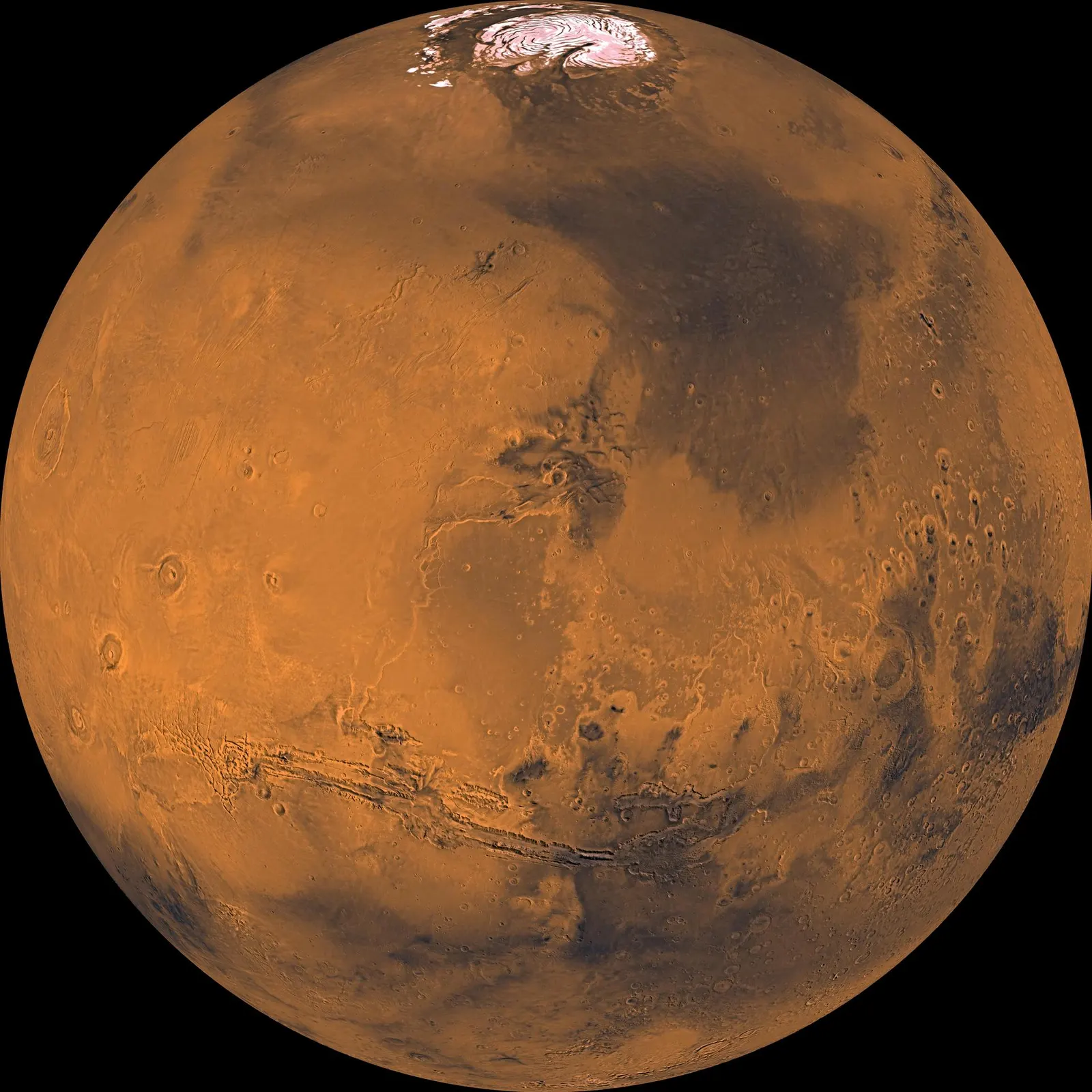
An arid world is a rocky planet with a thin, cold atmosphere and no stable liquid water on its surface. Water may survive as ice at the poles or underground, and the surface may still carry the marks of rivers and lakes from a wetter past, but today any liquid would freeze or boil away. Mars is the Solar System's example and the model for the class: a planet that began with water and a thicker atmosphere and lost most of both. Its history shows how a potentially habitable planet can stop being one.
Characteristics
Thin air and the triple point
Mars's atmosphere is 95 per cent carbon dioxide, with a mean surface pressure of about 6.4 millibars, less than 1 per cent of Earth's; the pressure swings by about a third over the year as carbon dioxide freezes onto the winter pole and returns in spring 1. That number sits close to the triple point of water, 6.1 millibars and 273 K, the only pressure and temperature at which ice, liquid water and vapour can coexist. Below it, ice warmed in sunlight turns straight to vapour. Only in the deepest basins, where the pressure is a little higher, can pure liquid water exist at all, and there only in a narrow range of temperature before it boils. Salty brines, which freeze at lower temperatures, can do slightly better.
The thin air holds little heat. Mars's equilibrium temperature is about 210 K, and its average surface temperature, about 214 K, is only a few degrees warmer, because the greenhouse effect of so little gas is weak 1. Temperatures swing widely between day and night.
Why the atmosphere is thin
Whether a planet keeps its air depends on how strongly it holds on and how hard its star pulls the gas away (see Barren rock world and the cosmic shoreline 2). Mars is small: its surface gravity is 38 per cent of Earth's and its escape velocity 5.0 km/s. Its global magnetic field, recorded in its oldest crust, died out about four billion years ago 3, leaving its upper atmosphere exposed to the solar wind.
NASA's MAVEN orbiter has measured the escape directly. Hydrogen escapes thermally, oxygen is thrown out by chemical reactions in sunlight, and ions are picked up and swept away by the solar wind. Mars loses about 2 to 3 kg of gas every second today. Extrapolated back in time, when the young Sun was more active, the losses add up to at least 0.8 bar of carbon dioxide and enough hydrogen to have made a global layer of water 23 metres deep 4. The ratio of argon isotopes shows that about two-thirds of Mars's argon has been knocked off into space by particles in the solar wind, a process called sputtering 5.
Radiation at the surface
A thin atmosphere and no magnetic field let cosmic rays reach the ground. The radiation detector on NASA's Curiosity rover measured an average dose equivalent of about 0.64 millisieverts per day at Gale crater 6, a few hundred times the dose from cosmic rays at Earth's surface. Ultraviolet light and oxidising salts in the soil, such as perchlorates, make the surface hostile to organic molecules as well.
Interior
NASA's InSight lander listened to Marsquakes from 2018 to 2022. The first analysis put the radius of Mars's liquid core at about 1,830 km 7. Later studies found that a layer of molten silicate rock sits on top of the core and had been mistaken for part of it; the metallic core itself is about 1,650 to 1,675 km in radius 8 9. A 2025 study reported evidence for a solid inner core 10. The crust averages somewhere between about 30 and 70 km thick 11. Mars has no plate tectonics; its crust is a single stagnant lid, which is why its volcanoes, such as Olympus Mons, grew so high over a single hot spot.
Water, past and present
Mars was not always arid. Branching valley networks carved by flowing water, deltas such as the one in Jezero crater, and clay minerals that form in water all date from more than about 3.5 billion years ago. Martian water is enriched in deuterium, the heavy isotope of hydrogen, about seven times over compared with Earth's oceans, because the lighter hydrogen escaped more easily. From that enrichment Villanueva and colleagues estimated that early Mars had enough water to cover the planet to a depth of at least 137 metres 12.
Some water is still there. The polar caps hold water ice, ground ice lies beneath much of the mid-latitudes, and hydrated minerals lock water into the rock. Radar reflections from beneath the south polar cap have been interpreted as a lake of salty liquid water about 20 km across, though that interpretation is disputed 13. Seismic data from InSight suggest that rock 11.5 to 20 km beneath the surface may be saturated with liquid water 14.
Formation and evolution
Mars formed quickly and stayed small, perhaps because the young Jupiter's movements through the disc starved its region of material 15. Its early history was wetter and warmer, at least at times: the valleys and lake beds require liquid water that was stable for long enough to move sediment. As the core cooled and the magnetic field stopped, and as the atmosphere escaped, the surface water froze, sank into the ground or was lost to space. The planet has been cold and dry for most of the last three billion years, with occasional floods and volcanic episodes.
Any arid world may follow a similar path: a planet too small to keep its air, or too far from its star to keep water liquid, or one that lost its water and carbon dioxide over time. Arid worlds are therefore also a possible late stage of worlds that start more Earth-like.
How we know
Mars is the best-explored planet after Earth. Orbiters have mapped its surface, gravity and atmosphere since the 1970s. Landers and rovers have studied it on the ground since Viking in 1976. Among many results relevant to habitability, Curiosity found organic molecules preserved in 3-billion-year-old mudstone 16 and measured a low background of methane, about 0.4 parts per billion, that varies with the seasons 17. Perseverance, exploring Jezero crater's ancient lake deposits since 2021, found a rock whose minerals and organic matter are associated in ways that could be a sign of past life, though processes without life can also produce them 18. Samples it has sealed in tubes could settle such questions if they are brought back to laboratories on Earth.
No arid world has been identified around another star. Mars-sized planets are hard to find and harder to study, and telescopes cannot yet measure a thin atmosphere like Mars's on an exoplanet.
Notable example
| Property | Mars |
|---|---|
| Mass | 0.107 Earth masses |
| Radius | 3,389.5 km (0.53 Earth radii) |
| Density | 3.93 g/cm³ |
| Surface gravity | 3.73 m/s² (0.38 g) |
| Orbit | 1.52 AU, 687 days |
| Day | 24 h 40 min |
| Surface pressure | about 6.4 mbar |
| Mean surface temperature | about 214 K |
| Atmosphere | CO₂ 95.1%, N₂ 2.6%, Ar 1.9% |
See also
- Mars
- Dry habitable world
- Barren rock world
- Arid clouded world
- Atmospheric escape
- Planetary magnetic fields
- Space radiation and dose
- Planet classification
References
- 1Williams, D. R.. Mars Fact Sheet. NASA Space Science Data Coordinated Archive. nssdc.gsfc.nasa.gov/planetary/factsheet/marsfact.html
- 2Zahnle, K. J. and Catling, D. C. (2017). The Cosmic Shoreline: The Evidence that Escape Determines which Planets Have Atmospheres, and what this May Mean for Proxima Centauri B. The Astrophysical Journal 843, 122. doi:10.3847/1538-4357/aa7846
- 3Lillis, R. J. et al. (2013). Time history of the Martian dynamo from crater magnetic field analysis. Journal of Geophysical Research: Planets 118, 1488-1511. doi:10.1002/jgre.20105
- 4Jakosky, B. et al. (2018). Loss of the Martian atmosphere to space: Present-day loss rates determined from MAVEN observations and integrated loss through time. Icarus 315, 146-157. doi:10.1016/j.icarus.2018.05.030
- 5Jakosky, B. M. et al. (2017). Mars’ atmospheric history derived from upper-atmosphere measurements of 38 Ar/ 36 Ar. Science 355, 1408-1410. doi:10.1126/science.aai7721
- 6Hassler, D. M. et al. (2014). Mars’ Surface Radiation Environment Measured with the Mars Science Laboratory’s Curiosity Rover. Science 343, 1244797. doi:10.1126/science.1244797
- 7Stähler, S. C. et al. (2021). Seismic detection of the martian core. Science 373, 443-448. doi:10.1126/science.abi7730
- 8Khan, A. et al. (2023). Evidence for a liquid silicate layer atop the Martian core. Nature 622, 718-723. doi:10.1038/s41586-023-06586-4
- 9Samuel, H. et al. (2023). Geophysical evidence for an enriched molten silicate layer above Mars’s core. Nature 622, 712-717. doi:10.1038/s41586-023-06601-8
- 10Bi, H. et al. (2025). Seismic detection of a 600-km solid inner core in Mars. Nature 645, 67-72. doi:10.1038/s41586-025-09361-9
- 11Wieczorek, M. A. et al. (2022). InSight Constraints on the Global Character of the Martian Crust. Journal of Geophysical Research: Planets 127, e2022JE007298. doi:10.1029/2022je007298
- 12Villanueva, G. L. et al. (2015). Strong water isotopic anomalies in the martian atmosphere: Probing current and ancient reservoirs. Science 348, 218-221. doi:10.1126/science.aaa3630
- 13Orosei, R. et al. (2018). Radar evidence of subglacial liquid water on Mars. Science 361, 490-493. doi:10.1126/science.aar7268
- 14Wright, V., Morzfeld, M. and Manga, M. (2024). Liquid water in the Martian mid-crust. Proceedings of the National Academy of Sciences 121, e2409983121. doi:10.1073/pnas.2409983121
- 15Walsh, K. J. et al. (2011). A low mass for Mars from Jupiter’s early gas-driven migration. Nature 475, 206-209. doi:10.1038/nature10201
- 16Eigenbrode, J. L. et al. (2018). Organic matter preserved in 3-billion-year-old mudstones at Gale crater, Mars. Science 360, 1096-1101. doi:10.1126/science.aas9185
- 17Webster, C. R. et al. (2018). Background levels of methane in Mars’ atmosphere show strong seasonal variations. Science 360, 1093-1096. doi:10.1126/science.aaq0131
- 18Hurowitz, J. A. et al. (2025). Redox-driven mineral and organic associations in Jezero Crater, Mars. Nature 645, 332-340. doi:10.1038/s41586-025-09413-0