- On this page
- 1
- figure
- 1
- table
- 1
- panel
- 17
- references
Planet class · TMW · T2-T
Mixed world
ContentsShow
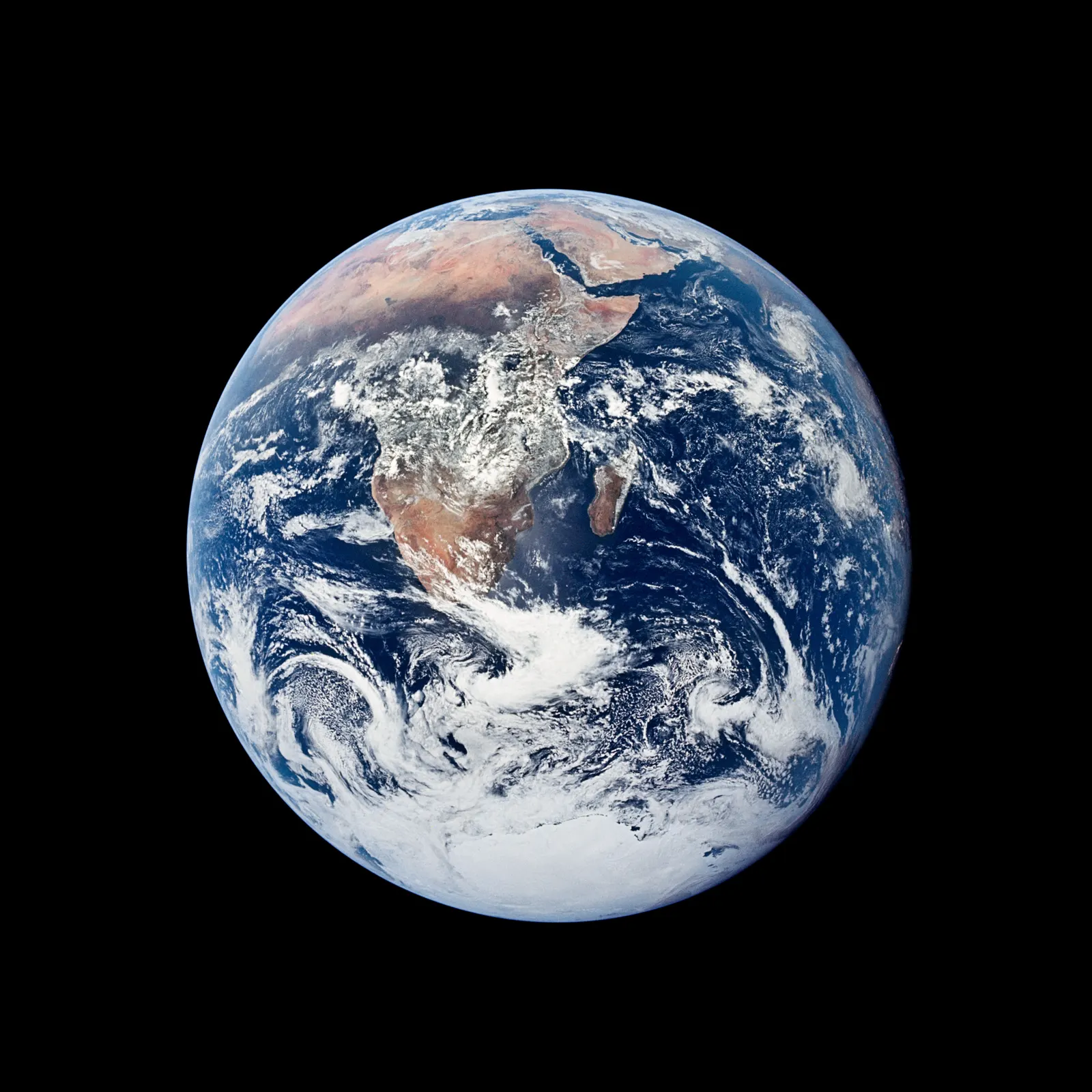
A mixed world is a rocky planet with both continents and oceans, a temperate climate and liquid water at the surface: a planet like Earth. It is the only kind of world known to host life, which makes it the reference point for the search for habitable planets, although Earth remains its one confirmed member. Planets of Earth's size have been found in the habitable zones of other stars, but none is yet known to have oceans, continents or an atmosphere like ours. Pax Abyssi generates the class throughout its galaxy as the Earth-like end of its habitable worlds.
Characteristics
Temperature and the habitable zone
Earth receives 1,361 W/m² of sunlight and reflects about 30 per cent of it. On those numbers alone it would settle at an equilibrium temperature of 255 K, well below freezing (see Planet classification). Its mean surface temperature is about 288 K because water vapour, carbon dioxide and other gases absorb and re-emit infrared heat before it escapes: the greenhouse effect.
The range of orbits in which a planet like Earth could keep liquid water is the Habitable zone. Its inner edge is set by the runaway greenhouse: once the surface is warm enough, evaporating oceans add so much water vapour that the planet cannot shed the extra heat, and the oceans boil away. For a planet of Earth's mass around the Sun, one-dimensional climate models put that limit at about 0.95 AU 1; three-dimensional models, in which dry subtropical air lets more heat escape, move it somewhat closer to the star 2. The outer edge is the maximum greenhouse limit near 1.7 AU, beyond which adding more carbon dioxide cools a planet, because the gas starts to scatter sunlight and condense into clouds 3 4.
The thermostat
A planet at the right distance still needs something to hold its climate steady over billions of years, while its star brightens by tens of per cent. On Earth that job is done by the carbonate-silicate cycle. Volcanoes release carbon dioxide. Rain dissolves it into a weak acid that weathers silicate rocks on land, and the dissolved products wash into the sea, where they are locked into carbonate minerals and buried on the seafloor. In simplified form,
Weathering runs faster when the climate is warm and wet, so a warming planet draws down more carbon dioxide and cools, and a cooling one lets volcanic carbon dioxide build up and warms 5. The feedback is slow, responding over hundreds of thousands of years 6, but over geological time it keeps the surface in the liquid-water range. Plate tectonics closes the loop by carrying carbonate-rich seafloor down into the mantle, where it is heated and the carbon returns through volcanoes.
This is where a mixture of land and sea matters. Exposed continents give rain rock to weather, and oceans give the products somewhere to be deposited. A planet with almost no land, or almost no water, must regulate its climate differently or not at all (see Ocean world and Dry habitable world).
Atmosphere and life
Earth's present air, 78 per cent nitrogen and 21 per cent oxygen, is not the atmosphere it formed with. The early atmosphere had almost no free oxygen, and the air pressure 2.7 billion years ago was less than half of today's 7. Oxygen made by photosynthesising microbes began to accumulate in the Great Oxidation Event about 2.43 to 2.46 billion years ago 8. On a living mixed world, the atmosphere is therefore partly a product of biology, and a spectrum showing oxygen alongside methane would be among the strongest signs of life a telescope could detect.
Size
Not every rocky planet in the habitable zone is equally promising. A small planet like Mars cools quickly, loses its magnetic field and much of its air. Heller and Armstrong (2014) argued that a planet somewhat larger and older than Earth, orbiting a K-type star that lives longer and is steadier than the Sun, might be even more hospitable; they called such planets superhabitable 9. A later search of known planets and candidates found two dozen that fit some of those criteria, none of them confirmed as habitable 10.
Formation
Earth-like planets form in the inner part of their star's disc, where it is too warm for water ice to condense, so they start out dry. Their water has to be delivered. Earth's oceans weigh about kg, only about 0.02 per cent of the planet's mass, and the ratio of deuterium to hydrogen in seawater matches carbonaceous asteroids from the outer asteroid belt rather than most comets. Dynamical models show how the growing giant planets could have scattered water-rich bodies of that kind inward to the young Earth 11. Simulations of planet formation find that the amount of water a planet in the habitable zone ends up with can vary by orders of magnitude, depending on where the giant planets are and how they move 12. A planet with Earth's orbit could as easily be a desert or a water world. Earth's balance of land and sea may be a matter of chance.
How we know
Only Earth has been studied as a mixed world, but the question of how many others exist is now statistical. Combining Kepler's detections with Gaia-refined stellar properties, Bryson and colleagues estimated that between about a third and two-thirds of Sun-like stars host a rocky planet in the conservative habitable zone, with large uncertainties because Kepler found few such planets directly 13.
A handful of known planets have roughly Earth's size or mass and receive roughly Earth's sunlight. None has a measured atmosphere, so none can yet be called Earth-like:
| Planet | Host star | Size or mass | Sunlight received | Notes |
|---|---|---|---|---|
| TRAPPIST-1 e | ultracool red dwarf | 0.92 R⊕, 0.69 M⊕ | about 0.65 × Earth's | density slightly below Earth's 14 |
| TOI-700 d | red dwarf | about 1.2 R⊕ | 0.86 × Earth's | first Earth-sized habitable-zone planet from TESS 15 |
| Kepler-186 f | red dwarf | about 1.1 R⊕ | about a third of Earth's | first Earth-sized planet found in a habitable zone 16 |
| Proxima Centauri b | nearest star, a red dwarf | at least 1.07 M⊕ | about 0.65 × Earth's | minimum mass from radial velocity; no transit 17 |
All four orbit red dwarfs, whose planets are easiest to find. Such planets are probably tidally locked, and their stars flare and may have stripped their early atmospheres, so whether any of them keeps oceans and air is an open question (see Red dwarf habitability).
Notable examples
Earth is the only confirmed mixed world: 1 Earth mass, 5.51 g/cm³, 71 per cent ocean, 1 bar of nitrogen and oxygen, a mean surface temperature of 288 K, active plate tectonics and a global magnetic field. The first life appeared within a billion years or so of its formation; oxygen-producing life took far longer to change the air.
Early Mars may once have come close. Valley networks and lake beds more than 3.5 billion years old show that liquid water flowed on its surface, before the planet lost most of its atmosphere (see Arid world).
See also
- Habitable zone
- Ocean world
- Dry habitable world
- Super-Earth
- Superhabitable worlds
- Life in Pax Abyssi
- Colony and Habitat Viability Indices
- Sol
- Planet classification
References
- 1Kopparapu, R. K. et al. (2014). Habitable Zones Around Main-sequence Stars: Dependence on Planetary Mass. The Astrophysical Journal 787, L29. doi:10.1088/2041-8205/787/2/l29
- 2Leconte, J. et al. (2013). Increased insolation threshold for runaway greenhouse processes on Earth-like planets. Nature 504, 268-271. doi:10.1038/nature12827
- 3Kasting, J. F., Whitmire, D. P. and Reynolds, R. T. (1993). Habitable Zones around Main Sequence Stars. Icarus 101, 108-128. doi:10.1006/icar.1993.1010
- 4Kopparapu, R. K. et al. (2013). Habitable zones around main-sequence stars: new estimates. The Astrophysical Journal 765, 131. doi:10.1088/0004-637x/765/2/131
- 5Walker, J. C. G., Hays, P. B. and Kasting, J. F. (1981). A negative feedback mechanism for the long-term stabilization of Earth's surface temperature. Journal of Geophysical Research: Oceans 86, 9776-9782. doi:10.1029/jc086ic10p09776
- 6Colbourn, G., Ridgwell, A. and Lenton, T. M. (2015). The time scale of the silicate weathering negative feedback on atmospheric CO2. Global Biogeochemical Cycles 29, 583-596. doi:10.1002/2014gb005054
- 7Som, S. M. et al. (2016). Earth's air pressure 2.7 billion years ago constrained to less than half of modern levels. Nature Geoscience 9, 448-451. doi:10.1038/ngeo2713
- 8Gumsley, A. P. et al. (2017). Timing and tempo of the Great Oxidation Event. Proceedings of the National Academy of Sciences 114, 1811-1816. doi:10.1073/pnas.1608824114
- 9Heller, R. and Armstrong, J. (2014). Superhabitable Worlds. Astrobiology 14, 50-66. doi:10.1089/ast.2013.1088
- 10Schulze-Makuch, D., Heller, R. and Guinan, E. (2020). In Search for a Planet Better than Earth: Top Contenders for a Superhabitable World. Astrobiology 20, 1394-1404. doi:10.1089/ast.2019.2161
- 11Morbidelli, A. et al. (2000). Source regions and timescales for the delivery of water to the Earth. Meteoritics & Planetary Science 35, 1309-1320. doi:10.1111/j.1945-5100.2000.tb01518.x
- 12Raymond, S. N., Quinn, T. and Lunine, J. I. (2004). Making other earths: dynamical simulations of terrestrial planet formation and water delivery. Icarus 168, 1-17. doi:10.1016/j.icarus.2003.11.019
- 13Bryson, S. et al. (2021). The Occurrence of Rocky Habitable-zone Planets around Solar-like Stars from Kepler Data. The Astronomical Journal 161, 36. doi:10.3847/1538-3881/abc418
- 14Agol, E. et al. (2021). Refining the Transit-timing and Photometric Analysis of TRAPPIST-1: Masses, Radii, Densities, Dynamics, and Ephemerides. The Planetary Science Journal 2, 1. doi:10.3847/psj/abd022
- 15Gilbert, E. A. et al. (2020). The First Habitable-zone Earth-sized Planet from TESS. I. Validation of the TOI-700 System. The Astronomical Journal 160, 116. doi:10.3847/1538-3881/aba4b2
- 16Quintana, E. V. et al. (2014). An Earth-Sized Planet in the Habitable Zone of a Cool Star. Science 344, 277-280. doi:10.1126/science.1249403
- 17Faria, J. P. et al. (2022). A candidate short-period sub-Earth orbiting Proxima Centauri. Astronomy & Astrophysics 658, A115. doi:10.1051/0004-6361/202142337