- On this page
- 1
- figure
- 2
- tables
- 2
- panels
- 17
- references
Physics concept
Habitable zone
ContentsShow
The habitable zone is the range of distances from a star at which a planet like Earth, with an atmosphere of nitrogen, carbon dioxide and water vapour, could keep liquid water on its surface. Its edges come from climate physics: closer in, the oceans boil away in a runaway greenhouse; farther out, no amount of carbon dioxide can keep the surface above freezing. For the Sun the zone runs from about 0.95 to 1.68 astronomical units (AU), where 1 AU is Earth's average distance from the Sun 1. Astronomers use it as the first cut when they sort exoplanets into those that might hold water and those that almost certainly do not. A place in the zone makes surface water possible; whether a particular planet has any, or has life, is a separate question.
One definition
Several versions of the habitable zone circulate, in the literature and in software, and they disagree by tens of per cent. This wiki uses one: the conservative habitable zone of Kopparapu and colleagues 2 1, computed for a planet of one Earth mass. Its inner edge is the runaway greenhouse limit and its outer edge is the maximum greenhouse limit, both defined below. Where a page quotes the wider optimistic limits, named "Recent Venus" and "Early Mars", it says so.
The boundaries are expressed as an effective stellar flux, : the starlight a planet receives, in units of what Earth receives today (1,361 watts per square metre at the top of the atmosphere 3). Because a cool star puts more of its light into the near infrared, where water vapour and carbon dioxide absorb strongly and where air scatters light less, each limit shifts with the star's effective temperature . Kopparapu and colleagues fitted that shift with a polynomial:
The flux falls off with the square of distance, so the boundary lies at
where is the star's luminosity in units of the Sun's. The fit holds for stars between 2,600 and 7,200 K, which covers late M dwarfs through early F stars.
| Limit | Role | For the Sun | |||||
|---|---|---|---|---|---|---|---|
| Recent Venus | optimistic inner | 1.776 | 2.136e-4 | 2.533e-8 | -1.332e-11 | -3.097e-15 | 0.75 AU |
| Runaway greenhouse | conservative inner | 1.107 | 1.332e-4 | 1.580e-8 | -8.308e-12 | -1.931e-15 | 0.95 AU |
| Maximum greenhouse | conservative outer | 0.356 | 6.171e-5 | 1.698e-9 | -3.198e-12 | -5.575e-16 | 1.68 AU |
| Early Mars | optimistic outer | 0.320 | 5.547e-5 | 1.526e-9 | -2.874e-12 | -5.011e-16 | 1.77 AU |
Coefficients for a 1 Earth-mass planet, from Kopparapu et al. (2014) 1. The 2013 paper's coefficients were corrected in an erratum 4; the 2014 values supersede both.
The physics of the two edges
The inner edge: the runaway greenhouse
Water vapour is a greenhouse gas, and a warmer ocean puts more of it into the air. On Earth that feedback is held in check because the planet can still radiate away the heat it absorbs. But there is a ceiling. Once the lower atmosphere is thick with steam, the infrared a planet can emit to space levels off at roughly 280 watts per square metre, whatever the surface temperature 5. A planet that absorbs more sunlight than that cannot cool itself; its surface heats until the oceans have boiled into the atmosphere, and the hydrogen from that water is then lost to space over time. That is the runaway greenhouse, and it sets the conservative inner edge at about 1.1 times Earth's present flux for a Sun-like star.
The optimistic inner edge is empirical. Radar maps of Venus show no sign of surface water in roughly the last billion years; a billion years ago the Sun was about 8% fainter, so Venus then received about 1.76 times Earth's present flux. If Venus was dry at that flux, an Earth-like planet could not have been wet there either, and that sets the Recent Venus limit 2.
The outer edge: the maximum greenhouse
Earth's thermostat is the carbonate-silicate cycle. Rain dissolves carbon dioxide, weathers silicate rock and carries the carbon to the sea floor as carbonate; volcanoes return it to the air. Weathering runs faster when the climate is warm and wet, so a cooling planet draws down less carbon dioxide and lets volcanic gas build up, which warms it again 6. A planet farther from its star can in principle build a thicker carbon dioxide blanket to compensate. The blanket has a limit: beyond several bars of carbon dioxide, the extra gas scatters more incoming sunlight back to space (Rayleigh scattering, the same process that makes the sky blue) than it traps as heat. The distance at which even the best carbon dioxide atmosphere can no longer hold the surface at 273 K is the maximum greenhouse limit 7 2.
The optimistic outer edge is again empirical. Dry river valleys and lake beds show that Mars had liquid water about 3.8 billion years ago, when the young Sun was about 25% fainter and Mars received about 0.32 times Earth's present flux. That sets the Early Mars limit 2.
Planet mass
The limits depend on the planet. In the 2014 calculations a 0.1 Earth-mass world has its inner edge at a flux about 10% lower than an Earth-mass one, and a 5 Earth-mass world about 7% higher, because gravity changes how tall and dense the water-vapour column is. The outer edge barely moves 1. Larger planets therefore have slightly wider zones.
The zone moves
Stars brighten as they age. The Sun was about 70% as luminous as it is now when it formed 4.6 billion years ago 8, so its habitable zone has crept outward since. Earth has stayed inside because the carbonate-silicate cycle has slowly drawn down carbon dioxide as the Sun warmed. The part of a zone that a planet can occupy for billions of years, the continuously habitable zone, is narrower than the zone at any one moment. Red dwarfs add a complication in the other direction: they spend hundreds of millions of years as brighter, contracting young stars, and a planet that ends up in a red dwarf's habitable zone may have spent that time inside a runaway greenhouse, losing much of its water before the star settled down 9.
What one-dimensional models leave out
The Kopparapu limits come from one-dimensional, cloud-free climate models, which treat a planet as a single average column of air. Three-dimensional climate models change the answer at the edges. For an Earth-like planet around the Sun, one such model finds that the runaway begins only at a higher absorbed flux than the one-dimensional models of the time predicted, placing the inner edge near 0.95 AU, in line with the 2014 value used here 10. For planets that keep one face towards a red dwarf, thick clouds over the permanent dayside reflect so much light that the inner edge can move substantially inward 11 12. At the far end, a planet with a thick primordial hydrogen atmosphere could stay warm well beyond the maximum greenhouse limit, because hydrogen molecules absorb infrared when they collide 13.
None of these results replaces the definition used here. They show why a planet just outside the conservative zone still deserves a second look.
How we know
No habitable zone around another star has been measured. The zone is a calculation, built on physics tested in our own system: Venus as a planet that lost its water, Mars as one that once had it and froze, and Earth as the working case in between. Its inputs are measured, though. A star's luminosity comes from its distance and brightness, its temperature from its spectrum, and a planet's orbit from transit or radial-velocity data, so the flux a planet receives is usually known to a few per cent even when nothing is known about its atmosphere.
The zone matters because it tells telescope time where to go. Using Kepler data, Bryson and colleagues estimated that between about 0.37 and 0.60 rocky planets (0.5 to 1.5 Earth radii) orbit in the conservative habitable zone of a typical Sun-like star, with wide uncertainties, which implies that the nearest such planet around a G or K dwarf is probably about 6 parsecs (20 light years) away 14. See Planet occurrence for how such rates are measured.
Notable examples
| System | Star | (K) | () | Conservative zone (AU) | Planets and their flux |
|---|---|---|---|---|---|
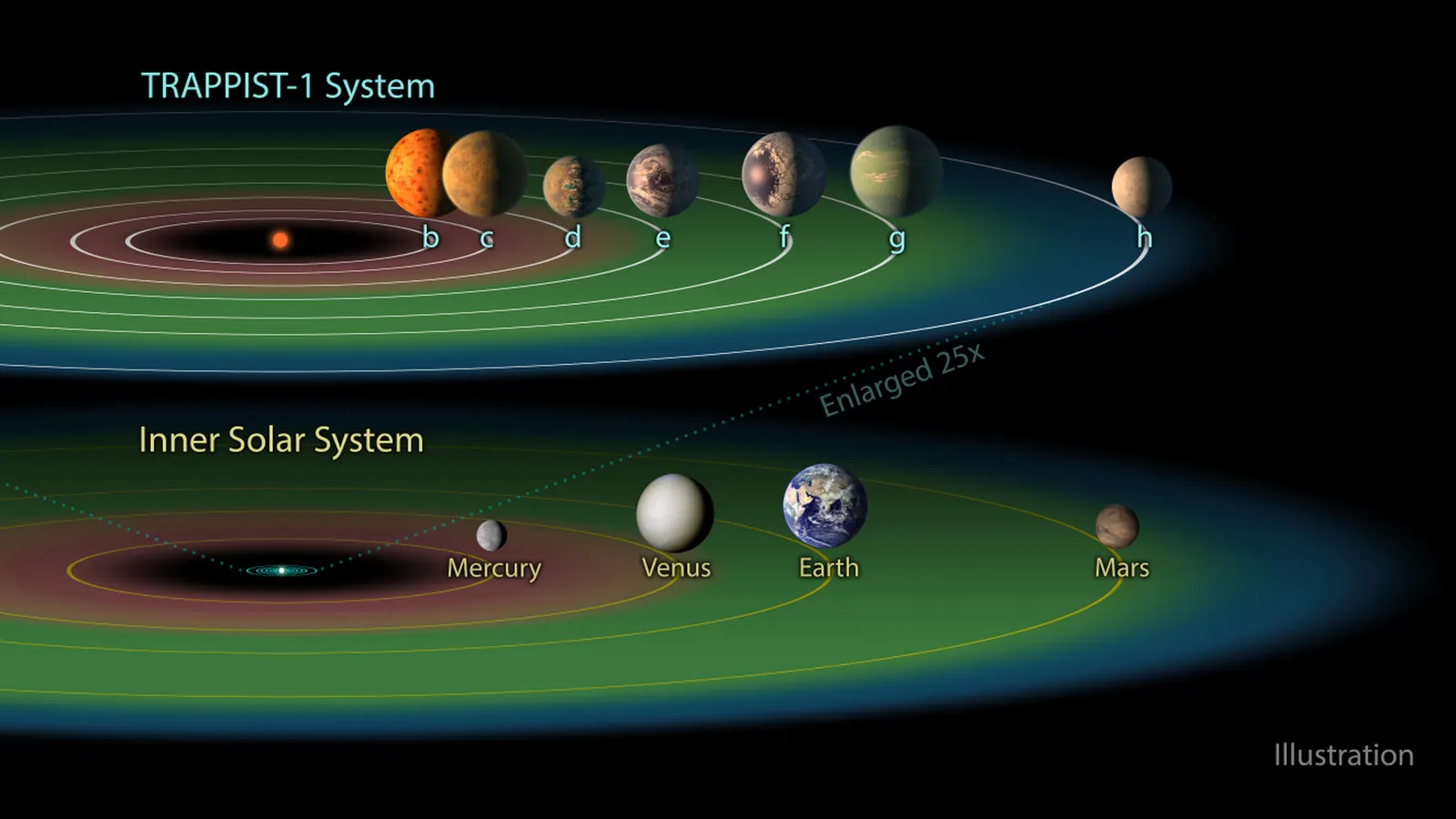
| Sol | the Sun, G2V | 5,772 | 1 | 0.95 to 1.68 | Venus 1.91 (outside); Earth 1.00 (inside); Mars 0.43 (inside) |
| Proxima Centauri | M5.5V | 3,050 | 0.00155 | 0.041 to 0.081 | Proxima b, 0.65 (inside) |
| TRAPPIST-1 | M8V | 2,566 | 0.000553 | 0.025 to 0.050 | d 1.115 (optimistic only); e 0.646, f 0.373, g 0.252 (inside); h 0.144 (outside) |
Stellar values: the Sun from the IAU nominal values 15; Proxima Centauri and its planet from the discovery paper 16; TRAPPIST-1 and its planets' fluxes from Agol et al. 17. Zone edges computed on this page with the 2014 coefficients. TRAPPIST-1 sits about 30 K below the fit's validity range, so its edges are a slight extrapolation.
The table carries a warning in its first row. Mars orbits inside the Sun's conservative habitable zone and has no liquid water on its surface today. At about a tenth of Earth's mass it could not hold on to a thick atmosphere or keep its interior active enough to recycle carbon, so the carbonate-silicate thermostat that the zone assumes stopped working.
See also
- Colony and Habitat Viability Indices, the sim's scores for whether people could live on a world
- Planet occurrence
- Star system generation
- Orbit
- Sol
- Red dwarf
- Mixed world, Ocean world, Subsurface ocean world
- Science in Pax Abyssi
References
- 1Kopparapu, R. K. et al. (2014). Habitable Zones around Main-sequence Stars: Dependence on Planetary Mass. The Astrophysical Journal Letters 787, L29. doi:10.1088/2041-8205/787/2/L29
- 2Kopparapu, R. K. et al. (2013). Habitable Zones around Main-sequence Stars: New Estimates. The Astrophysical Journal 765, 131. doi:10.1088/0004-637X/765/2/131
- 3Kopp, G. and Lean, J. L. (2011). A new, lower value of total solar irradiance: Evidence and climate significance. Geophysical Research Letters 38, L01706. doi:10.1029/2010GL045777
- 4Kopparapu, R. K. et al. (2013). Erratum: Habitable Zones around Main-sequence Stars: New Estimates. The Astrophysical Journal 770, 82. doi:10.1088/0004-637X/770/1/82
- 5Goldblatt, C. et al. (2013). Low simulated radiation limit for runaway greenhouse climates. Nature Geoscience 6, 661-667. doi:10.1038/ngeo1892
- 6Walker, J. C. G., Hays, P. B. and Kasting, J. F. (1981). A negative feedback mechanism for the long-term stabilization of Earth's surface temperature. Journal of Geophysical Research 86, 9776-9782. doi:10.1029/JC086iC10p09776
- 7Kasting, J. F., Whitmire, D. P. and Reynolds, R. T. (1993). Habitable Zones around Main Sequence Stars. Icarus 101, 108-128. doi:10.1006/icar.1993.1010
- 8Gough, D. O. (1981). Solar interior structure and luminosity variations. Solar Physics 74, 21-34. doi:10.1007/BF00151270
- 9Luger, R. and Barnes, R. (2015). Extreme Water Loss and Abiotic O2 Buildup on Planets Throughout the Habitable Zones of M Dwarfs. Astrobiology 15, 119-143. doi:10.1089/ast.2014.1231
- 10Leconte, J. et al. (2013). Increased insolation threshold for runaway greenhouse processes on Earth-like planets. Nature 504, 268-271. doi:10.1038/nature12827
- 11Yang, J., Cowan, N. B. and Abbot, D. S. (2013). Stabilizing Cloud Feedback Dramatically Expands the Habitable Zone of Tidally Locked Planets. The Astrophysical Journal Letters 771, L45. doi:10.1088/2041-8205/771/2/L45
- 12Kopparapu, R. K. et al. (2016). The Inner Edge of the Habitable Zone for Synchronously Rotating Planets around Low-mass Stars Using General Circulation Models. The Astrophysical Journal 819, 84. doi:10.3847/0004-637X/819/1/84
- 13Pierrehumbert, R. and Gaidos, E. (2011). Hydrogen Greenhouse Planets beyond the Habitable Zone. The Astrophysical Journal Letters 734, L13. doi:10.1088/2041-8205/734/1/L13
- 14Bryson, S. and et al. (2021). The Occurrence of Rocky Habitable-zone Planets around Solar-like Stars from Kepler Data. The Astronomical Journal 161, 36. doi:10.3847/1538-3881/abc418
- 15Prša, A. and et al. (2016). Nominal Values for Selected Solar and Planetary Quantities: IAU 2015 Resolution B3. The Astronomical Journal 152, 41. doi:10.3847/0004-6256/152/2/41
- 16Anglada-Escudé, G. and et al. (2016). A terrestrial planet candidate in a temperate orbit around Proxima Centauri. Nature 536, 437-440. doi:10.1038/nature19106
- 17Agol, E. et al. (2021). Refining the Transit-timing and Photometric Analysis of TRAPPIST-1: Masses, Radii, Densities, Dynamics, and Ephemerides. The Planetary Science Journal 2, 1. doi:10.3847/PSJ/abd022