- On this page
- 2
- figures
- 1
- table
- 2
- panels
- 17
- references
Planetary system
Sol
ContentsShow
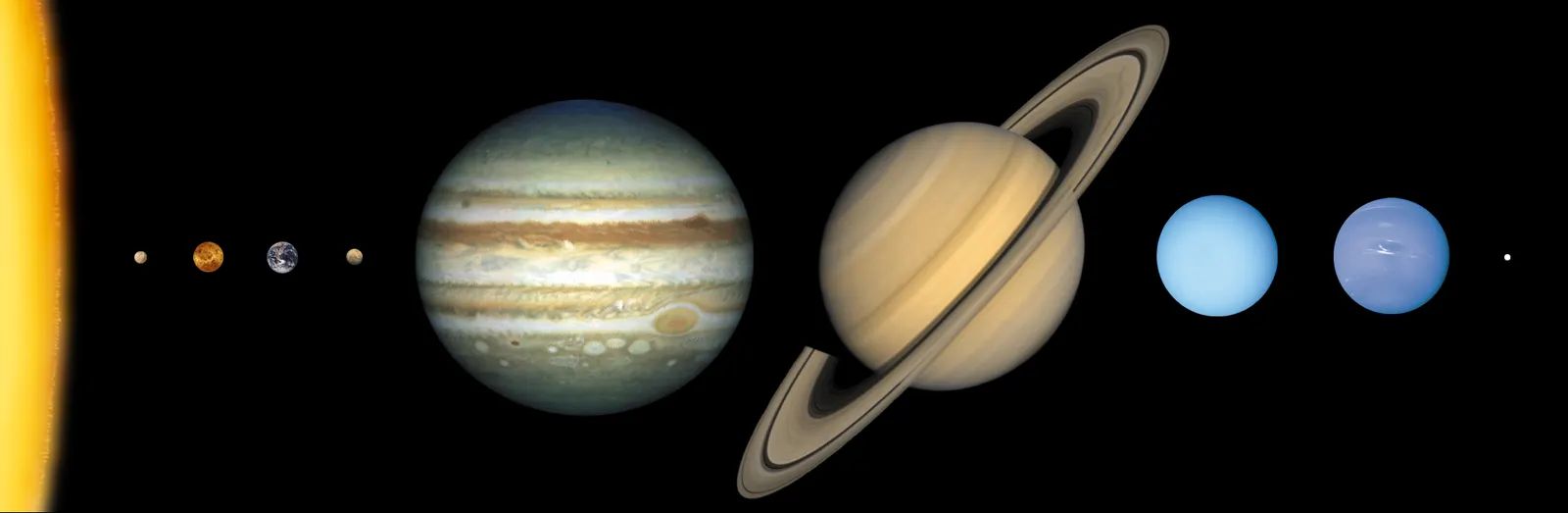
Sol is the Sun and everything bound to it: eight planets, five recognised dwarf planets, more than 450 known moons, two great belts of small bodies and a wind of charged particles that reaches beyond 120 astronomical units (AU; 1 AU is Earth's mean distance from the Sun, about 150 million km). It is the only planetary system known in full detail and the yardstick against which every other is measured. In Pax Abyssi it is also the one system built entirely from measurement, where every other system is generated.
The Sun
The Sun is a G2V star, a yellow dwarf on the main sequence, fusing hydrogen into helium in its core. Its nominal values, fixed by the International Astronomical Union in 2015 so that every paper uses the same conversion constants, are a radius of 695,700 km, a luminosity of W and an effective temperature of 5,772 K. 1 Its mass is kg, about 333,000 times Earth's. 2
Those three numbers are tied together by the Stefan-Boltzmann law, which gives the power radiated by a sphere of radius and surface temperature :
With W m K, m and K, the formula returns W, the Sun's measured luminosity.
The oldest solids in meteorites, calcium- and aluminium-rich inclusions, formed 4.567 billion years ago, and that date is taken as the birth of the Solar System. 3 The Sun is a little less than halfway through its life. In about 5 billion years it will swell into a red giant large enough to engulf Mercury and Venus, then shed its outer layers and end as a white dwarf. 4 It carries its planets around the centre of the Milky Way about 8.2 kiloparsecs away, once every 220 to 230 million years.
The planets
| Planet | Mean distance (AU) | Orbital period | Diameter (km) | Mass (Earths) | Density (g/cm³) | Moons (Sept 2026) |
|---|---|---|---|---|---|---|
| Mercury | 0.387 | 88.0 days | 4,879 | 0.055 | 5.43 | 0 |
| Venus | 0.723 | 224.7 days | 12,104 | 0.815 | 5.24 | 0 |
| Earth | 1.000 | 365.2 days | 12,756 | 1 | 5.51 | 1 |
| Mars | 1.524 | 1.88 years | 6,792 | 0.107 | 3.93 | 2 |
| Jupiter | 5.20 | 11.9 years | 142,984 | 318 | 1.33 | 115 |
| Saturn | 9.57 | 29.4 years | 120,536 | 95.2 | 0.69 | 293 |
| Uranus | 19.2 | 83.7 years | 51,118 | 14.5 | 1.27 | 29 |
| Neptune | 30.2 | 164 years | 49,528 | 17.1 | 1.64 | 16 |
Orbital and physical values are from NASA's planetary fact sheet. 5 Moon counts are those recognised by September 2026 and change often. 6 7 8 9
The periods and distances obey Kepler's third law: the square of a planet's period in years equals the cube of its distance in AU, . Jupiter at 5.20 AU gives years, as observed. See Orbit for where the law comes from.
The system splits cleanly in two. The four inner planets are small, dense and rocky: Mercury, Venus, Earth and Mars. The four outer planets are giants: Jupiter and Saturn, made mostly of hydrogen and helium, and the ice giants Uranus and Neptune, rich in water, ammonia and methane. Neptune is often shown deep blue, but careful recalibration of Voyager and telescope images shows it is a pale greenish-blue only slightly bluer than Uranus. 10
The dividing line is the frost line (or snow line), the distance in the young solar nebula beyond which water condensed as ice and gave growing planets far more solid material to build from. The classic model of the solar nebula puts it at about 2.7 AU, between Mars and Jupiter. 11 Jupiter formed just outside it.
Many other Sun-like stars have planets larger than Earth and smaller than Neptune orbiting closer in than Mercury, a kind of planet the Solar System does not have at all. 12 Sol is one arrangement among many; see Planet occurrence and Planetary system archetypes.
Moons, belts and dwarf planets
Most of Sol's moons are small, irregular bodies a few kilometres across, captured on distant, tilted and often backward orbits around the giants. Jupiter's 115 include only eight regular moons that formed with it: four small inner moons and the four large Galilean moons. 6 The large moons are worlds in their own right: Titan has a nitrogen atmosphere thicker than Earth's, and Europa and Enceladus hide oceans under their ice. See Natural satellite.
The main asteroid belt fills the zone from 2.06 to 3.27 AU, where Jupiter's gravity stopped a planet from forming. Its total mass, measured from its pull on the planets and on spacecraft, is Earth masses, about 3 percent of the Moon. 13 The Kuiper belt of icy bodies lies mostly between Neptune's 3:2 and 2:1 resonances, 39.4 to 47.8 AU, with about Earth masses, some 50 times the main belt. 13 See Asteroid belt.
The IAU recognises five dwarf planets, bodies massive enough to be round that have not cleared their orbits: Ceres in the main belt, and Pluto, Haumea, Makemake and Eris beyond Neptune. 14 Pluto has five known moons. 5
Zones and boundaries
The habitable zone is the range of distances where an Earth-like planet with a carbon dioxide and water atmosphere could keep liquid water on its surface. For the Sun its conservative limits run from about 0.95 AU, where an Earth-mass planet would tip into a runaway greenhouse, to about 1.7 AU, where even a thick carbon dioxide atmosphere could no longer keep it warm. Optimistic limits, based on the evidence that Venus once had water and Mars once had rivers, stretch from about 0.75 to 1.77 AU. 15 16 Earth sits near the inner edge. The details are on the Habitable zone page.
The heliopause is where the solar wind meets the gas between the stars. Voyager 1 crossed it on 25 August 2012 at about 122 AU, the first spacecraft to reach interstellar space, and Voyager 2 followed on 5 November 2018. 17
How we know
Planetary distances are known to metres from radar ranging and the tracking of spacecraft, which together feed the numerical ephemerides that predict every body's position. Planet masses come from the orbits of their moons and from the paths of spacecraft that fly past. The belts are too faint and scattered to weigh by counting, so their masses are inferred from the small tugs they give the planets and spacecraft. 13 The Sun's age comes from radioactive clocks in meteorites. 3
See also
- Yellow dwarf, the Sun's class of star
- Milky Way, the Sun's place in the Galaxy
- Star catalogue
- Orbit and Habitable zone
- Natural satellite and Asteroid belt
- Planetary system archetypes
- Star system generation, how every other system is built
References
- 1Prša, A. and et al. (2016). Nominal Values for Selected Solar and Planetary Quantities: IAU 2015 Resolution B3. The Astronomical Journal 152, 41. doi:10.3847/0004-6256/152/2/41
- 2Williams, D. R. (2024). Sun Fact Sheet. NASA Space Science Data Coordinated Archive. nssdc.gsfc.nasa.gov/planetary/factsheet/sunfact.html
- 3Connelly, J. N. and et al. (2012). The Absolute Chronology and Thermal Processing of Solids in the Solar Protoplanetary Disk. Science 338, 651-655. doi:10.1126/science.1226919
- 4NASA Science. Sun: Facts. science.nasa.gov. science.nasa.gov/sun/facts/
- 5Williams, D. R. (2025). Planetary Fact Sheet - Metric. NASA Space Science Data Coordinated Archive. nssdc.gsfc.nasa.gov/planetary/factsheet/
- 6NASA Science (2026). Jupiter Moons. science.nasa.gov. science.nasa.gov/jupiter/moons/
- 7NASA Science (2026). Saturn Moons. science.nasa.gov. science.nasa.gov/saturn/moons/
- 8NASA Science (2026). Uranus Moons. science.nasa.gov. science.nasa.gov/uranus/moons/
- 9NASA Science (2026). Neptune Moons. science.nasa.gov. science.nasa.gov/neptune/moons/
- 10Irwin, P. G. J. and et al. (2024). Modelling the seasonal cycle of Uranus's colour and magnitude, and comparison with Neptune. Monthly Notices of the Royal Astronomical Society 527, 11521-11538. doi:10.1093/mnras/stad3761
- 11Hayashi, C. (1981). Structure of the Solar Nebula, Growth and Decay of Magnetic Fields and Effects of Magnetic and Turbulent Viscosities on the Nebula. Progress of Theoretical Physics Supplement 70, 35-53. doi:10.1143/PTPS.70.35
- 12Zhu, W. and Dong, S. (2021). Exoplanet Statistics and Theoretical Implications. Annual Review of Astronomy and Astrophysics 59, 291-336. doi:10.1146/annurev-astro-112420-020055
- 13Pitjeva, E. V. and Pitjev, N. P. (2018). Masses of the Main Asteroid Belt and the Kuiper Belt from the Motions of Planets and Spacecraft. Astronomy Letters 44, 554-566. doi:10.1134/S1063773718090050
- 14NASA Science. Dwarf Planets. science.nasa.gov. science.nasa.gov/dwarf-planets/
- 15Kopparapu, R. K. and et al. (2013). Habitable Zones around Main-sequence Stars: New Estimates. The Astrophysical Journal 765, 131. doi:10.1088/0004-637X/765/2/131
- 16Kopparapu, R. K. and et al. (2014). Habitable Zones around Main-sequence Stars: Dependence on Planetary Mass. The Astrophysical Journal Letters 787, L29. doi:10.1088/2041-8205/787/2/L29
- 17NASA Science. Voyager: The Interstellar Mission. science.nasa.gov. science.nasa.gov/mission/voyager/interstellar-mission/