- On this page
- 2
- figures
- 1
- table
- 1
- panel
- 20
- references
Belt
Asteroid belt
ContentsShow
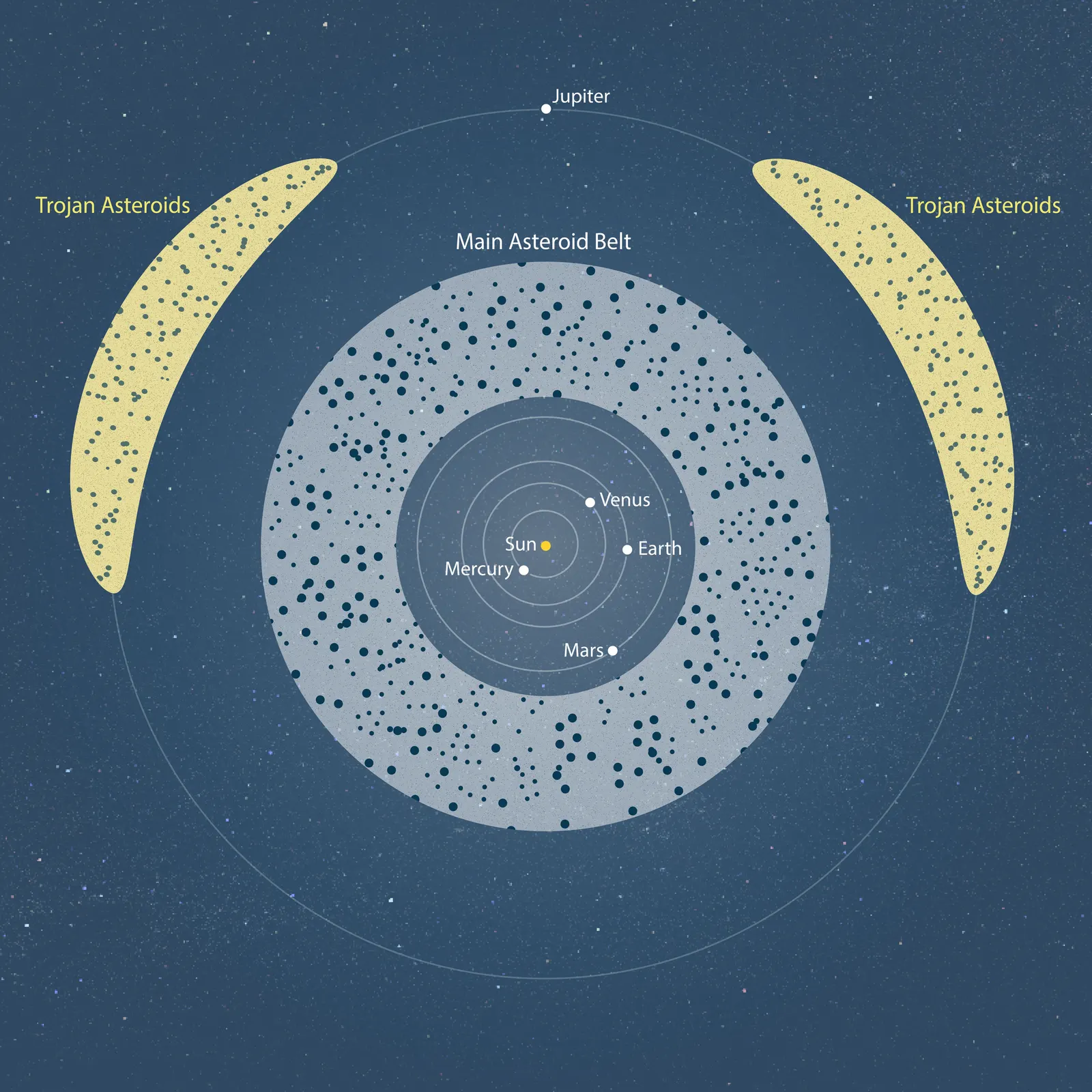
An asteroid belt is a ring of small rocky and icy bodies orbiting a star where no planet managed to form. The Sun's Main Belt, between Mars and Jupiter at 2.06 to 3.27 astronomical units (AU), holds over a million bodies larger than a kilometre, yet their combined mass is only about 3 percent of the Moon's 1 2. Its edges and gaps are set by resonances with Jupiter, its make-up records how material moved around the young Solar System, and it is the source of most meteorites that reach Earth.
Where the Main Belt is, and why there
The belt's inner edge at about 2.06 AU coincides with Jupiter's 4:1 mean-motion resonance, where an asteroid would complete four orbits for every one of Jupiter's, together with the secular resonance with Saturn. Its outer edge, near 3.28 AU, is Jupiter's 2:1 resonance 3. Kepler's third law turns any resonance into a distance. An asteroid making orbits for every of Jupiter's has a period of Jupiter's, and so a semi-major axis
With Jupiter at AU, the 3:1 resonance falls at 2.50 AU, the 5:2 at 2.82 AU and the 7:3 at 2.96 AU. Because the rule depends only on period ratios, the same fractions of a giant's orbit mark the same features around any star.
The Kirkwood gaps. In the 1860s Daniel Kirkwood noticed that asteroids avoid exactly these distances 3. At a resonance, Jupiter tugs on an asteroid at the same point of its orbit again and again, and the kicks build up: its eccentricity grows until it crosses the orbit of Mars or Earth, falls into the Sun or is thrown out by Jupiter. Numerical experiments show that bodies pushed into the 3:1 or resonances typically last only a few million years, and some of the survivors reach Earth as meteorites 4. The gaps are the emptied lanes.
Not every resonance empties. The Hildas, at the 3:2 resonance near 3.97 AU, are a stable clump whose orbits keep them away from Jupiter, and the Trojans share Jupiter's orbit at its L4 and L5 points, 60 degrees ahead and behind. The Trojans are dark, primitive bodies that were probably captured when the giant planets' orbits reshuffled early in the Solar System's history 5. NASA's Lucy spacecraft, launched in 2021, is due to make its first Trojan flyby in August 2027 6.
A belt that is mostly empty
Pictures of spaceships dodging tumbling boulders get the belt badly wrong. Its total mass, measured from the pull it exerts on the planets and on spacecraft, is Earth masses, or kg 1. Ceres alone, at 939 km across, holds about 39 percent of that 7. The number of bodies larger than a kilometre is 1.1 to 1.9 million 2, spread through a doughnut-shaped volume roughly cubic kilometres in size. Dividing one by the other puts neighbouring kilometre-sized asteroids some 3 million km apart on average, about eight times the distance from Earth to the Moon. Standing anywhere in the real belt you would almost never see an asteroid as more than a point of light, and spacecraft cross it without having to steer around anything.
What asteroids are made of
Asteroids are sorted into classes by their colour and reflectance spectra. The stony S types dominate the inner belt, the dark carbon-rich C types the outer belt, and the even darker P and D types the Hildas and Trojans. Smaller groups include the basaltic V types, chips off Vesta's crust, and the metal-rich M types 8. The gradient from S to C roughly tracks distance from the Sun, and from the snow line, beyond which water ice could condense. DeMeo and Carry's survey of asteroid colours found far more mixing than a smooth gradient allows, especially among smaller bodies, evidence that material was stirred and moved around after it formed 8.
Meteorites tell a matching story. They fall into two isotopically distinct families that formed in separate reservoirs, one inside and one outside the orbit of Jupiter, and the separation appears to have been set by Jupiter's early growth within the first million years or so 9. Both families are now mixed in the belt.
Why no planet formed here
The idea that the belt is the rubble of an exploded planet dates from Heinrich Olbers in 1802 and does not survive the numbers: the whole belt would make a body less than half the size of the Moon, and its material comes from at least two different reservoirs with different formation ages. The accepted picture is that a planet never formed. Several models reproduce the belt we see. In one, Jupiter's resonances and wandering planetary embryos stirred up the original belt and cleared out most of its mass 10. In the "Grand Tack", Jupiter migrated inward toward Mars's present orbit and back out again, truncating the disk and refilling the belt with S types from inside and C types from outside 11. In a third, the belt formed nearly empty and was later seeded with material scattered in from both sides 12.
The Kuiper belt and belts around other stars
Beyond Neptune lies a second, larger belt. The Kuiper belt's main population orbits between Neptune's 3:2 resonance at 39.4 AU, where Pluto and the other Plutinos sit, and its 2:1 resonance at 47.8 AU. Its mass, about Earth masses, is roughly 50 times the Main Belt's 1. The first Kuiper belt object after Pluto was found in 1992 13, and in 2019 New Horizons flew past Arrokoth, a primitive body about 36 km long made of two lobes that joined gently 14. Kuiper belt objects are ice-rich, and the belt feeds the short-period comets.
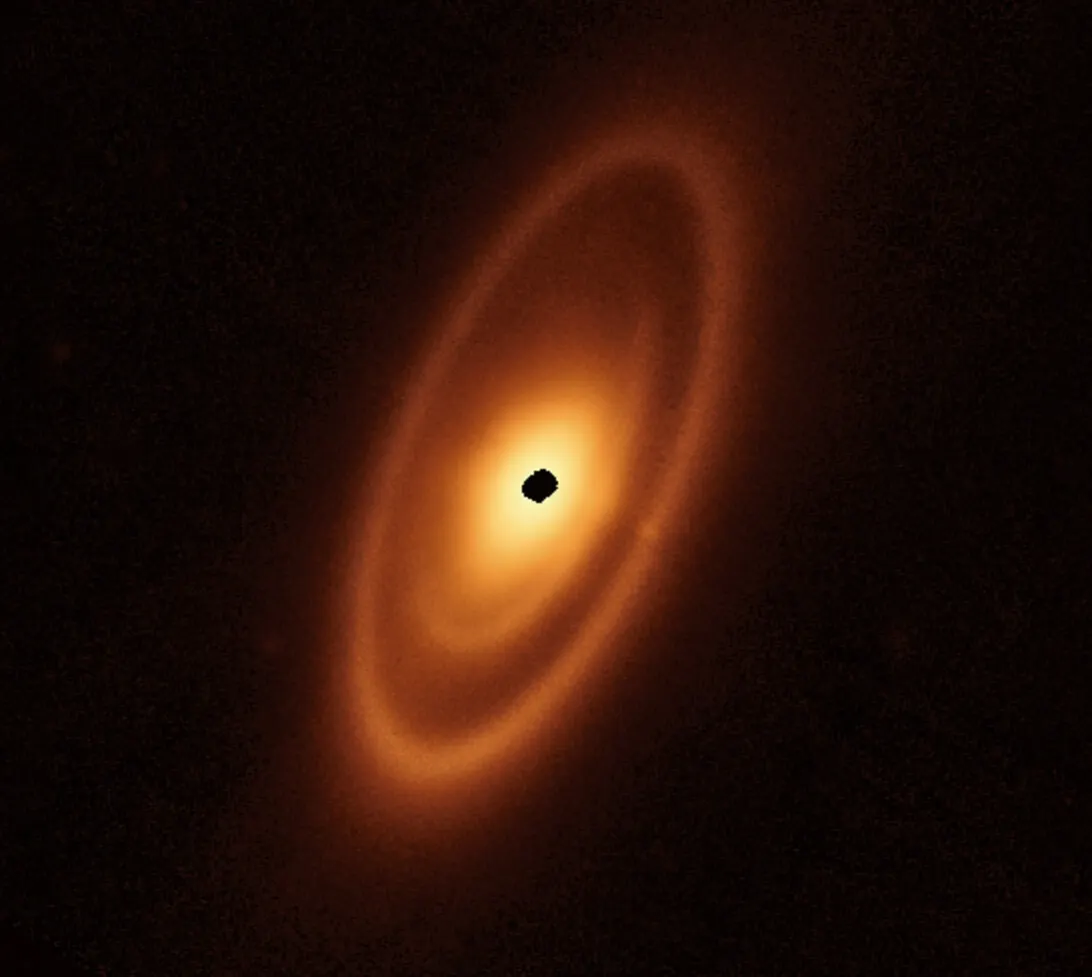
Other stars have belts too, seen as the infrared glow of dust ground off colliding bodies. Herschel detected such debris discs around 17 percent of nearby Sun-like stars 15. Those are only the dustiest: the Sun's own Kuiper belt would sit close to the median of the population, so perhaps half of all stars have a belt at least as bright as ours, and most belts as faint as the Sun's Main Belt are far below any survey's reach 15. The James Webb Space Telescope resolved three nested belts around the young star Fomalhaut, reaching about 23 billion km (some 150 AU) from the star, with gaps that may be carved by unseen planets 16.
How we know
Most of what is known comes from ground surveys that find asteroids and track their orbits, now numbering in the hundreds of thousands, and from the belt's gravitational pull on the planets and spacecraft, which gives its total mass 1. The Gaia mission added precise astrometry for more than 150,000 Solar System objects and reflectance spectra of 60,518 asteroids in its third data release 17. Spacecraft have visited individual bodies. Dawn orbited Vesta, a differentiated protoplanet with an iron core 18, and Ceres, which turned out to be partly differentiated, with a rocky interior under a volatile-rich shell 7. NASA's Psyche spacecraft, launched in October 2023, is due to begin orbiting the metal-rich asteroid Psyche in August 2029 19.
Notable members
| Body | Where | Size | Class | Notes |
|---|---|---|---|---|
| Ceres | 2.77 AU | 939 km | C | Dwarf planet; about 39 percent of the belt's mass |
| Vesta | 2.36 AU | 523 km | V | Differentiated protoplanet; source of the HED meteorites |
| Pallas | 2.77 AU | 513 km | B | Orbit inclined 35 degrees to the ecliptic |
| Hygiea | 3.15 AU | about 410 km | C | Fourth-largest asteroid; largest in the outer belt |
| Psyche | 2.93 AU | 222 km | M | Metal-rich; NASA spacecraft arrives 2029 |
| 624 Hektor | 5.28 AU | about 225 km | D | Largest Jupiter Trojan |
| Arrokoth | 44.1 AU | about 36 km long | Kuiper belt object | Visited by New Horizons in 2019 |
Orbital and size values from the JPL Small-Body Database 20.
See also
- Orbit
- Natural satellite
- Planetary system archetypes
- Star system generation
- Sol
- Gas giant
- Planet occurrence
References
- 1Pitjeva, E. V. and Pitjev, N. P. (2018). Masses of the Main Asteroid Belt and the Kuiper Belt from the Motions of Planets and Spacecraft. Astronomy Letters 44, 554-566. doi:10.1134/S1063773718090050
- 2Tedesco, E. F. and Desert, F. X. (2002). The Infrared Space Observatory Deep Asteroid Search. The Astronomical Journal 123, 2070-2082. doi:10.1086/339482
- 3Murray, C. D. and Dermott, S. F. (1999). Solar System Dynamics. Cambridge University Press. doi:10.1017/CBO9781139174817
- 4Gladman, B. J. et al. (1997). Dynamical Lifetimes of Objects Injected into Asteroid Belt Resonances. Science 277, 197-201. doi:10.1126/science.277.5323.197
- 5Nesvorny, D., Vokrouhlicky, D. and Morbidelli, A. (2013). Capture of Trojans by Jumping Jupiter. The Astrophysical Journal 768, 45. doi:10.1088/0004-637X/768/1/45
- 6NASA. Lucy. NASA Science. science.nasa.gov/mission/lucy/
- 7Park, R. S. et al. (2016). A partially differentiated interior for (1) Ceres deduced from its gravity field and shape. Nature 537, 515-517. doi:10.1038/nature18955
- 8DeMeo, F. E. and Carry, B. (2014). Solar System evolution from compositional mapping of the asteroid belt. Nature 505, 629-634. doi:10.1038/nature12908
- 9Kruijer, T. S. et al. (2017). Age of Jupiter inferred from the distinct genetics and formation times of meteorites. Proceedings of the National Academy of Sciences 114, 6712-6716. doi:10.1073/pnas.1704461114
- 10Petit, J. M., Morbidelli, A. and Chambers, J. (2001). The Primordial Excitation and Clearing of the Asteroid Belt. Icarus 153, 338-347. doi:10.1006/icar.2001.6702
- 11Walsh, K. J. et al. (2011). A low mass for Mars from Jupiter's early gas-driven migration. Nature 475, 206-209. doi:10.1038/nature10201
- 12Raymond, S. N. and Izidoro, A. (2017). The empty primordial asteroid belt. Science Advances 3, e1701138. doi:10.1126/sciadv.1701138
- 13Jewitt, D. and Luu, J. (1993). Discovery of the candidate Kuiper belt object 1992 QB1. Nature 362, 730-732. doi:10.1038/362730a0
- 14Stern, S. A. et al. (2019). Initial results from the New Horizons exploration of 2014 MU69, a small Kuiper Belt object. Science 364, eaaw9771. doi:10.1126/science.aaw9771
- 15Sibthorpe, B. et al. (2018). Analysis of the Herschel DEBRIS Sun-like star sample. Monthly Notices of the Royal Astronomical Society 475, 3046-3064. doi:10.1093/mnras/stx3188
- 16Gaspar, A. et al. (2023). Spatially resolved imaging of the inner Fomalhaut disk using JWST/MIRI. Nature Astronomy 7, 790-798. doi:10.1038/s41550-023-01962-6
- 17Gaia Collaboration et al. (2023). Gaia Data Release 3: The Solar System survey. Astronomy & Astrophysics 674, A12. doi:10.1051/0004-6361/202243796
- 18Russell, C. T. et al. (2012). Dawn at Vesta: Testing the Protoplanetary Paradigm. Science 336, 684-686. doi:10.1126/science.1219381
- 19NASA. Psyche. NASA Science. science.nasa.gov/mission/psyche/
- 20JPL Solar System Dynamics. Small-Body Database. ssd.jpl.nasa.gov/tools/sbdb_lookup.html