- On this page
- 1
- figure
- 1
- table
- 19
- references
Redirected from Asymptotic giant branch
Star class · RGI (M giants), OGI (K giants), YGI (G giants)
Red giant
ContentsShow
A red giant is a star near the end of its life that has used up the hydrogen in its core and swollen to tens or hundreds of times its former size. Its outer layers, spread over so large a surface, cool to about 3,000 to 5,000 K, which gives the star an orange-red colour and a spectral type of late G, K or M with luminosity class III. Every star born with between roughly 0.8 and 8 times the Sun's mass passes through the red giant stages, and the Sun will begin to in about five and a half billion years, reaching the peak of the red giant branch about seven and a half billion years from now 1. Red giants are rare near the Sun (there are none within 33 light years 2), but they are so bright that they are among the most familiar stars in the night sky: Arcturus, Aldebaran and Pollux are all red giants.
How a star becomes a red giant
A main-sequence star fuses hydrogen into helium in its core. When the core's hydrogen runs out, fusion continues in a shell around an inert helium core. The core contracts and heats, the shell burns faster, and the star's envelope expands and cools: the star leaves the main sequence, crosses the subgiant branch and climbs the red giant branch of the Hertzsprung-Russell diagram, growing brighter and larger as its core grows.
In stars below about two solar masses the helium core becomes so dense that it is supported by electron degeneracy pressure, the resistance of electrons to being packed together. When the core reaches about 0.48 solar masses its temperature reaches the point at which helium fuses to carbon, and because a degenerate core cannot expand to cool itself, helium ignites in a runaway helium flash. The flash begins off-centre and proceeds in a series of subflashes that lift the degeneracy over about two million years 3. Heavier stars ignite helium gently.
The brightest point a star reaches on the red giant branch, the tip, is almost the same for all old, low-mass stars, because it is set by the core mass at ignition. That makes the tip of the red giant branch a standard candle: calibrated at an absolute I-band magnitude of -4.05, it is used to measure distances to nearby galaxies and from them the expansion rate of the universe 4.
The red clump
After the flash, a star settles down to burn helium in its core and hydrogen in a shell, at a much smaller size and a nearly fixed luminosity. Stars in this phase gather in a compact red clump on the Hertzsprung-Russell diagram, the sharpest feature of the diagram of nearby stars and a widely used tool for measuring distances and dust 5. Gaia calibrates the clump at an absolute magnitude of -1.61 in the near-infrared K band and +0.44 in Gaia's own G band, with a scatter of about 0.17 magnitudes 6.
A red clump star and a star still climbing the red giant branch can look identical from outside. Starquakes tell them apart. Oscillations measured by the Kepler spacecraft include gravity modes that probe the core: the spacing between their periods is about 50 seconds in stars burning hydrogen in a shell and about 100 to 300 seconds in stars burning helium in the core 7.
The asymptotic giant branch and the end
When core helium runs out, the star has a carbon-oxygen core surrounded by helium- and hydrogen-burning shells, and it swells again, up the asymptotic giant branch (AGB). AGB stars pulsate, suffer periodic thermal pulses as the helium shell ignites in flashes, make heavy elements by slow neutron capture, and shed their envelopes in dense, dusty winds 8. The exposed core briefly lights up the ejected gas as a planetary nebula and then cools as a white dwarf. Star clusters show how much mass is lost: a star born with 1.6 solar masses leaves a white dwarf of about 0.54 9.
The surfaces of these stars are dominated by a few enormous convection cells. Interferometric images of the giant pi1 Gruis show cells about a quarter of the star's diameter across 10, and radio images of R Doradus from the ALMA array show surface structures about 0.7 AU across that change in about a month 11.
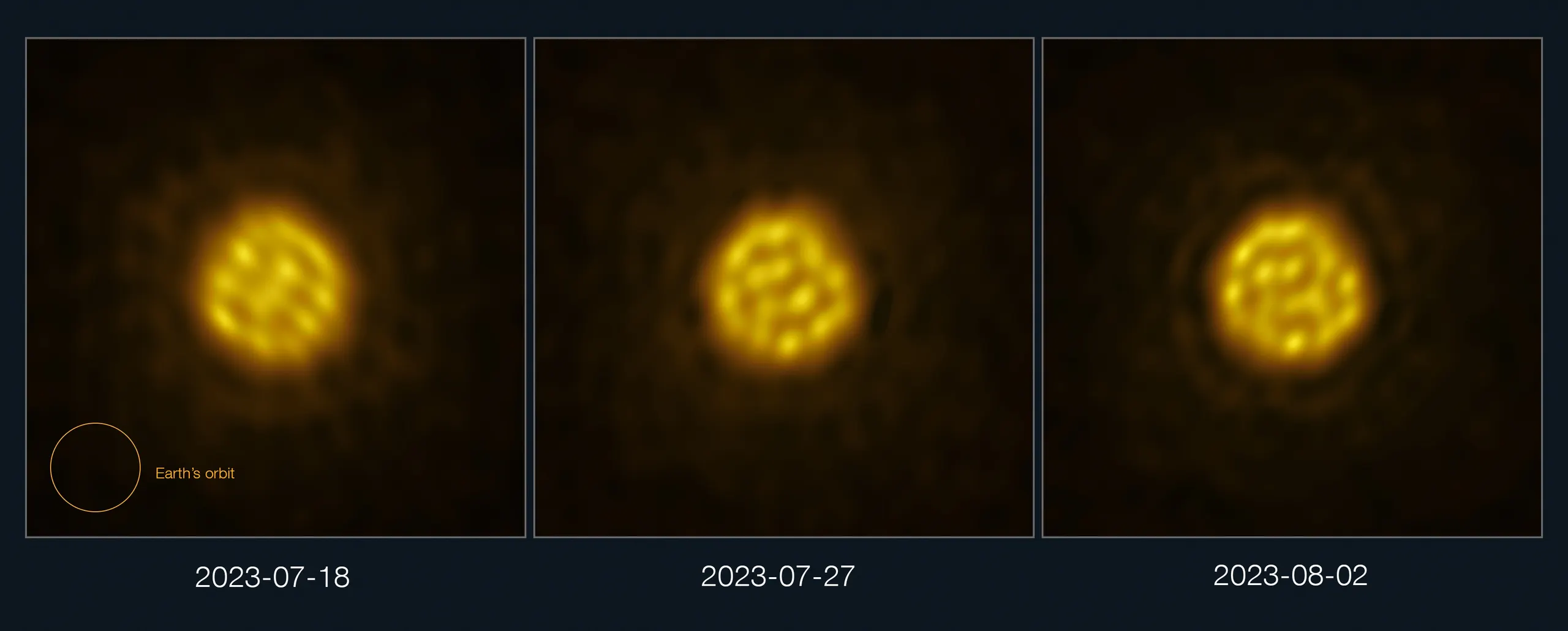 , open full size
The Sun as a red giant
The Sun will leave the main sequence about 5.4 billion years from now. In the model of Schröder and Smith (2008) it climbs the red giant branch to a peak of 2,730 times its present luminosity and 256 times its present radius, 1.2 AU, while losing a third of its mass in its wind; after the helium flash it shrinks to about 11 solar radii, and on the asymptotic giant branch it grows again to between 150 and 180 solar radii 1. As the Sun loses mass its planets drift outward, but in this model not far enough to save Earth, which is engulfed at the red giant tip. An earlier model, with less mass loss, stops the Sun at 170 solar radii, engulfing Mercury but sparing Venus and Earth 12. The difference shows how sensitive the outcome is to the red giant's wind, which is still the least certain part of the physics.
Planets around red giants
Planets are common around giants, and astronomers have now watched one being swallowed. In 2020 the Zwicky Transient Facility caught an outburst, bright in the infrared, from a Sun-like star swallowing a planet of up to about ten Jupiter masses 13. Others survive: 8 Ursae Minoris b orbits a helium-burning giant at 0.5 AU, inside the 0.7 AU radius the star should have reached earlier as a red giant, which suggests that the star's history was not that of a single star, perhaps a merger 14. Pollux, the nearest giant to the Sun, has a planet of at least 2.9 Jupiter masses on a 590-day orbit 15 16. Planet claims around giants need care, because the stars' own pulsations and spots can mimic a planet: a proposed planet around Aldebaran 17 is contradicted by later data, in which its 620-day signal is absent before about 2006 18.
Notable examples
| Star | Type | Distance | Notes |
|---|---|---|---|
| Pollux | K0IIIb | 10.4 pc | Nearest giant; planet on a 590-day orbit 15 |
| Arcturus | K1.5III | 11.3 pc | 4,286 K, 25.4 solar radii, 1.08 solar masses, about 7 billion years old; a metal-poor star of the thick disc 19 |
| Aldebaran | K5+III | 20.4 pc | Proposed planet disputed 17 18 |
| Gacrux | M3.5III | 27.2 pc | The red star at the top of the Southern Cross |
| pi1 Gruis | S-type AGB star | Giant convection cells imaged 10 | |
| R Doradus | M-type AGB star | Surface convection filmed over weeks 11 |
In Pax Abyssi
Pax Abyssi names giants by the colour of their spectral letter, so K giants such as Arcturus and Aldebaran are "orange giants" (code OGI), M giants such as Gacrux are "red giants" (RGI), and G giants are "yellow giants". Their subtypes follow the stages on this page: the lower and upper red giant branch, the red clump, the asymptotic giant branch, and pulsating Mira variables. The game's catalogue, which favours stars bright enough to see, holds about 24,600 K giants and 2,900 M giants, most of the evolved stars in the sky. Arcturus, Aldebaran, Pollux and Gacrux are all systems you can fly to, and giants keep planets: of the 1,325 evolved K stars in the flyable set, 705 have generated systems, and Arcturus has seven worlds. Every star's record also holds the remnant it will leave, and for stars below about eight solar masses that is a white dwarf.
Up close, each stage has its own surface. A red clump giant is gold-orange with hundreds of rounded convection cells. A giant higher on the branch is deep orange, with tens to hundreds of large, blobby cells and a very soft limb. An asymptotic giant branch star shows only 8 to 30 enormous cells across its whole disc, as pi1 Gruis does, and brightens and fades with its own pulsation.
See also
- Stellar classification
- G-type main-sequence star
- K-type main-sequence star
- Supergiant
- White dwarf
- Sol
References
- 1Schröder, K. P. and Connon Smith, R. (2008). Distant future of the Sun and Earth revisited. Monthly Notices of the Royal Astronomical Society 386, 155-163. doi:10.1111/j.1365-2966.2008.13022.x
- 2Reylé, C. et al. (2021). The 10 parsec sample in the Gaia era. Astronomy & Astrophysics 650, A201. doi:10.1051/0004-6361/202140985
- 3Bildsten, L. et al. (2012). Acoustic Signatures of the Helium Core Flash. The Astrophysical Journal Letters 744, L6. doi:10.1088/2041-8205/744/1/L6
- 4Freedman, W. L. et al. (2019). The Carnegie-Chicago Hubble Program. VIII. An Independent Determination of the Hubble Constant Based on the Tip of the Red Giant Branch. The Astrophysical Journal 882, 34. doi:10.3847/1538-4357/ab2f73
- 5Girardi, L. (2016). Red Clump Stars. Annual Review of Astronomy and Astrophysics 54, 95-133. doi:10.1146/annurev-astro-081915-023354
- 6Hawkins, K. et al. (2017). Red clump stars and Gaia: calibration of the standard candle using a hierarchical probabilistic model. Monthly Notices of the Royal Astronomical Society 471, 722-729. doi:10.1093/mnras/stx1655
- 7Bedding, T. R. et al. (2011). Gravity modes as a way to distinguish between hydrogen- and helium-burning red giant stars. Nature 471, 608-611. doi:10.1038/nature09935
- 8Herwig, F. (2005). Evolution of Asymptotic Giant Branch Stars. Annual Review of Astronomy and Astrophysics 43, 435-479. doi:10.1146/annurev.astro.43.072103.150600
- 9Kalirai, J. S. et al. (2008). The Initial-Final Mass Relation: Direct Constraints at the Low-Mass End. The Astrophysical Journal 676, 594-609. doi:10.1086/527028
- 10Paladini, C. et al. (2018). Large granulation cells on the surface of the giant star pi1 Gruis. Nature 553, 310-312. doi:10.1038/nature25001
- 11Vlemmings, W. et al. (2024). One month convection timescale on the surface of a giant evolved star. Nature 633, 323-326. doi:10.1038/s41586-024-07836-9
- 12Sackmann, I. J., Boothroyd, A. I. and Kraemer, K. E. (1993). Our Sun. III. Present and Future. The Astrophysical Journal 418, 457. doi:10.1086/173407
- 13De, K. et al. (2023). An infrared transient from a star engulfing a planet. Nature 617, 55-60. doi:10.1038/s41586-023-05842-x
- 14Hon, M. et al. (2023). A close-in giant planet escapes engulfment by its star. Nature 618, 917-920. doi:10.1038/s41586-023-06029-0
- 15Reffert, S. et al. (2006). Precise Radial Velocities of Giant Stars. II. Pollux and Its Planetary Companion. The Astrophysical Journal 652, 661-665. doi:10.1086/507516
- 16Hatzes, A. P. et al. (2006). Confirmation of the planet hypothesis for the long-period radial velocity variations of beta Geminorum. Astronomy & Astrophysics 457, 335-341. doi:10.1051/0004-6361:20065445
- 17Hatzes, A. P. et al. (2015). Long-lived, long-period radial velocity variations in Aldebaran: A planetary companion and stellar activity. Astronomy & Astrophysics 580, A31. doi:10.1051/0004-6361/201425519
- 18Reichert, K. et al. (2019). Precise radial velocities of giant stars. XII. Evidence against the proposed planet Aldebaran b. Astronomy & Astrophysics 625, A22. doi:10.1051/0004-6361/201834028
- 19Ramírez, I. and Allende Prieto, C. (2011). Fundamental Parameters and Chemical Composition of Arcturus. The Astrophysical Journal 743, 135. doi:10.1088/0004-637X/743/2/135