- On this page
- 2
- figures
- 2
- tables
- 33
- references
Redirected from T dwarf
Brown dwarf · BDL, BDT, BDY (as stars); BRD (as companions to stars)
Brown dwarf
ContentsShow
A brown dwarf is an object too massive to be a planet and too light to be a star. Brown dwarfs form like stars, from collapsing clouds of gas, but with less than about 75 times Jupiter's mass (0.07 solar masses) their cores never become hot enough to sustain hydrogen fusion 1 2. They shine instead with the heat of their formation, and a brief flicker of deuterium burning if they have more than about 13 Jupiter masses 3, then cool for ever, dimming from the dull red of an L dwarf through the methane-laden T class to the Y dwarfs, the coolest about as warm as a cool day on Earth. The first were confirmed in 1995 4 5. The latest census finds about one for every four stars 6.
Characteristics
Between a star and a planet
The line between the lightest stars and the heaviest brown dwarfs is set by fusion. An object must reach about 0.072 solar masses (about 75 Jupiter masses) at solar composition to fuse hydrogen steadily, and more, up to about 0.083 solar masses, if it is poor in heavy elements 1; a newer equation of state for hydrogen and helium gives 0.075 solar masses, about 78 Jupiter masses 2. Observations place the boundary near spectral type L2.5 and a temperature of about 2,075 K, where the radii of the lowest-mass stars reach a minimum 7.
The lower edge, where brown dwarfs meet planets, is set by deuterium, the heavy form of hydrogen, which fuses at lower temperatures. Objects above about 13 Jupiter masses burn most of their deuterium early in life; the exact threshold runs from about 11 to 16 Jupiter masses depending on composition and on how much deuterium must burn to count 3. The International Astronomical Union uses 13 Jupiter masses as the working upper limit for planets, a convention rather than a sharp physical line.
Lithium provides a test. Lithium is destroyed at slightly lower temperatures than hydrogen fuses, so a cool object that still shows lithium in its spectrum must be below about 0.06 solar masses and is a brown dwarf 1. The test, proposed by Rafael Rebolo and colleagues in 1992 8, confirmed Teide 1 in the Pleiades as a brown dwarf 9.
Jupiter-sized, whatever the mass
Brown dwarfs are held up mostly by electron degeneracy pressure, the resistance of electrons packed close together, and the result is that their radius barely depends on mass: across roughly two orders of magnitude in mass, from giant planets to the heaviest brown dwarfs, old objects all have about Jupiter's radius 10. A 70 Jupiter-mass brown dwarf is about the size of Jupiter but some 70 times as dense, with a surface gravity 70 to 100 times Jupiter's.
Cooling for ever
With no steady energy source, a brown dwarf cools and fades throughout its life. For older objects the effective temperature follows approximately 10
where is the age and the mass. A brown dwarf of 50 Jupiter masses (0.048 solar masses) is about 1,500 K at one billion years old, an L dwarf, but about 900 K at five billion years, a T dwarf. One of 13 Jupiter masses has already cooled to about 490 K at one billion years. So a brown dwarf's spectral type is not a fixed property like a star's: it records a combination of mass and age, and every brown dwarf moves down through the classes as it ages.
The L, T and Y classes
Brown dwarfs and the coolest stars needed spectral classes beyond M.
| Class | Temperature (approx.) | Hallmarks | Defined |
|---|---|---|---|
| L | about 2,200 to 1,300 K | Metal hydrides and alkali metals; dust clouds of silicates and iron make them very red | 1999 11 |
| T | about 1,300 to 500 K | Methane absorption; the clouds sink out of sight | Gliese 229B, 1995 12 13 |
| Y | below about 500 K | Ammonia absorption joins water and methane | 2011, from WISE 14 |
Temperatures are approximate and vary with the author and with each object's gravity and composition 15 16. The first L and T dwarfs came from infrared sky surveys in the 1990s, and by 2005 more than 450 were known 13. The Y class was established when the WISE satellite found objects with tentative signs of ammonia in their spectra and temperatures of perhaps 300 to 500 K 14.
Clouds and the L/T transition
In L dwarfs, grains of silicate rock and iron condense into thick clouds. Models in which these clouds form and rain out, with the rate of settling as the key parameter, explain how L dwarfs grow redder and dustier 17. Then, over a narrow range of temperature near 1,200 to 1,350 K, brown dwarfs turn rapidly from red to blue in the near-infrared as the clouds break up and sink below the visible atmosphere. Brown dwarfs appear to linger in this L/T transition: the 20-parsec census shows a pile-up of objects at these temperatures, as if cooling slows there 15. In the coldest Y dwarfs water itself should condense, forming water-ice clouds below about 450 K that become thick below about 350 to 375 K 18.
Weather
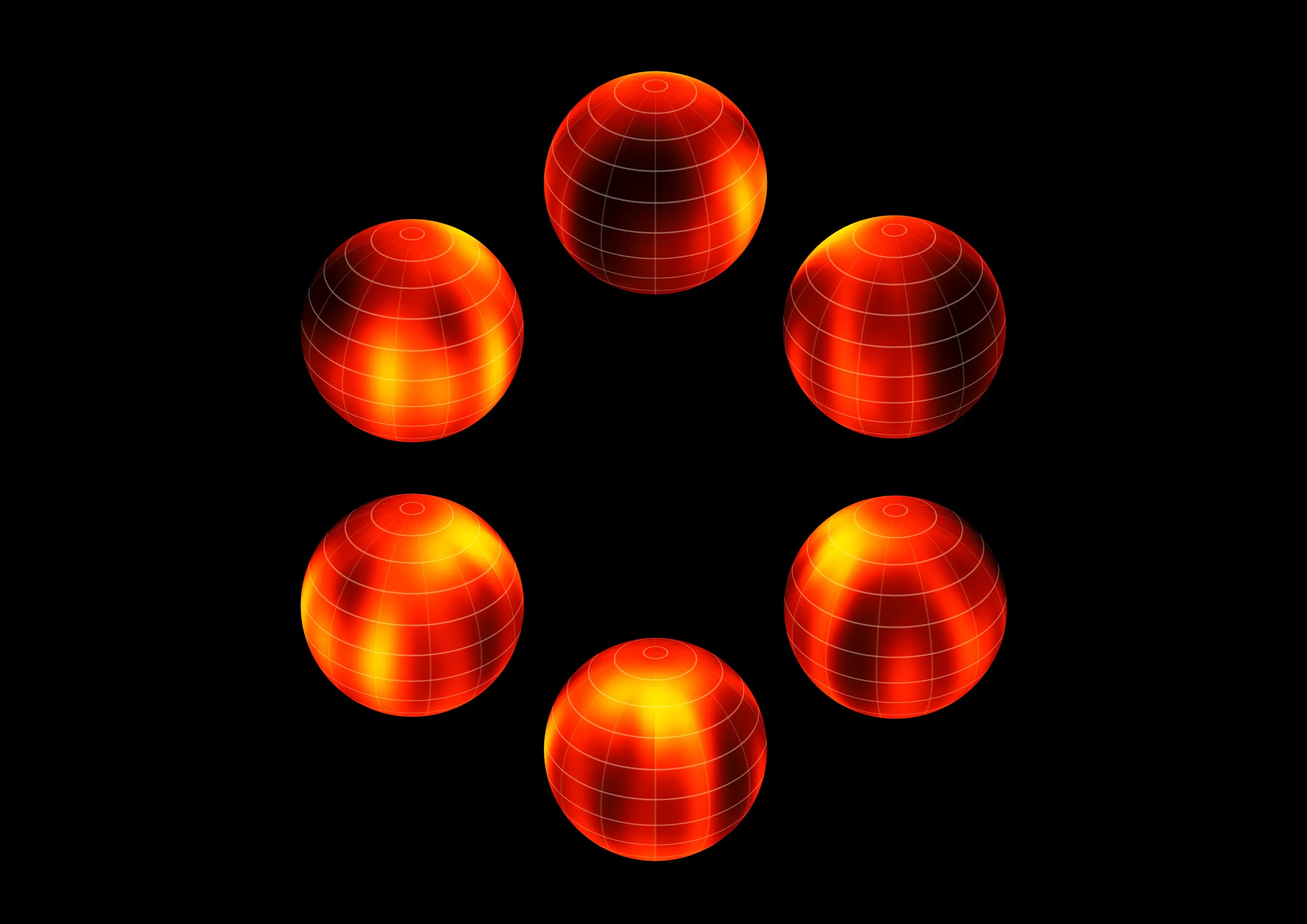
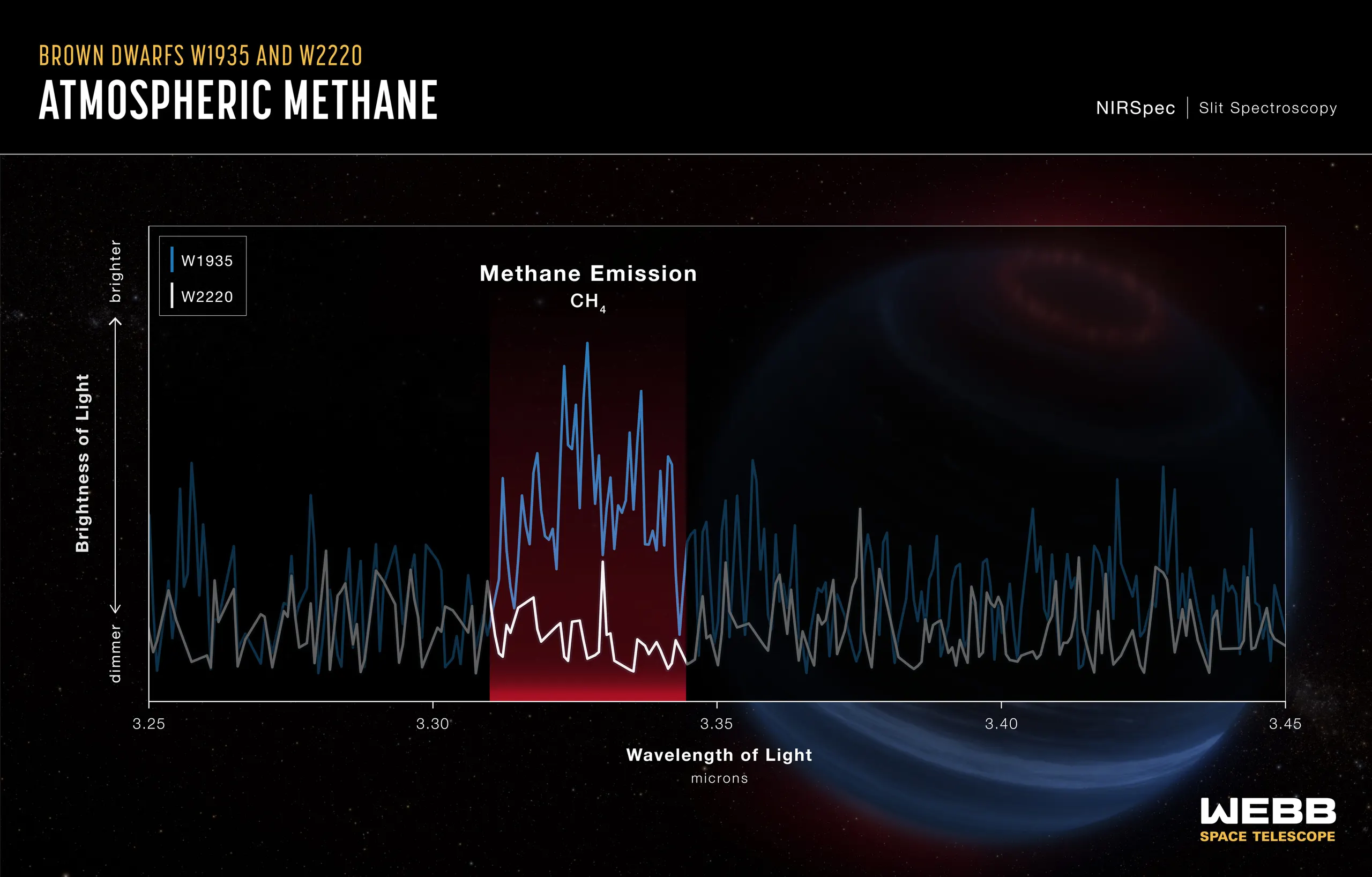
Brown dwarfs rotate in hours and have weather. Their brightness in the infrared varies as cloudy and clearer patches rotate into view: about 80% of L dwarfs vary by more than 0.2% and about 36% of T dwarfs by more than 0.4% 19, and the largest variations, above 2%, are found at the L/T transition, where clouds are breaking up 20. By following how the spectrum of Luhman 16B changed as it rotated, astronomers made the first map of the clouds on a brown dwarf 21. JWST found methane glowing in emission from the isolated cold brown dwarf W1935, which needs a warm upper atmosphere; an aurora is a plausible explanation, which is surprising in an object with no star nearby to power it 22.
 , open full size
Discovery
The first brown dwarfs were confirmed in 1995. Teide 1, in the Pleiades cluster, was announced by Rafael Rebolo's team 4 and confirmed by the lithium test 9; Gliese 229B, a companion to a nearby red dwarf, was found the same year 5, and its spectrum showed methane, like Jupiter's and unlike any star's, the signature of a surface cooler than about 1,000 K 12. Gliese 229B later posed a puzzle: its orbit gave it about 70 Jupiter masses 23, far too much for its faintness. In 2024 it was resolved into two brown dwarfs, Gliese 229 Ba and Bb, of 38.1 and 34.4 Jupiter masses, orbiting each other every 12.1 days at 0.042 AU, sixteen times the distance from the Earth to the Moon 24 25.
How many are there?
A census of the 20 parsecs around the Sun counts 525 L, T and Y dwarfs 15, and a full census of about 3,600 stars and brown dwarfs in the same volume gives, after correcting for those not yet found, one brown dwarf for every four stars 6. The coldest are still being discovered, and objects below 400 K must exist in large numbers 15. Brown dwarfs are rare, however, as close companions to Sun-like stars: fewer than 1% of such stars have a brown dwarf on an orbit shorter than about five years, against about 5% with a giant planet and 11% with a stellar companion, a gap called the brown dwarf desert 26.
At the other end of the mass range, JWST observations of the young cluster IC 348 found brown dwarfs of only about two Jupiter masses, some showing a 3.4-micrometre absorption band from aliphatic hydrocarbons, for which the authors proposed a new spectral class, H 27.
Notable examples
| Object | Type | Distance | Notes |
|---|---|---|---|
| Luhman 16 A and B | L8 and early T | 1.99 pc (6.5 ly) | Nearest brown dwarfs; 33.5 and 28.6 Jupiter masses; first weather map 28 29 21 |
| WISE 0855-0714 | about Y4 | 2.28 pc (7.4 ly) | Coldest known brown dwarf, about 285 K; water clouds suspected but not confirmed 15 30 31 |
| Gliese 229 Ba and Bb | T | 5.8 pc | First T dwarf; a tight binary of 38.1 and 34.4 Jupiter masses 5 24 |
| Epsilon Indi Ba and Bb | T1 to T1.5 and T6 | 3.6 pc | 66.9 and 53.3 Jupiter masses, orbiting a K dwarf 32 |
| Teide 1 | late M | about 135 pc (Pleiades) | One of the first brown dwarfs confirmed 4 9 |
| W1935 | cold brown dwarf | About 482 K; methane emission, a possible aurora 22 |
WISE 0855-0714 is the coldest known brown dwarf. It was found in 2014 at about 2 parsecs, moving across the sky at 8 arcseconds a year 33. JWST spectra fit a temperature of about 285 K, with carbon monoxide but no phosphine 30, and mid-infrared spectra show water depleted as if condensing, though no clear sign of water-ice clouds has yet been found 31.
 , open full size
In Pax Abyssi
Brown dwarfs are three stellar classes in the simulation, L, T and Y (codes BDL, BDT and BDY), each divided into early, mid and late subtypes and into cloud states: thick, patchy or thin clouds for L and Y dwarfs, and banded, patchy or uniform for T dwarfs. Each class has a physics engine that sets temperature, mass and radius from the subclass, and the galaxy map gives L, T and Y dwarfs classes of their own. No brown dwarf is bright enough to see without a large telescope, so none is in the naked-eye sky that the game's flyable stars are drawn from; they arrive with the generated galaxy, whose Milky Way model holds about 22 billion of them, one for every five stars.
See also
References
- 1Chabrier, G. and Baraffe, I. (2000). Theory of Low-Mass Stars and Substellar Objects. Annual Review of Astronomy and Astrophysics 38, 337-377. doi:10.1146/annurev.astro.38.1.337
- 2Chabrier, G. et al. (2023). Impact of a new H/He equation of state on the evolution of massive brown dwarfs. Astronomy & Astrophysics 671, A119. doi:10.1051/0004-6361/202243832
- 3Spiegel, D. S., Burrows, A. and Milsom, J. A. (2011). The Deuterium-burning Mass Limit for Brown Dwarfs and Giant Planets. The Astrophysical Journal 727, 57. doi:10.1088/0004-637X/727/1/57
- 4Rebolo, R., Osorio, M. R. Z. and Martín, E. L. (1995). Discovery of a brown dwarf in the Pleiades star cluster. Nature 377, 129-131. doi:10.1038/377129a0
- 5Nakajima, T. et al. (1995). Discovery of a cool brown dwarf. Nature 378, 463-465. doi:10.1038/378463a0
- 6Kirkpatrick, J. D. et al. (2024). The Initial Mass Function Based on the Full-sky 20 pc Census of ~3600 Stars and Brown Dwarfs. The Astrophysical Journal Supplement Series 271, 55. doi:10.3847/1538-4365/ad24e2
- 7Dieterich, S. B. et al. (2014). The Solar Neighborhood. XXXII. The Hydrogen Burning Limit. The Astronomical Journal 147, 94. doi:10.1088/0004-6256/147/5/94
- 8Rebolo, R., Martin, E. L. and Magazzu, A. (1992). Spectroscopy of a brown dwarf candidate in the Alpha Persei open cluster. The Astrophysical Journal Letters 389, L83. doi:10.1086/186354
- 9Rebolo, R. et al. (1996). Brown Dwarfs in the Pleiades Cluster Confirmed by the Lithium Test. The Astrophysical Journal Letters 469, L53-L56. doi:10.1086/310263
- 10Burrows, A. et al. (2001). The theory of brown dwarfs and extrasolar giant planets. Reviews of Modern Physics 73, 719-765. doi:10.1103/RevModPhys.73.719
- 11Kirkpatrick, J. D. et al. (1999). Dwarfs Cooler than "M": The Definition of Spectral Type "L" Using Discoveries from the 2 Micron All-Sky Survey (2MASS). The Astrophysical Journal 519, 802-833. doi:10.1086/307414
- 12Oppenheimer, B. R. et al. (1995). Infrared Spectrum of the Cool Brown Dwarf Gl 229B. Science 270, 1478-1479. doi:10.1126/science.270.5241.1478
- 13Kirkpatrick, J. D. (2005). New Spectral Types L and T. Annual Review of Astronomy and Astrophysics 43, 195-245. doi:10.1146/annurev.astro.42.053102.134017
- 14Cushing, M. C. et al. (2011). The Discovery of Y Dwarfs Using Data from the Wide-field Infrared Survey Explorer (WISE). The Astrophysical Journal 743, 50. doi:10.1088/0004-637X/743/1/50
- 15Kirkpatrick, J. D. et al. (2021). The Field Substellar Mass Function Based on the Full-sky 20 pc Census of 525 L, T, and Y Dwarfs. The Astrophysical Journal Supplement Series 253, 7. doi:10.3847/1538-4365/abd107
- 16Beiler, S. A. et al. (2024). Precise Bolometric Luminosities and Effective Temperatures of 23 Late-T and Y Dwarfs Obtained with JWST. The Astrophysical Journal 973, 107. doi:10.3847/1538-4357/ad6301
- 17Ackerman, A. S. and Marley, M. S. (2001). Precipitating Condensation Clouds in Substellar Atmospheres. The Astrophysical Journal 556, 872-884. doi:10.1086/321540
- 18Morley, C. V. et al. (2014). Water Clouds in Y Dwarfs and Exoplanets. The Astrophysical Journal 787, 78. doi:10.1088/0004-637X/787/1/78
- 19Metchev, S. A. et al. (2015). Weather on Other Worlds. II. Survey Results: Spots Are Ubiquitous on L and T Dwarfs. The Astrophysical Journal 799, 154. doi:10.1088/0004-637X/799/2/154
- 20Radigan, J. et al. (2014). Strong Brightness Variations Signal Cloudy-to-clear Transition of Brown Dwarfs. The Astrophysical Journal 793, 75. doi:10.1088/0004-637X/793/2/75
- 21Crossfield, I. J. M. et al. (2014). A global cloud map of the nearest known brown dwarf. Nature 505, 654-656. doi:10.1038/nature12955
- 22Faherty, J. K. et al. (2024). Methane emission from a cool brown dwarf. Nature 628, 511-514. doi:10.1038/s41586-024-07190-w
- 23Brandt, T. D. et al. (2020). A Dynamical Mass of 70 ± 5 MJup for Gliese 229B, the First T Dwarf. The Astronomical Journal 160, 196. doi:10.3847/1538-3881/abb45e
- 24Xuan, J. W. et al. (2024). The cool brown dwarf Gliese 229 B is a close binary. Nature 634, 1070-1074. doi:10.1038/s41586-024-08064-x
- 25Whitebook, S. et al. (2024). Discovery of the Binarity of Gliese 229B, and Constraints on the System's Properties. The Astrophysical Journal Letters 974, L30. doi:10.3847/2041-8213/ad7714
- 26Grether, D. and Lineweaver, C. H. (2006). How Dry is the Brown Dwarf Desert? Quantifying the Relative Number of Planets, Brown Dwarfs, and Stellar Companions around Nearby Sun-like Stars. The Astrophysical Journal 640, 1051-1062. doi:10.1086/500161
- 27Luhman, K. L. and Alves de Oliveira, C. (2025). A New Spectral Class of Brown Dwarfs at the Bottom of the IMF in IC 348. The Astrophysical Journal Letters 986, L14. doi:10.3847/2041-8213/addc55
- 28Luhman, K. L. (2013). Discovery of a Binary Brown Dwarf at 2 pc from the Sun. The Astrophysical Journal Letters 767, L1. doi:10.1088/2041-8205/767/1/L1
- 29Lazorenko, P. F. and Sahlmann, J. (2018). Updated astrometry and masses of the LUH 16 brown dwarf binary. Astronomy & Astrophysics 618, A111. doi:10.1051/0004-6361/201833626
- 30Luhman, K. L. et al. (2024). JWST/NIRSpec Observations of the Coldest Known Brown Dwarf. The Astronomical Journal 167, 5. doi:10.3847/1538-3881/ad0b72
- 31Kühnle, H. et al. (2025). Water depletion and 15NH3 in the atmosphere of the coldest brown dwarf observed with JWST/MIRI. Astronomy & Astrophysics 695, A224. doi:10.1051/0004-6361/202452547
- 32Chen, M. et al. (2022). Precise Dynamical Masses of epsilon Indi Ba and Bb: Evidence of Slowed Cooling at the L/T Transition. The Astronomical Journal 163, 288. doi:10.3847/1538-3881/ac66d2
- 33Luhman, K. L. (2014). Discovery of a ~250 K Brown Dwarf at 2 pc from the Sun. The Astrophysical Journal Letters 786, L18. doi:10.1088/2041-8205/786/2/L18