- On this page
- 2
- figures
- 2
- tables
- 1
- panel
- 22
- references
Planet class · GGC · G1-C
Cold gas giant
ContentsShow
A cold gas giant is a gas giant far enough from its star that its upper atmosphere is cold enough, below about 150 K, for ammonia to freeze into clouds. Jupiter and Saturn are the two in the Solar System, and they are the planets on which almost everything known about giant planets was learned. A cold giant's own internal heat is comparable to the sunlight it absorbs, its weather is organised into bands by rapid rotation, and it can keep a large family of moons and rings. In the Sudarsky classification these are Class I, the "Jovian" giants. Among exoplanets they are called cold Jupiters, and around Sun-like stars they are the most common kind of giant.
Characteristics
A planet heated from within
Jupiter orbits at 5.2 AU, where sunlight is about 27 times weaker than at Earth. Its equilibrium temperature, the temperature sunlight alone would give it, is about 102 K. Yet Jupiter radiates 7.5 watts per square metre of its own heat on top of the sunlight it re-emits, a little more than it absorbs from the Sun, so its effective temperature is about 125 K 1. That heat is left over from formation and is released as the planet slowly contracts and as helium settles out of its interior. The Galileo probe found helium depleted in Jupiter's upper atmosphere, a sign that helium is raining out below 2; Saturn, smaller and colder, has lost more of its helium to the depths 3. Internal heat keeps the deep atmosphere convecting and so drives the weather and the magnetic field.
Three cloud decks
A cold giant's atmosphere gets warmer with depth, and three clouds form where the temperature crosses the condensation point of a trace gas 4 5.
| Deck | Approximate pressure (Jupiter) | Composition | Appearance |
|---|---|---|---|
| Upper | about 0.7 bar | Ammonia (NH3) ice | White; the visible cloud tops of the zones |
| Middle | about 2 bar | Ammonium hydrosulfide (NH4SH), formed from ammonia and hydrogen sulfide | Seen through gaps in the belts |
| Lower | about 5 bar | Water ice and liquid water | Home of the deepest convective storms and lightning |
Saturn has the same decks, but because Saturn is colder each forms deeper, under a thicker layer of haze, which is one reason Saturn looks softer and more muted than Jupiter. Juno's microwave instrument can see below the clouds and found water at about 2.5 times the solar proportion at Jupiter's equator, with a wide uncertainty 6, and ammonia depleted to surprising depths, which may be carried down by slushy hailstones of ammonia and water called "mushballs" 7.
The colours are the least understood part. Pure ammonia ice is white, and the tans, browns and reds of the belts and the Great Red Spot come from small amounts of coloured material called chromophores, whose chemistry has not been identified. A leading laboratory candidate forms when sunlight breaks up ammonia and the fragments react with acetylene, making a reddish material whose spectrum matches the Great Red Spot's 8. Sulfur and phosphorus compounds are other candidates. Because these absorbers darken the planet at blue and ultraviolet wavelengths, Jupiter reflects about half of the sunlight that reaches it (a Bond albedo of 0.503) rather than the higher value a clean ammonia cloud would give 1.
Belts, zones and jets
A cold giant spins fast: Jupiter's day is 9.9 hours and Saturn's 10.7 9 10. The rotation stretches the weather into bands. Bright zones and darker belts alternate with latitude, separated by jet streams that blow alternately east and west. Jupiter's fastest jets blow at about 150 m/s 11; Saturn's reaches 370 to 450 m/s, among the fastest steady winds in the Solar System 12. The jets are not a thin surface layer. Juno measured the slight north-south asymmetry they impose on Jupiter's gravity field and found that they extend about 3,000 km down 13.
Storms and polar vortices
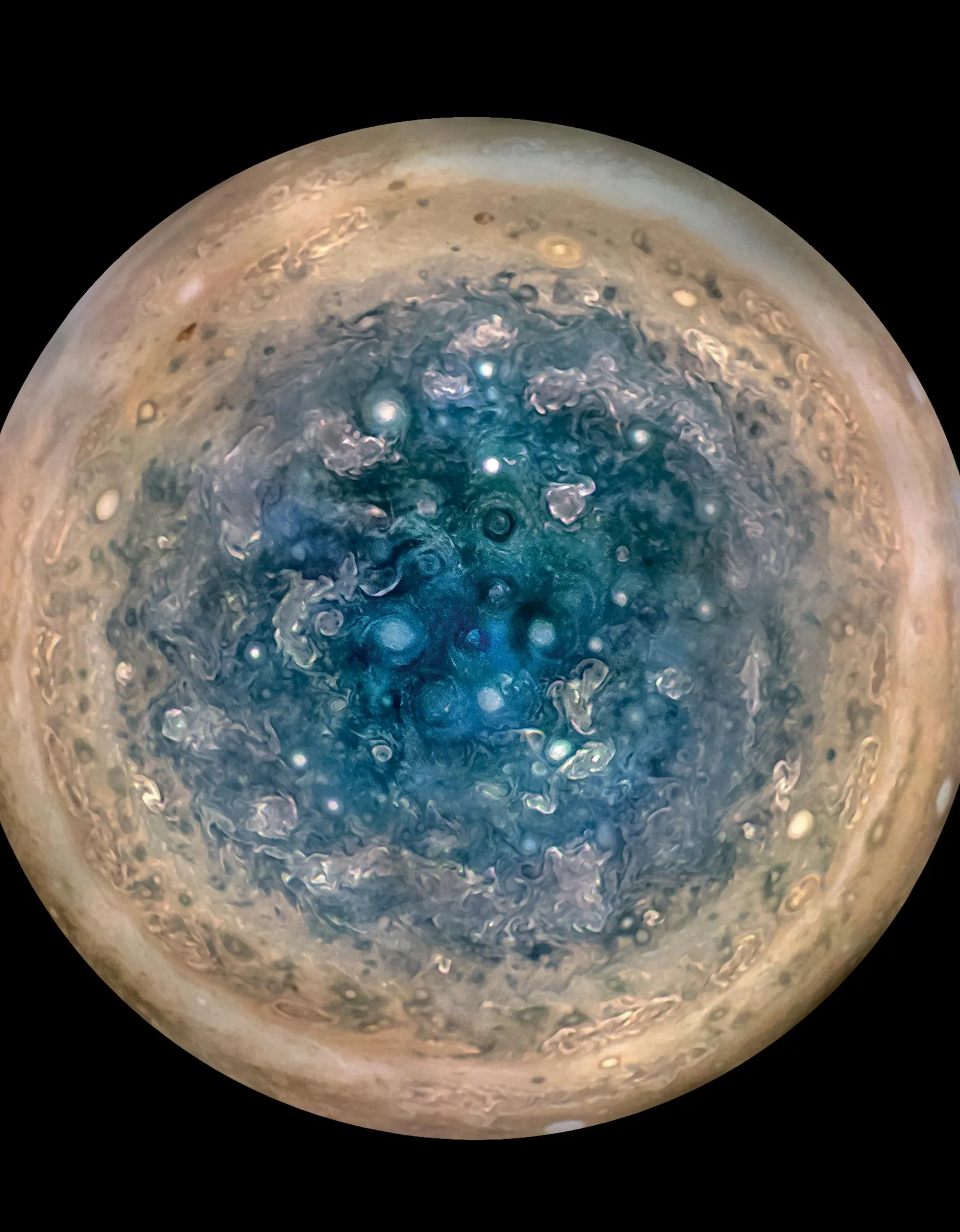
Long-lived storms sit between the jets. The Great Red Spot, an anticyclone larger than Earth, has been watched for more than 150 years; it is shrinking in length by about 0.19 degrees of longitude a year and drifting westward faster than it did in the 1980s 14. Juno found Jupiter's poles unlike anything seen before: eight cyclones arranged in a ring around one at the north pole and five around one at the south 15. Saturn's north pole is circled by a jet that meanders into a six-sided wave, the hexagon, first seen in Voyager images 16.
Moons and rings
Far from their stars, cold giants have large Hill spheres, the regions where their gravity dominates, and they can hold many moons. As of 26 March 2026 the International Astronomical Union's Minor Planet Center lists 101 known moons of Jupiter and 285 of Saturn; most are small, distant captured bodies, and the count rises every year 17. Both planets have rings. Saturn's bright rings are almost pure water ice, and their age is disputed: the slow rain of dark micrometeoroid dust measured by Cassini suggests they are no more than a few hundred million years old 18, while impact simulations suggest that much of that dust vaporises and is removed, which would allow the rings to be as old as the planet 19.
Formation and evolution
Cold giants are thought to form by core accretion beyond the snow line, where ice adds to the solid material available to build a core of about ten Earth masses before the gas disc disperses (see Gas giant). Most stay where they formed or near it. Radial-velocity surveys find giant planets about four times more common beyond 1 AU than inside it, with about 14 per 100 Sun-like stars between 2 and 8 AU 20. After formation, a cold giant cools and contracts for billions of years; its internal heat fades, its helium rains inward, and its cloud decks settle slowly deeper.
How we know
Almost everything known in detail comes from the Solar System: Pioneer and Voyager flybys, the Galileo orbiter and its atmospheric probe, Cassini's thirteen years at Saturn, and Juno at Jupiter since 2016, alongside decades of telescope monitoring. Around other stars, cold giants are hard to find. Their orbits take years, so radial-velocity surveys need long baselines, and few transit. Kepler-167 e is one that does: a Jupiter-sized planet on a 1,071-day orbit around a K dwarf 21. Direct imaging can see giants that still glow with youth or internal heat; JWST imaged epsilon Indi Ab, a cold giant of about six Jupiter masses whose effective temperature of about 275 K comes almost entirely from its interior 22.
Notable examples
| Planet | Mass | Radius | Orbit | Notes |
|---|---|---|---|---|
| Jupiter | 317.8 Earth masses | 71,492 km | 5.20 AU | Bond albedo 0.503; 101 known moons 9 1 17 |
| Saturn | 95.2 Earth masses | 60,268 km | 9.6 AU | Less dense than water; 285 known moons 10 17 |
| Kepler-167 e | about 0.9 R_Jup | 1,071 days | A transiting Jupiter analogue around a K dwarf 21 | |
| epsilon Indi Ab | about 6 M_Jup | about 200 years | Imaged by JWST; about 275 K 22 |
See also
References
- 1Li, L. et al. (2018). Less absorbed solar energy and more internal heat for Jupiter. Nature Communications 9, 3709. doi:10.1038/s41467-018-06107-2
- 2von Zahn, U., Hunten, D. M. and Lehmacher, G. (1998). Helium in Jupiter's atmosphere: Results from the Galileo probe Helium Interferometer Experiment. Journal of Geophysical Research: Planets 103, 22815-22829. doi:10.1029/98JE00695
- 3Mankovich, C. R. and Fortney, J. J. (2020). Evidence for a Dichotomy in the Interior Structures of Jupiter and Saturn from Helium Phase Separation. The Astrophysical Journal 889, 51. doi:10.3847/1538-4357/ab6210
- 4Weidenschilling, S. J. and Lewis, J. S. (1973). Atmospheric and cloud structures of the Jovian planets. Icarus 20, 465-476. doi:10.1016/0019-1035(73)90019-5
- 5Atreya, S. K. et al. (1999). A comparison of the atmospheres of Jupiter and Saturn: deep atmospheric composition, cloud structure, vertical mixing, and origin. Planetary and Space Science 47, 1243-1262. doi:10.1016/S0032-0633(99)00047-1
- 6Li, C. et al. (2020). The water abundance in Jupiter's equatorial zone. Nature Astronomy 4, 609-616. doi:10.1038/s41550-020-1009-3
- 7Guillot, T. et al. (2020). Storms and the Depletion of Ammonia in Jupiter: I. Microphysics of "Mushballs". Journal of Geophysical Research: Planets 125, e2020JE006403. doi:10.1029/2020JE006403
- 8Carlson, R. W. et al. (2016). Chromophores from photolyzed ammonia reacting with acetylene: Application to Jupiter's Great Red Spot. Icarus 274, 106-115. doi:10.1016/j.icarus.2016.03.008
- 9NASA Space Science Data Coordinated Archive. Jupiter Fact Sheet. nssdc.gsfc.nasa.gov/planetary/factsheet/jupiterfact.html
- 10NASA Space Science Data Coordinated Archive. Saturn Fact Sheet. nssdc.gsfc.nasa.gov/planetary/factsheet/saturnfact.html
- 11Tollefson, J. et al. (2017). Changes in Jupiter's Zonal Wind Profile preceding and during the Juno mission. Icarus 296, 163-178. doi:10.1016/j.icarus.2017.06.007
- 12García-Melendo, E. et al. (2011). Saturn's zonal wind profile in 2004-2009 from Cassini ISS images and its long-term variability. Icarus 215, 62-74. doi:10.1016/j.icarus.2011.07.005
- 13Kaspi, Y. et al. (2018). Jupiter's atmospheric jet streams extend thousands of kilometres deep. Nature 555, 223-226. doi:10.1038/nature25793
- 14Simon, A. A. et al. (2018). Historical and Contemporary Trends in the Size, Drift, and Color of Jupiter's Great Red Spot. The Astronomical Journal 155, 151. doi:10.3847/1538-3881/aaae01
- 15Adriani, A. et al. (2018). Clusters of cyclones encircling Jupiter's poles. Nature 555, 216-219. doi:10.1038/nature25491
- 16Godfrey, D. A. (1988). A hexagonal feature around Saturn's north pole. Icarus 76, 335-356. doi:10.1016/0019-1035(88)90075-9
- 17International Astronomical Union (2026). IAU Minor Planet Center Confirms New Moons of Saturn and Jupiter. www.iau.org/IAU/IAU/News/Ann2026/MPC-New-Moons-Saturn-Jupiter.aspx
- 18Kempf, S. et al. (2023). Micrometeoroid infall onto Saturn's rings constrains their age to no more than a few hundred million years. Science Advances 9, eadf8537. doi:10.1126/sciadv.adf8537
- 19Hyodo, R., Genda, H. and Madeira, G. (2025). Pollution resistance of Saturn's ring particles during micrometeoroid impact. Nature Geoscience 18, 44-49. doi:10.1038/s41561-024-01598-9
- 20Fulton, B. J. et al. (2021). California Legacy Survey. II. Occurrence of Giant Planets beyond the Ice Line. The Astrophysical Journal Supplement Series 255, 14. doi:10.3847/1538-4365/abfcc1
- 21Kipping, D. M. et al. (2016). A Transiting Jupiter Analog. The Astrophysical Journal 820, 112. doi:10.3847/0004-637X/820/2/112
- 22Matthews, E. C. et al. (2024). A temperate super-Jupiter imaged with JWST in the mid-infrared. Nature 633, 789-792. doi:10.1038/s41586-024-07837-8