- On this page
- 2
- figures
- 1
- table
- 1
- panel
- 18
- references
Planet class · TIW · T3-I
Ice world
ContentsShow
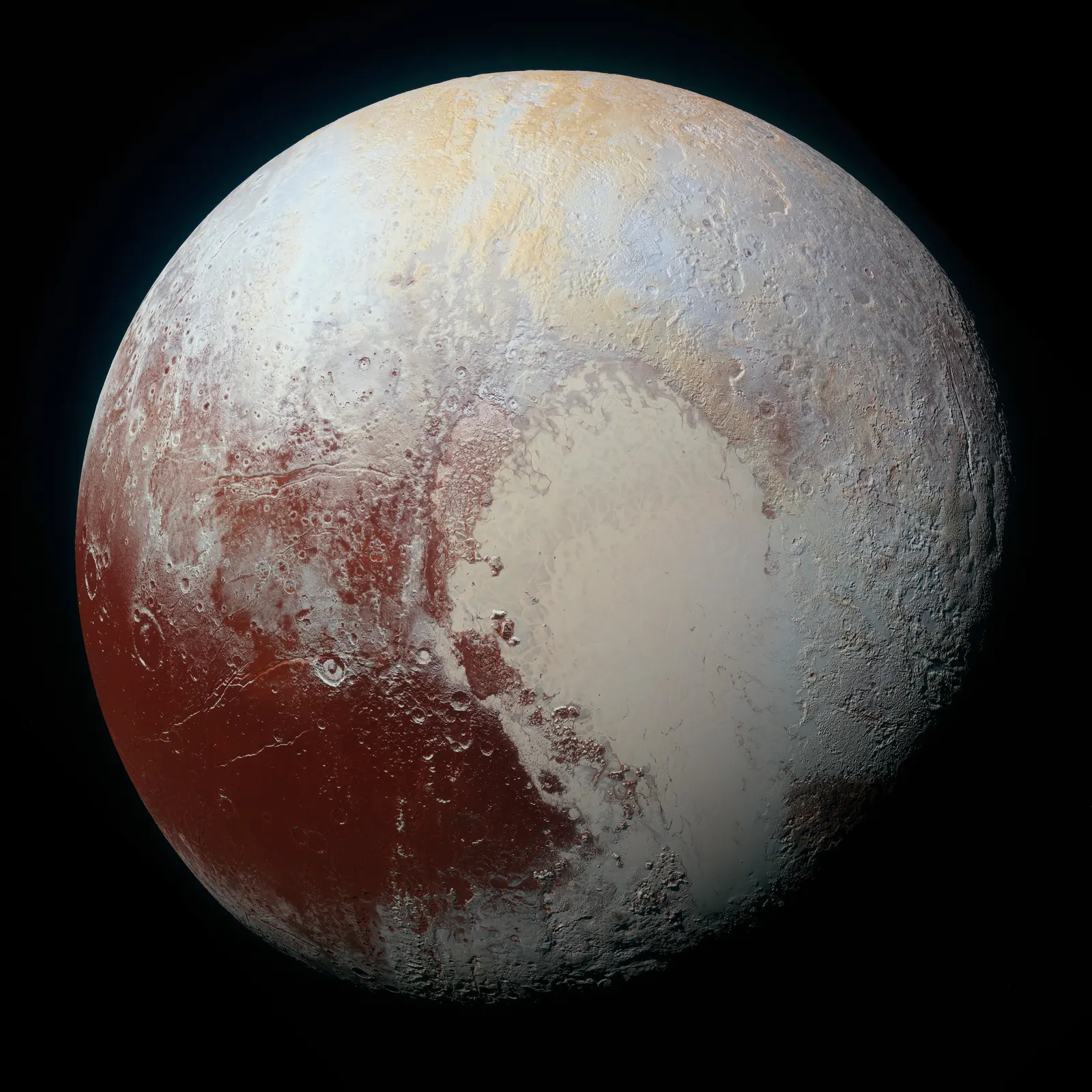
An ice world is a world cold enough that the familiar gases of Earth's air freeze solid. Its crust is water ice as hard as granite, and on top of it lie softer ices of nitrogen, methane and carbon monoxide that flow as glaciers, sublimate in sunlight and fall again as frost. Pluto and Neptune's moon Triton are the best-studied examples, with the dwarf planets Eris and Makemake close behind. In Pax Abyssi the class is also generated as planets in the outer reaches of other systems, many of them far larger than Pluto.
Characteristics
Cold enough to freeze air
At Pluto's average distance of 39.5 AU the Sun delivers less than a thousandth of the light Earth receives. With a Bond albedo around 0.7, the equilibrium temperature (see Planet classification) is only about 32 K. The measured surface is a little warmer, about 40 K, because dark regions absorb more light and heat is stored in the ground. At these temperatures water ice behaves as bedrock and can hold up mountains several kilometres high, while nitrogen ice, which melts at 63 K, is soft enough to flow.
The atmosphere is set by the ices. Nitrogen at the surface evaporates until the gas pressure matches the vapour pressure of the ice, which depends very steeply on temperature. On Pluto that balance gives about 10 microbar, a hundred-thousandth of Earth's surface pressure, with traces of methane and carbon monoxide 1. A change of a couple of kelvin in the temperature of the nitrogen ice changes the pressure several-fold, so the atmosphere follows the seasons. Pluto's surface pressure roughly tripled between 1988 and 2016 as its long northern spring advanced 2, and far from the Sun it may largely freeze onto the ground.
Keeping the ices
Whether a small body can keep nitrogen and methane at all depends on how fast those molecules escape. The key number is the Jeans escape parameter, the ratio of a molecule's gravitational binding energy to its thermal energy at the top of the atmosphere:
where is the body's mass, the molecular mass, the temperature and the radius at which molecules can escape. When is large, few molecules are fast enough to leave. Schaller and Brown (2007) worked through this over the age of the Solar System and showed that only the largest, coldest Kuiper belt objects (Pluto, Eris, Makemake and perhaps Quaoar) should retain nitrogen, methane and carbon monoxide at their surfaces, which matches what telescopes see 3. Smaller bodies at the same distance keep only water ice.
Colour and chemistry
Ultraviolet light and charged particles break methane and nitrogen apart in the upper atmosphere and on the surface. The fragments recombine into larger organic molecules, and eventually into a reddish-brown residue called tholin. On Pluto the process runs through about twenty stacked layers of haze reaching more than 200 km above the ground 1. The haze settles out and stains the old, stable terrain dark red, while fresh nitrogen frost keeps other regions bright; the result is one of the most varied surfaces in the Solar System.
Geology
New Horizons found Pluto far more active than expected 4. Its heart-shaped Sputnik Planitia is a basin about 1,000 km across filled with nitrogen ice several kilometres deep. The ice slowly overturns in convection cells tens of kilometres wide, erasing craters so thoroughly that the surface must be younger than about 10 million years 5 6. Nitrogen glaciers flow down into it from the surrounding uplands, and ranges of water-ice mountains float in it like icebergs. The basin's position, almost exactly opposite Charon, suggests that a dense mass beneath it tipped the whole planet over, which is easiest to explain if a liquid water ocean lies under the shell 7. A thin layer of gas hydrates at the top of that ocean could insulate it well enough to survive to the present 8.
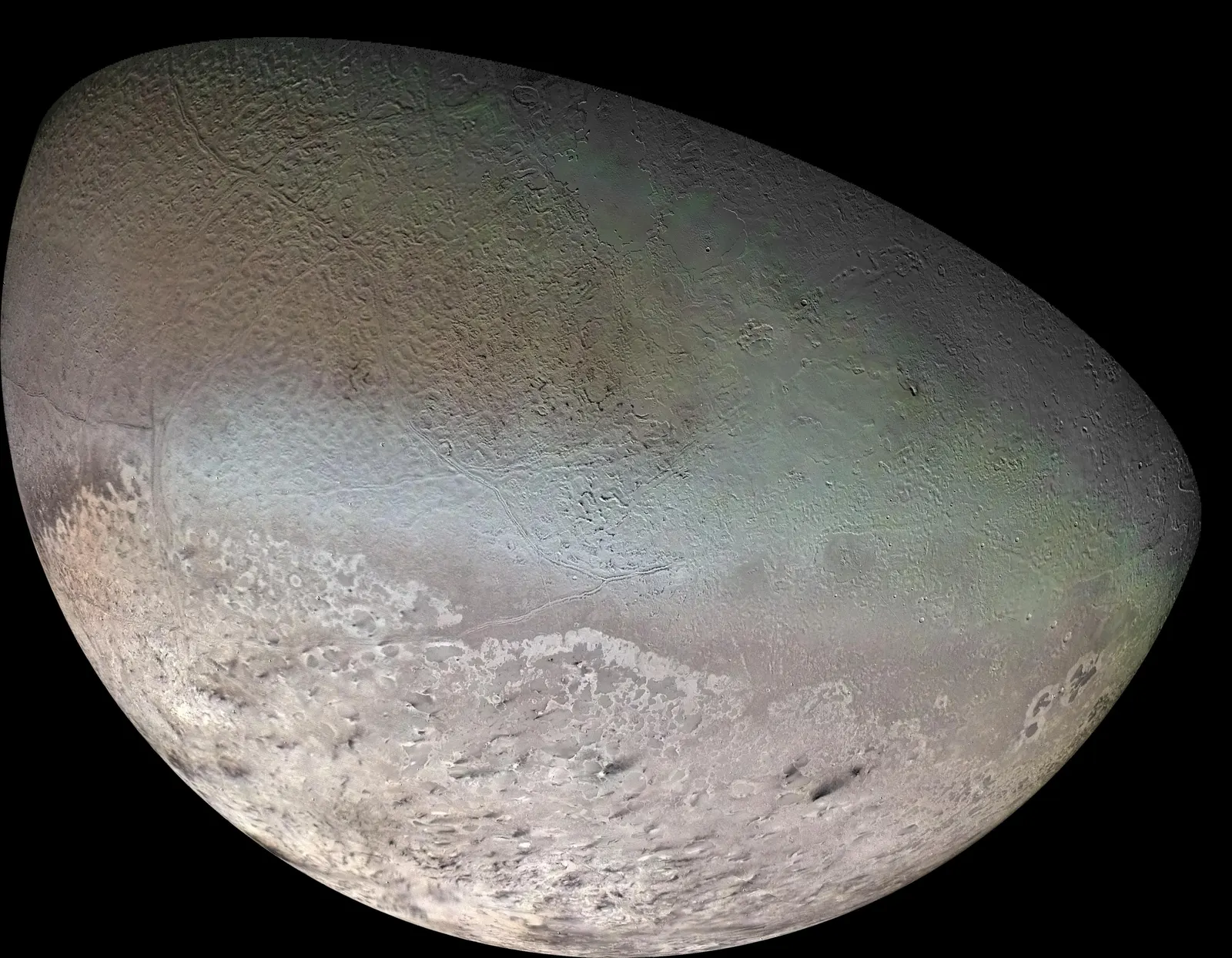
Triton, captured by Neptune, is younger still. Voyager 2 photographed dark plumes rising about 8 km and trailing downwind for more than 100 km, driven by sunlight warming nitrogen ice from below 9.
Formation
Ice worlds formed far enough from their stars for water, and further out nitrogen, carbon monoxide and methane, to condense as solids. In the Solar System they are survivors of the population of small bodies that formed beyond Neptune. Most kept their original orbits in the Kuiper belt, but some were thrown into strange paths as the giant planets migrated. Pluto and Charon are thought to have formed from a giant impact between two such bodies 10. Triton orbits Neptune backwards, the mark of capture: the leading idea is that it was one of a pair of Kuiper belt objects that passed close to Neptune, where its partner was ejected and Triton was left behind 11.
Around other stars, larger ice-rich planets presumably form the same way beyond the snow line, as the cores that in other circumstances would have grown into giant planets. Gravitational microlensing, which can detect cold planets far from their stars, has found planets of a few Earth masses in orbits where their surfaces should be around 50 K, such as OGLE-2005-BLG-390Lb, about 5.5 Earth masses 12. Their compositions cannot yet be measured.
How we know
Almost everything known about ice worlds in detail comes from two flybys: Voyager 2 at Triton in August 1989 and New Horizons at Pluto on 14 July 2015. Between them, ground-based astronomers have watched stars pass behind these bodies. These stellar occultations are how Pluto's atmosphere was discovered and how its pressure has been tracked since 1988 2, and they give precise sizes: an occultation in 2010 measured Eris's radius as 1,163 km and showed it has no global atmosphere today, with a geometric albedo of 0.96, among the brightest surfaces in the Solar System 13. A similar event showed that Makemake also lacks a Pluto-like atmosphere 14.
The James Webb Space Telescope now takes spectra of these distant bodies. It has found ethane, acetylene and ethylene ices, products of methane chemistry, on Sedna, Gonggong and Quaoar 15, and deuterium-to-hydrogen ratios in the methane of Eris and Makemake that point to methane produced or processed inside the bodies rather than inherited unchanged from the Sun's birth cloud 16. Webb has also detected a trace of methane gas above Makemake 17.
Notable examples
| Body | Radius | Mass | Density | Surface temperature | Distance from the Sun |
|---|---|---|---|---|---|
| Pluto | 1,188 km | 1.30 × 10²² kg | 1.85 g/cm³ | about 40 K | 29.7 to 49.3 AU |
| Triton (Neptune) | 1,353 km | 2.14 × 10²² kg | 2.06 g/cm³ | 38 K | 30 AU, with Neptune |
| Eris | 1,163 km | 1.66 × 10²² kg | 2.52 g/cm³ | about 30 to 55 K | 38 to 98 AU |
| Makemake | about 715 km | about 3 × 10²¹ kg (estimate) | about 1.9 g/cm³ (estimate) | about 40 K | 38 to 53 AU |
| Sedna | about 500 km | unknown | unknown | about 12 to 35 K | 76 to about 940 AU |
Sedna, discovered in 2003, spends most of its long orbit far beyond the Kuiper belt and is too small and cold to keep the volatile ices of its larger relatives 18.
See also
- Subsurface ocean world
- Super-Earth (icy super-Earths, SEI)
- Asteroid belt
- Natural satellite
- Titan
- Frost lines
- Atmospheric escape
- Planet classification
References
- 1Gladstone, G. R. et al. (2016). The atmosphere of Pluto as observed by New Horizons. Science 351, aad8866. doi:10.1126/science.aad8866
- 2Meza, E. et al. (2019). Lower atmosphere and pressure evolution on Pluto from ground-based stellar occultations, 1988-2016. Astronomy & Astrophysics 625, A42. doi:10.1051/0004-6361/201834281
- 3Schaller, E. L. and Brown, M. E. (2007). Volatile Loss and Retention on Kuiper Belt Objects. The Astrophysical Journal 659, L61-L64. doi:10.1086/516709
- 4Stern, S. A. et al. (2015). The Pluto system: Initial results from its exploration by New Horizons. Science 350, aad1815. doi:10.1126/science.aad1815
- 5the New Horizons Geology, Geophysics and Imaging Theme Team et al. (2016). Convection in a volatile nitrogen-ice-rich layer drives Pluto’s geological vigour. Nature 534, 82-85. doi:10.1038/nature18289
- 6Moore, J. M. et al. (2016). The geology of Pluto and Charon through the eyes of New Horizons. Science 351, 1284-1293. doi:10.1126/science.aad7055
- 7Nimmo, F. et al. (2016). Reorientation of Sputnik Planitia implies a subsurface ocean on Pluto. Nature 540, 94-96. doi:10.1038/nature20148
- 8Kamata, S. et al. (2019). Pluto’s ocean is capped and insulated by gas hydrates. Nature Geoscience 12, 407-410. doi:10.1038/s41561-019-0369-8
- 9Soderblom, L. A. et al. (1990). Triton's Geyser-Like Plumes: Discovery and Basic Characterization. Science 250, 410-415. doi:10.1126/science.250.4979.410
- 10Canup, R. M. (2005). A Giant Impact Origin of Pluto-Charon. Science 307, 546-550. doi:10.1126/science.1106818
- 11Agnor, C. B. and Hamilton, D. P. (2006). Neptune's capture of its moon Triton in a binary-planet gravitational encounter. Nature 441, 192-194. doi:10.1038/nature04792
- 12Beaulieu, J. P. et al. (2006). Discovery of a cool planet of 5.5 Earth masses through gravitational microlensing. Nature 439, 437-440. doi:10.1038/nature04441
- 13Sicardy, B. et al. (2011). A Pluto-like radius and a high albedo for the dwarf planet Eris from an occultation. Nature 478, 493-496. doi:10.1038/nature10550
- 14Ortiz, J. L. et al. (2012). Albedo and atmospheric constraints of dwarf planet Makemake from a stellar occultation. Nature 491, 566-569. doi:10.1038/nature11597
- 15Emery, J. et al. (2024). A tale of 3 dwarf planets: Ices and organics on Sedna, Gonggong, and Quaoar from JWST spectroscopy. Icarus 414, 116017. doi:10.1016/j.icarus.2024.116017
- 16Grundy, W. et al. (2024). Measurement of D/H and 13C/12C ratios in methane ice on Eris and Makemake: Evidence for internal activity. Icarus 411, 115923. doi:10.1016/j.icarus.2023.115923
- 17Protopapa, S. et al. (2025). JWST Detection of Hydrocarbon Ices and Methane Gas on Makemake. The Astrophysical Journal Letters 991, L34. doi:10.3847/2041-8213/adfe63
- 18Brown, M. E., Trujillo, C. and Rabinowitz, D. (2004). Discovery of a Candidate Inner Oort Cloud Planetoid. The Astrophysical Journal 617, 645-649. doi:10.1086/422095