- On this page
- 2
- figures
- 2
- tables
- 1
- panel
- 12
- references
Star class · ODW
K-type main-sequence star
ContentsShow
A K-type main-sequence star is a star of spectral class K that is fusing hydrogen in its core: smaller, cooler and fainter than the Sun, but larger and brighter than a red dwarf. K dwarfs have between about 0.6 and 0.9 times the Sun's mass, surface temperatures of about 3,900 to 5,300 K, and between a tenth and a half of the Sun's luminosity 1. They are often called orange dwarfs, and to the eye they are a pale orange 2. Near the Sun they are about twice as common as G dwarfs 3, and because they are long-lived, steady and bright enough to warm a planet at a comfortable distance, many astronomers regard them as the most promising homes for life beyond the Solar System 4.
Characteristics
| Type | Temperature (K) | Mass (Sun = 1) | Radius (Sun = 1) | Luminosity (Sun = 1) | B-V | M_V |
|---|---|---|---|---|---|---|
| K0V | 5,270 | 0.88 | 0.81 | 0.46 | 0.82 | 5.78 |
| K2V | 5,100 | 0.82 | 0.78 | 0.37 | 0.88 | 6.07 |
| K5V | 4,440 | 0.70 | 0.70 | 0.17 | 1.15 | 7.28 |
| K7V | 4,100 | 0.64 | 0.63 | 0.10 | 1.34 | 8.16 |
| K9V | 3,930 | 0.59 | 0.61 | 0.08 | 1.40 | 8.56 |
Values are from Eric Mamajek's compilation of mean main-sequence properties, building on Pecaut and Mamajek (2013) 1 5. A K dwarf's spectrum shows strong lines of neutral metals such as iron, calcium and sodium, and toward the late K types the first molecular bands appear. Like the Sun, K dwarfs have a radiative core wrapped in a convective envelope, and they have magnetic cycles and starspots; young K dwarfs are more active than the Sun and flare, though less violently, relative to their size, than red dwarfs.
Long, steady lives
A star's lifetime on the main sequence grows steeply as its mass falls, roughly as the inverse third to fourth power of the mass for stars like these 6. That puts a K0 dwarf's main-sequence life at roughly 15 to 20 billion years and a K5 dwarf's at 30 to 40 billion, estimates from the scaling rather than from detailed models. Either way it is longer than the present age of the universe, 13.8 billion years: only stars heavier than about 0.8 solar masses have yet had time to leave the main sequence 6, so every K dwarf ever formed is still a K dwarf, apart from a few of the heaviest.
A K dwarf also brightens more slowly than the Sun, so its habitable zone drifts outward more slowly. Cuntz and Guinan (2016) estimated how long a planet could stay within the conservative habitable zone as its star ages: about 16 billion years around a K0 dwarf and 30 billion around a K5, against about 5 billion for a G2 star like the Sun. Weighing that against the higher ultraviolet and flare output of the smaller M dwarfs, they found late G to mid K stars the most promising hosts for life, with early K dwarfs at the top 4.
The habitable zone
K dwarfs' habitable zones are closer in than the Sun's but not so close that planets there are certain to be tidally locked: about 0.66 to 1.19 AU for a K0 dwarf and about 0.42 to 0.79 AU for a K5, using the conservative limits of Kopparapu et al. (2014) 7. See Habitable zone for how these edges are set.
How we know
Several K dwarfs are among the Sun's nearest neighbours, and one of them was the first star beyond the Sun to have its distance measured. In 1838 Friedrich Bessel reported the parallax of 61 Cygni, a pair of K dwarfs, the tiny annual shift in its position as Earth orbits the Sun 8. Today the masses of K dwarfs come from binary orbits such as that of Alpha Centauri B around A 9, and their radii from interferometry.
Notable examples
| Star | Type | Distance | Notes |
|---|---|---|---|
| Alpha Centauri B | K1V | 1.33 pc (4.34 ly) | 0.909 solar masses, 0.859 solar radii; orbits the G dwarf Alpha Centauri A 9 |
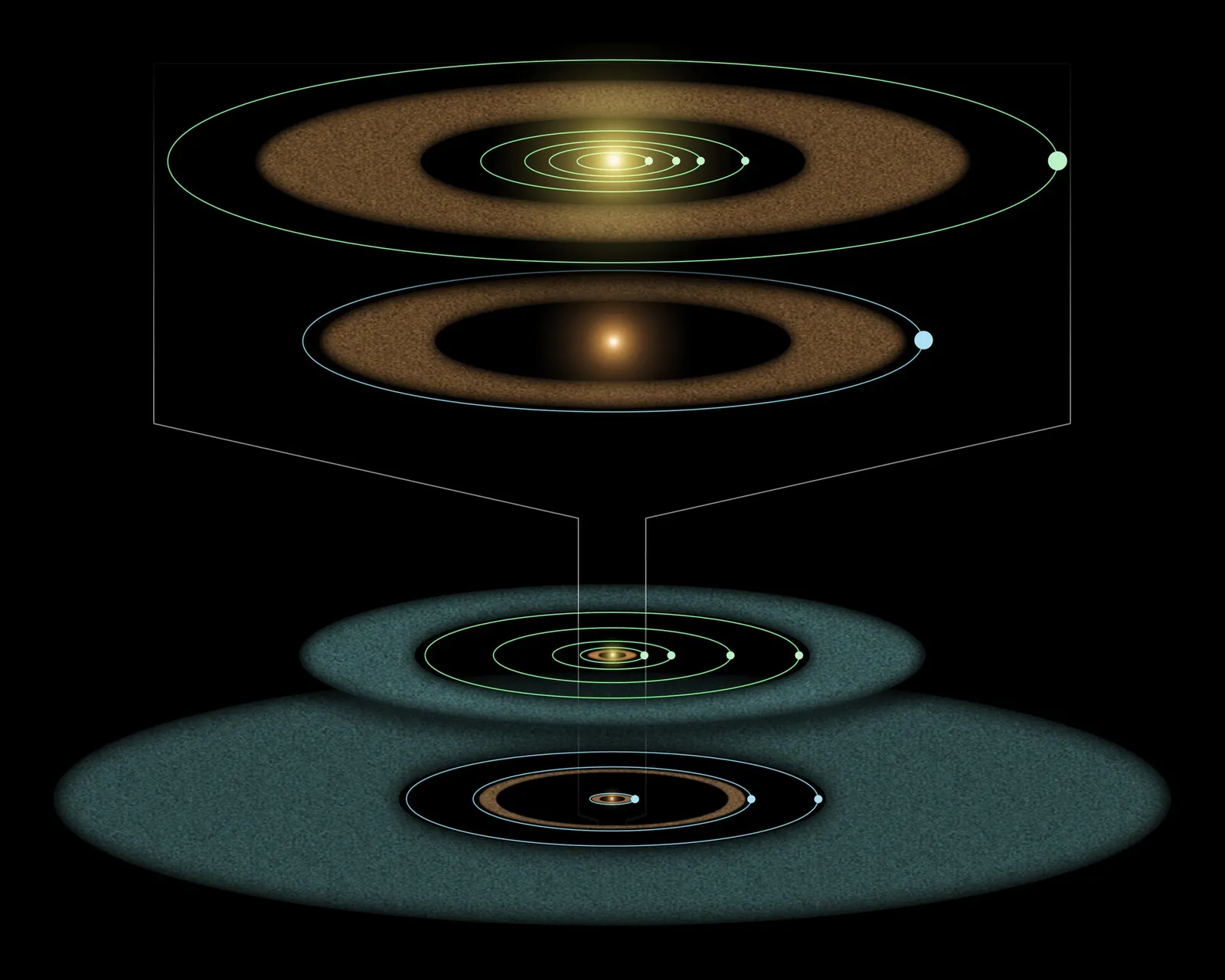
| Epsilon Eridani | K2V | 3.22 pc (10.5 ly) | Giant planet of 0.78 Jupiter masses at 3.5 AU on a 7.4-year orbit 10 11 |
| 61 Cygni A and B | K5V, K7V | 3.50 pc (11.4 ly) | First star with a measured parallax, 1838 8 |
| Epsilon Indi A | K5V | 3.6 pc (12 ly) | Its cold giant planet, epsilon Indi Ab, was imaged by JWST 12 |
Epsilon Eridani's planet, first reported from the star's wobble in 2000 10, was confirmed with a combination of radial velocities and direct-imaging limits, which pinned its mass and orbit 11.
See also
- Stellar classification
- G-type main-sequence star
- Red dwarf
- Habitable zone
- Red giant
- Planet occurrence
References
- 1Mamajek, E. E.. A Modern Mean Dwarf Stellar Color and Effective Temperature Sequence (version 2022.04.16). www.pas.rochester.edu/~emamajek/EEM_dwarf_UBVIJHK_colors_Teff.txt
- 2Harre, J. V. and Heller, R. (2021). Digital color codes of stars. Astronomische Nachrichten 342, 578-587. doi:10.1002/asna.202113868
- 3Reylé, C. et al. (2021). The 10 parsec sample in the Gaia era. Astronomy & Astrophysics 650, A201. doi:10.1051/0004-6361/202140985
- 4Cuntz, M. and Guinan, E. F. (2016). About Exobiology: The Case for Dwarf K Stars. The Astrophysical Journal 827, 79. doi:10.3847/0004-637X/827/1/79
- 5Pecaut, M. J. and Mamajek, E. E. (2013). Intrinsic Colors, Temperatures, and Bolometric Corrections of Pre-main-sequence Stars. The Astrophysical Journal Supplement Series 208, 9. doi:10.1088/0067-0049/208/1/9
- 6Adams, F. C. and Laughlin, G. (1997). A dying universe: the long-term fate and evolution of astrophysical objects. Reviews of Modern Physics 69, 337-372. doi:10.1103/RevModPhys.69.337
- 7Kopparapu, R. K. et al. (2014). Habitable Zones around Main-sequence Stars: Dependence on Planetary Mass. The Astrophysical Journal Letters 787, L29. doi:10.1088/2041-8205/787/2/L29
- 8Bessel, F. W. (1838). A letter from Professor Bessel to Sir J. Herschel, Bart., dated Konigsberg, Oct. 23, 1838. Monthly Notices of the Royal Astronomical Society 4, 152-161. doi:10.1093/mnras/4.17.152
- 9Akeson, R. et al. (2021). Precision Millimeter Astrometry of the alpha Centauri AB System. The Astronomical Journal 162, 14. doi:10.3847/1538-3881/abfaff
- 10Hatzes, A. P. et al. (2000). Evidence for a Long-Period Planet Orbiting epsilon Eridani. The Astrophysical Journal 544, L145-L148. doi:10.1086/317319
- 11Mawet, D. et al. (2019). Deep Exploration of epsilon Eridani with Keck Ms-band Vortex Coronagraphy and Radial Velocities: Mass and Orbital Parameters of the Giant Exoplanet. The Astronomical Journal 157, 33. doi:10.3847/1538-3881/aaef8a
- 12Matthews, E. C. et al. (2024). A temperate super-Jupiter imaged with JWST in the mid-infrared. Nature 633, 789-792. doi:10.1038/s41586-024-07837-8