- On this page
- 3
- figures
- 2
- tables
- 22
- references
Redirected from M-type main-sequence star
Star class · RDW
Red dwarf
ContentsShow
A red dwarf is a small, cool star on the main sequence, fusing hydrogen in its core like the Sun but at a far slower rate. Red dwarfs are the stars of spectral class M, with between about 8% and 60% of the Sun's mass, surface temperatures of about 2,300 to 3,900 K, and luminosities from about 7% of the Sun's down to a few ten-thousandths 1. They are the commonest stars in the Galaxy, about three in every four 2, yet not one is bright enough to see with the naked eye. They will also be the last stars shining: the smallest will burn for around ten trillion years 3.
Characteristics
Small, cool and faint
Along the M sequence, size, temperature and brightness all fall with mass 1 4:
| Type | Temperature (K) | Mass (Sun = 1) | Radius (Sun = 1) | Luminosity (Sun = 1) |
|---|---|---|---|---|
| M0V | 3,850 | 0.57 | 0.59 | 0.069 |
| M5V | 3,060 | 0.162 | 0.196 | 0.0030 |
| M9V | 2,380 | 0.079 | 0.102 | 0.0003 |
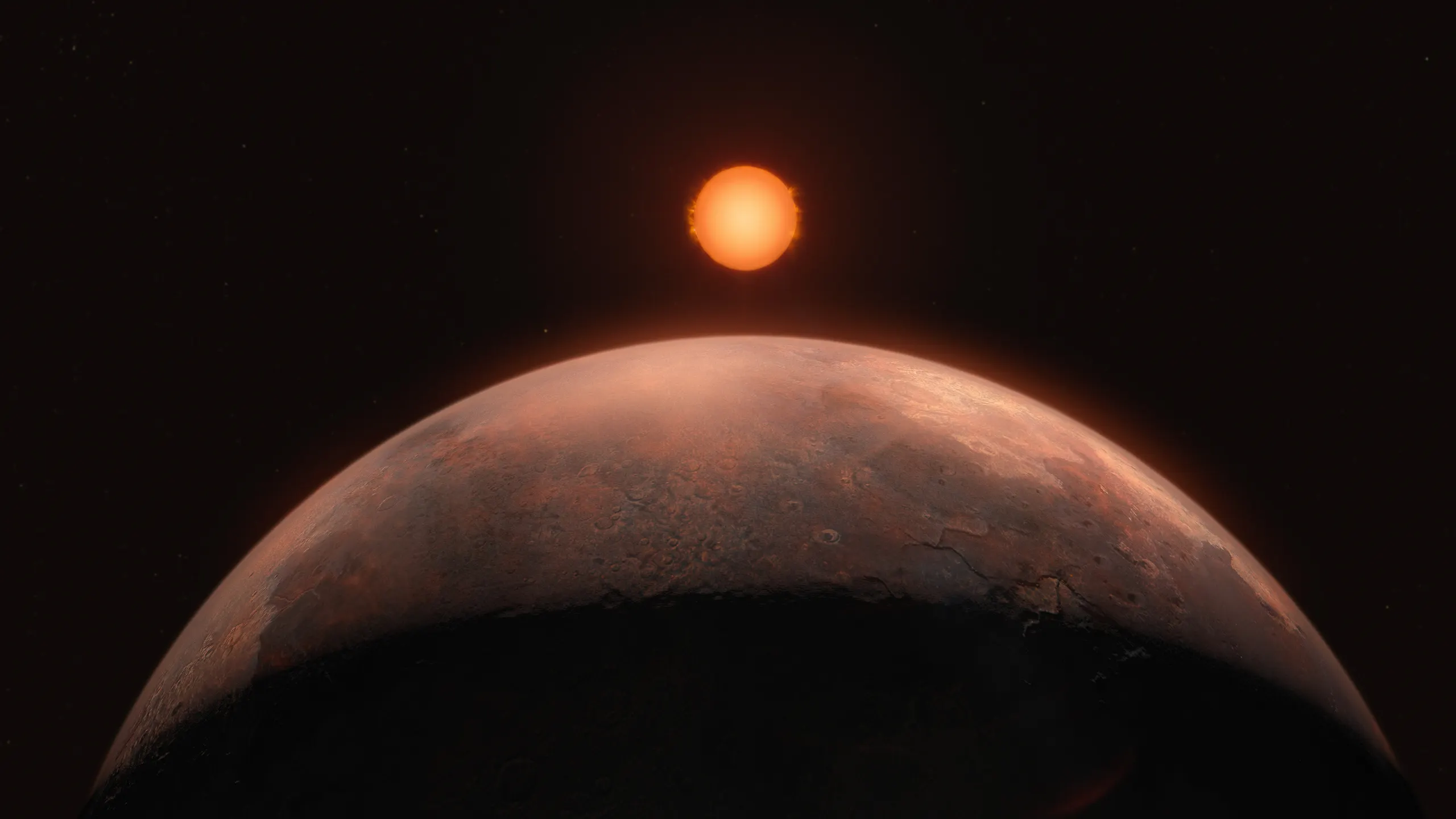
The lightest red dwarfs are barely larger than Jupiter. Below about 0.075 solar masses an object cannot sustain hydrogen fusion and is a brown dwarf. Despite the name, red dwarfs do not look red: models of how their light appears to the human eye show a warm orange, paler than a blackbody of the same temperature would suggest 5.
Stirred from top to bottom
Red dwarfs below about 0.35 solar masses are convective all the way through: hot gas rises from the core to the surface and cool gas sinks, whatever the star's metal content 6. Heavier ones have a radiative core, like the Sun. The change leaves a mark in the Gaia data: a narrow gap in the main sequence near spectral type M3V, where stars pass from one structure to the other 7. Full convection mixes fresh hydrogen into the core throughout the star's life, which is one reason red dwarfs last so long.
Flares
Convection and rotation together wind up strong magnetic fields, and red dwarfs, particularly young and fast-rotating ones, release that magnetic energy in flares far more powerful, relative to the star, than the Sun's. In March 2016 the Evryscope survey caught Proxima Centauri brightening 68-fold in a flare that briefly made it visible to the naked eye, releasing about 10³³·⁵ ergs 8. On 1 May 2019 the Hubble Space Telescope and the ALMA radio array together recorded a Proxima flare that brightened the star more than 14,000 times in far-ultraviolet light in a few seconds 9. Flare rates are not steady: a TESS study of 658 late-K and M dwarfs found 66 whose superflare rate changed over time 10. For any planets close in, that radiation and the particles that come with it are a hazard for atmospheres and for life.
Lives of trillions of years
A star's main-sequence life is roughly its fuel divided by its burn rate, and red dwarfs have little fuel but burn it very slowly. The lightest hydrogen-burning stars will last about 10¹³ years, some 700 times the present age of the universe 3. Stars below about 0.2 solar masses never swell into red giants: as they use their hydrogen they grow slowly hotter and brighter for trillions of years, and end as helium white dwarfs 3 11. None has done so yet; the universe is far too young.
Planets and the habitable zone
Because red dwarfs are faint, their habitable zones, where a rocky planet could keep liquid water, lie close in: about 0.27 to 0.52 AU for an M0 dwarf and about 0.06 to 0.11 AU for an M5 dwarf, using the conservative limits of Kopparapu et al. (2014) 12. A planet there orbits in days to weeks and is likely to be tidally locked, with one face towards its star. Small planets are common around red dwarfs, and they are easier to find than planets around Sun-like stars, because a small planet makes a larger dip or wobble in a small star.
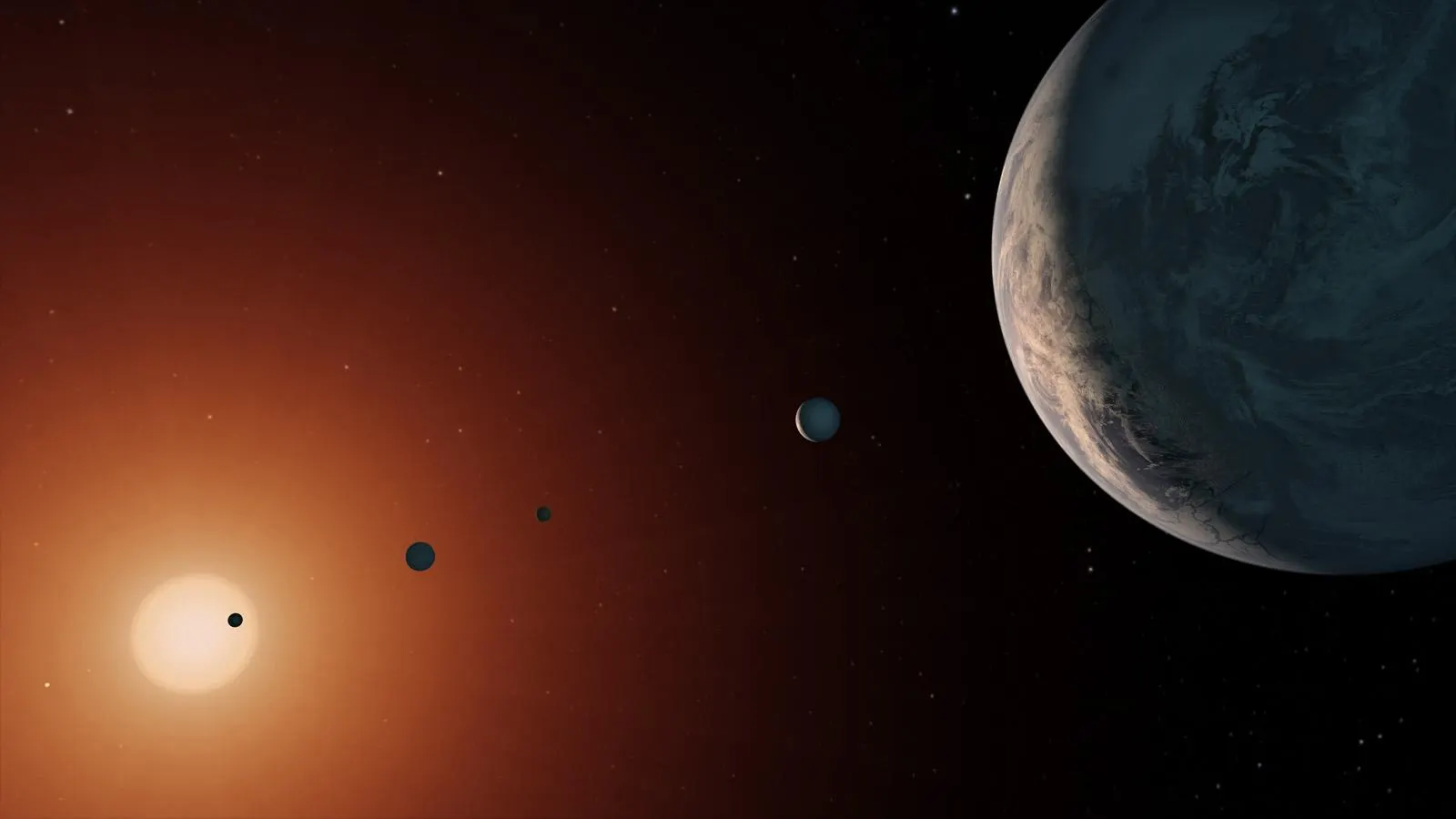
The three most famous red dwarfs all have rocky planets. Proxima Centauri, 4.25 light years away, has Proxima b, at least 1.07 Earth masses on an 11.2-day orbit in the habitable zone 13 14, and a candidate sub-Earth, Proxima d, on a 5.1-day orbit 14. Barnard's Star, the nearest single star to the Sun, has four confirmed sub-Earth-mass planets on orbits of 2.3 to 6.7 days 15 16; an earlier candidate on a 233-day orbit 17 was not borne out 15. TRAPPIST-1, a star of only 0.09 solar masses 18, has seven Earth-sized planets 19. JWST has found no thick carbon dioxide atmosphere on TRAPPIST-1 c 20, and its spectra of TRAPPIST-1 e, in the habitable zone, do not yet show whether that planet has an atmosphere at all 21. See Habitable zone for how these limits are set.
 , open full size
How we know
Red dwarfs are so faint that their true numbers came only from careful censuses of nearby space. Of the 337 stars within 10 parsecs, 249 are red dwarfs 2. Their masses come from binary orbits and from relations calibrated on them; their radii from interferometry and eclipsing binaries. Proxima Centauri's orbit around the bright pair Alpha Centauri A and B takes about 550,000 years, confirming that the three stars are bound 22.
Notable examples
 , open full size
In Pax Abyssi
Red dwarfs are the simulation's red dwarf class (code RDW), divided by temperature into early, mid and late M dwarfs and an ultracool class, each either quiet or active. The game's catalogue holds 6,530 real M-type stars, and Proxima Centauri, Barnard's Star and the other nearby red dwarfs sit at their Gaia distances. None is bright enough to see without a telescope, and the stars you can fly to today are the naked-eye sky, where the data is best, so the red dwarfs among them are few: Proxima Centauri is one. The generated galaxy, arriving next, fills in the rest of the Milky Way from the true local mix, in which about three quarters of all stars are red dwarfs.
Gliese 690.1, an M2.5 dwarf, shows what the generator builds for this class. Its seven planets are packed inside 0.3 AU: bare basalt worlds close in, a clouded highland world, then a biotic ocean world with island arcs at 0.09 AU, inside the star's habitable zone, followed by a cold mini-Neptune and a cryovolcanic ice super-Earth. Compact systems of rocky worlds are the class's favourite architecture, with TRAPPIST-1 as the real model.
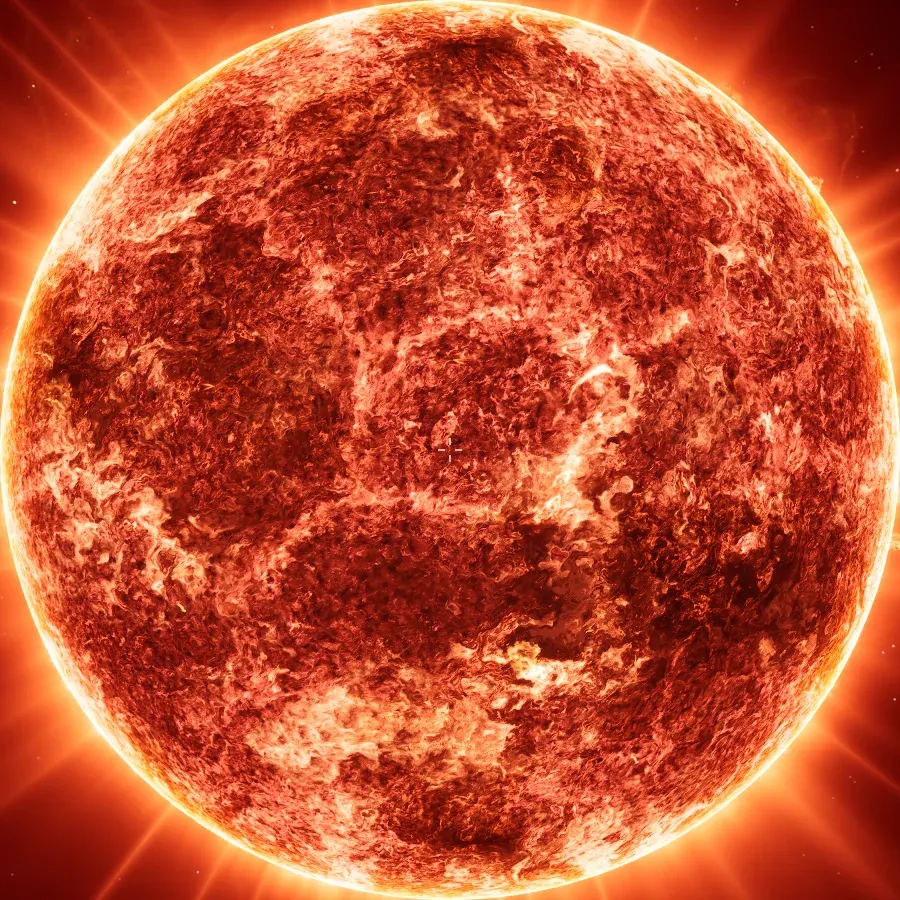
Up close, a red dwarf's face is broken into large, high-contrast convection cells. The star's activity level brightens its hot cells and flare regions, and its starspot coverage darkens the cool zones, so an active M dwarf looks busier than a quiet one. The picture here uses the GAME sun palette; under the default SCIENTIFIC palette an M dwarf takes the true colour of its light, orange rather than red.
 , open full size
See also
- Stellar classification
- K-type main-sequence star
- Brown dwarf
- Habitable zone
- Planet occurrence
- White dwarf
References
- 1Mamajek, E. E.. A Modern Mean Dwarf Stellar Color and Effective Temperature Sequence (version 2022.04.16). www.pas.rochester.edu/~emamajek/EEM_dwarf_UBVIJHK_colors_Teff.txt
- 2Reylé, C. et al. (2021). The 10 parsec sample in the Gaia era. Astronomy & Astrophysics 650, A201. doi:10.1051/0004-6361/202140985
- 3Laughlin, G., Bodenheimer, P. and Adams, F. C. (1997). The End of the Main Sequence. The Astrophysical Journal 482, 420-432. doi:10.1086/304125
- 4Pecaut, M. J. and Mamajek, E. E. (2013). Intrinsic Colors, Temperatures, and Bolometric Corrections of Pre-main-sequence Stars. The Astrophysical Journal Supplement Series 208, 9. doi:10.1088/0067-0049/208/1/9
- 5Harre, J. V. and Heller, R. (2021). Digital color codes of stars. Astronomische Nachrichten 342, 578-587. doi:10.1002/asna.202113868
- 6Chabrier, G. and Baraffe, I. (1997). Structure and evolution of low-mass stars. Astronomy & Astrophysics 327, 1039-1053. arxiv.org/abs/astro-ph/9704118
- 7Jao, W. C. et al. (2018). A Gap in the Lower Main Sequence Revealed by Gaia Data Release 2. The Astrophysical Journal Letters 861, L11. doi:10.3847/2041-8213/aacdf6
- 8Howard, W. S. et al. (2018). The First Naked-eye Superflare Detected from Proxima Centauri. The Astrophysical Journal Letters 860, L30. doi:10.3847/2041-8213/aacaf3
- 9MacGregor, M. A. et al. (2021). Discovery of an Extremely Short Duration Flare from Proxima Centauri Using Millimeter through Far-ultraviolet Observations. The Astrophysical Journal Letters 911, L25. doi:10.3847/2041-8213/abf14c
- 10Crowley, J., Wheatland, M. S. and Yang, K. (2024). Superflare rate variability on M dwarfs. Monthly Notices of the Royal Astronomical Society 530, 457-472. doi:10.1093/mnras/stae818
- 11Adams, F. C. and Laughlin, G. (1997). A dying universe: the long-term fate and evolution of astrophysical objects. Reviews of Modern Physics 69, 337-372. doi:10.1103/RevModPhys.69.337
- 12Kopparapu, R. K. et al. (2014). Habitable Zones around Main-sequence Stars: Dependence on Planetary Mass. The Astrophysical Journal Letters 787, L29. doi:10.1088/2041-8205/787/2/L29
- 13Anglada-Escudé, G. et al. (2016). A terrestrial planet candidate in a temperate orbit around Proxima Centauri. Nature 536, 437-440. doi:10.1038/nature19106
- 14Faria, J. P. et al. (2022). A candidate short-period sub-Earth orbiting Proxima Centauri. Astronomy & Astrophysics 658, A115. doi:10.1051/0004-6361/202142337
- 15González Hernández, J. I. et al. (2024). A sub-Earth-mass planet orbiting Barnard's star. Astronomy & Astrophysics 690, A79. doi:10.1051/0004-6361/202451311
- 16Basant, R. et al. (2025). Four Sub-Earth Planets Orbiting Barnard's Star from MAROON-X and ESPRESSO. The Astrophysical Journal Letters 982, L1. doi:10.3847/2041-8213/adb8d5
- 17Ribas, I. et al. (2018). A candidate super-Earth planet orbiting near the snow line of Barnard's star. Nature 563, 365-368. doi:10.1038/s41586-018-0677-y
- 18Agol, E. et al. (2021). Refining the Transit-timing and Photometric Analysis of TRAPPIST-1: Masses, Radii, Densities, Dynamics, and Ephemerides. The Planetary Science Journal 2, 1. doi:10.3847/PSJ/abd022
- 19Gillon, M. et al. (2017). Seven temperate terrestrial planets around the nearby ultracool dwarf star TRAPPIST-1. Nature 542, 456-460. doi:10.1038/nature21360
- 20Zieba, S. et al. (2023). No thick carbon dioxide atmosphere on the rocky exoplanet TRAPPIST-1 c. Nature 620, 746-749. doi:10.1038/s41586-023-06232-z
- 21Glidden, A. et al. (2025). JWST-TST DREAMS: Secondary Atmosphere Constraints for the Habitable Zone Planet TRAPPIST-1 e. The Astrophysical Journal Letters 990, L53. doi:10.3847/2041-8213/adf62e
- 22Kervella, P., Thévenin, F. and Lovis, C. (2017). Proxima's orbit around alpha Centauri. Astronomy & Astrophysics 598, L7. doi:10.1051/0004-6361/201629930