- On this page
- 1
- figure
- 2
- tables
- 1
- panel
- 19
- references
Redirected from Degenerate dwarf
White dwarf
White dwarf
ContentsShow
A white dwarf is what remains when a star like the Sun has burned its fuel and shed its outer layers: a bare stellar core, typically about 60 per cent as massive as the Sun but only the size of Earth. Nothing inside it burns. It is held up by the quantum-mechanical pressure of electrons packed as tightly as nature allows, and it shines only with stored heat, fading for billions of years. More than 95 per cent of the stars in the Galaxy, the Sun among them, will end this way 1. The nearest, Sirius B, is 8.6 light years away 2.
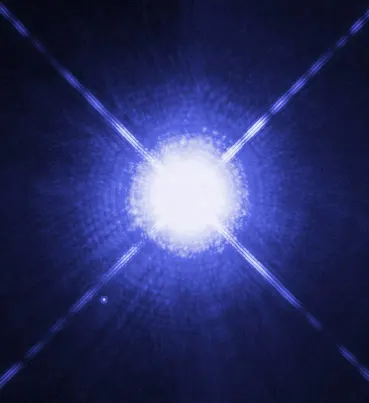 , open full size
In Pax Abyssi, white dwarfs are charted on the galaxy map from the star catalogue, the nearest ones as named companions of their bright partners, and the simulation behind the generated galaxy gives every white dwarf it creates a spectral class, a temperature and a radius set by its mass, as the physics below requires.
What holds a white dwarf up
In an ordinary star, the pressure of hot gas balances gravity, and fusion keeps the gas hot. A white dwarf has no fusion, so something else must hold it up. That something is electron degeneracy pressure. The Pauli exclusion principle forbids two electrons from sharing the same quantum state, so when matter is squeezed hard enough, electrons are forced into states of ever higher momentum. They push back whether the star is hot or cold, which is why a white dwarf can cool for billions of years without shrinking.
The numbers are extreme. Procyon B, a white dwarf of 0.592 solar masses, has a radius of 0.0123 solar radii, about 8,600 km, or 1.35 times Earth's 3. Its mean density is about kg/m³, roughly 400 kg in every cubic centimetre, and its surface gravity is about m/s², a hundred thousand times Earth's. Astronomers write this as , the logarithm of the gravity in centimetres per second squared.
Heavier is smaller
For slowly moving electrons, degeneracy pressure grows with density as . Balancing that against gravity gives a surprising result:
so a heavier white dwarf is a smaller one. Add mass and the star shrinks, the electrons are squeezed faster, and as their speeds approach the speed of light the pressure law softens towards . At that point no radius can balance gravity, and there is a maximum mass. Subrahmanyan Chandrasekhar calculated it in 1931 4; for matter made of carbon and oxygen it is about 1.44 solar masses in the classic calculation. Real white dwarfs become unstable a little below that, and one that grows close to the limit by gaining mass can ignite its carbon and explode 5.
The measured stars follow the curve. Sirius B has 1.018 ± 0.011 solar masses and is a little smaller than Earth 2. The heaviest known white dwarf, ZTF J1901+1458, is thought to be close to the limit, with a radius of about 2,100 km, only slightly larger than the Moon's 6.
How white dwarfs form
A star of up to about eight times the Sun's mass ends its life as a red giant and then an asymptotic giant branch star, puffing its outer layers into space as a glowing planetary nebula. The core left behind, made of carbon and oxygen ash from helium burning, is the white dwarf. The very lightest white dwarfs, below about half a solar mass, have helium cores; they cannot have formed from single stars in the age of the Universe and are made when a companion strips a red giant early. The heaviest can have cores of oxygen and neon.
The initial-final mass relation links a star's birth mass to the white dwarf it leaves. Measured from white dwarfs in star clusters of known age, it shows that stars from 0.85 to 7.5 solar masses shed between a third and five sixths of their mass on the way 7. The Sun will leave a white dwarf of a little over half its present mass.
Cooling, crystals and cosmic clocks
A white dwarf is born at over 100,000 K and simply cools. Leon Mestel showed in 1952 that its luminosity falls roughly as 8: it dims quickly at first, then more and more slowly. Because the physics is so simple, a white dwarf's temperature and mass give its cooling age, and the coolest white dwarfs in a population date the population itself. The faintest white dwarfs in the Galactic disk showed in 1987 that the disk is about 9 billion years old 9 1.
As it cools, the carbon and oxygen in the core freeze into a crystal lattice, releasing latent heat that slows the cooling for a while. Gaia's precise measurements of thousands of nearby white dwarfs revealed the resulting pile-up in the colour-brightness diagram in 2019, the first direct evidence that white dwarf cores crystallise 10.
Spectral classes
White dwarf spectral types begin with D, for degenerate, followed by a letter for the strongest features in the spectrum and a number for the temperature 11:
| Class | Spectrum shows | What it means |
|---|---|---|
| DA | hydrogen lines | a thin hydrogen skin over the star; the most common class |
| DB | neutral helium lines | a helium surface, about 12,000 to 30,000 K |
| DO | ionised helium lines | a very hot helium surface |
| DC | no lines | too cool for lines to form |
| DQ | carbon features | carbon dredged up from the core |
| DZ | metal lines | calcium, magnesium or iron, accreted from outside |
The number is , rounded: Sirius B, at about 25,000 K, is a DA2. Letters combine for mixed spectra, and an H or P marks a magnetic star.
Gravity at a white dwarf's surface is so strong that heavy elements sink out of sight within days to millions of years. Any metals seen must have arrived recently.
Polluted white dwarfs and the ghosts of planets
Between a quarter and a half of young white dwarfs are accreting rocky material right now 12. The source is the remnant of a planetary system: asteroids or comets nudged onto orbits that take them close to the star, where tides shred them into a disk of dust that rains onto the surface. The metals in the star's atmosphere then give the bulk composition of rocks from another planetary system, measured element by element.
The process has been caught in the act. WD 1145+017 shows dimming events every 4.5 hours from a disintegrating body and its trailing dust 13, and in 2020 a giant planet candidate was found transiting the white dwarf WD 1856+534 every 1.4 days 14.
Magnetism, mergers and explosions
Some white dwarfs carry fields of millions to hundreds of millions of gauss. ZTF J1901+1458 has a surface field of 600 to 900 million gauss and spins once every 6.94 minutes; its extreme mass, field and spin suggest it formed when two white dwarfs merged 6.
A white dwarf that gains mass from a companion, or merges with another, can approach the Chandrasekhar limit and ignite carbon in a runaway that destroys it completely: a Type Ia supernova 5. Because these explosions have similar peak brightness, they serve as distance markers across the Universe; in 1998 they revealed that the expansion of the Universe is accelerating 15.
How we know
Sirius B was the first white dwarf found, from the wobble it gives Sirius A: Friedrich Bessel predicted an unseen companion in 1844, and Alvan Clark saw it in 1862. Its mass is still measured the same way. Hubble's astrometry of the 50.1-year orbit gives 1.018 ± 0.011 solar masses, and its cooling age is about 126 million years 2. Procyon B and 40 Eridani B are weighed the same way 3 16.
Gaia has turned white dwarfs from a few hundred curiosities into a mapped population: its third data release yields about 359,000 high-confidence candidates 17, and a volume-complete census within 40 parsecs of the Sun contains about 1,100 18.
Notable white dwarfs
| Name | Class | Mass (solar masses) | Distance | Note |
|---|---|---|---|---|
| Sirius B | DA2 | 1.018 ± 0.011 | 2.64 pc (8.6 ly) | nearest white dwarf; cooling age about 126 Myr 2 |
| Procyon B | DQZ | 0.592 ± 0.006 | 3.5 pc (11.5 ly) | radius 0.0123 solar radii 3 |
| 40 Eridani B | DA | 0.573 ± 0.018 | 5.0 pc (16 ly) | in a triple system; cooling age about 122 Myr 16 |
| Van Maanen's Star | DZ | 4.3 pc (14 ly) | nearest white dwarf with no companion 18 | |
| ZTF J1901+1458 | magnetic | about 1.33 to 1.36 | heaviest known; radius about 2,100 km 6 | |
| WD 1145+017 | polluted | disintegrating planetesimal in orbit 13 | ||
| WD 1856+534 | cool, old | giant planet candidate in a 1.4-day orbit 14 |
See also
References
- 1Fontaine, G., Brassard, P. and Bergeron, P. (2001). The Potential of White Dwarf Cosmochronology. Publications of the Astronomical Society of the Pacific 113, 409-435. doi:10.1086/319535
- 2Bond, H. E. and et al. (2017). The Sirius System and Its Astrophysical Puzzles: Hubble Space Telescope and Ground-based Astrometry. The Astrophysical Journal 840, 70. doi:10.3847/1538-4357/aa6af8
- 3Bond, H. E. and et al. (2015). Hubble Space Telescope Astrometry of the Procyon System. The Astrophysical Journal 813, 106. doi:10.1088/0004-637X/813/2/106
- 4Chandrasekhar, S. (1931). The Maximum Mass of Ideal White Dwarfs. The Astrophysical Journal 74, 81. doi:10.1086/143324
- 5Hillebrandt, W. and Niemeyer, J. C. (2000). Type Ia Supernova Explosion Models. Annual Review of Astronomy and Astrophysics 38, 191-230. doi:10.1146/annurev.astro.38.1.191
- 6Caiazzo, I. and et al. (2021). A highly magnetized and rapidly rotating white dwarf as small as the Moon. Nature 595, 39-42. doi:10.1038/s41586-021-03615-y
- 7Cummings, J. D. et al. (2018). The White Dwarf Initial-Final Mass Relation for Progenitor Stars from 0.85 to 7.5 solar masses. The Astrophysical Journal 866, 21. doi:10.3847/1538-4357/aadfd6
- 8Mestel, L. (1952). On the Theory of White Dwarf Stars: I. The Energy Sources of White Dwarfs. Monthly Notices of the Royal Astronomical Society 112, 583-597. doi:10.1093/mnras/112.6.583
- 9Winget, D. E. and et al. (1987). An independent method for determining the age of the universe. The Astrophysical Journal 315, L77. doi:10.1086/184864
- 10Tremblay, P. E. and et al. (2019). Core crystallization and pile-up in the cooling sequence of evolving white dwarfs. Nature 565, 202-205. doi:10.1038/s41586-018-0791-x
- 11Sion, E. M. et al. (1983). A proposed new white dwarf spectral classification system. The Astrophysical Journal 269, 253. doi:10.1086/161036
- 12Koester, D., Gänsicke, B. T. and Farihi, J. (2014). The frequency of planetary debris around young white dwarfs. Astronomy & Astrophysics 566, A34. doi:10.1051/0004-6361/201423691
- 13Vanderburg, A. and et al. (2015). A disintegrating minor planet transiting a white dwarf. Nature 526, 546-549. doi:10.1038/nature15527
- 14Vanderburg, A. and et al. (2020). A giant planet candidate transiting a white dwarf. Nature 585, 363-367. doi:10.1038/s41586-020-2713-y
- 15Riess, A. G. and et al. (1998). Observational Evidence from Supernovae for an Accelerating Universe and a Cosmological Constant. The Astronomical Journal 116, 1009-1038. doi:10.1086/300499
- 16Bond, H. E. and et al. (2017). Astrophysical Implications of a New Dynamical Mass for the Nearby White Dwarf 40 Eridani B. The Astrophysical Journal 848, 16. doi:10.3847/1538-4357/aa8a63
- 17Gentile Fusillo, N. P. and et al. (2021). A catalogue of white dwarfs in Gaia EDR3. Monthly Notices of the Royal Astronomical Society 508, 3877-3896. doi:10.1093/mnras/stab2672
- 18O'Brien, M. W. and et al. (2024). The 40 pc sample of white dwarfs from Gaia. Monthly Notices of the Royal Astronomical Society 527, 8687-8705. doi:10.1093/mnras/stad3773
- 19Kalirai, J. S. and et al. (2008). The Initial-Final Mass Relation: Direct Constraints at the Low-Mass End. The Astrophysical Journal 676, 594-609. doi:10.1086/527028