- On this page
- 1
- figure
- 1
- panel
- 28
- references
Physics concept
Atmospheric escape
ContentsShow
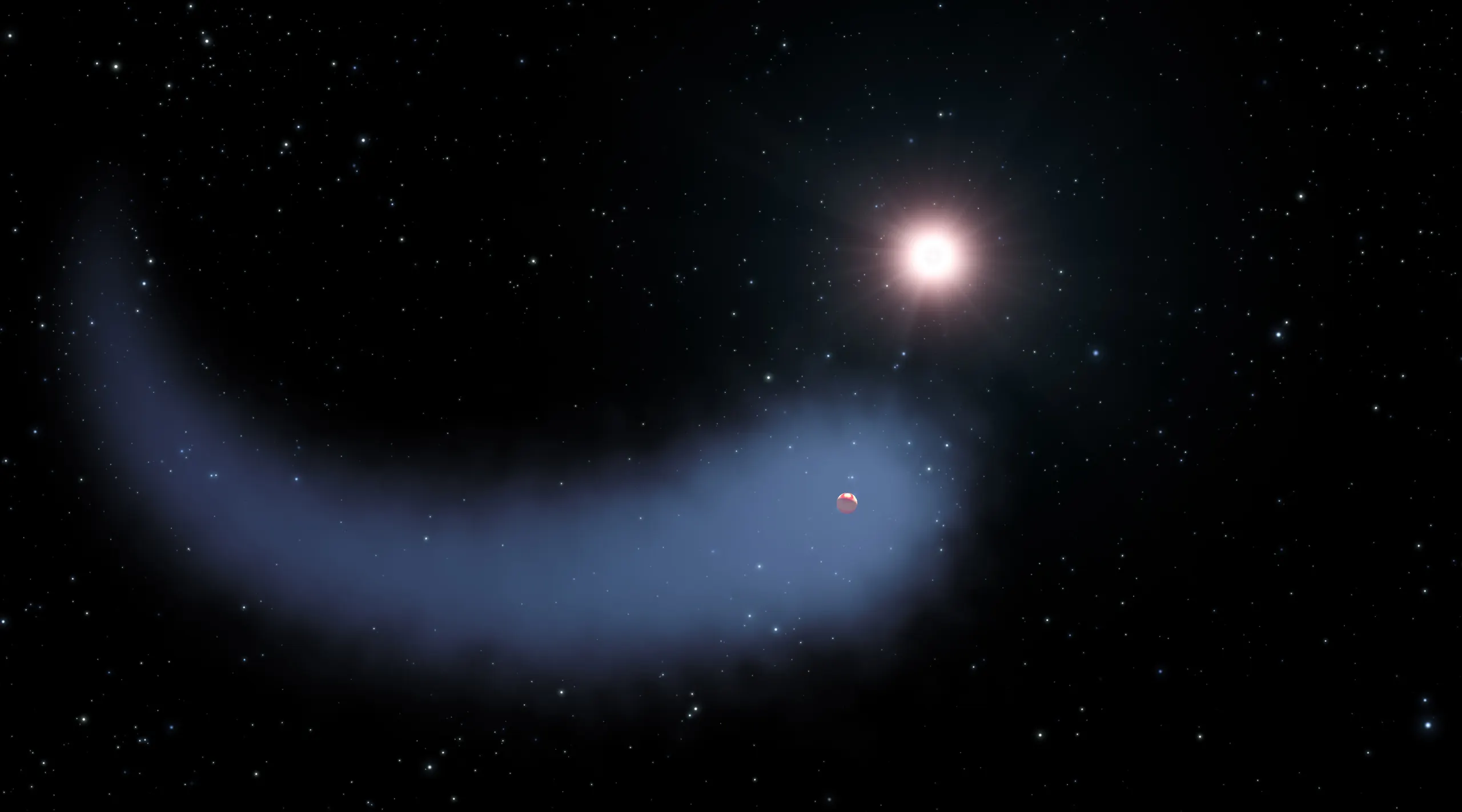
Atmospheric escape is the loss of a planet's or moon's air to space. Every atmosphere leaks from the top, where the gas is so thin that a fast molecule heading upward can leave without hitting anything on the way. For Earth the leak is slow and mostly hydrogen. For a planet close to a young, active star it can be a wind that carries away a whole envelope of gas in a few hundred million years. Escape explains why Mars has thin air and Venus has almost no water, why some rocky exoplanets are bare, and why two of the clearest patterns in the planet census exist: the radius valley among small planets and the hot Neptune desert close to their stars. In Pax Abyssi the generator works out escape for every mini-Neptune it makes, and the planets losing their air fastest form a type of their own.
 , open full size
Where gas leaves
Low in an atmosphere, molecules collide constantly and none gets far. Higher up the air thins until, at a level called the exobase, a molecule is more likely to fly off on a ballistic path than to hit another one. Earth's exobase is about 500 km up, in the thermosphere, where sunlight in the extreme ultraviolet heats the thin gas to around 1,000 K, more in years of high solar activity 1. Whether a molecule at the exobase escapes depends on how its speed compares with the planet's escape velocity there.
Thermal escape
Jeans escape
At any temperature the molecules of a gas have a spread of speeds, and a few in the fast tail of the distribution always exceed escape velocity. Their steady trickle away is Jeans escape, after James Jeans, who worked it out early in the twentieth century. Its strength is set by one number, the Jeans parameter, the ratio of a molecule's gravitational binding energy at the exobase to its thermal energy:
where is the planet's mass, the mass of the molecule, the exobase temperature, the exobase radius and the most probable thermal speed. The escaping flux falls roughly as , so a modest change in makes an enormous difference 1.
At Earth's exobase, is about 7 for hydrogen atoms and about 110 for oxygen atoms. Hydrogen therefore leaks away, while oxygen, sixteen times heavier, is held for the life of the planet. Earth loses about 3 kg of hydrogen and some 50 g of helium every second, through Jeans escape and the non-thermal routes described below 2. The hydrogen comes mostly from water vapour and methane broken apart high in the atmosphere, and its loss is limited less by the exobase than by how fast hydrogen-bearing molecules can diffuse up to it, the diffusion limit 3.
Hydrodynamic escape
If the upper atmosphere is heated hard enough, falls toward a few and escape changes character. The gas no longer leaks molecule by molecule but expands outward as a bulk flow, accelerating through the speed of sound like the solar wind. This is hydrodynamic escape 4. A strong enough outflow of hydrogen drags heavier atoms with it, and because lighter species are carried more easily, it leaves the remaining gas enriched in heavy isotopes, a fingerprint that survives billions of years 5.
The energy for the flow comes from the star's X-ray and extreme-ultraviolet light (together, XUV), absorbed high in the atmosphere. If a fixed fraction of that energy goes into lifting gas out of the planet's gravity well, the mass-loss rate is
the energy-limited rate, where is the XUV flux at the planet, and its radius and mass, a heating efficiency of order 0.1 and , at most 1, a correction for the star's tidal pull, which helps gas over the top 4 6. At the highest fluxes the formula overestimates: much of the absorbed energy is radiated away by hydrogen recombining with electrons, and the rate grows only as the square root of the flux, the recombination-limited regime 7 8.
Starlight that fades
The XUV output of a star changes with age. A young Sun-like star spins fast, and its magnetic activity holds its X-ray output near a ceiling of about a thousandth of its total light 9. It stays there for about its first 100 million years, then fades as the star's spin slows 10. Low-mass red dwarfs spin down more slowly and stay at that ceiling for longer, which makes their planets the hardest places to keep an atmosphere 9. Most escape driven by starlight therefore happens early, and a planet's atmosphere today is the record of what survived its star's youth.
Stripping whole envelopes
Close-in planets with hydrogen-helium envelopes are the most vulnerable, because hydrogen is light and a puffy planet presents a large target with weak gravity at its top. Several processes act on them, at different times.
- Boil-off. A planet that forms inside its star's gas disc is hot and swollen. When the disc disperses, the pressure holding its outer envelope in place disappears, and a young planet can lose a large share of its envelope in a rapid episode as it contracts 11.
- Photoevaporation. Over the next few hundred million years, XUV heating drives an energy-limited wind. Owen and Wu (2013) and Lopez and Fortney (2013) showed that it should strip the envelopes from small cores on close orbits and spare heavier cores or more distant planets, predicting a gap in planet sizes before it was found 12 13 14.
- Core-powered mass loss. The heat left from a planet's formation also escapes through its envelope, and the star's ordinary light keeps the outer layers warm. Together they can drive the envelope away over about a billion years with no help from XUV at all 15 16.
- Roche-lobe overflow. A planet so close to its star that its atmosphere reaches the point where the star's gravity takes over loses gas directly across that boundary. The hot Jupiter WASP-12 b is distorted by tides and probably overflowing in this way 17.
The first two predict almost the same split of small planets into stripped rocky cores and survivors with envelopes, the radius valley. For larger planets, the same erosion helps empty the hot Neptune desert.
Seeing it happen
Escaping gas is too thin to image, but it can be seen in silhouette. During a transit, a planet with an extended cloud of escaping hydrogen absorbs the star's ultraviolet light in the Lyman-alpha line over an area far larger than the planet itself. The first detection, around the hot Jupiter HD 209458 b in 2003, showed hydrogen extending beyond the planet's Roche lobe 18. The warm Neptune GJ 436 b trails a hydrogen cloud large enough to block about half the star's Lyman-alpha light, in a tail that follows the planet like a comet's 19.
Lyman-alpha light is largely absorbed by interstellar hydrogen, so only nearby stars can be studied this way. In 2018 Oklopčić and Hirata proposed a line of helium at 1,083 nanometres, in the near-infrared, which passes through interstellar space and can be observed from the ground 20. Helium escaping from the super-Neptune WASP-107 b was detected with it the same year 21. Because hydrogen escapes more readily than helium, slow escape could leave some warm Neptunes with atmospheres rich in helium 22; see Exotic worlds.
Non-thermal escape
Atoms and molecules can also be given escape speed without being heated as a gas. Sunlight and particles from the solar wind ionise the upper atmosphere, and ions can be picked up by the passing wind's magnetic field and swept away (ion pickup), or hit neutral atoms hard enough to knock them out (sputtering). A fast ion can steal an electron from a slow atom and leave as a fast neutral (charge exchange). Molecules broken apart by sunlight can leave fragments with enough energy to escape (photochemical escape) 1.
These processes dominate on small, cool worlds. NASA's MAVEN orbiter has measured these processes at Mars, which loses about 2 to 3 kg of gas a second today; extrapolated over the Sun's history, escape removed at least 0.8 bar of carbon dioxide and enough water to cover the planet 23 metres deep 23. See Arid world.
Whether a global magnetic field protects an atmosphere is less clear than often assumed. A field deflects the solar wind, but it also channels energy into the polar regions and opens other escape routes, and Earth, Mars and Venus lose ions at comparable rates today 24.
Who keeps an atmosphere
Across the Solar System, the bodies with substantial atmospheres are those whose escape velocity is high for the light they receive. Zahnle and Catling traced a cosmic shoreline separating them from airless bodies, in which the insolation needed to strip a body rises roughly as the fourth power of its escape velocity 25. Mercury and the Moon fall on the airless side; Titan, with a lower escape velocity than Mercury's but far from the Sun, keeps a thick one. Venus kept its carbon dioxide but lost its water: the ratio of deuterium to ordinary hydrogen in its atmosphere is about 100 times Earth's, the heavy isotope left behind as hydrogen escaped 26. See Greenhouse world.
The shoreline is now being tested on rocky exoplanets, most of them around red dwarfs. The hot rocky planet LHS 3844 b has no thick atmosphere 27, and the James Webb Space Telescope found that TRAPPIST-1 b's dayside is as hot as a bare rock's 28. See Barren rock world.
See also
- Radius valley
- Hot Neptune desert
- Mini-Neptune
- Hot Jupiter
- Exotic worlds
- Barren rock world
- Arid world
- Greenhouse world
- Titan
- Red dwarf
References
- 1Catling, D. C. and Kasting, J. F. (2017). Atmospheric Evolution on Inhabited and Lifeless Worlds. Cambridge University Press. doi:10.1017/9781139020558
- 2Catling, D. C. and Zahnle, K. J. (2009). The Planetary Air Leak. Scientific American 300, 36-43. doi:10.1038/scientificamerican0509-36
- 3Hunten, D. M. (1973). The escape of light gases from planetary atmospheres. Journal of the Atmospheric Sciences 30, 1481-1494. doi:10.1175/1520-0469(1973)030<1481:TEOLGF>2.0.CO;2
- 4Watson, A. J., Donahue, T. M. and Walker, J. C. G. (1981). The dynamics of a rapidly escaping atmosphere: applications to the evolution of Earth and Venus. Icarus 48, 150-166. doi:10.1016/0019-1035(81)90101-9
- 5Hunten, D. M., Pepin, R. O. and Walker, J. C. G. (1987). Mass fractionation in hydrodynamic escape. Icarus 69, 532-549. doi:10.1016/0019-1035(87)90022-4
- 6Erkaev, N. V. et al. (2007). Roche lobe effects on the atmospheric loss from "Hot Jupiters". Astronomy & Astrophysics 472, 329-334. doi:10.1051/0004-6361:20066929
- 7Murray-Clay, R. A., Chiang, E. I. and Murray, N. (2009). Atmospheric escape from hot Jupiters. The Astrophysical Journal 693, 23-42. doi:10.1088/0004-637X/693/1/23
- 8Owen, J. E. and Alvarez, M. A. (2016). UV driven evaporation of close-in planets: energy-limited, recombination-limited, and photon-limited flows. The Astrophysical Journal 816, 34. doi:10.3847/0004-637X/816/1/34
- 9Wright, N. J. et al. (2011). The stellar-activity-rotation relationship and the evolution of stellar dynamos. The Astrophysical Journal 743, 48. doi:10.1088/0004-637X/743/1/48
- 10Jackson, A. P., Davis, T. A. and Wheatley, P. J. (2012). The coronal X-ray-age relation and its implications for the evaporation of exoplanets. Monthly Notices of the Royal Astronomical Society 422, 2024-2043. doi:10.1111/j.1365-2966.2012.20657.x
- 11Owen, J. E. and Wu, Y. (2016). Atmospheres of low-mass planets: the "boil-off". The Astrophysical Journal 817, 107. doi:10.3847/0004-637X/817/2/107
- 12Owen, J. E. and Wu, Y. (2013). Kepler planets: a tale of evaporation. The Astrophysical Journal 775, 105. doi:10.1088/0004-637X/775/2/105
- 13Lopez, E. D. and Fortney, J. J. (2013). The role of core mass in controlling evaporation: the Kepler radius distribution and the Kepler-36 density dichotomy. The Astrophysical Journal 776, 2. doi:10.1088/0004-637X/776/1/2
- 14Owen, J. E. and Wu, Y. (2017). The evaporation valley in the Kepler planets. The Astrophysical Journal 847, 29. doi:10.3847/1538-4357/aa890a
- 15Ginzburg, S., Schlichting, H. E. and Sari, R. (2018). Core-powered mass-loss and the radius distribution of small exoplanets. Monthly Notices of the Royal Astronomical Society 476, 759-765. doi:10.1093/mnras/sty290
- 16Gupta, A. and Schlichting, H. E. (2019). Sculpting the valley in the radius distribution of small exoplanets as a by-product of planet formation: the core-powered mass-loss mechanism. Monthly Notices of the Royal Astronomical Society 487, 24-33. doi:10.1093/mnras/stz1230
- 17Li, S. L. et al. (2010). WASP-12b as a prolate, inflated and disrupting planet from tidal dissipation. Nature 463, 1054-1056. doi:10.1038/nature08715
- 18Vidal-Madjar, A. et al. (2003). An extended upper atmosphere around the extrasolar planet HD209458b. Nature 422, 143-146. doi:10.1038/nature01448
- 19Ehrenreich, D. et al. (2015). A giant comet-like cloud of hydrogen escaping the warm Neptune-mass exoplanet GJ 436b. Nature 522, 459-461. doi:10.1038/nature14501
- 20Oklopčić, A. and Hirata, C. M. (2018). A New Window into Escaping Exoplanet Atmospheres: 10830 Å Line of Helium. The Astrophysical Journal Letters 855, L11. doi:10.3847/2041-8213/aaada9
- 21Spake, J. J. et al. (2018). Helium in the eroding atmosphere of an exoplanet. Nature 557, 68-70. doi:10.1038/s41586-018-0067-5
- 22Hu, R., Seager, S. and Yung, Y. L. (2015). Helium Atmospheres on Warm Neptune- and Sub-Neptune-sized Exoplanets and Applications to GJ 436b. The Astrophysical Journal 807, 8. doi:10.1088/0004-637X/807/1/8
- 23Jakosky, B. et al. (2018). Loss of the Martian atmosphere to space: Present-day loss rates determined from MAVEN observations and integrated loss through time. Icarus 315, 146-157. doi:10.1016/j.icarus.2018.05.030
- 24Gunell, H. et al. (2018). Why an intrinsic magnetic field does not protect a planet against atmospheric escape. Astronomy & Astrophysics 614, L3. doi:10.1051/0004-6361/201832934
- 25Zahnle, K. J. and Catling, D. C. (2017). The Cosmic Shoreline: The Evidence that Escape Determines which Planets Have Atmospheres, and what this May Mean for Proxima Centauri B. The Astrophysical Journal 843, 122. doi:10.3847/1538-4357/aa7846
- 26Donahue, T. M. et al. (1982). Venus Was Wet: A Measurement of the Ratio of Deuterium to Hydrogen. Science 216, 630-633. doi:10.1126/science.216.4546.630
- 27Kreidberg, L. et al. (2019). Absence of a thick atmosphere on the terrestrial exoplanet LHS 3844b. Nature 573, 87-90. doi:10.1038/s41586-019-1497-4
- 28Greene, T. P. et al. (2023). Thermal emission from the Earth-sized exoplanet TRAPPIST-1 b using JWST. Nature 618, 39-42. doi:10.1038/s41586-023-05951-7