- On this page
- 1
- figure
- 1
- table
- 1
- panel
- 25
- references
Planet class · LWN (not tidally locked); LWTL (tidally locked) · LW1-H; LW2-TL
Lava world
ContentsShow
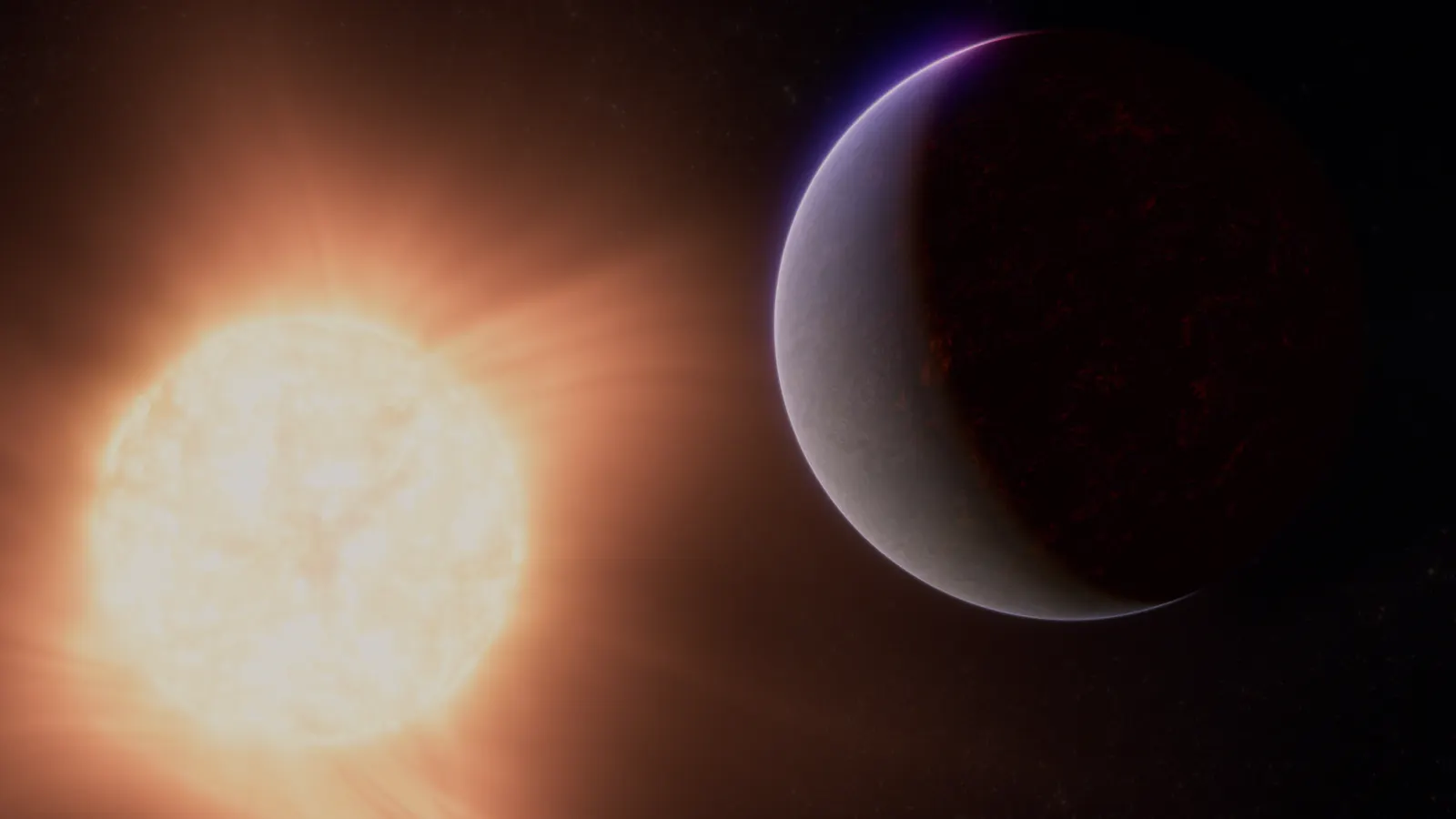
A lava world is a rocky planet so close to its star that the rock on its dayside is molten. Most known examples circle their stars in less than a day, a few times their star's radius away, and are tidally locked, so one hemisphere faces the star permanently. The dayside can hold a sea of magma hundreds or thousands of kilometres across, under a thin atmosphere of vaporised rock, while the night side may be frozen solid. Lava worlds are the easiest small planets to study, because short orbits mean frequent transits and hot daysides shine brightly in infrared light, and their magma oceans and rock-vapour atmospheres test ideas about how planets gain and lose their lighter elements.
Characteristics
How hot is hot enough
On a tidally locked planet with no atmosphere to move heat, the hottest point is directly beneath the star, where the ground reaches the substellar temperature
about 1.4 times the planet's equilibrium temperature for a dark surface. Dry mantle rock starts to melt at about 1,390 K at low pressure 1, so a planet whose substellar point is hotter than that holds at least a pool of magma. Around a Sun-like star that happens inside about 0.08 AU, an orbit of about eight days, although only a small pool beneath the star melts at that distance. Most known lava worlds are much closer, with equilibrium temperatures of 1,300 to 2,700 K and molten daysides.
Magma oceans and rock-vapour atmospheres
At these temperatures the melt itself evaporates. Chemical models show that a magma ocean at 2,000 to 3,000 K is covered by a thin atmosphere made from the rock: sodium, potassium, silicon monoxide, atomic and molecular oxygen, iron and magnesium, with sodium dominant at the cool end and silicon monoxide growing at the hot end 2. Such an atmosphere absorbs starlight high up and should be warmer at altitude than below, a temperature inversion that would show up in its spectrum 3. Gas is continually exchanged between the magma and the atmosphere, which slowly changes the composition of both 4.
Because the atmosphere exists only where the rock is hot enough to evaporate, it is thickest beneath the star and thins towards the terminator. The pressure difference drives winds from day to night, which carry rock vapour to cooler regions where it condenses and falls as mineral grains: "rock rain" 5. Models of K2-141 b, one of the hottest known, predict supersonic winds of more than 5,000 km/h 6.
Dayside and nightside
With only a thin atmosphere, a lava world's night side receives little heat, and on K2-141 b the night side is too faint to detect 7. 55 Cancri e is different. Spitzer found its hottest point shifted away from the substellar point and a night side at about 1,400 K, too warm for bare rock, which implies that something, an atmosphere or flowing lava, carries heat around the planet 8.
Formation and evolution
Planets probably do not form this close to their stars: there is too little material and it is too hot. Ultra-short-period planets are more likely to have formed a little farther out and been pulled inward, their orbits shrinking through tidal interaction with the star and gravitational nudges from sibling planets 9. Most are smaller than about twice Earth's radius 10. At this distance any hydrogen envelope a planet started with is stripped away by the star's radiation, leaving a bare rocky core, which is one explanation for the super-Earths below the Radius valley.
What happens next depends on the planet's size. A large lava world can outgas carbon, hydrogen and other volatiles from its magma and hold them as a secondary atmosphere. A small one can lose its rock outright. BD+05 4868Ab, a planet thought to be no more massive than Mercury on a 30.5-hour orbit, is disintegrating: the star's heat vaporises its surface and the vapour condenses into dust that streams away in tails ahead of and behind the planet 11.
How we know
Lava worlds are found by transits and weighed by radial velocity. CoRoT-7 b, found by the French-led CoRoT satellite and announced in 2009, was the first rocky planet with a measured radius and one of the first recognised as a probable lava world 12 13. Kepler-10 b, Kepler's first confirmed rocky planet, followed in 2011 14. The Kepler survey showed that planets with periods shorter than a day orbit about 0.5 per cent of G-type stars and about 0.8 per cent of K-type stars 10.
Their atmospheres are tested by their heat. As a hot planet passes behind its star, the drop in infrared light measures the dayside's temperature; comparing it with the bare-rock prediction reveals whether an atmosphere is carrying heat away. JWST has now done this in detail:
- 55 Cancri e. The dayside measures about 1,800 K, well below the roughly 2,500 K expected for bare rock. The spectrum rules out a thin rock-vapour atmosphere and points to a genuine volatile atmosphere, likely rich in carbon dioxide or carbon monoxide, outgassed from and sustained by a magma ocean 15 16. It is strong evidence rather than a confirmation. The planet's brightness also changes markedly from one observation to the next, perhaps with volcanic activity or clouds 17.
- TOI-561 b. An ultra-hot super-Earth around an old, metal-poor star, its dayside is far cooler than the roughly 3,000 K expected for bare rock, which the authors read as a thick volatile envelope on a planet that should have lost one 18.
Notable examples
| Planet | Orbital period | Radius | Mass | Density | Notes |
|---|---|---|---|---|---|
| 55 Cancri e | 17.7 hours | 1.88 R⊕ | 8.0 M⊕ | about 6.4 g/cm³ | 19; probable CO or CO₂ atmosphere (JWST) |
| CoRoT-7 b | 20.5 hours | about 1.6 R⊕ | 4.7 M⊕ | about 6.6 g/cm³ | 20 |
| Kepler-10 b | 20.1 hours | 1.47 R⊕ | 3.3 M⊕ | about 5.8 g/cm³ | 21 |
| K2-141 b | 6.7 hours | 1.51 R⊕ | 5.1 M⊕ | about 8.2 g/cm³ | dayside about 2,050 K 22 7 |
| Kepler-78 b | 8.5 hours | about 1.2 R⊕ | 1.7 to 1.9 M⊕ | about 5.3 to 5.6 g/cm³ | first Earth-sized planet with an Earth-like density 23 24 25 |
Kepler-78 b's two mass measurements, made independently by two teams with two telescopes and published together, agree within their uncertainties.
See also
- Barren rock world
- Volcanic world
- Super-Earth
- Radius valley
- Exotic worlds
- Atmospheric escape
- JWST and rocky exoplanet atmospheres
- Planet classification
References
- 1Hirschmann, M. M. (2000). Mantle solidus: Experimental constraints and the effects of peridotite composition. Geochemistry, Geophysics, Geosystems 1, 2000GC000070. doi:10.1029/2000gc000070
- 2Schaefer, L. and Fegley, B. (2009). Chemistry of silicate atmospheres of evaporating super-Earths. The Astrophysical Journal 703, L113-L117. doi:10.1088/0004-637x/703/2/l113
- 3Ito, Y. et al. (2015). Theoretical emission spectra of atmospheres of hot rocky super-Earths. The Astrophysical Journal 801, 144. doi:10.1088/0004-637x/801/2/144
- 4Kite, E. S. et al. (2016). Atmosphere-interior exchange on hot, rocky exoplanets. The Astrophysical Journal 828, 80. doi:10.3847/0004-637x/828/2/80
- 5Castan, T. and Menou, K. (2011). Atmospheres of hot super-Earths. The Astrophysical Journal 743, L36. doi:10.1088/2041-8205/743/2/l36
- 6Nguyen, T. G. et al. (2020). Modelling the atmosphere of lava planet K2-141b: implications for low- and high-resolution spectroscopy. Monthly Notices of the Royal Astronomical Society 499, 4605-4612. doi:10.1093/mnras/staa2487
- 7Zieba, S. et al. (2022). K2 and Spitzer phase curves of the rocky ultra-short-period planet K2-141 b hint at a tenuous rock vapor atmosphere. Astronomy & Astrophysics 664, A79. doi:10.1051/0004-6361/202142912
- 8Demory, B. O. et al. (2016). A map of the large day-night temperature gradient of a super-Earth exoplanet. Nature 532, 207-209. doi:10.1038/nature17169
- 9Winn, J. N., Sanchis-Ojeda, R. and Rappaport, S. (2018). Kepler-78 and the Ultra-Short-Period planets. New Astronomy Reviews 83, 37-48. doi:10.1016/j.newar.2019.03.006
- 10Sanchis-Ojeda, R. et al. (2014). A study of the shortest-period planets found with Kepler. The Astrophysical Journal 787, 47. doi:10.1088/0004-637x/787/1/47
- 11Hon, M. et al. (2025). A Disintegrating Rocky Planet with Prominent Comet-like Tails around a Bright Star. The Astrophysical Journal Letters 984, L3. doi:10.3847/2041-8213/adbf21
- 12Léger, A. et al. (2009). Transiting exoplanets from the CoRoT space mission. VIII. CoRoT-7b: the first super-Earth with measured radius. Astronomy & Astrophysics 506, 287-302. doi:10.1051/0004-6361/200911933
- 13Léger, A. et al. (2011). The extreme physical properties of the CoRoT-7b super-Earth. Icarus 213, 1-11. doi:10.1016/j.icarus.2011.02.004
- 14Batalha, N. M. et al. (2011). Kepler's first rocky planet: Kepler-10b. The Astrophysical Journal 729, 27. doi:10.1088/0004-637x/729/1/27
- 15Hu, R. et al. (2024). A secondary atmosphere on the rocky exoplanet 55 Cancri e. Nature 630, 609-612. doi:10.1038/s41586-024-07432-x
- 16NASA Science (2024). NASA's Webb hints at possible atmosphere surrounding rocky exoplanet. NASA Science: Webb. science.nasa.gov/missions/webb/nasas-webb-hints-at-possible-atmosphere-surrounding-rocky-exoplanet/
- 17Patel, J. A. et al. (2024). JWST reveals the rapid and strong day-side variability of 55 Cancri e. Astronomy & Astrophysics 690, A159. doi:10.1051/0004-6361/202450748
- 18Teske, J. K. et al. (2025). A Thick Volatile Atmosphere on the Ultrahot Super-Earth TOI-561 b. The Astrophysical Journal Letters 995, L39. doi:10.3847/2041-8213/ae0a4c
- 19Bourrier, V. et al. (2018). The 55 Cancri system reassessed. Astronomy & Astrophysics 619, A1. doi:10.1051/0004-6361/201833154
- 20Haywood, R. D. et al. (2014). Planets and stellar activity: hide and seek in the CoRoT-7 system. Monthly Notices of the Royal Astronomical Society 443, 2517-2531. doi:10.1093/mnras/stu1320
- 21Dumusque, X. et al. (2014). The Kepler-10 planetary system revisited by HARPS-N: a hot rocky world and a solid Neptune-mass planet. The Astrophysical Journal 789, 154. doi:10.1088/0004-637x/789/2/154
- 22Malavolta, L. et al. (2018). An Ultra-short Period Rocky Super-Earth with a Secondary Eclipse and a Neptune-like Companion around K2-141. The Astronomical Journal 155, 107. doi:10.3847/1538-3881/aaa5b5
- 23Sanchis-Ojeda, R. et al. (2013). Transits and occultations of an Earth-sized planet in an 8.5 hr orbit. The Astrophysical Journal 774, 54. doi:10.1088/0004-637x/774/1/54
- 24Howard, A. W. et al. (2013). A rocky composition for an Earth-sized exoplanet. Nature 503, 381-384. doi:10.1038/nature12767
- 25Pepe, F. et al. (2013). An Earth-sized planet with an Earth-like density. Nature 503, 377-380. doi:10.1038/nature12768