- On this page
- 1
- figure
- 1
- table
- 1
- panel
- 26
- references
Planet class · MNT (temperate, 200 to 500 K), MNC (cold, below 200 K), MNH (hot, 500 K and above)
Mini-Neptune
ContentsShow
A mini-Neptune, or sub-Neptune, is a planet between about 1.7 and 4 times Earth's radius, larger than any rocky planet in the Solar System and smaller than Uranus or Neptune. Most appear to be rocky or icy cores wrapped in a thin envelope of hydrogen and helium, a few per cent of their mass, which makes them far larger than their cores alone. The Solar System has none, yet the Kepler mission found that they, together with the slightly smaller super-Earths, are among the most common planets in the Galaxy's inner planetary systems. What they are made of, and whether any of them could hold oceans, is one of the busiest questions in exoplanet science.
Characteristics
Small cores, puffy envelopes
Hydrogen is so light that a little of it goes a long way. A rocky core of 5 Earth masses is about 1.5 times Earth's radius; wrap it in hydrogen and helium weighing just 1 to 2 per cent of the planet and it swells to between 2 and 3 Earth radii. The radius of a sub-Neptune therefore tracks the fraction of its mass in the envelope far more than its total mass, which lets a measured radius be read, with care, as a rough measure of composition 1. That is why the population divides so sharply at the Radius valley: planets that keep some gas are about twice the size of those that lose it all. Above the valley, the number of planets peaks near 2.4 Earth radii and then drops steeply beyond about 3 2.
Because the envelope dominates the size, mass and radius are only loosely linked. For planets of 1.5 to 4 Earth radii, measured masses scatter widely around a nearly linear trend 3. Across the whole "Neptunian" range, from about 2 Earth masses to about 130, radius grows roughly as 4, much faster than for rocky planets; fitting only the volatile-rich planets gives a similar slope 5.
What is inside
The same mass and radius can be matched by quite different interiors, and this degeneracy is the central problem of the class:
- Rock with a thin hydrogen envelope, the standard picture, with the envelope about 1 to 10 per cent of the mass.
- Water-rich cores, formed beyond the snow line and migrated inward, whose water could be mostly steam or supercritical fluid mixed with hydrogen 6 7 8.
- Metal-rich, mixed envelopes, in which heavy molecules such as water, carbon dioxide and methane make up a large share of the atmosphere.
Spectra are the way to tell them apart. A hydrogen-dominated atmosphere is extended, because light molecules make for a tall atmosphere, and gives strong absorption features in a transit spectrum. An atmosphere heavy in water or carbon dioxide is compact and gives weaker features.
Chemistry and temperature
Temperature sets the chemistry. In a hydrogen-rich atmosphere, carbon takes the form of methane at low temperatures and carbon monoxide at high ones, with the switch near 1,000 K at a pressure of about a bar and lower at lower pressures 9. Cool sub-Neptunes should therefore show methane, and hot ones carbon monoxide. Ultraviolet light breaks methane apart high in the atmosphere, and the fragments can build hazes of complex organic molecules.
Formation and evolution
A sub-Neptune's core must grow large enough to pull in gas from its star's disc before the disc disperses, but not so fast that it runs away into a gas giant. The result is a planet holding only a few per cent of its mass as hydrogen and helium. From then on, the envelope is under attack. Starlight, especially the strong X-ray and ultraviolet output of young stars, and the planet's own cooling heat can drive the gas away 10. Planets close to their stars and with small cores lose their envelopes and become super-Earths; those farther out or with heavier cores keep them. This sculpting is the leading explanation for the radius valley.
At higher masses and closer orbits, the same erosion clears out Neptune-sized planets altogether. Planets of Neptune's size and mass are scarce on orbits shorter than about three days, the hot Neptune desert 11; just outside it lies a "ridge" of planets at periods of about 3 to 6 days, and a more normal "savanna" beyond 12. The few survivors inside the desert are odd. LTT 9779 b, a Neptune-sized planet on a 19-hour orbit, reflects about 80 per cent of the light that falls on it, making it the most reflective exoplanet known, probably because of metallic clouds 13.
How we know
Sub-Neptunes are found by transits and weighed by radial velocity or, in tightly packed systems, by the way neighbouring planets tug on each other's timing. The six planets of Kepler-11, five of them closer to their star than Mercury is to the Sun, were one of the first such systems, and several have densities so low that they must hold substantial envelopes of light gas 14. Kepler's statistics showed that planets of this size are common around stars of many types 15.
The James Webb Space Telescope has turned sub-Neptunes from sizes into atmospheres:
- GJ 1214 b, discovered in 2009 around a nearby red dwarf 16, has 8.2 Earth masses and 2.7 Earth radii 17. Its transmission spectrum is flat, hidden by haze, but JWST's measurement of its heat around a full orbit showed a reflective, metal-rich atmosphere with a Bond albedo of about 0.5 18.
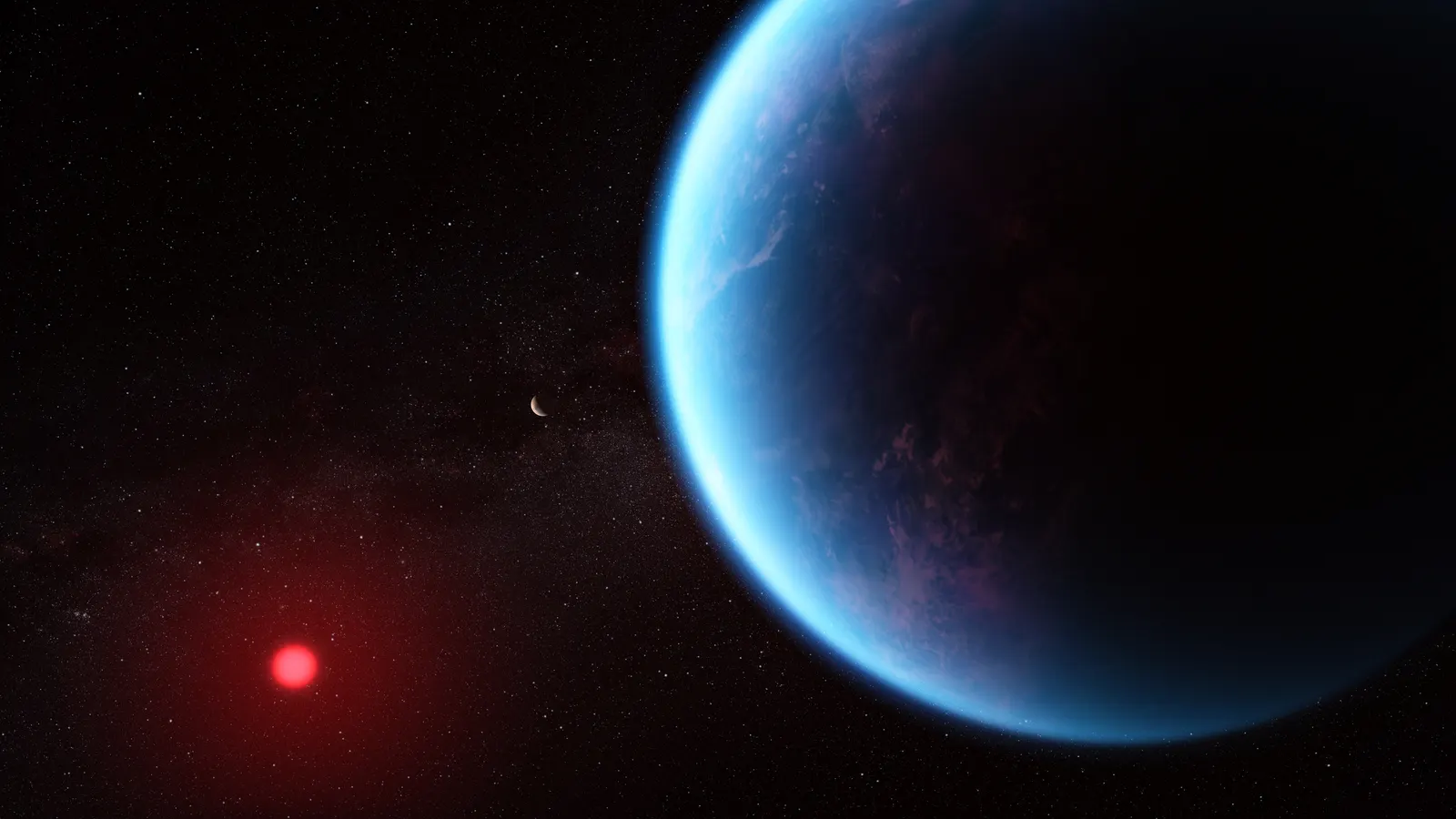
- K2-18 b, 8.6 Earth masses and 2.6 Earth radii in its red dwarf's habitable zone 19, has methane and carbon dioxide in its atmosphere 20. Whether it has a water ocean beneath a hydrogen atmosphere or is a gas-rich planet with no surface is disputed 21, and a joint reanalysis found insufficient evidence for the claimed dimethyl sulfide 22. See Ocean world.
- TOI-270 d, 4.8 Earth masses and 2.1 Earth radii at about 390 K 23, also shows methane and carbon dioxide 24.
- GJ 9827 d, about 2 Earth radii, has an atmosphere dominated by water vapour, a "steam world" 25.
- TOI-421 b, a hot sub-Neptune near 920 K around a Sun-like star, has a clear, hydrogen-rich atmosphere free of haze 26.
Notable examples
| Planet | Radius | Mass | Temperature | Atmosphere (JWST) |
|---|---|---|---|---|
| GJ 1214 b | 2.74 R⊕ | 8.2 M⊕ | about 550 to 600 K | hazy, metal-rich, reflective |
| K2-18 b | 2.61 R⊕ | 8.6 M⊕ | about 250 to 300 K | CH₄ and CO₂; nature disputed |
| TOI-270 d | 2.13 R⊕ | 4.8 M⊕ | about 390 K | CH₄ and CO₂ |
| GJ 9827 d | about 2.0 R⊕ | about 3 M⊕ | about 620 K | water vapour dominated |
| TOI-421 b | about 2.7 R⊕ | about 7 M⊕ | about 920 K | clear, hydrogen-rich |
See also
- Radius valley
- Super-Earth
- Ocean world
- Hycean worlds and K2-18 b
- Ice giant
- Hot Neptune desert
- Atmospheric escape
- Planet classification
References
- 1Lopez, E. D. and Fortney, J. J. (2014). Understanding the mass-radius relation for sub-Neptunes: radius as a proxy for composition. The Astrophysical Journal 792, 1. doi:10.1088/0004-637x/792/1/1
- 2Fulton, B. J. et al. (2017). The California-Kepler Survey. III. A Gap in the Radius Distribution of Small Planets. The Astronomical Journal 154, 109. doi:10.3847/1538-3881/aa80eb
- 3Weiss, L. M. and Marcy, G. W. (2014). The Mass-radius Relation for 65 Exoplanets Smaller Than 4 Earth Radii. The Astrophysical Journal 783, L6. doi:10.1088/2041-8205/783/1/l6
- 4Chen, J. and Kipping, D. (2017). Probabilistic Forecasting of the Masses and Radii of Other Worlds. The Astrophysical Journal 834, 17. doi:10.3847/1538-4357/834/1/17
- 5Otegi, J. F., Bouchy, F. and Helled, R. (2020). Revisited mass-radius relations for exoplanets below 120 M ⊕. Astronomy & Astrophysics 634, A43. doi:10.1051/0004-6361/201936482
- 6Zeng, L. et al. (2019). Growth model interpretation of planet size distribution. Proceedings of the National Academy of Sciences 116, 9723-9728. doi:10.1073/pnas.1812905116
- 7Venturini, J. et al. (2020). The nature of the radius valley. Astronomy & Astrophysics 643, L1. doi:10.1051/0004-6361/202039141
- 8Burn, R. et al. (2024). A radius valley between migrated steam worlds and evaporated rocky cores. Nature Astronomy 8, 463-471. doi:10.1038/s41550-023-02183-7
- 9Lodders, K. (2002). Atmospheric Chemistry in Giant Planets, Brown Dwarfs, and Low-Mass Dwarf Stars I. Carbon, Nitrogen, and Oxygen. Icarus 155, 393-424. doi:10.1006/icar.2001.6740
- 10Owen, J. E. and Wu, Y. (2017). The Evaporation Valley in the Kepler Planets. The Astrophysical Journal 847, 29. doi:10.3847/1538-4357/aa890a
- 11Mazeh, T., Holczer, T. and Faigler, S. (2016). Dearth of short-period Neptunian exoplanets: A desert in period-mass and period-radius planes. Astronomy & Astrophysics 589, A75. doi:10.1051/0004-6361/201528065
- 12Castro-González, A. et al. (2024). Mapping the exo-Neptunian landscape. Astronomy & Astrophysics 689, A250. doi:10.1051/0004-6361/202450957
- 13Hoyer, S. et al. (2023). The extremely high albedo of LTT 9779 b revealed by CHEOPS. Astronomy & Astrophysics 675, A81. doi:10.1051/0004-6361/202346117
- 14Lissauer, J. J. et al. (2011). A closely packed system of low-mass, low-density planets transiting Kepler-11. Nature 470, 53-58. doi:10.1038/nature09760
- 15Fressin, F. et al. (2013). The False Positive Rate of Kepler and the Occurrence of Planets. The Astrophysical Journal 766, 81. doi:10.1088/0004-637x/766/2/81
- 16Charbonneau, D. et al. (2009). A super-Earth transiting a nearby low-mass star. Nature 462, 891-894. doi:10.1038/nature08679
- 17Cloutier, R. et al. (2021). A More Precise Mass for GJ 1214 b and the Frequency of Multiplanet Systems Around Mid-M Dwarfs. The Astronomical Journal 162, 174. doi:10.3847/1538-3881/ac1584
- 18Kempton, E. M. R. et al. (2023). A reflective, metal-rich atmosphere for GJ 1214b from its JWST phase curve. Nature 620, 67-71. doi:10.1038/s41586-023-06159-5
- 19Benneke, B. et al. (2019). Water Vapor and Clouds on the Habitable-zone Sub-Neptune Exoplanet K2-18b. The Astrophysical Journal Letters 887, L14. doi:10.3847/2041-8213/ab59dc
- 20Madhusudhan, N. et al. (2023). Carbon-bearing Molecules in a Possible Hycean Atmosphere. The Astrophysical Journal Letters 956, L13. doi:10.3847/2041-8213/acf577
- 21Wogan, N. F. et al. (2024). JWST Observations of K2-18b Can Be Explained by a Gas-rich Mini-Neptune with No Habitable Surface. The Astrophysical Journal Letters 963, L7. doi:10.3847/2041-8213/ad2616
- 22Luque, R. et al. (2025). Insufficient evidence for DMS and DMDS in the atmosphere of K2-18 b. Astronomy & Astrophysics 700, A284. doi:10.1051/0004-6361/202555580
- 23Van Eylen, V. et al. (2021). Masses and compositions of three small planets orbiting the nearby M dwarf L231-32 (TOI-270) and the M dwarf radius valley. Monthly Notices of the Royal Astronomical Society. doi:10.1093/mnras/stab2143
- 24Holmberg, M. and Madhusudhan, N. (2024). Possible Hycean conditions in the sub-Neptune TOI-270 d. Astronomy & Astrophysics 683, L2. doi:10.1051/0004-6361/202348238
- 25Piaulet-Ghorayeb, C. et al. (2024). JWST/NIRISS Reveals the Water-rich “Steam World” Atmosphere of GJ 9827 d. The Astrophysical Journal Letters 974, L10. doi:10.3847/2041-8213/ad6f00
- 26Davenport, B. et al. (2025). TOI-421 b: A Hot Sub-Neptune with a Haze-free, Low Mean Molecular Weight Atmosphere. The Astrophysical Journal Letters 984, L44. doi:10.3847/2041-8213/adcd76