- On this page
- 4
- figures
- 3
- tables
- 19
- references
Redirected from G dwarf
Star class · YDW
G-type main-sequence star
ContentsShow
A G-type main-sequence star is a star of spectral class G that is fusing hydrogen into helium in its core. The Sun is one: a G2V star with a surface temperature of 5,772 K 1. G dwarfs have masses of about 0.9 to 1.1 times the Sun's and surface temperatures of about 5,300 to 6,000 K 2. They are often called yellow dwarfs, but seen from space they look white with only a faint warm tint 3. About one star in twenty near the Sun is a G dwarf 4, and because the Sun is one, they are the reference against which every other star, and the search for other Earths, is measured.
Characteristics
The G sequence
| Type | Temperature (K) | Mass (Sun = 1) | Radius (Sun = 1) | Luminosity (Sun = 1) | B-V | M_V |
|---|---|---|---|---|---|---|
| G0V | 5,930 | 1.06 | 1.10 | 1.35 | 0.60 | 4.48 |
| G2V | 5,770 | 1.00 | 1.01 | 1.02 | 0.65 | 4.80 |
| G5V | 5,660 | 0.98 | 0.98 | 0.89 | 0.68 | 4.98 |
| G9V | 5,380 | 0.90 | 0.85 | 0.55 | 0.78 | 5.55 |
Values are the mean main-sequence sequence compiled by Eric Mamajek, building on Pecaut and Mamajek (2013) 2 5. A G dwarf's spectrum is dominated by the strong lines of ionised calcium and by the lines of many metals; the hydrogen lines that dominate hotter stars are much weaker.
The Sun as a G dwarf
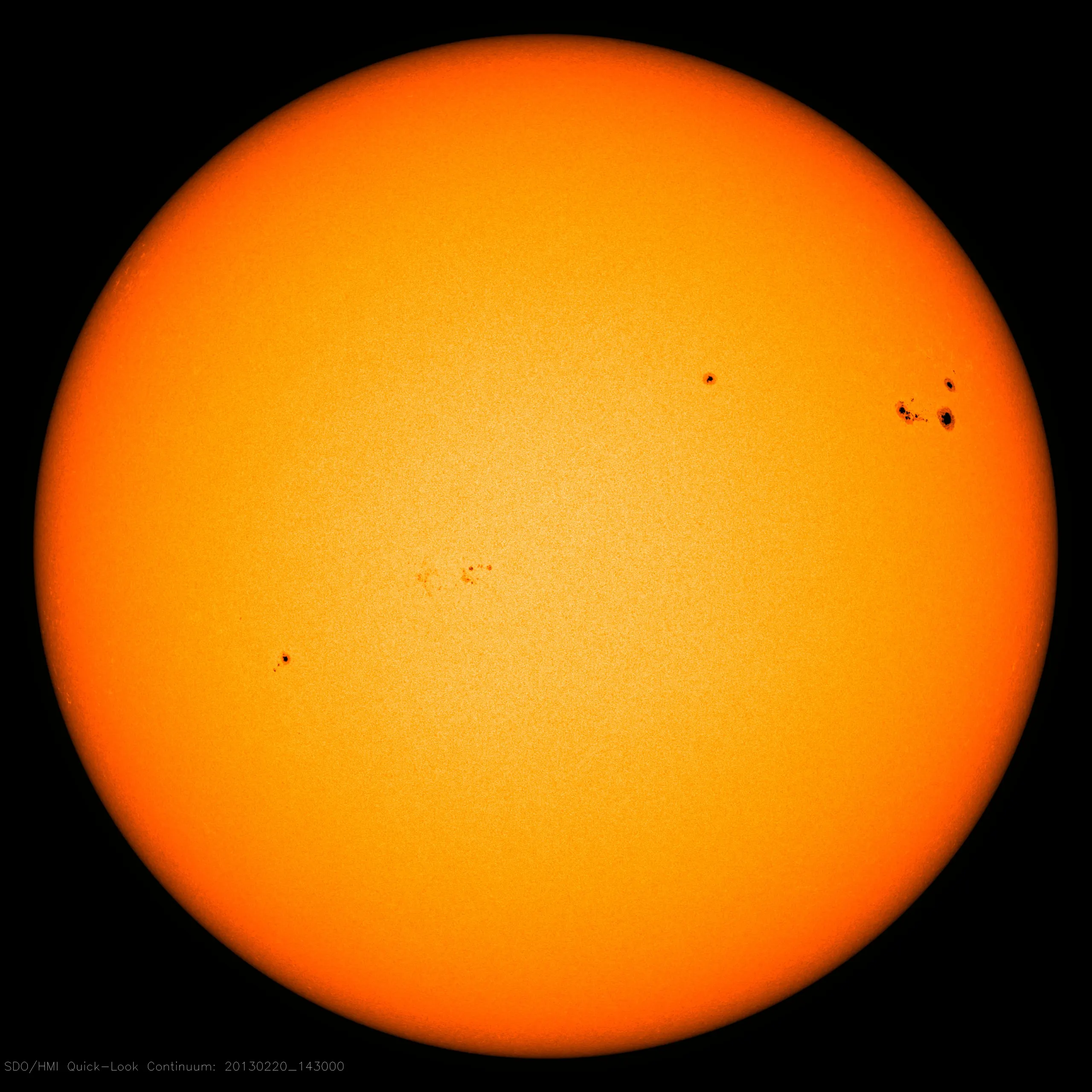
The International Astronomical Union's nominal solar values, adopted in 2015 as conversion constants, are a radius of 695,700 km, a luminosity of 3.828 × 10²⁶ watts, an effective temperature of 5,772 K and a total solar irradiance at Earth of 1,361 W/m² 1. The oldest solids in the Solar System, calcium- and aluminium-rich inclusions in meteorites, date to 4,567.3 million years ago, which fixes the Sun's age 6. Inside, energy travels outward as radiation through the inner 71% of the Sun's radius and by convection above that; helioseismology puts the base of the convection zone at 0.713 solar radii 7. The convective layer drives the granulation visible on the surface and, with the Sun's rotation, the magnetic field that produces sunspots, flares and the 11-year activity cycle.
 , open full size
What colour is the Sun?
The Sun's light peaks in the green, but it is spread across all visible wavelengths, and to the eye it adds up to white. Converting model spectra of G2V stars into the colour the eye would see gives a white with the faintest yellow tint 3. The Sun looks yellow or orange from the ground only because the atmosphere scatters away blue light, most strongly when the Sun is low.
Evolution
A G dwarf brightens slowly as helium accumulates in its core. The Sun began its main-sequence life at about 70% of its present luminosity and is now brightening at about 1% every 110 million years 8. Models agree on the broad course of what follows and differ in the details 8 9:
| Stage | Sun's age (billion years) | Luminosity (Sun today = 1) | Radius (Sun today = 1) |
|---|---|---|---|
| Arrival on the main sequence | 0 | 0.70 | 0.89 |
| Today | 4.58 | 1.00 | 1.00 |
| End of the main sequence | 10.0 | 1.84 | 1.37 |
| Tip of the red giant branch | 12.17 | 2,730 | 256 (1.2 AU) |
| Helium burning begins | 12.17 | 54 | 11 |
| Tip of the asymptotic giant branch | 12.30 | about 2,100 to 4,200 | 149 to 179 |
(Values from Schröder and Smith 2008.) In that model the Sun loses a third of its mass as a red giant, its planets' orbits widen as a result, and Earth still does not escape: it would need to orbit at about 1.15 AU or more today to survive 8. An earlier model, with less mass loss, has the red giant Sun reach 170 solar radii, engulf Mercury and spare Venus and Earth 9. Either way the Sun ends as a white dwarf of about 0.54 solar masses. See Red giant for this phase.
Earlier G types, slightly heavier than the Sun, run through the same sequence faster; later ones, lighter, more slowly.
Planets around G dwarfs
The habitable zone of a G dwarf lies roughly where Earth orbits the Sun: from about 0.95 to 1.68 AU for the Sun itself, using the conservative limits of Kopparapu et al. (2014), shifting inward to about 0.73 to 1.30 AU for a G9 dwarf 10. The first planet found around a Sun-like star orbited a G dwarf, 51 Pegasi 11. Kepler-452 b, announced in 2015 as a planet 1.6 times Earth's radius in the habitable zone of a G2 star 12, is a caution about such claims: a later reanalysis found it must still be considered a candidate 13. The nearest G dwarf, Alpha Centauri A, has a candidate giant planet in its habitable zone imaged by JWST, which awaits confirmation 14.
Notable examples
| Star | Type | Distance | Notes |
|---|---|---|---|
| The Sun | G2V | 1 AU | 1 solar mass, 4.57 billion years old 1 6 |
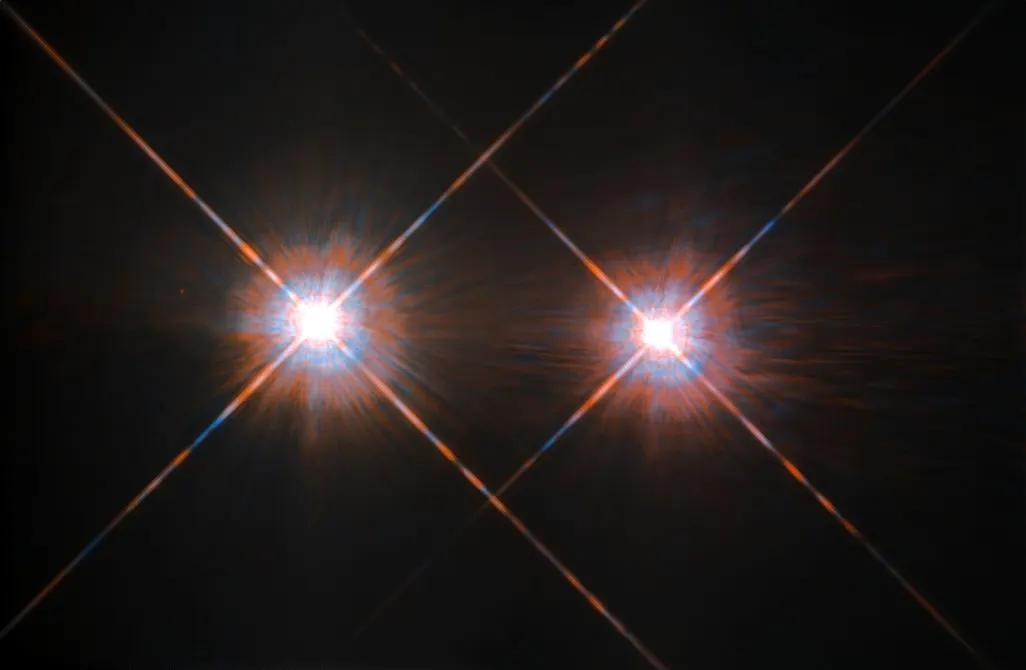
| Alpha Centauri A | G2V | 1.33 pc (4.34 ly) | 1.079 solar masses, 1.22 solar radii; bound to the K dwarf Alpha Centauri B 15 |
| Tau Ceti | G8V | 3.65 pc (11.9 ly) | Four planet candidates from radial velocities 16 |
| 18 Scorpii | G2Va | 14.1 pc | A solar twin: 5,823 K and 1.04 solar masses, about 1.6 billion years younger than the Sun 17 18 |
| 51 Pegasi | G2IV | 15.5 pc | Host of the first planet found around a Sun-like star 11 |
 , open full size
In Pax Abyssi
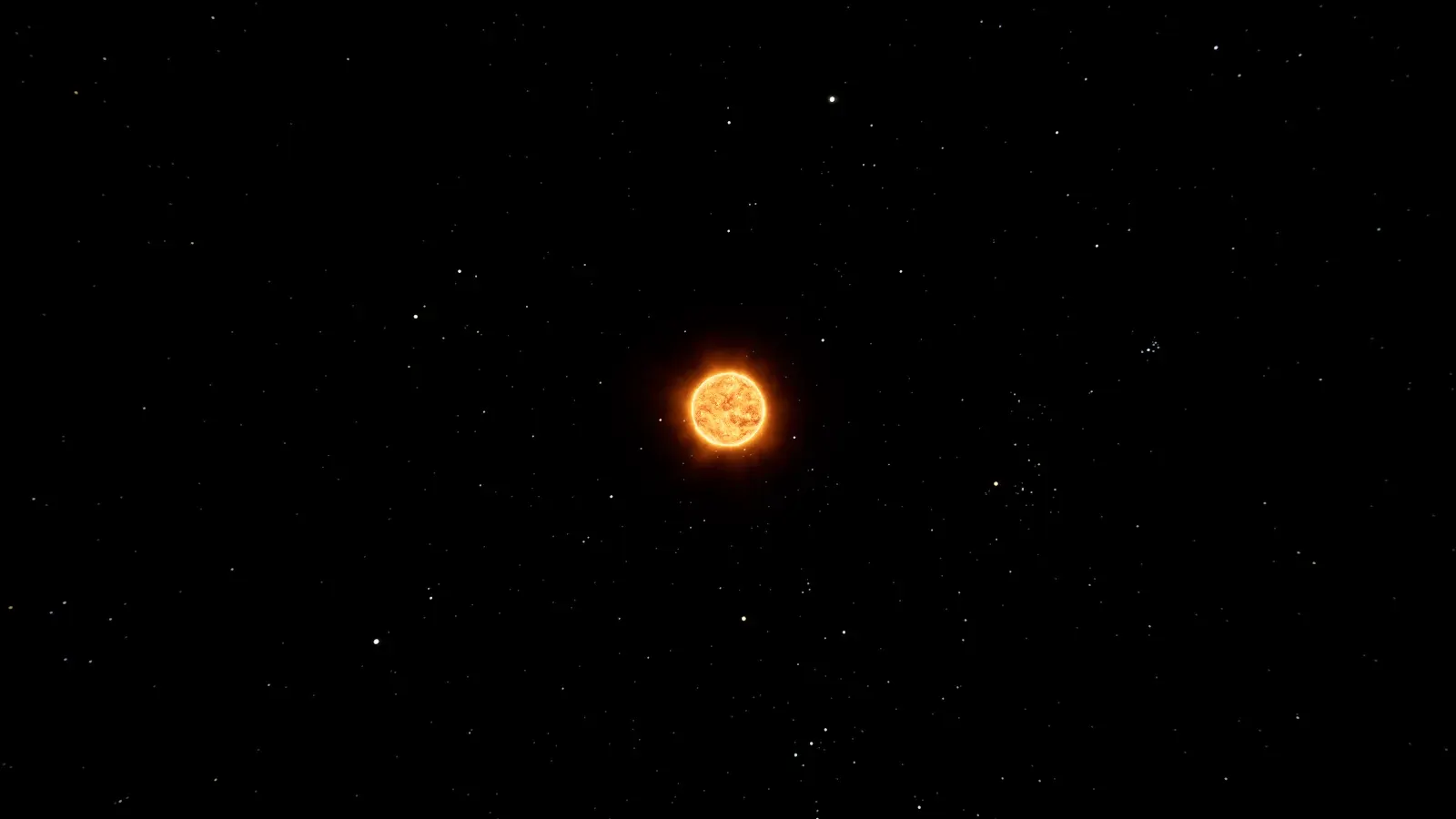
G dwarfs are the simulation's yellow dwarf class (code YDW), split into early and late G, each active, moderate or quiet. The game's catalogue holds 23,382 real G-type stars; about half are dwarfs and most of the rest are giants and subgiants, which a catalogue of visible stars favours. The Sun is Sol, with its planets and moons at their true positions. Alpha Centauri A (Rigil Kentaurus), Tau Ceti, 18 Scorpii and 51 Pegasi (Helvetios) sit at their measured distances, and each is a system you can fly to. Of the 106 G dwarfs in the flyable set, 74 have generated planets. For this class the generator favours the Sun's own pattern, rocky worlds inside and giant planets gathered beyond the frost line, with habitable zones set by the Kopparapu limits 19.
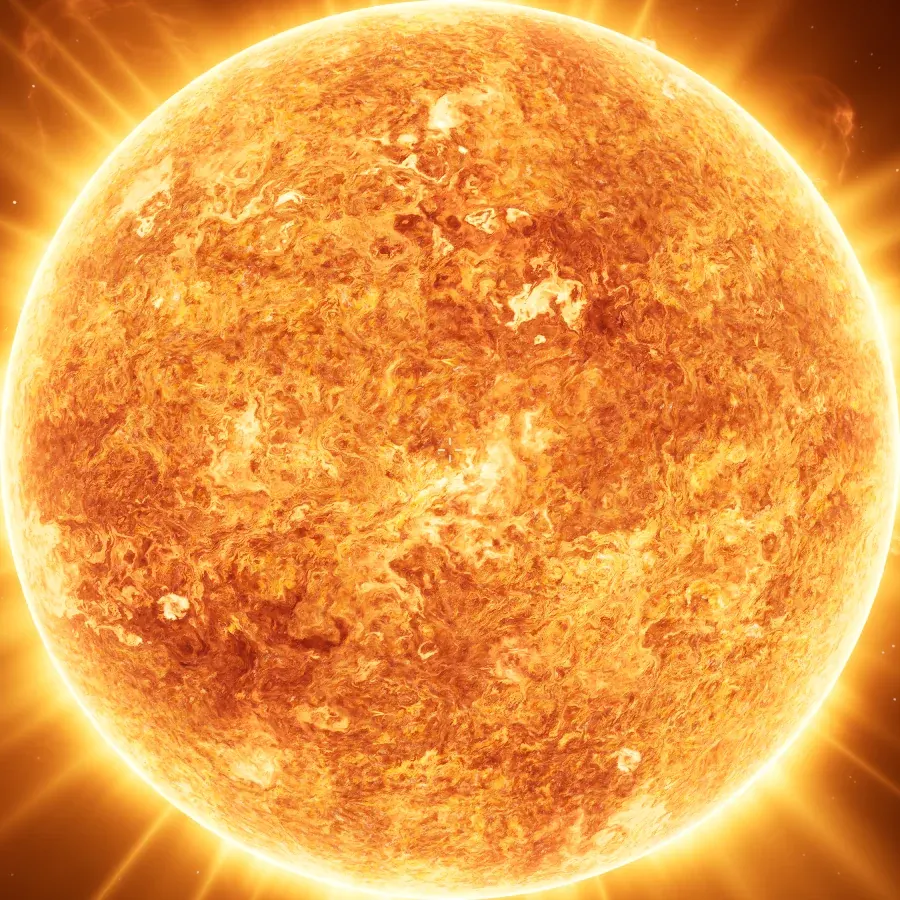
Up close, a G dwarf's face is a fine mosaic of granulation with a few spots, its limb darkened by the coefficient for the class, 0.60, and the whole surface turning at the star's own rotation. Its colour is the player's choice. From space the Sun is white, and that is what the default SCIENTIFIC sun palette draws. The GAME palette, used for the pictures here, paints it the deep gold of films and games, because a close sun has to read as hot; VIVID goes further still. The row is sun palette, in Esc > Options > SPACE under SUN.
 , open full size
 , open full size
See also
References
- 1Prša, A. et al. (2016). Nominal Values for Selected Solar and Planetary Quantities: IAU 2015 Resolution B3. The Astronomical Journal 152, 41. doi:10.3847/0004-6256/152/2/41
- 2Mamajek, E. E.. A Modern Mean Dwarf Stellar Color and Effective Temperature Sequence (version 2022.04.16). www.pas.rochester.edu/~emamajek/EEM_dwarf_UBVIJHK_colors_Teff.txt
- 3Harre, J. V. and Heller, R. (2021). Digital color codes of stars. Astronomische Nachrichten 342, 578-587. doi:10.1002/asna.202113868
- 4Reylé, C. et al. (2021). The 10 parsec sample in the Gaia era. Astronomy & Astrophysics 650, A201. doi:10.1051/0004-6361/202140985
- 5Pecaut, M. J. and Mamajek, E. E. (2013). Intrinsic Colors, Temperatures, and Bolometric Corrections of Pre-main-sequence Stars. The Astrophysical Journal Supplement Series 208, 9. doi:10.1088/0067-0049/208/1/9
- 6Connelly, J. N. et al. (2012). The Absolute Chronology and Thermal Processing of Solids in the Solar Protoplanetary Disk. Science 338, 651-655. doi:10.1126/science.1226919
- 7Basu, S. and Antia, H. M. (1997). Seismic measurement of the depth of the solar convection zone. Monthly Notices of the Royal Astronomical Society 287, 189-198. doi:10.1093/mnras/287.1.189
- 8Schröder, K. P. and Connon Smith, R. (2008). Distant future of the Sun and Earth revisited. Monthly Notices of the Royal Astronomical Society 386, 155-163. doi:10.1111/j.1365-2966.2008.13022.x
- 9Sackmann, I. J., Boothroyd, A. I. and Kraemer, K. E. (1993). Our Sun. III. Present and Future. The Astrophysical Journal 418, 457. doi:10.1086/173407
- 10Kopparapu, R. K. et al. (2014). Habitable Zones around Main-sequence Stars: Dependence on Planetary Mass. The Astrophysical Journal Letters 787, L29. doi:10.1088/2041-8205/787/2/L29
- 11Mayor, M. and Queloz, D. (1995). A Jupiter-mass companion to a solar-type star. Nature 378, 355-359. doi:10.1038/378355a0
- 12Jenkins, J. M. et al. (2015). Discovery and Validation of Kepler-452b: A 1.6 Earth-radius Super Earth Exoplanet in the Habitable Zone of a G2 Star. The Astronomical Journal 150, 56. doi:10.1088/0004-6256/150/2/56
- 13Mullally, F. et al. (2018). Kepler's Earth-like Planets Should Not Be Confirmed without Independent Detection: The Case of Kepler-452b. The Astronomical Journal 155, 210. doi:10.3847/1538-3881/aabae3
- 14Beichman, C. et al. (2025). Worlds Next Door: A Candidate Giant Planet Imaged in the Habitable Zone of alpha Centauri A. I. Observations, Orbital and Physical Properties, and Exozodi Upper Limits. The Astrophysical Journal Letters 989, L22. doi:10.3847/2041-8213/adf53f
- 15Akeson, R. et al. (2021). Precision Millimeter Astrometry of the alpha Centauri AB System. The Astronomical Journal 162, 14. doi:10.3847/1538-3881/abfaff
- 16Feng, F. et al. (2017). Color Difference Makes a Difference: Four Planet Candidates around tau Ceti. The Astronomical Journal 154, 135. doi:10.3847/1538-3881/aa83b4
- 17Meléndez, J. et al. (2014). 18 Sco: A Solar Twin Rich in Refractory and Neutron-capture Elements. Implications for Chemical Tagging. The Astrophysical Journal 791, 14. doi:10.1088/0004-637X/791/1/14
- 18Porto de Mello, G. F. and da Silva, L. (1997). HR 6060: The Closest Ever Solar Twin?. The Astrophysical Journal 482, L89-L92. doi:10.1086/310693
- 19Kopparapu, R. K. et al. (2013). Habitable Zones around Main-sequence Stars: New Estimates. The Astrophysical Journal 765, 131. doi:10.1088/0004-637X/765/2/131