- On this page
- 3
- figures
- 2
- tables
- 1
- panel
- 37
- references
Redirected from Jovian planet
Planet class · GGC, GGT, GGH (gas giants); IGC, IGH (ice giants) · G1-C, G3-T, G2-H
Gas giant
ContentsShow
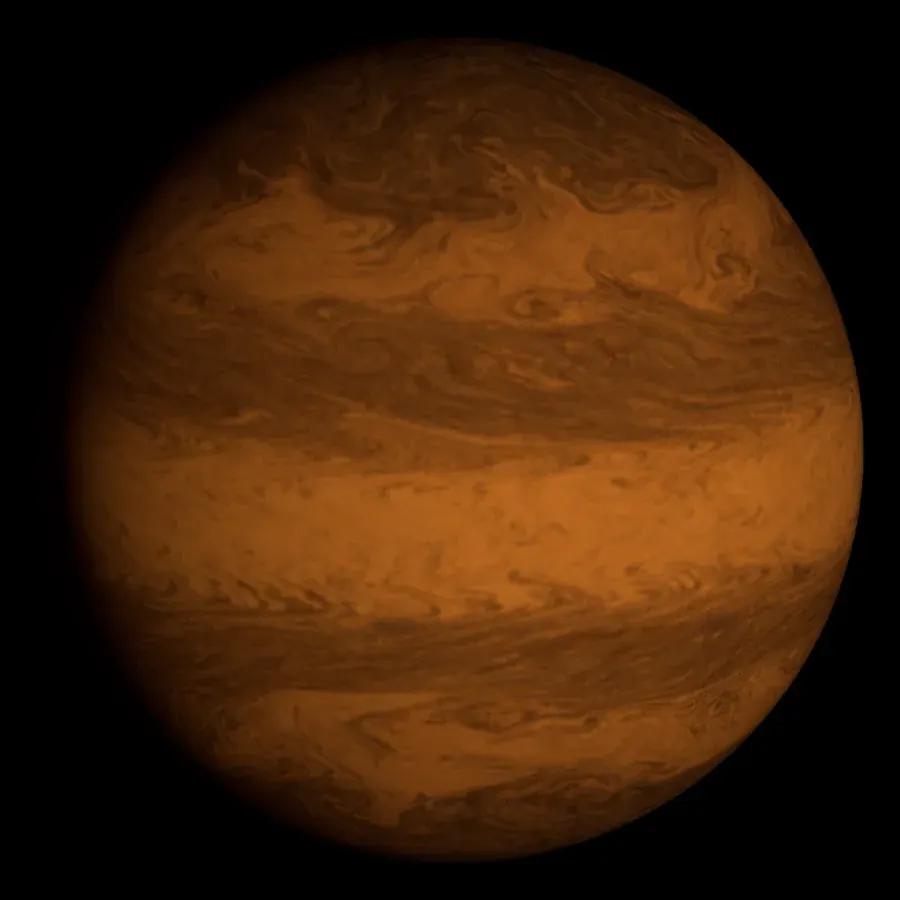
A gas giant is a planet made mostly of hydrogen and helium, the two lightest elements, with no solid surface to stand on. Jupiter and Saturn are the Solar System's gas giants; Uranus and Neptune, which are mostly heavier material, are classed separately as ice giants. Gas giants range from about a tenth of Jupiter's mass up to about 13 Jupiter masses, where objects become massive enough to fuse deuterium and are called brown dwarfs. Pax Abyssi generates giant planets around every star it simulates and sorts each one into five families and 41 types, then draws it from the physics that type describes. This page sets out that scheme and why it is built the way it is; the family pages show every type.
How Pax Abyssi classifies giant planets
A giant planet has no surface to map, so everything a pilot sees of it is the top of its atmosphere: which clouds have formed, what has stained them, and how the winds have arranged them. Our classification follows the same order the physics does. Each level answers one question, and each answer narrows what the planet can look like.
1. What is it made of?
The first cut is bulk composition. A gas giant is mostly hydrogen and helium; an ice giant is mostly water, methane and ammonia under a thinner hydrogen envelope, and is a different kind of planet inside and out. The two are separate series in Pax Abyssi, with their own physics engines. Real exoplanets from the catalogue are sorted by mass: from 50 to about 4,000 Earth masses a planet is a gas giant.
2. How warm is it?
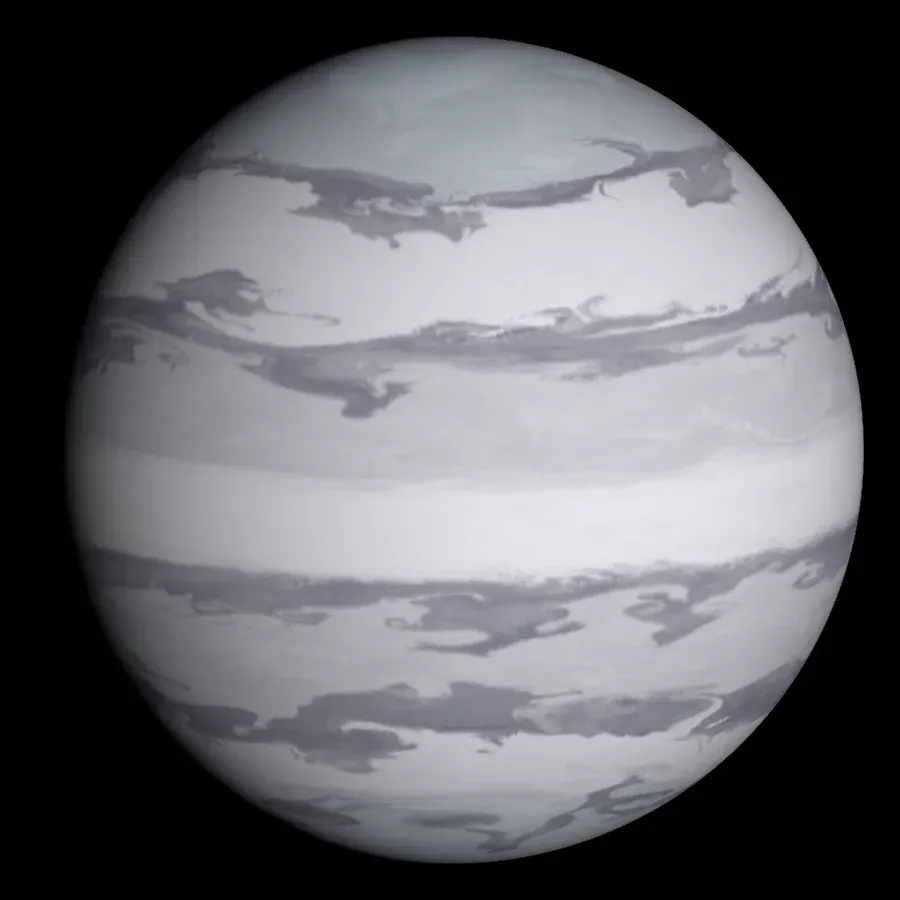
The second cut, and the most important, is equilibrium temperature, the temperature starlight alone would give the planet. It decides which substances can condense into cloud high in the atmosphere, and the highest cloud deck decides almost everything about how a giant looks 1. Each substance condenses at its own temperature, spread across thousands of kelvin: ammonia near 150 K, water near 250 to 300 K, salts near 1,000 K, silicate rock and iron above about 1,500 K 2 3. So temperature sorts the giants into families:
| Family | Code | Equilibrium temperature | Highest cloud | Sudarsky class | Real examples | Types |
|---|---|---|---|---|---|---|
| Cold gas giant | GGC | below 150 K | Ammonia ice | I | Jupiter, Saturn | 10 |
| Temperate gas giant | GGT | 150 to 700 K | Fading ammonia, then water ice, then none | II and III | Warm Jupiters | 8 |
| Hot Jupiter | GGH | 700 K and above | Sulfides and salts, then silicates and iron, then none | IV and V | 51 Pegasi b, HD 189733 b, KELT-9 b | 7 |
| Ice giant, cold | IGC | Cold, like Uranus and Neptune | Methane ice | none | Uranus, Neptune | 6 |
| Ice giant, hot | IGH | 350 K and above | Water cloud, then none | none | GJ 436 b, LTT 9779 b | 10 |
The boundaries follow the chemistry rather than round numbers. At 150 K ammonia stops forming a high, bright deck; from about 700 K the highest clouds a giant can form are sulfides and salts, such as zinc sulfide, potassium chloride and sodium sulfide 4, and hotter still methane gives way to carbon monoxide. The Sudarsky classification page shows how our families map onto Sudarsky's five classes.
3. What colours the clouds?
Within a family, the next question is what tints or hides the top cloud, and the answer differs by family because the physics does:
- Cold gas giants are split by trace chemistry. Pure ammonia ice is white, and the tans, browns and reds of Jupiter come from small amounts of coloured compounds, the chromophores, made when sunlight breaks molecules apart high in the atmosphere 5. We tie each palette to one trace gas, a choice made so that chemistry, not chance, picks the colour: ammonia-rich giants band cream and brown like Jupiter, sulfur-rich ones wear a gold haze like Saturn, phosphorus-rich ones a rust haze, and giants scarce in all three stay pale.
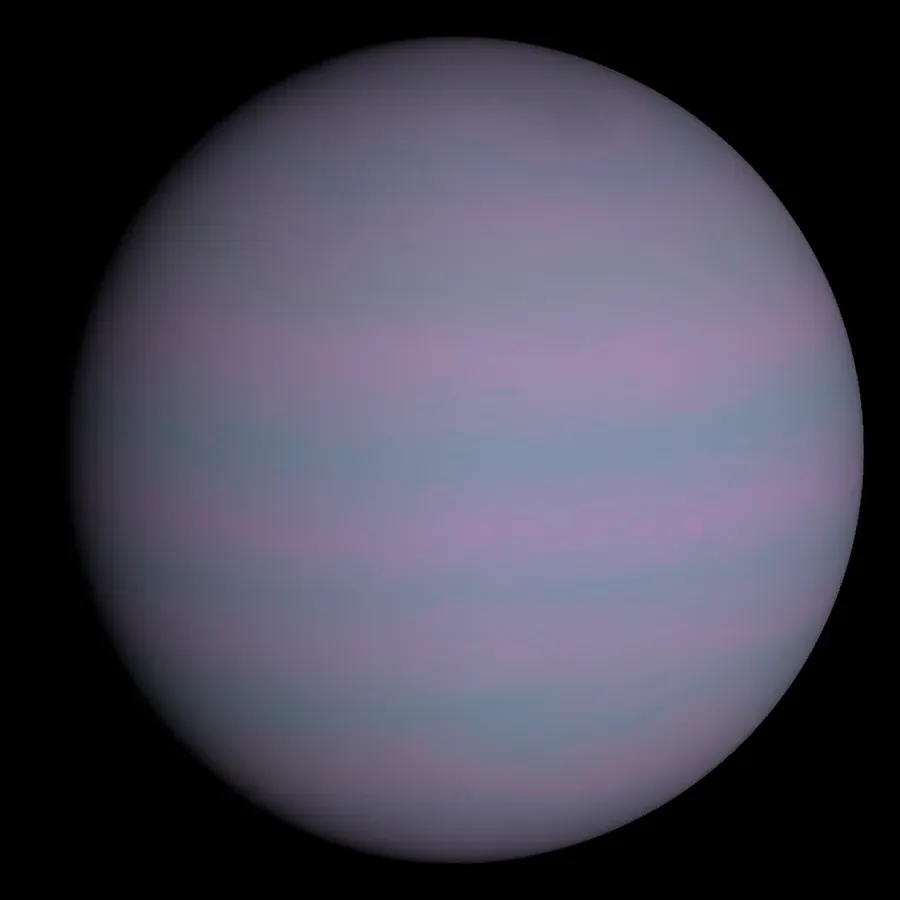
- Temperate gas giants are split by temperature and by photochemical haze, the smog that ultraviolet starlight makes from methane. A clear atmosphere at 400 K is deep blue; the same planet under haze turns grey or tawny 6.
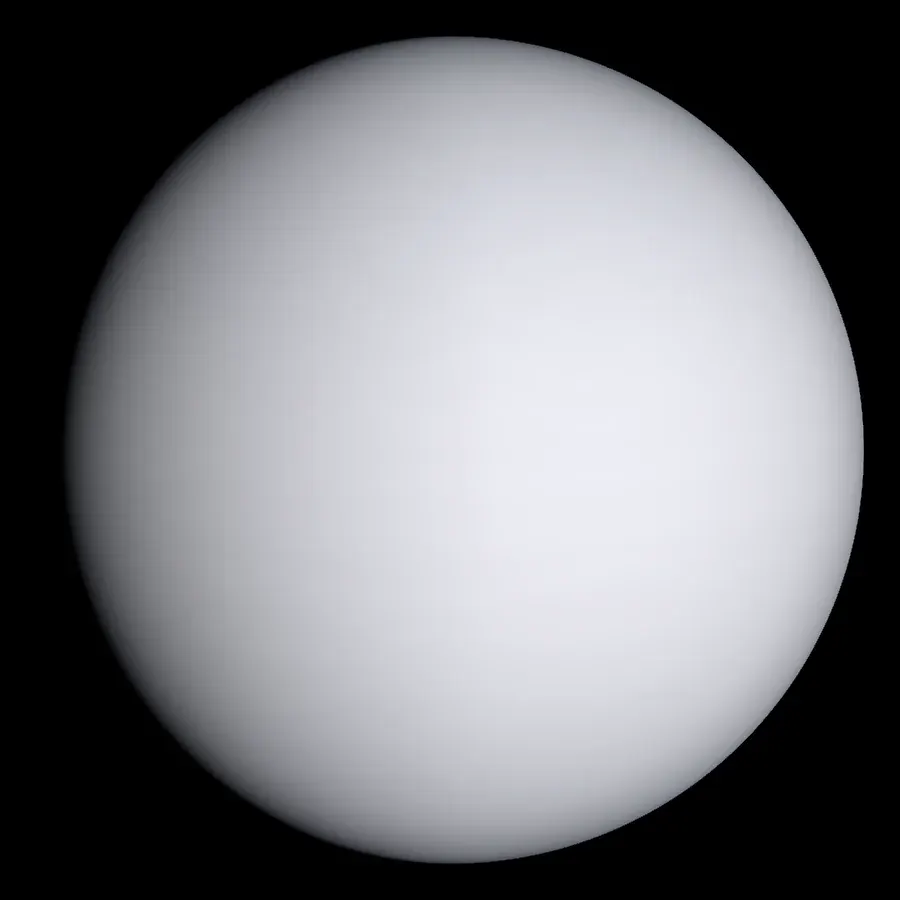
- Hot gas giants are split by dayside temperature into six subtypes, Methane-Jade, Silicate-Sapphire, Ferro-Copper, Opaline, Ashen and Ultra-Dark, which walk them through the condensation sequence from salts to silicates to iron to no cloud at all.
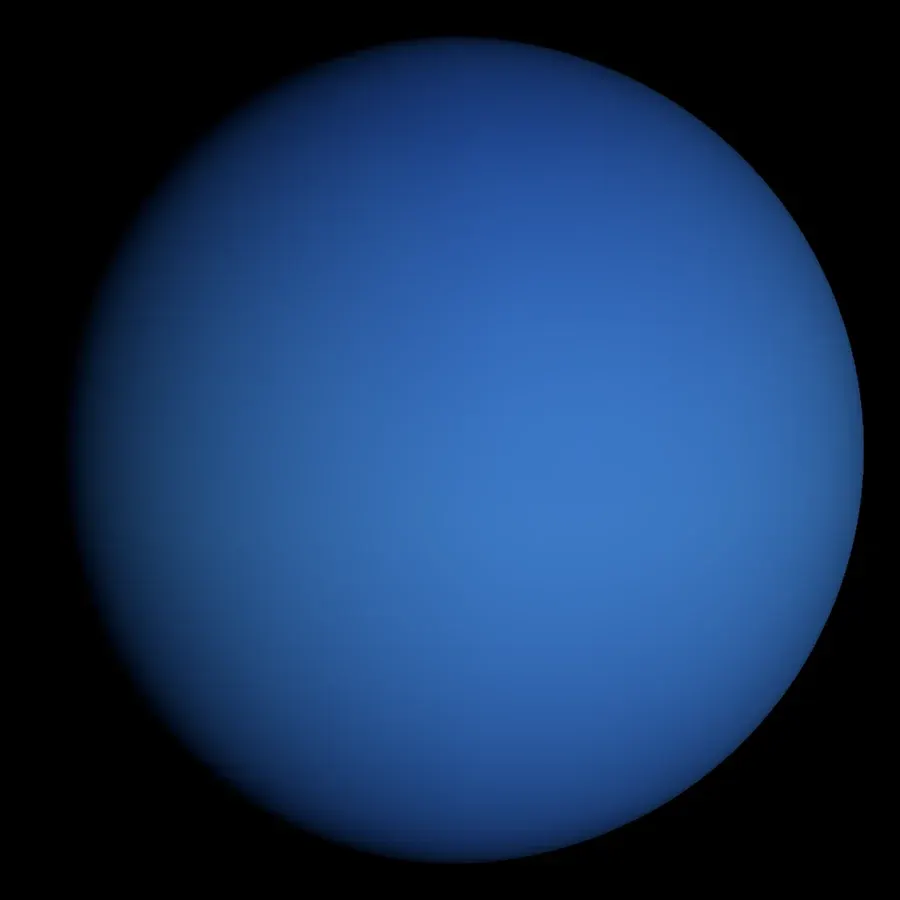
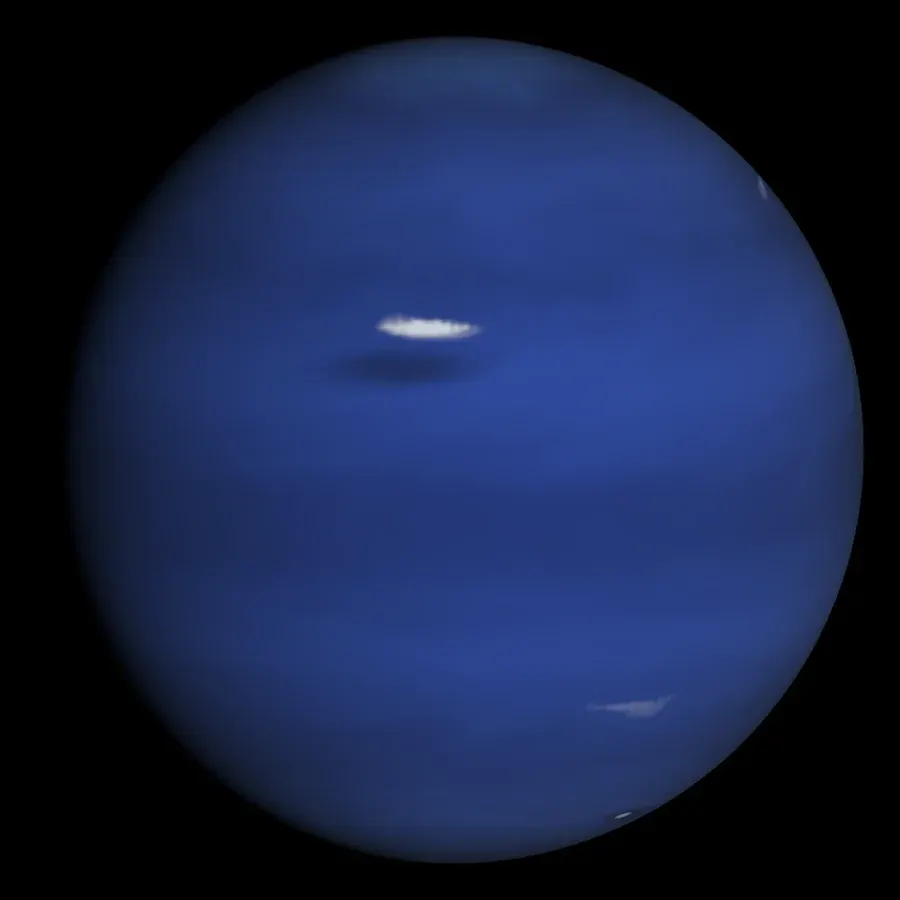
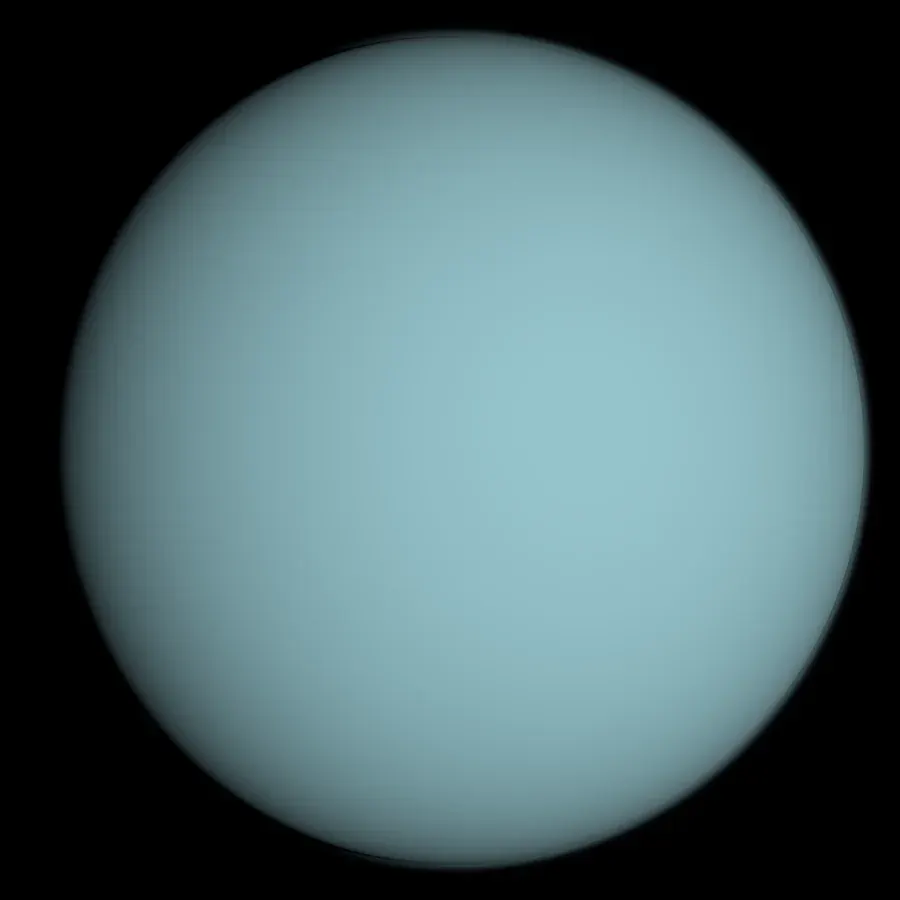
- Cold ice giants are split by internal heat. Neptune radiates about 2.6 times the energy it absorbs from the Sun and has fast winds and dark storms; Uranus, with almost no internal heat, is hazy and nearly featureless 7. That one number separates our Active and Quiescent ice giants.
- Hot ice giants are split by temperature, from water cloud through a cloudless blue to dark, alkali-stained worlds.
4. What is the weather doing?
The last level is the weather: how many bands, how turbulent their edges, whether great storms are present, how thick the haze lies. A calm, young Jupiter and a storm-torn old one share their chemistry and differ in their jets and vortices, so they are separate types (GGC-AB-CB and GGC-AB-SA). These are the codes printed in the galleries below and on each family page.
5. Every world its own
A type is a recipe, not a picture. Pax Abyssi grows each giant's clouds with its own gas giant generator, which traces a modelled wind of jets, eddies and storms and reads where the cloud was carried 8. The generator can dress every one of the 1,965 giants in the generated star systems, and each draws its own random seed and one of up to four variants of its type, so two giants of the same type share a character and differ in their weather. The galleries show variant 1 of each type unless the caption says otherwise.
From painted maps to procedural planets
Our first simulator dressed its giants in painted maps: one picture wrapped around the sphere for each type, painted to match our research on that type, with the belts, festoons, storms and hazes it should show. A painted map gives beautiful fine detail, and it has two limits. A given map always looks the same, so every giant of a type was the same planet. And a map holds a fixed number of pixels, so the closer you fly, the softer it gets, until the picture breaks down.
Procedural generation promises the opposite: planets computed from rules, each one different, with as much detail as you care to compute. In practice procedural planets tend to look alike, and to look dull. So we set the generator a harder target. Every feature the painted maps had, the belts and zones, festoons hooking off the equatorial zone, hooked vortices, great spots, Saturn's polar hexagon, layers of haze, had to grow out of the modelled wind, matched to the painted original as closely as we could make it. It has worked, and the sliders below show how well.
The payoff comes in two places. Every giant is now its own world: the same type gives the same character, and each planet's own seed gives it its own weather. And the detail holds as you close in. The generator computes the cloud beneath the ship again at finer and finer scales, down to about 210 metres a pixel on a planet the size of Jupiter, so you can skim low over the cloud tops and they stay sharp. The same approach carries over to rocky worlds, where it brings a seamless descent from space to the ground and a whole planet to walk.
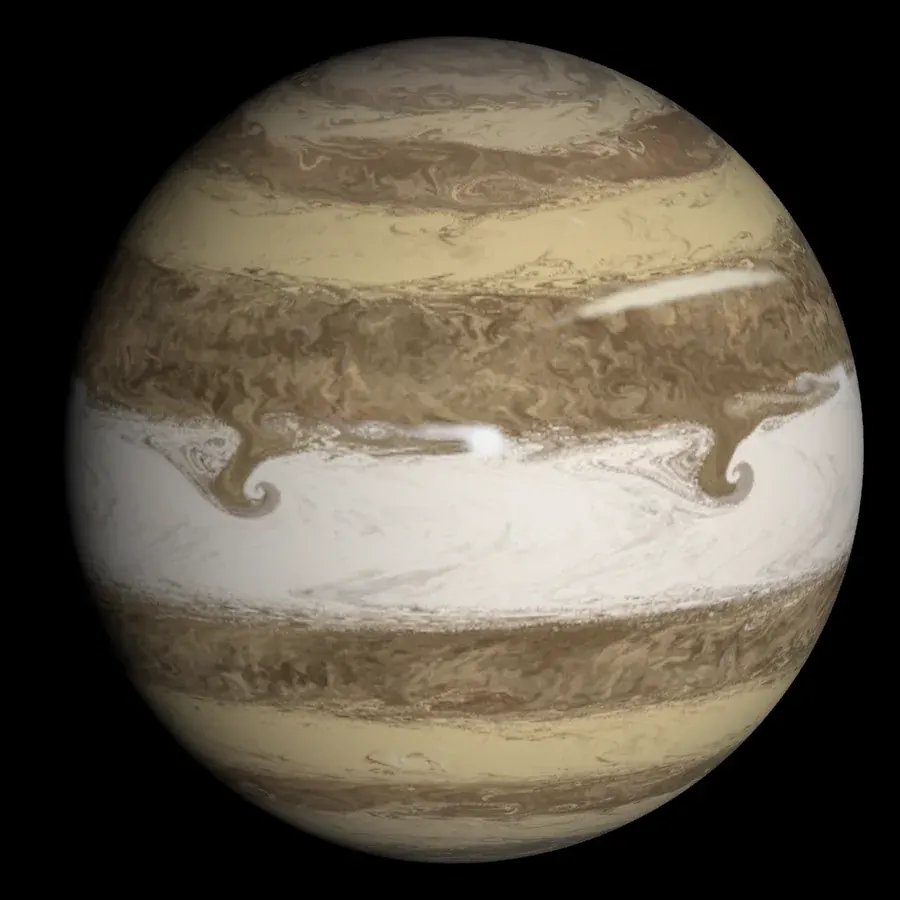
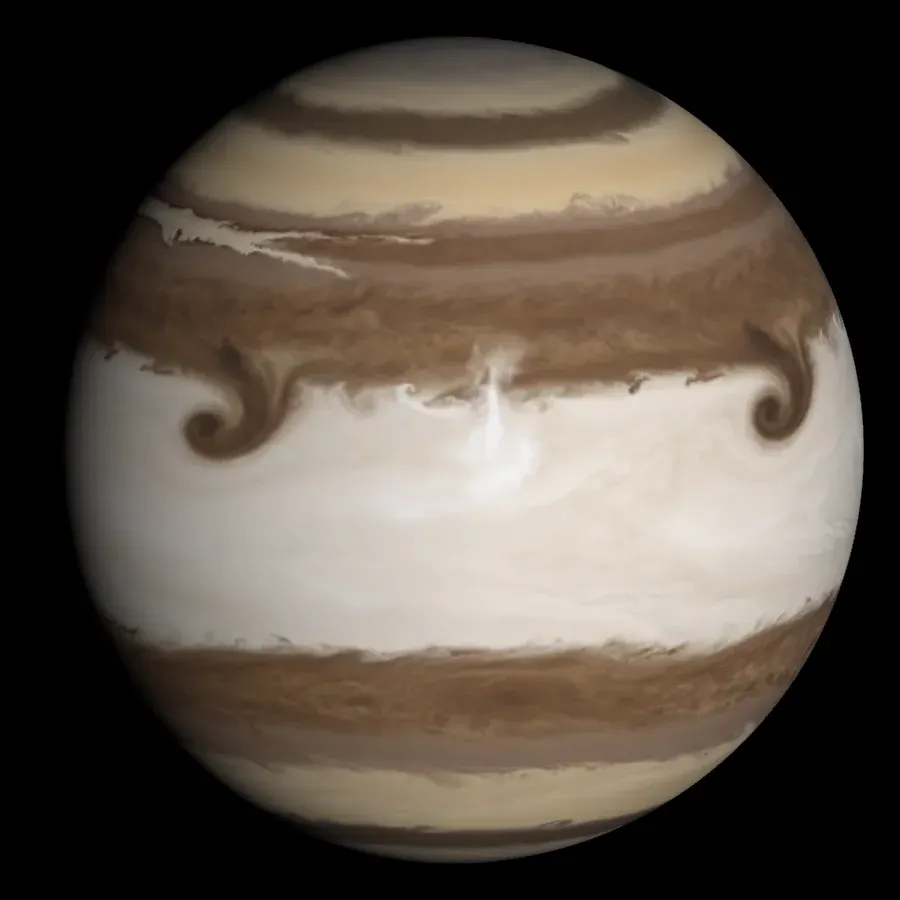
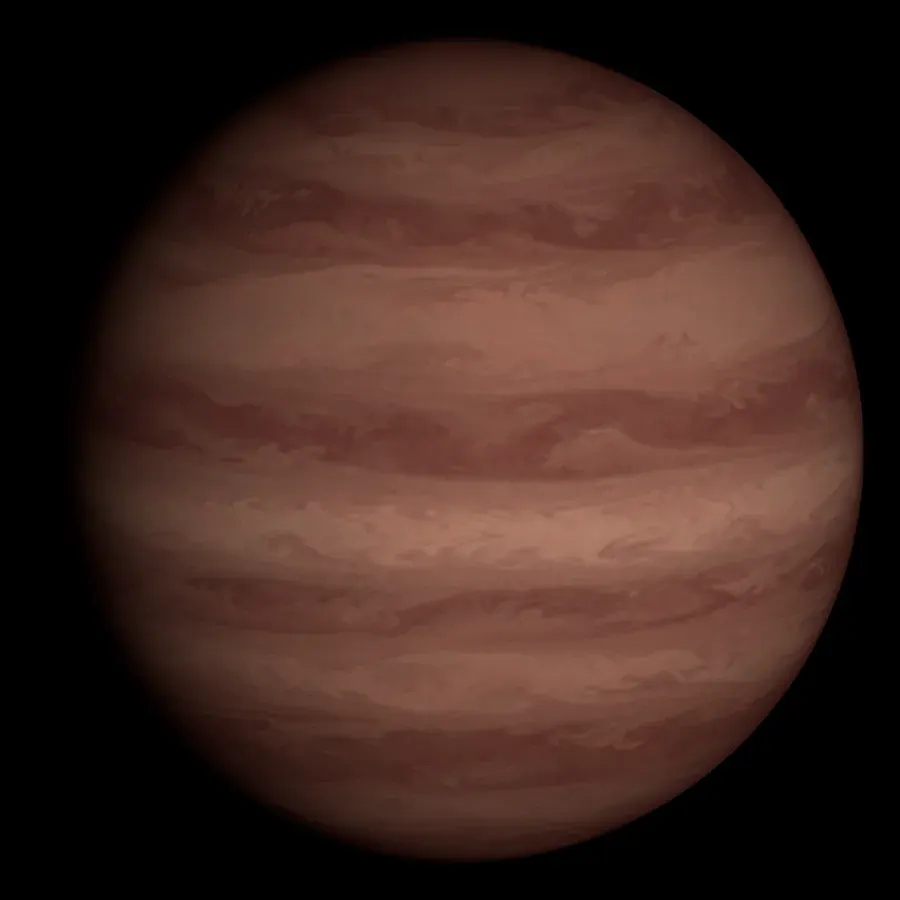
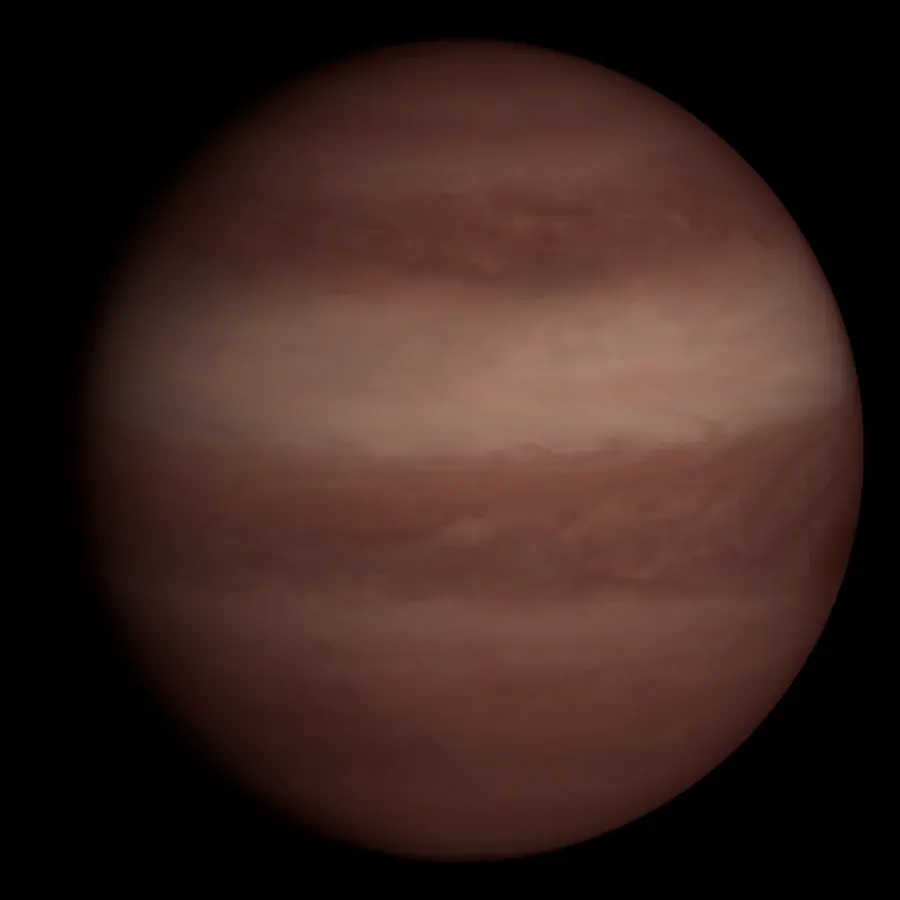
One of each
, open full size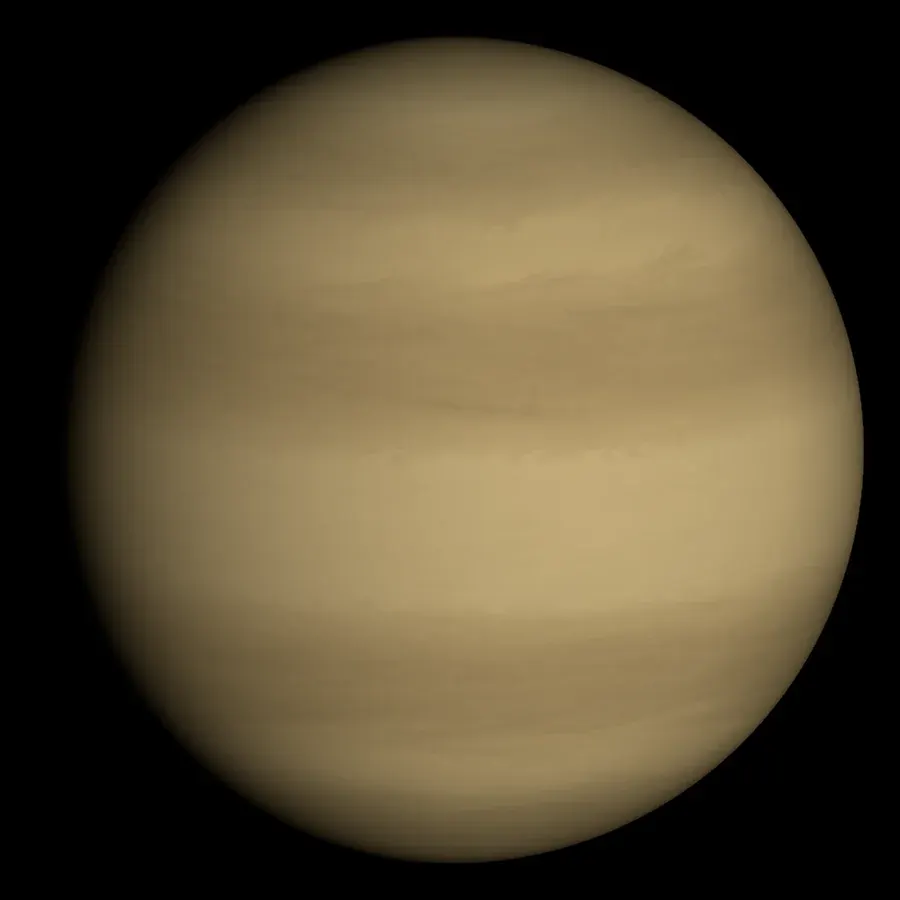 , open full size
 , open full size
 , open full size
 , open full size
 , open full size
 , open full size
 , open full size
 , open full size
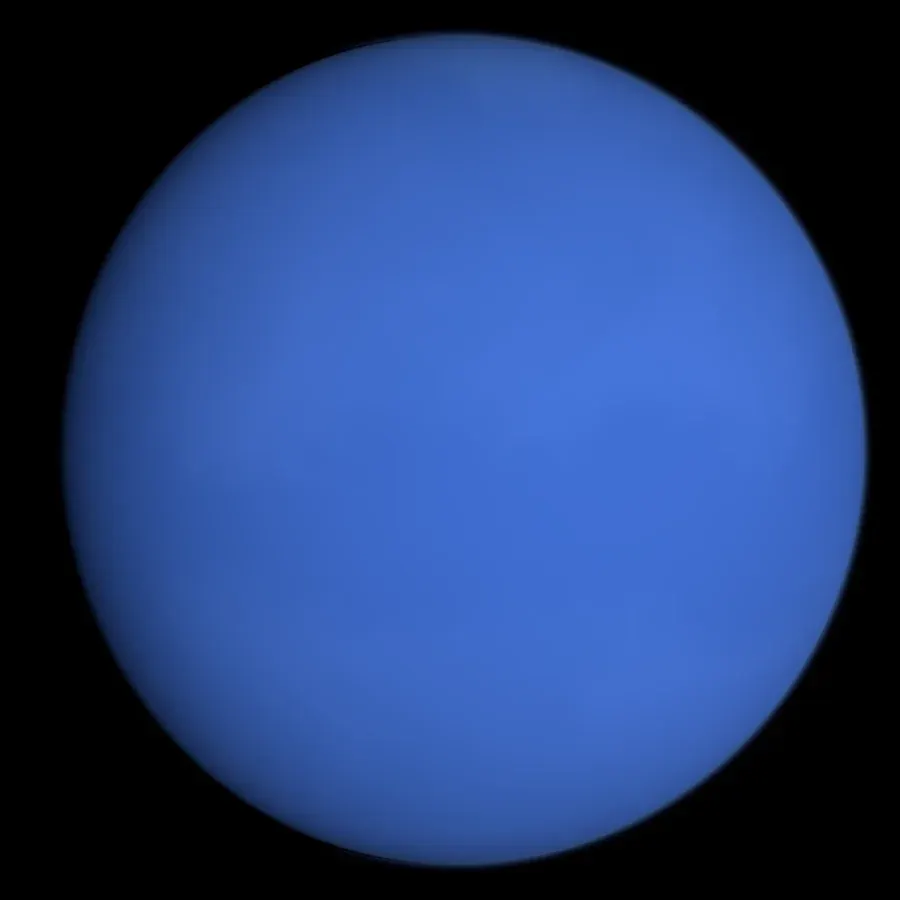 , open full size
What makes a gas giant
A gas giant has roughly the composition of the gas its star formed from. Jupiter's upper atmosphere is about 90% molecular hydrogen and 10% helium by volume, with methane, ammonia, water and hydrogen sulfide as trace gases 9. The heavier elements are enriched relative to the Sun: the Galileo probe, which fell into Jupiter in 1995, measured carbon, nitrogen and sulfur at about three times the solar proportion 10. That enrichment is a clue to how the planet formed, since it means Jupiter swallowed solids as well as gas.
The name is slightly misleading. Only the outer few per cent of a gas giant's radius behaves like a gas. Deeper, the pressure squeezes hydrogen into a dense fluid, and beyond about a million times the pressure at Earth's surface the hydrogen's electrons break free and it conducts electricity like a liquid metal. Currents in this metallic hydrogen generate the planet's magnetic field 11.
Gas giants are also oddly uniform in size. Adding mass to a giant squeezes its interior harder, and above about half a Jupiter mass the extra compression nearly cancels the extra material. An old, cool giant of 0.5 Jupiter masses and one of 10 both have radii close to Jupiter's own, and the curve stays nearly flat into the brown dwarf range 12 13. Saturn, at 0.30 Jupiter masses, is on the rising part of the curve at 0.84 Jupiter radii, and its mean density of 0.687 g/cm³ is lower than that of water 14. The main exceptions are the hot Jupiters, many of which are inflated well beyond Jupiter's size by their stars' heat.
Inside a gas giant
NASA's Juno spacecraft, orbiting Jupiter since 2016, has mapped the planet's gravity field closely enough to test models of its interior. The result was unexpected: Jupiter's heavy elements are not packed into a small, dense core but spread through a large "dilute core" that blends into the hydrogen envelope around it 15 16. Saturn has a similar diffuse core, revealed by the way oscillations inside the planet disturb the waves in its rings 17.
Helium is separating out of both planets. At the pressures and temperatures deep in a cooling giant, helium stops mixing with metallic hydrogen and condenses into droplets that sink, a process called helium rain. The Galileo probe found Jupiter's upper atmosphere depleted in helium, with a mass fraction of 0.234 against about 0.27 in the gas the Sun formed from 18. Neon, which dissolves into the helium droplets and is carried down with them, is depleted about tenfold, the signature helium rain predicts 19. Saturn, smaller and colder, has taken the process further 20.
Gas giants also shine by their own heat. Jupiter radiates 7.5 watts per square metre from its interior on top of the sunlight it re-emits, so it gives off slightly more than twice the energy it absorbs from the Sun 21. The heat is left over from the planet's formation and is released as the planet slowly cools and contracts; helium rain adds to it. Internal heat drives the convection that stirs the atmosphere and powers the magnetic field.
Clouds, colours and temperature
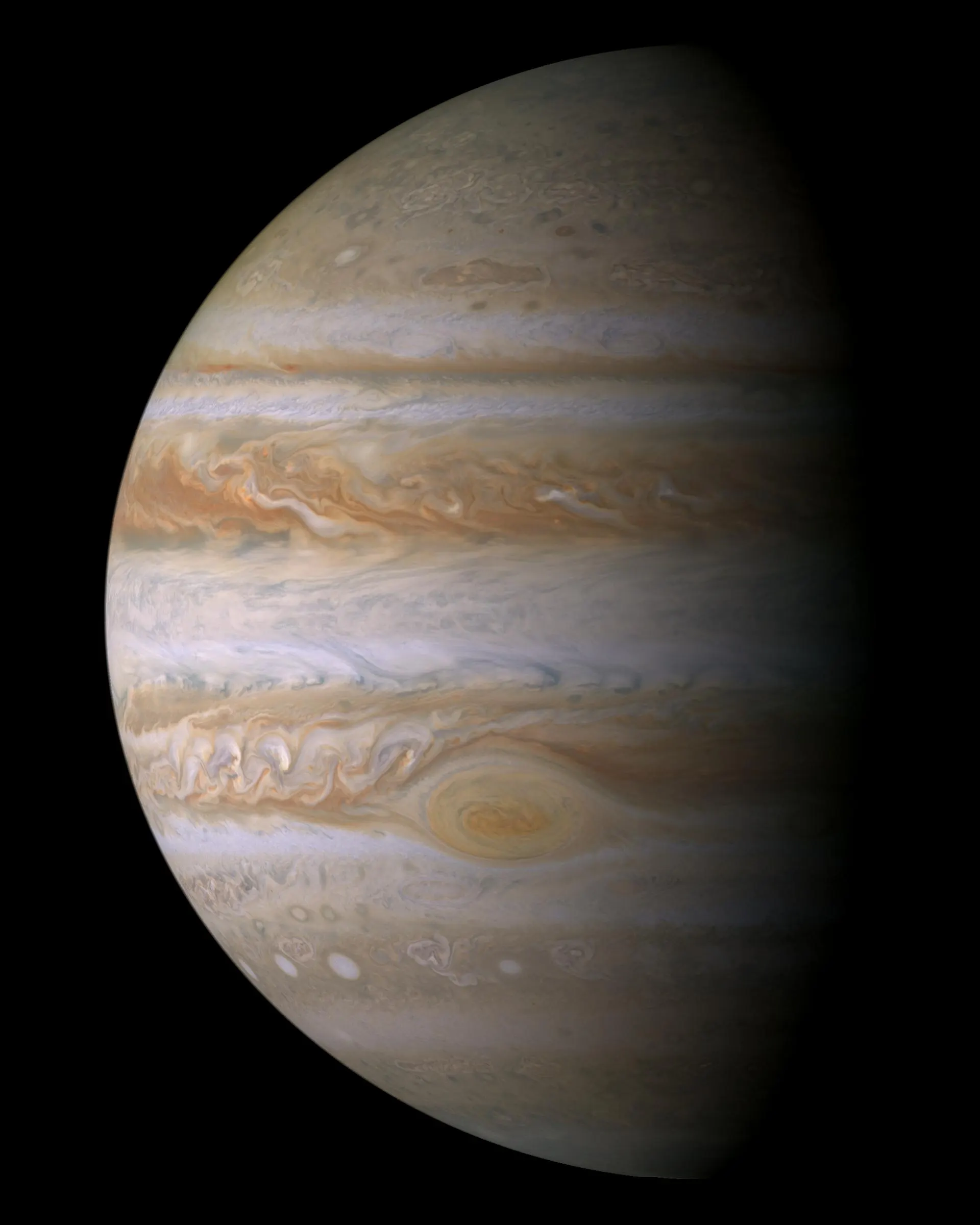
Rapid rotation (Jupiter turns in 9.93 hours 9) organises a gas giant's weather into bands of alternating east and west winds: the familiar belts and zones, with long-lived storms like the Great Red Spot riding between them. Which clouds form, and so what colour the bands are, depends on temperature. A cold giant like Jupiter has ammonia ice clouds on top; a warmer one would have water clouds; warmer still, no clouds form high in the atmosphere at all; and the hottest have clouds of rock and metal. Astronomers usually sort giant exoplanets by orbital period or equilibrium temperature: hot Jupiters have periods of a few days, warm Jupiters orbit in roughly 10 to 200 days, and cold Jupiters orbit beyond about 1 AU, the region where giants are most common.
 , open full size
Formation
Two ideas compete to explain how gas giants form. In core accretion, the favoured model for most giants, a core of rock and ice grows in the disc around a young star until, at about ten Earth masses, its gravity can pull in the surrounding gas faster and faster. The planet must finish before the disc disperses, within a few million years, which favours the region just beyond the snow line, where ice adds to the solid material available 22. In disc instability, a massive, cold disc fragments directly into giant planets under its own gravity, far faster than a core can grow 23; this route may explain some massive giants on very wide orbits.
Giants need not stay where they form. Interactions with the gas disc, with other planets or with a distant companion star can move them inward, and a giant pushed close to its star becomes a hot Jupiter 24.
Core accretion predicts that stars richer in heavy elements should form giants more easily, and they do. The chance that a Sun-like star has a giant planet rises roughly with the square of its iron abundance, so a star with twice the Sun's iron is about four times as likely to host one 25.
How common are they?
Radial-velocity surveys, which detect the wobble a planet induces in its star, find about 14 giant planets per 100 Sun-like stars with orbits of 2 to 8 AU, and about 9 per 100 at 8 to 32 AU. Giants are about four times more common beyond 1 AU than inside it 26. Hot Jupiters are rare: they orbit about 0.4% of the stars Kepler watched 27 and about 1.2% of nearby Sun-like stars in radial-velocity surveys 28. They were found first because they are the easiest planets to detect.
How we know
- Spacecraft have visited all four giants of the Solar System. The Galileo probe sampled Jupiter's atmosphere directly in 1995; Cassini measured Saturn's gravity, rings and heat balance and refined Jupiter's 21; Juno is mapping Jupiter's gravity and magnetic field.
- Radial velocities found the first gas giant around a Sun-like star, 51 Pegasi b, in 1995 29.
- Transits give radii and, combined with radial velocities, densities; HD 209458 b in 1999 was the first planet seen to transit 30.
- Spectroscopy during transits and eclipses reads the atmospheres. JWST made the first clear detection of carbon dioxide in an exoplanet, the Saturn-mass WASP-39 b, in 2022 31.
- Direct imaging separates the light of young or wide-orbit giants from their stars' glare 32 33.
Notable examples
| Planet | Mass | Radius | Orbit | Notes |
|---|---|---|---|---|
| Jupiter | 1 M_Jup (317.8 Earth masses) | 71,492 km | 5.20 AU, 11.9 years | Largest planet in the Solar System 9 |
| Saturn | 0.30 M_Jup (95.2 Earth masses) | 60,268 km | 9.6 AU, 29.4 years | Mean density below water's 14 |
| 51 Pegasi b | at least about 0.5 M_Jup | unknown | 4.23 days | First gas giant found around a Sun-like star 29 |
| HD 209458 b | 0.69 M_Jup | 1.27 R_Jup | 3.5 days | First planet seen to transit 34 30 |
| KELT-9 b | about 2.9 M_Jup | about 1.9 R_Jup | 1.5 days | Dayside near 4,600 K, one of the hottest planets known 35 |
| epsilon Indi Ab | about 6 M_Jup | about 200 years | Cold giant 12 light years away, imaged by JWST; effective temperature about 275 K 33 36 | |
| HR 8799 b, c, d, e | several M_Jup each | about 15 to 70 AU | Four young giants imaged around one star 32 37 |
See also
- Cold gas giant
- Temperate gas giant
- Hot Jupiter
- Ice giant
- Sudarsky classification
- Mini-Neptune
- Brown dwarf
- Planet classification
- Sol
References
- 1Sudarsky, D., Burrows, A. and Pinto, P. (2000). Albedo and Reflection Spectra of Extrasolar Giant Planets. The Astrophysical Journal 538, 885-903. doi:10.1086/309160
- 2Lewis, J. S. (1969). The clouds of Jupiter and the NH3-H2O and NH3-H2S systems. Icarus 10, 365-378. doi:10.1016/0019-1035(69)90091-8
- 3Visscher, C., Lodders, K. and Fegley, B. (2010). Atmospheric Chemistry in Giant Planets, Brown Dwarfs, and Low-mass Dwarf Stars. III. Iron, Magnesium, and Silicon. The Astrophysical Journal 716, 1060-1075. doi:10.1088/0004-637X/716/2/1060
- 4Morley, C. V. et al. (2012). Neglected Clouds in T and Y Dwarf Atmospheres. The Astrophysical Journal 756, 172. doi:10.1088/0004-637X/756/2/172
- 5Carlson, R. W. et al. (2016). Chromophores from photolyzed ammonia reacting with acetylene: Application to Jupiter's Great Red Spot. Icarus 274, 106-115. doi:10.1016/j.icarus.2016.03.008
- 6Cahoy, K. L., Marley, M. S. and Fortney, J. J. (2010). Exoplanet Albedo Spectra and Colors as a Function of Planet Phase, Separation, and Metallicity. The Astrophysical Journal 724, 189-214. doi:10.1088/0004-637X/724/1/189
- 7Pearl, J. C. and Conrath, B. J. (1991). The albedo, effective temperature, and energy balance of Neptune, as determined from Voyager data. Journal of Geophysical Research: Space Physics 96, 18921-18930. doi:10.1029/91JA01087
- 8Ingersoll, A. P. et al. (2004). Dynamics of Jupiter's atmosphere. Jupiter: The Planet, Satellites and Magnetosphere 105-128.
- 9NASA Space Science Data Coordinated Archive. Jupiter Fact Sheet. nssdc.gsfc.nasa.gov/planetary/factsheet/jupiterfact.html
- 10Atreya, S. K. et al. (1999). A comparison of the atmospheres of Jupiter and Saturn: deep atmospheric composition, cloud structure, vertical mixing, and origin. Planetary and Space Science 47, 1243-1262. doi:10.1016/S0032-0633(99)00047-1
- 11Stevenson, D. J. (2020). Jupiter's Interior as Revealed by Juno. Annual Review of Earth and Planetary Sciences 48, 465-489. doi:10.1146/annurev-earth-081619-052855
- 12Fortney, J. J., Marley, M. S. and Barnes, J. W. (2007). Planetary Radii across Five Orders of Magnitude in Mass and Stellar Insolation: Application to Transits. The Astrophysical Journal 659, 1661-1672. doi:10.1086/512120
- 13Chen, J. and Kipping, D. (2017). Probabilistic Forecasting of the Masses and Radii of Other Worlds. The Astrophysical Journal 834, 17. doi:10.3847/1538-4357/834/1/17
- 14NASA Space Science Data Coordinated Archive. Saturn Fact Sheet. nssdc.gsfc.nasa.gov/planetary/factsheet/saturnfact.html
- 15Wahl, S. M. et al. (2017). Comparing Jupiter interior structure models to Juno gravity measurements and the role of a dilute core. Geophysical Research Letters 44, 4649-4659. doi:10.1002/2017GL073160
- 16Militzer, B. et al. (2022). Juno Spacecraft Measurements of Jupiter's Gravity Imply a Dilute Core. The Planetary Science Journal 3, 185. doi:10.3847/PSJ/ac7ec8
- 17Mankovich, C. R. and Fuller, J. (2021). A diffuse core in Saturn revealed by ring seismology. Nature Astronomy 5, 1103-1109. doi:10.1038/s41550-021-01448-3
- 18von Zahn, U., Hunten, D. M. and Lehmacher, G. (1998). Helium in Jupiter's atmosphere: Results from the Galileo probe Helium Interferometer Experiment. Journal of Geophysical Research: Planets 103, 22815-22829. doi:10.1029/98JE00695
- 19Wilson, H. F. and Militzer, B. (2010). Sequestration of Noble Gases in Giant Planet Interiors. Physical Review Letters 104, 121101. doi:10.1103/PhysRevLett.104.121101
- 20Mankovich, C. R. and Fortney, J. J. (2020). Evidence for a Dichotomy in the Interior Structures of Jupiter and Saturn from Helium Phase Separation. The Astrophysical Journal 889, 51. doi:10.3847/1538-4357/ab6210
- 21Li, L. et al. (2018). Less absorbed solar energy and more internal heat for Jupiter. Nature Communications 9, 3709. doi:10.1038/s41467-018-06107-2
- 22Pollack, J. B. et al. (1996). Formation of the Giant Planets by Concurrent Accretion of Solids and Gas. Icarus 124, 62-85. doi:10.1006/icar.1996.0190
- 23Boss, A. P. (1997). Giant Planet Formation by Gravitational Instability. Science 276, 1836-1839. doi:10.1126/science.276.5320.1836
- 24Dawson, R. I. and Johnson, J. A. (2018). Origins of Hot Jupiters. Annual Review of Astronomy and Astrophysics 56, 175-221. doi:10.1146/annurev-astro-081817-051853
- 25Fischer, D. A. and Valenti, J. (2005). The Planet-Metallicity Correlation. The Astrophysical Journal 622, 1102-1117. doi:10.1086/428383
- 26Fulton, B. J. et al. (2021). California Legacy Survey. II. Occurrence of Giant Planets beyond the Ice Line. The Astrophysical Journal Supplement Series 255, 14. doi:10.3847/1538-4365/abfcc1
- 27Fressin, F. et al. (2013). The False Positive Rate of Kepler and the Occurrence of Planets. The Astrophysical Journal 766, 81. doi:10.1088/0004-637X/766/2/81
- 28Wright, J. T. et al. (2012). The Frequency of Hot Jupiters Orbiting Nearby Solar-type Stars. The Astrophysical Journal 753, 160. doi:10.1088/0004-637X/753/2/160
- 29Mayor, M. and Queloz, D. (1995). A Jupiter-mass companion to a solar-type star. Nature 378, 355-359. doi:10.1038/378355a0
- 30Charbonneau, D. et al. (2000). Detection of Planetary Transits Across a Sun-like Star. The Astrophysical Journal 529, L45-L48. doi:10.1086/312457
- 31JWST Transiting Exoplanet Community Early Release Science Team et al. (2023). Identification of carbon dioxide in an exoplanet atmosphere. Nature 614, 649-652. doi:10.1038/s41586-022-05269-w
- 32Marois, C. et al. (2008). Direct Imaging of Multiple Planets Orbiting the Star HR 8799. Science 322, 1348-1352. doi:10.1126/science.1166585
- 33Matthews, E. C. et al. (2024). A temperate super-Jupiter imaged with JWST in the mid-infrared. Nature 633, 789-792. doi:10.1038/s41586-024-07837-8
- 34Mazeh, T. et al. (2000). The Spectroscopic Orbit of the Planetary Companion Transiting HD 209458. The Astrophysical Journal 532, L55-L58. doi:10.1086/312558
- 35Gaudi, B. S. et al. (2017). A giant planet undergoing extreme-ultraviolet irradiation by its hot massive-star host. Nature 546, 514-518. doi:10.1038/nature22392
- 36Max Planck Society (2024). Webb images nearest super-Jupiter, opening a new window to exoplanet research. www.mpg.de/22154949/0702-astr-2024-jwst-eps-ind-150980-x
- 37Marois, C. et al. (2010). Images of a fourth planet orbiting HR 8799. Nature 468, 1080-1083. doi:10.1038/nature09684