- On this page
- 2
- figures
- 1
- table
- 1
- panel
- 21
- references
Planet class · IGC, IGH · IG1-C, IG2-H
Ice giant
ContentsShow
An ice giant is a giant planet made mostly of elements heavier than hydrogen and helium: chiefly water, methane and ammonia, which planetary scientists call "ices" whatever their state. Uranus and Neptune are the two in the Solar System, each about 15 to 17 times Earth's mass and four times its width. Despite the name, almost nothing inside them is frozen: most of each planet is a hot, dense, electrically conducting fluid under a comparatively thin hydrogen-helium atmosphere 1. Planets of about Neptune's mass appear to be among the most common in the Galaxy, which makes the two least-explored planets of the Solar System templates for a very large class.
Characteristics
Built differently from Jupiter
Jupiter and Saturn are mostly hydrogen and helium. Uranus and Neptune are not: at least 80% of Neptune's mass is a hot, dense fluid of water, methane and ammonia 2. Their densities, 1.27 g/cm³ for Uranus and 1.64 for Neptune 3 4, sit between those of the gas giants and the rocky planets. Their interiors are usually modelled as three layers: a hydrogen-helium envelope, a deep "mantle" of water-rich fluid, and a rocky core. The proportions are uncertain, because the same gravity field can be matched by different mixtures of rock and water, and the boundaries between layers may be gradual rather than sharp 1.
The pressures in an ice giant never become high enough in its thin hydrogen envelope to make metallic hydrogen, so the magnetic field must come from somewhere else. At the millions of atmospheres and thousands of degrees of the deep mantle, water is ionic and conducts electricity. Laboratory shock experiments have produced superionic water ice under such conditions: a crystal lattice of oxygen through which hydrogen ions flow like a liquid 5.
Tilted, lopsided magnetic fields
Voyager 2, the only spacecraft to visit either planet, found magnetic fields unlike any other planet's. Uranus's dipole is tilted about 59 degrees from its spin axis and offset from the centre by about a third of the planet's radius 6; Neptune's is tilted about 47 degrees and offset by more than half its radius 7. Both fields also have strong components more complex than a simple dipole. Models reproduce this if the field is generated in a thin convecting shell of conducting fluid above a stable interior, rather than in a deep, fully convecting region 8.
Hot Neptune, cold Uranus
The two planets are near twins in size and mass but not in heat. Neptune radiates about 2.6 times as much energy as it absorbs from the Sun 9. Voyager found Uranus's output almost indistinguishable from the sunlight it absorbs 10; a 2025 reanalysis of Uranus's reflected light finds that it emits about 12.5% more than it absorbs, a small but real internal heat flow 11. Why Uranus holds its heat in is unresolved; suggestions include a giant impact, which may also explain its 98-degree tilt, and layers in the interior that block convection 1.
Clouds, colour and wind
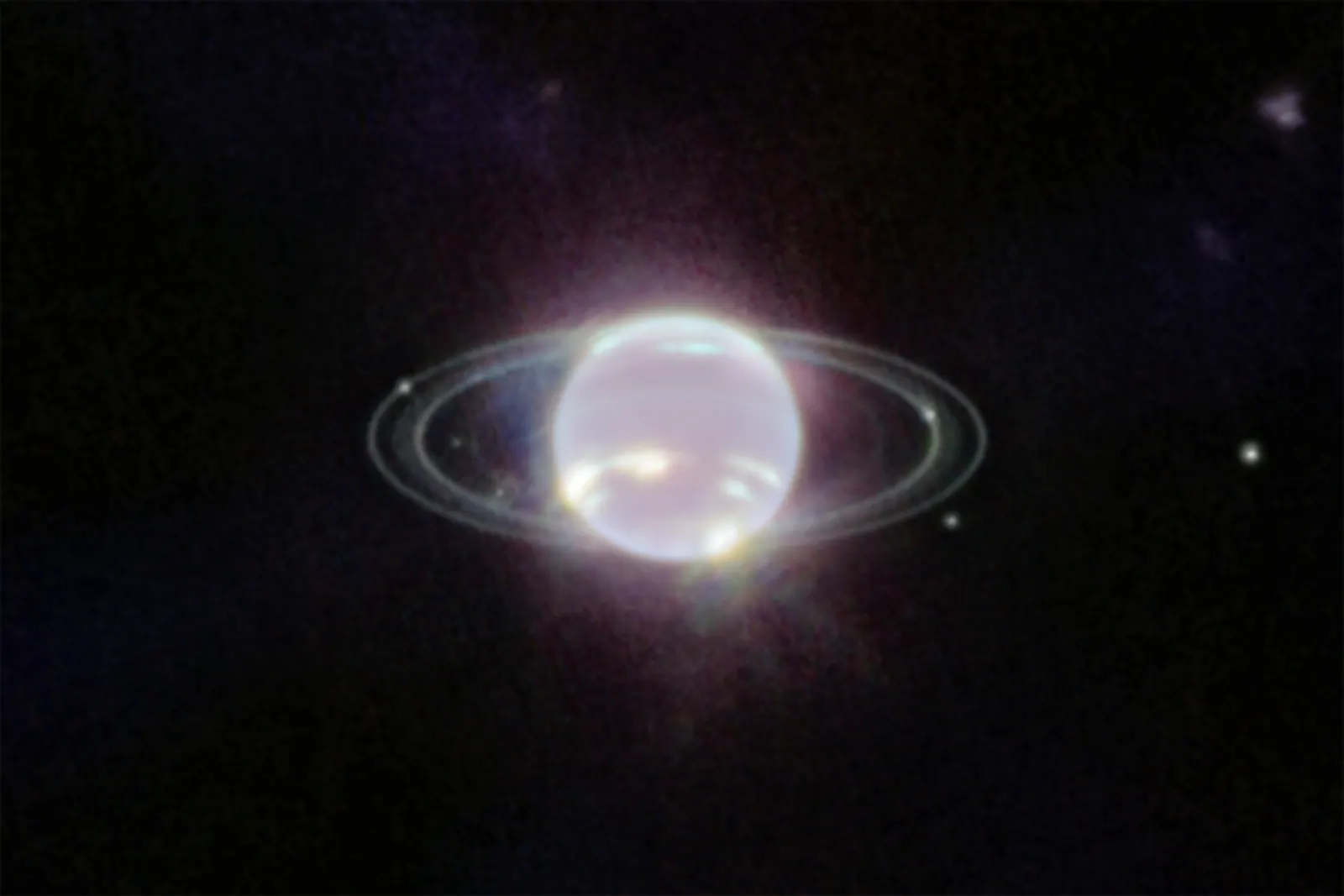
The top clouds of an ice giant are methane ice, near 1 to 2 bar, with a thicker layer of haze and hydrogen sulfide ice below 12. Methane gas absorbs red light, which is why both planets are blue-green. Their true colours are more alike than the familiar Voyager images suggest. Both are a pale greenish blue; Neptune is only slightly bluer, because Uranus has a thicker layer of haze over its methane cloud. Voyager's images of Neptune were contrast-stretched to bring out its clouds, which made it look a much deeper blue than it is 13.
Neptune, the planet farthest from the Sun, has the fastest winds measured on any planet: Voyager tracked clouds moving westward at about 400 m/s near the equator 14. Uranus's winds are gentler, with eastward jets near 60 degrees latitude of about 250 m/s 15. Neptune also makes large dark storms. The Great Dark Spot that Voyager photographed in 1989, about the size of Earth, was gone when the Hubble Space Telescope looked in 1994 16; new spots have appeared and faded since, each lasting a few years.
Formation
Ice giants are a puzzle for formation models. At 20 to 30 AU from the Sun, solid material was sparse and orbits slow, so growing a core of more than ten Earth masses before the gas disc disappeared would have taken too long. One answer is that Uranus and Neptune formed closer to the Sun and were pushed outward later, when the orbits of the giant planets were rearranged; the Nice model reproduces the giants' present orbits this way 17. Their modest hydrogen-helium envelopes suggest that their cores reached the size for runaway gas capture only as the disc was fading, so they never became gas giants.
Neptune-like planets around other stars
Microlensing surveys, which can detect planets several AU from their stars, find that planets of about Neptune's mass-to-star ratio are the most common type in that region 18. Close to their stars, however, Neptune-sized planets are rare: there is a hot Neptune desert at orbital periods shorter than two to four days, probably because such planets lose their atmospheres to starlight or never arrive there 19. The warm Neptune GJ 436 b trails a comet-like cloud of escaping hydrogen that blocks 56% of its star's ultraviolet light in transit, against 0.7% of visible light for the planet itself 20. LTT 9779 b, an ultra-hot Neptune inside the desert, is unexpectedly reflective, with a geometric albedo of about 0.8, similar to Venus's, best explained by silicate clouds in a very metal-rich atmosphere 21. Whether such planets have ice-giant interiors like Uranus and Neptune, or rocky cores with thick envelopes, usually cannot be told from mass and radius alone; the smaller, commoner mini-Neptunes are a separate class.
How we know
Voyager 2 flew past Uranus in 1986 and Neptune in 1989, and everything known about their magnetic fields, interiors and moons at close range comes from those two passes. Since then the Hubble Space Telescope, large ground-based telescopes with adaptive optics and JWST have tracked their clouds, storms, seasons and rings. Neptune-mass exoplanets are found by transits, radial velocities and microlensing.
Notable examples
| Planet | Mass | Radius | Orbit | Notes |
|---|---|---|---|---|
| Uranus | 14.5 Earth masses | 25,559 km | 19.2 AU, 84 years | Tilted 97.8 degrees; little internal heat 3 11 |
| Neptune | 17.1 Earth masses | 24,764 km | 30.2 AU, 165 years | Fastest winds; emits 2.6 times what it absorbs 4 9 |
| GJ 436 b | about 22 Earth masses | about 4 Earth radii | 2.6 days | Warm Neptune losing hydrogen 20 |
| LTT 9779 b | about 29 Earth masses | about 4.7 Earth radii | 0.8 days | Ultra-hot Neptune with an albedo near 0.8 21 |
See also
References
- 1Helled, R. and Fortney, J. J. (2020). The interiors of Uranus and Neptune: current understanding and open questions. Philosophical Transactions of the Royal Society A 378, 20190474. doi:10.1098/rsta.2019.0474
- 2NASA Science. Neptune Facts. science.nasa.gov/neptune/facts/
- 3NASA Space Science Data Coordinated Archive. Uranus Fact Sheet. nssdc.gsfc.nasa.gov/planetary/factsheet/uranusfact.html
- 4NASA Space Science Data Coordinated Archive. Neptune Fact Sheet. nssdc.gsfc.nasa.gov/planetary/factsheet/neptunefact.html
- 5Millot, M. et al. (2019). Nanosecond X-ray diffraction of shock-compressed superionic water ice. Nature 569, 251-255. doi:10.1038/s41586-019-1114-6
- 6Ness, N. F. et al. (1986). Magnetic Fields at Uranus. Science 233, 85-89. doi:10.1126/science.233.4759.85
- 7Ness, N. F. et al. (1989). Magnetic Fields at Neptune. Science 246, 1473-1478. doi:10.1126/science.246.4936.1473
- 8Stanley, S. and Bloxham, J. (2004). Convective-region geometry as the cause of Uranus' and Neptune's unusual magnetic fields. Nature 428, 151-153. doi:10.1038/nature02376
- 9Pearl, J. C. and Conrath, B. J. (1991). The albedo, effective temperature, and energy balance of Neptune, as determined from Voyager data. Journal of Geophysical Research: Space Physics 96, 18921-18930. doi:10.1029/91JA01087
- 10Pearl, J. C. et al. (1990). The albedo, effective temperature, and energy balance of Uranus, as determined from Voyager IRIS data. Icarus 84, 12-28. doi:10.1016/0019-1035(90)90155-3
- 11Wang, X. et al. (2025). Internal Heat Flux and Energy Imbalance of Uranus. Geophysical Research Letters 52, e2025GL115660. doi:10.1029/2025GL115660
- 12Irwin, P. G. J. et al. (2022). Hazy Blue Worlds: A Holistic Aerosol Model for Uranus and Neptune, Including Dark Spots. Journal of Geophysical Research: Planets 127, e2022JE007189. doi:10.1029/2022JE007189
- 13Irwin, P. G. J. et al. (2024). Modelling the seasonal cycle of Uranus's colour and magnitude, and comparison with Neptune. Monthly Notices of the Royal Astronomical Society 527, 11521-11538. doi:10.1093/mnras/stad3761
- 14Limaye, S. S. and Sromovsky, L. A. (1991). Winds of Neptune: Voyager observations of cloud motions. Journal of Geophysical Research: Space Physics 96, 18941-18960. doi:10.1029/91JA01701
- 15Sromovsky, L. A. et al. (2015). High S/N Keck and Gemini AO imaging of Uranus during 2012-2014: New cloud patterns, increasing activity, and improved wind measurements. Icarus 258, 192-223. doi:10.1016/j.icarus.2015.05.029
- 16Hammel, H. B. et al. (1995). Hubble Space Telescope Imaging of Neptune's Cloud Structure in 1994. Science 268, 1740-1742. doi:10.1126/science.268.5218.1740
- 17Tsiganis, K. et al. (2005). Origin of the orbital architecture of the giant planets of the Solar System. Nature 435, 459-461. doi:10.1038/nature03539
- 18Suzuki, D. et al. (2016). The Exoplanet Mass-Ratio Function from the MOA-II Survey: Discovery of a Break and Likely Peak at a Neptune Mass. The Astrophysical Journal 833, 145. doi:10.3847/1538-4357/833/2/145
- 19Mazeh, T., Holczer, T. and Faigler, S. (2016). Dearth of short-period Neptunian exoplanets: A desert in period-mass and period-radius planes. Astronomy & Astrophysics 589, A75. doi:10.1051/0004-6361/201528065
- 20Ehrenreich, D. et al. (2015). A giant comet-like cloud of hydrogen escaping the warm Neptune-mass exoplanet GJ 436b. Nature 522, 459-461. doi:10.1038/nature14501
- 21Hoyer, S. et al. (2023). The extremely high albedo of LTT 9779 b revealed by CHEOPS. Astronomy & Astrophysics 675, A81. doi:10.1051/0004-6361/202346117