- On this page
- 2
- figures
- 1
- table
- 1
- panel
- 22
- references
Redirected from Icy ocean world
Planet class · TSO · T2-S
Subsurface ocean world
ContentsShow
A subsurface ocean world is a world whose water is frozen at the surface but liquid underneath: a global ocean sealed beneath a shell of ice, kept from freezing by tidal flexing and radioactive heat from the rock below. Every confirmed example is a moon. Jupiter's Europa and Saturn's Enceladus are the best studied, and Ganymede, Titan and probably Callisto hold oceans too. Because they combine liquid water, rock and a source of chemical energy, these worlds are among the leading places to look for life beyond Earth. Pax Abyssi generates the class as planets in their own right, far larger than any known example, and sizes each one's ice shell and ocean from the heat balance described below.
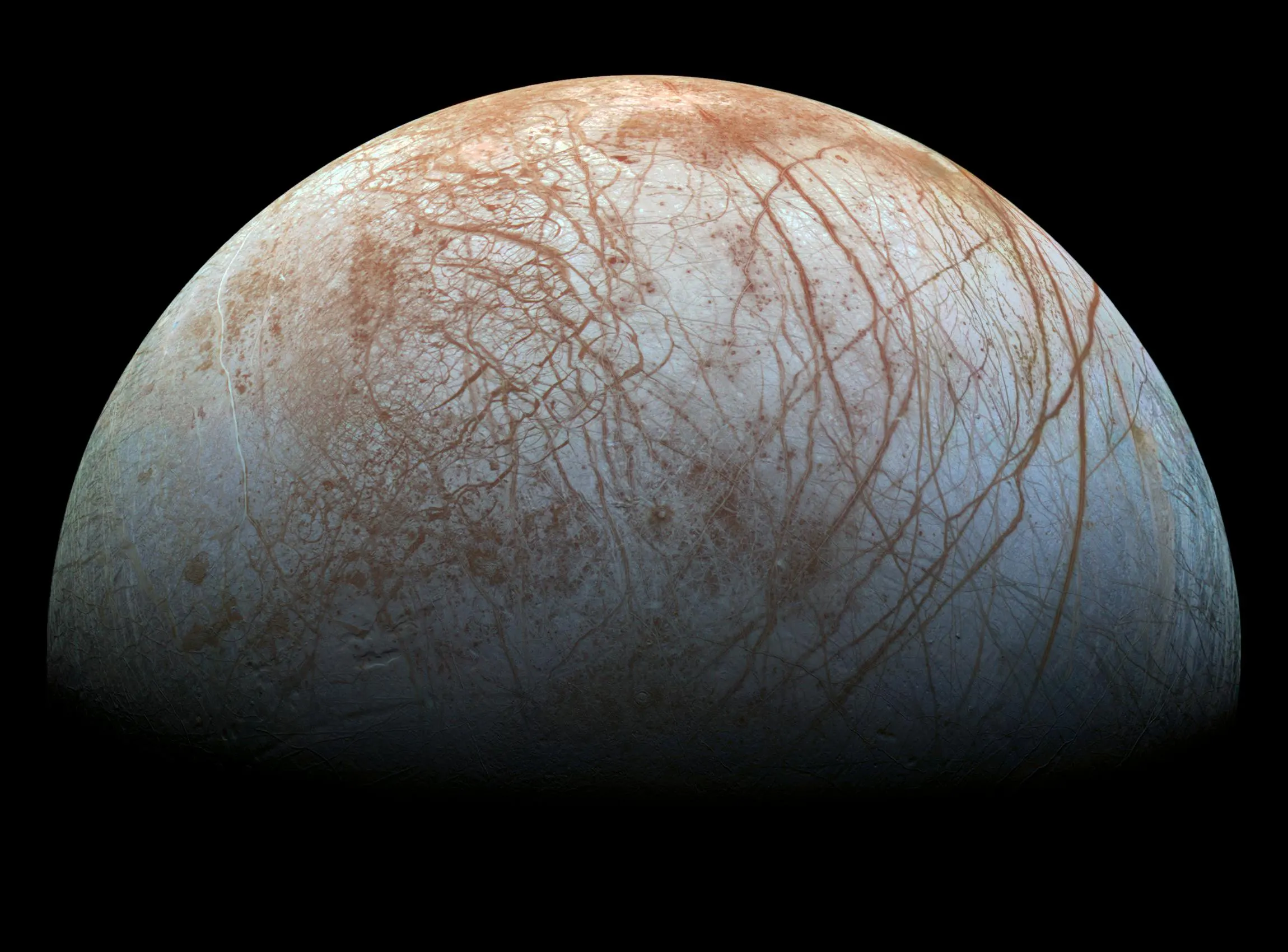 , open full size
Characteristics
Why the ocean stays liquid
Water ice is less dense than liquid water, so ice floats and forms a lid. Ice is also a good insulator. Heat flowing out from the interior must conduct through the shell, and the flux through a conducting layer of thickness is roughly
where is the thermal conductivity of ice (about 3 W m⁻¹ K⁻¹ when cold) and is the difference between the melting point at the base, about 270 K, and the surface, about 100 K on Europa. A shell 25 km thick lets only about 20 milliwatts per square metre escape, about a quarter of Earth's average heat flow. A modest heat supply therefore keeps a deep ocean liquid indefinitely, and the shell thickens or thins until it carries away exactly what the interior produces. Salts and ammonia lower the freezing point further.
The heat comes from two sources. Radioactive decay in the rocky core supplies a steady trickle. The larger source for Europa and Enceladus is tidal heating. A moon on a slightly eccentric orbit is squeezed and relaxed each orbit as its distance from the planet changes, and the flexing is dissipated as heat. For a moon of radius on an orbit of semi-major axis , eccentricity and mean motion around a planet of mass , the heating rate is
where and describe how easily the moon deforms and how much of the flexing becomes heat. This is the formula Peale, Cassen and Reynolds used in 1979 to predict Io's volcanoes days before Voyager 1 saw them 1. Tides would normally circularise an orbit and switch the heating off, but orbital resonances keep the eccentricity up: Io, Europa and Ganymede circle Jupiter in a 1:2:4 ratio of periods, and each nudges the others at the same points on every orbit. Enceladus's south polar region alone radiates about 16 gigawatts 2.
Shell and ocean
Europa's ice shell has been hard to measure. Juno's microwave radiometer, which senses heat from beneath the surface, found a cold conducting layer about 29 ± 10 km thick in the region it scanned; warmer, convecting ice may lie below 3. Galileo's gravity data show that Europa's water and ice together form a layer about 80 to 170 km deep over a rocky interior 4, so Europa probably holds about twice the liquid water of all Earth's oceans. On Enceladus, only 504 km across, the shell averages 18 to 22 km but thins to less than 5 km at the south pole, where the plumes erupt 5.
In larger bodies the pressure at the bottom of a deep ocean becomes high enough, above about 0.2 to 0.6 gigapascals, to form dense high-pressure ices that sink. On Ganymede and Titan, and in any planet-sized ocean world, a layer of these ices may lie between the ocean and the rock and cut the water off from the minerals and chemical energy of a rocky seafloor 6. Europa and Enceladus are small enough for their oceans to touch rock directly.
Atmosphere and surface
The small examples have no real atmosphere. Radiation from Jupiter's magnetosphere splits surface ice into hydrogen and oxygen, and Europa keeps a thin oxygen exosphere with a surface pressure around a trillionth of a bar. The surfaces are young and bright. Europa's is crossed by ridges, bands and "chaos terrain", where blocks of crust have broken, rotated and refrozen, which suggests warm ice or water close to the surface. Titan is the exception: its 1.47-bar nitrogen atmosphere hides an ocean beneath its icy crust.
Formation
Ocean-bearing moons formed in the discs of gas and dust around young giant planets, beyond the snow line where water condenses as ice. They are mixtures of rock and ice that separated as they warmed, rock sinking to form a core and water rising above it. Whether an ocean survives for billions of years depends on how the heat budget compares with the conductive loss through the shell. Tidal heating from resonances, antifreezes such as ammonia and salts, and insulating layers all extend an ocean's life. Saturn's small moon Mimas shows that the timing can vary: its orbit and libration point to an ocean that formed only within the last 25 million years or so, beneath a surface too cratered to hint at it 7.
A planet-sized version around a star would need a similar balance. A cold rocky planet with a thick layer of water beyond its star's snow line could keep a buried ocean warm with radioactive heat, or with tides if it had an eccentric orbit or a close companion. No such planet has been confirmed; the physics is the same, but the known oceans are all in moons.
How we know
Nobody has seen these oceans. Their existence is inferred from several independent measurements.
Magnetic induction. Jupiter's magnetic field sweeps past its moons and flips direction as the planet rotates. A conducting layer inside a moon responds with an induced field of its own. The Galileo spacecraft detected induced fields at Europa and Callisto 8, and a flyby in 2000 showed Europa's field flipping in step with Jupiter's, the signature of a global conductor close to the surface, most plausibly a salty ocean 9. At Ganymede, the Hubble Space Telescope found that the moon's auroral ovals rock back and forth less than they would without an ocean damping them 10.
Plumes. In 2005 Cassini found a plume of water vapour and ice grains rising from four long fractures, the "tiger stripes", near Enceladus's south pole 11. Flying through the plume, Cassini sampled the ocean directly. It found molecular hydrogen, a sign of hot water reacting with rock on the seafloor and a potential food source for microbes 12; nanometre-sized silica grains that form only in water above about 90 °C 13; large organic molecules 14; and phosphates, the scarcest of the elements life needs, at concentrations far above those in Earth's oceans 15.
Wobble and tides. A moon with a liquid layer wobbles more as it orbits, because its shell is free of the core. Enceladus's measured libration requires a global ocean rather than a regional sea 16. Titan's shape changes over each orbit by an amount that requires a liquid layer beneath the crust 17.
Surface chemistry. Telescopes see ocean material that has reached the surface. The Hubble Space Telescope detected sodium chloride, table salt, in Europa's young chaos terrain 18. The James Webb Space Telescope found carbon dioxide concentrated in the same kind of terrain, pointing to carbon from the interior 19 20.
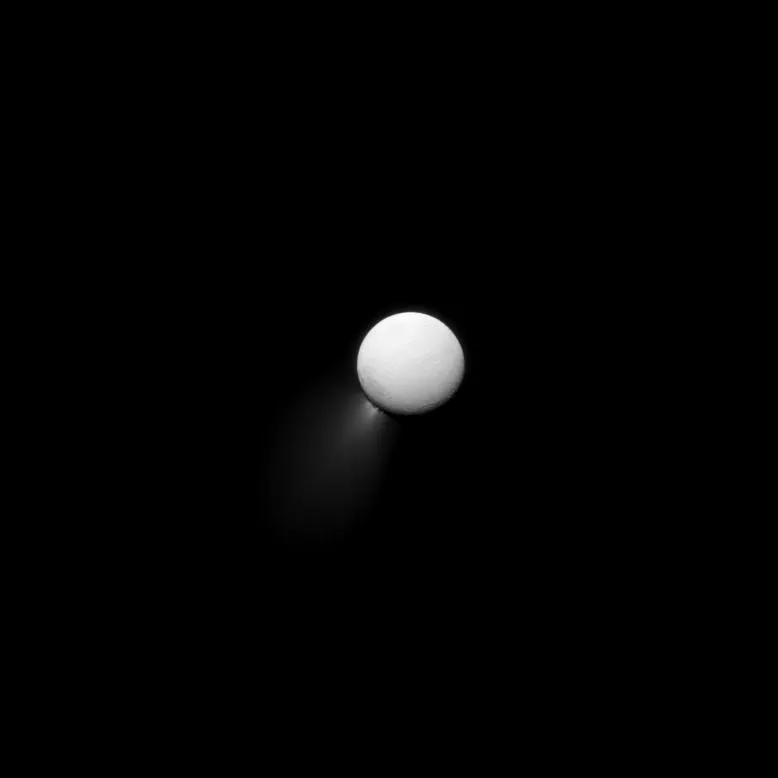 , open full size
What comes next. NASA's Europa Clipper, launched on 14 October 2024, reaches Jupiter in April 2030 and will make 49 close flybys of Europa 21. ESA's Juice, launched on 14 April 2023, arrives in July 2031 and will end its mission in orbit around Ganymede 22.
Notable examples
| Body | Radius | Mean density | Surface temperature | Evidence for an ocean |
|---|---|---|---|---|
| Europa (Jupiter) | 1,561 km | 3.01 g/cm³ | about 100 K | induced magnetic field; young chaos terrain; salt and CO₂ from below |
| Enceladus (Saturn) | 252 km | 1.61 g/cm³ | about 75 K | plumes sampled by Cassini; libration; gravity |
| Ganymede (Jupiter) | 2,631 km | 1.94 g/cm³ | about 110 K | induced field; auroral ovals |
| Titan (Saturn) | 2,575 km | 1.88 g/cm³ | 94 K | tidal deformation; rotation |
| Callisto (Jupiter) | 2,410 km | 1.83 g/cm³ | up to about 134 K | induced field (probable) |
Europa is the archetype: a moon slightly smaller than Earth's Moon, with an iron core, a rocky mantle and an ocean in direct contact with the rock. Enceladus is the one where the ocean has been sampled. Ganymede, the largest moon in the Solar System and the only one with its own magnetic dynamo, probably has an ocean sandwiched between ice layers, which makes it the model for our larger "barrier" subtype.
In Pax Abyssi
We take the physics of Europa and Enceladus and ask what it does to a whole planet. The generator makes subsurface ocean worlds as planets orbiting stars, from 0.1 to 2 Earth masses. A world becomes one in a cold orbital zone, or when an ocean world's surface freezes over. The physics engine then sizes the ice shell from the conductive balance above, sets the ocean's depth from the planet's mass, and flags high-pressure ice when the ocean is deep enough to form it. Icy moons are generated as moon types, and the ones with oceans run the same subsurface-ocean physics.
Jump to a system that holds one and it follows its true orbit at its true size, wearing the surface plate its subtype calls for.
See also
- Ocean world
- Ice world
- Europa
- Titan
- Tidal heating
- Natural satellite
- Habitable zone
- Planet classification
References
- 1Peale, S. J., Cassen, P. and Reynolds, R. T. (1979). Melting of Io by Tidal Dissipation. Science 203, 892-894. doi:10.1126/science.203.4383.892
- 2Howett, C. J. A. et al. (2011). High heat flow from Enceladus' south polar region measured using 10-600 cm −1 Cassini/CIRS data. Journal of Geophysical Research 116, E03003. doi:10.1029/2010je003718
- 3Levin, S. M. et al. (2025). Europa’s ice thickness and subsurface structure characterized by the Juno microwave radiometer. Nature Astronomy 10, 84-91. doi:10.1038/s41550-025-02718-0
- 4Anderson, J. D. et al. (1998). Europa's Differentiated Internal Structure: Inferences from Four Galileo Encounters. Science 281, 2019-2022. doi:10.1126/science.281.5385.2019
- 5Čadek, O. et al. (2016). Enceladus's internal ocean and ice shell constrained from Cassini gravity, shape, and libration data. Geophysical Research Letters 43, 5653-5660. doi:10.1002/2016gl068634
- 6Journaux, B. et al. (2020). Large Ocean Worlds with High-Pressure Ices. Space Science Reviews 216, 7. doi:10.1007/s11214-019-0633-7
- 7Lainey, V. et al. (2024). A recently formed ocean inside Saturn’s moon Mimas. Nature 626, 280-282. doi:10.1038/s41586-023-06975-9
- 8Khurana, K. K. et al. (1998). Induced magnetic fields as evidence for subsurface oceans in Europa and Callisto. Nature 395, 777-780. doi:10.1038/27394
- 9Kivelson, M. G. et al. (2000). Galileo Magnetometer Measurements: A Stronger Case for a Subsurface Ocean at Europa. Science 289, 1340-1343. doi:10.1126/science.289.5483.1340
- 10Saur, J. et al. (2015). The search for a subsurface ocean in Ganymede with Hubble Space Telescope observations of its auroral ovals. Journal of Geophysical Research: Space Physics 120, 1715-1737. doi:10.1002/2014ja020778
- 11Hansen, C. J. et al. (2006). Enceladus' Water Vapor Plume. Science 311, 1422-1425. doi:10.1126/science.1121254
- 12Waite, J. H. et al. (2017). Cassini finds molecular hydrogen in the Enceladus plume: Evidence for hydrothermal processes. Science 356, 155-159. doi:10.1126/science.aai8703
- 13Hsu, H. W. et al. (2015). Ongoing hydrothermal activities within Enceladus. Nature 519, 207-210. doi:10.1038/nature14262
- 14Postberg, F. et al. (2018). Macromolecular organic compounds from the depths of Enceladus. Nature 558, 564-568. doi:10.1038/s41586-018-0246-4
- 15Postberg, F. et al. (2023). Detection of phosphates originating from Enceladus’s ocean. Nature 618, 489-493. doi:10.1038/s41586-023-05987-9
- 16Thomas, P. et al. (2016). Enceladus’s measured physical libration requires a global subsurface ocean. Icarus 264, 37-47. doi:10.1016/j.icarus.2015.08.037
- 17Iess, L. et al. (2012). The Tides of Titan. Science 337, 457-459. doi:10.1126/science.1219631
- 18Trumbo, S. K., Brown, M. E. and Hand, K. P. (2019). Sodium chloride on the surface of Europa. Science Advances 5, eaaw7123. doi:10.1126/sciadv.aaw7123
- 19Trumbo, S. K. and Brown, M. E. (2023). The distribution of CO2 on Europa indicates an internal source of carbon. Science 381, 1308-1311. doi:10.1126/science.adg4155
- 20Villanueva, G. L. et al. (2023). Endogenous CO2 ice mixture on the surface of Europa and no detection of plume activity. Science 381, 1305-1308. doi:10.1126/science.adg4270
- 21NASA Science. Europa Clipper. NASA Science: Missions. science.nasa.gov/mission/europa-clipper/
- 22European Space Agency. Juice. ESA Science and Exploration. www.esa.int/Science_Exploration/Space_Science/Juice