- On this page
- 1
- figure
- 1
- table
Redirected from Pax Abyssi Wiki:Editorial policy
Project
Science in Pax Abyssi
ContentsShow
Pax Abyssi is built from the scientific literature. Every star in its sky is a measured object, every planet is generated from published occurrence rates and planetary physics, and every orbit is solved at true scale while you fly. Our aim is to make the most scientifically accurate space simulator ever made for a home computer, and in planetary science we believe we are there already. Where there is science we have not yet put in, we are putting it in: that is how the game is built, one paper and one measurement at a time.
This page sets out that approach, what it has produced so far, and the rules this wiki keeps so that a reader can always tell what has been measured, what has been inferred and what belongs to the game.
 , open full size
How we build it
Start from measurement. Where the universe has been measured, the game uses the measurement. The sky is the star catalogue: 119,626 real stars from the HYG database, corrected row by row against ESA's Gaia DR3, Hipparcos, the Extended Hipparcos Compilation and the Washington Double Star Catalog, with every correction kept in its own column beside the value it replaces. The galaxy map adds every pulsar in the ATNF catalogue, 113 known black holes and 375 other neutron stars at their published distances. Sol is built from JPL ephemerides: nine planets and 28 moons on their real orbits.
Generate the rest from the physics. Where nobody has measured, the game generates, and the generator is built from the papers. Every other star system comes from measured planet occurrence rates, stellar relations after Torres and colleagues and after Pecaut and Mamajek, companion statistics from Moe and Di Stefano, habitable zones after Kopparapu and colleagues, and six frost lines. Planets are drawn from a corpus of 107 scientific types, each with its own physics engine. The same star and seed always build the same system.
Keep true scale. Nothing is shrunk and no planet is inflated. The simulation runs in double precision with the ship at the origin and the universe moving around it, which holds metre precision at Neptune. Planets move on Kepler orbits every tick, matched to the original simulation within 0.8 mm across nine bodies, and the orrery plans real Hohmann transfers in the same simulation you fly in.
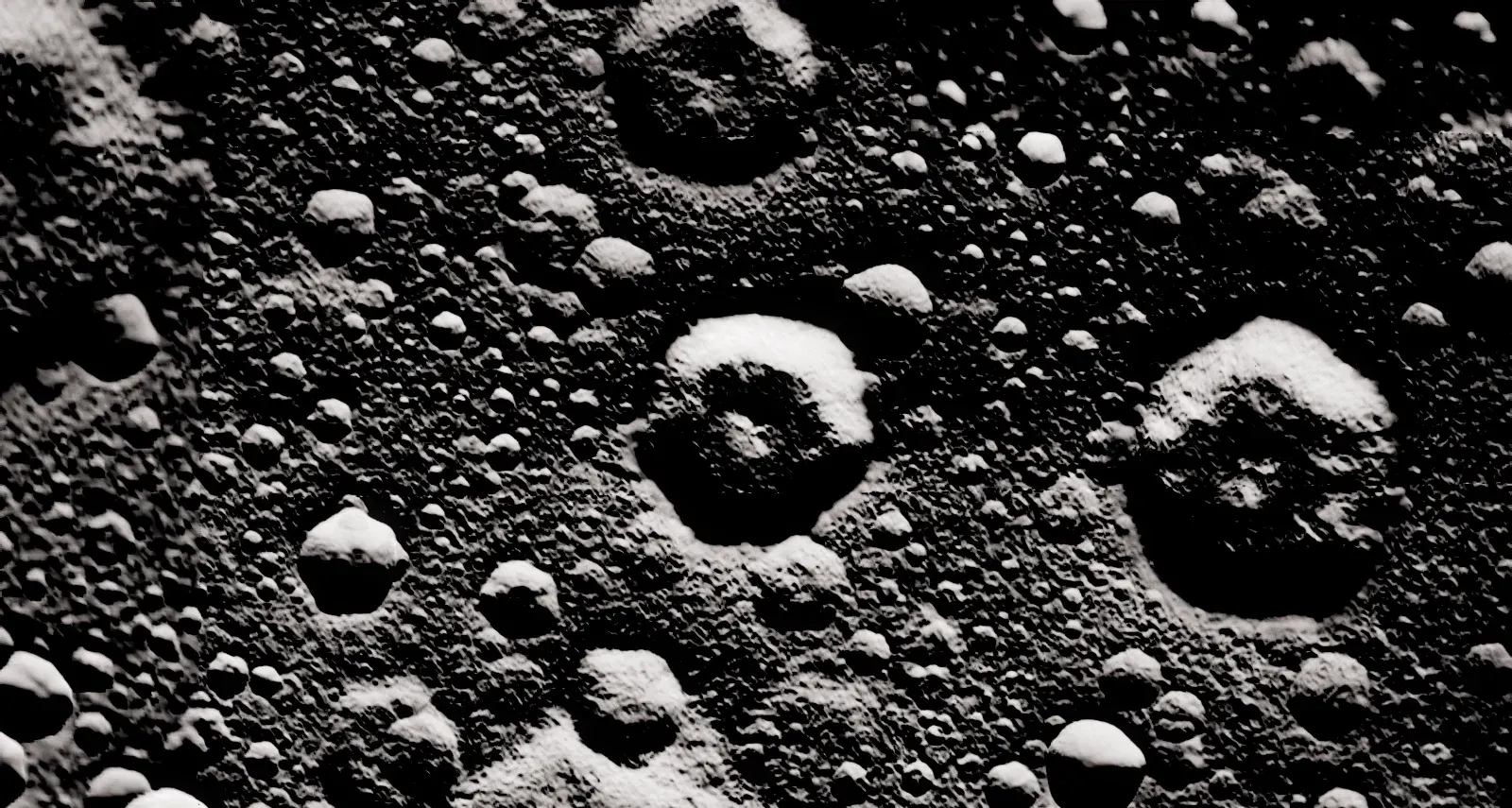
Judge the result against the real thing. A generated world is finished when it measures right, not when it looks right. Our airless worlds are judged side by side with Artemis photographs of the Moon. Halden Mare's maria have an albedo of 0.075 against highlands at 0.14 and cover 16.8 per cent of its sphere against the Moon's 16; its craters follow size-frequency slopes of -1.99 and -2.01 against the measured -2, with depth-to-diameter ratios within 1 per cent of Pike's lunar values.
What it gives a pilot today
- A real sky. The 5,070 stars brighter than magnitude 6 at their measured positions, brightnesses and colours, each one clickable for a 110-field star sheet.
- Real worlds. Gas and ice giants whose cloud bands are grown by a weather model across 75 subtypes, with zonal jets after Ingersoll, vortex streets and a six-sided polar wave like Saturn's; rings with Saturn's optical depths from Cassini occultations; airless moons measured against the Moon, lit by the Lommel-Seeliger law that gives the real Moon its evenly bright full disc and streaked with bright crater rays; oceans on a JONSWAP wave spectrum.
- Real extremes. Black holes drawn by tracing light through curved spacetime, with the spinning Kerr case solved in closed form for every pixel, and neutron stars whose gravity bends their own light so that you see about three quarters of the surface at once.
- Real hazards. Radiation dose from galactic cosmic rays and solar particle events, on the NCRP hazard ladder and checked against measurements from the ISS, the Curiosity rover and airliners.
What comes next
The procedural Milky Way already runs in the simulation Pax Abyssi grew from, and it is being ported into the game now. We began with the stars that have the best data; the rest of the Galaxy, 111 billion stars from a published model of its disks, bar, halo and spiral arms, arrives next, drawn so that the real and the generated stars add up to the true count. After it come the sky redrawn from whichever star you stand beside, and one continuous descent from orbit to the ground. Each comes from the literature the same way everything else has.
The rules this wiki keeps
The wiki is both the encyclopaedia of the game and a reference on the astrophysics the game is built from, so it is held to a published standard.
The five labels
Every page carries a science-status banner with one or more of these labels.
| Label | What it means | Examples |
|---|---|---|
| Observed | Measured, by a named instrument or survey, with a date | Mercury's relativistic perihelion advance of 43 arcseconds per century; the mass of Sagittarius A* from the orbits of nearby stars |
| Model | Mainstream theory or inference that has not been measured directly | The interior of Uranus; the edges of the habitable zone |
| Sim | Pax Abyssi's own approximation, parameterisation or invented category, physically motivated but not a class the scientific literature uses | The Colony and Habitat Viability Indices; named gas giant subtypes such as "Methane-Jade" |
| Speculative | Allowed by known physics, with no confirmed example | Carbon planets; superhabitable worlds; warp metrics |
| Fiction | True only inside the game's setting | The stardrive; the factions and their history |
A page can carry more than one label, and a section can carry its own. A page about a real star is Observed, while its "In Pax Abyssi" box, which says how the game draws that star, is Sim. The label follows the claim: a fictional world orbiting a real star is Fiction, and the star is still Observed.
Sources and citations
- Cite what is not common knowledge. Every factual paragraph that a curious non-specialist could not check in a general encyclopaedia carries at least one numbered citation. The reference list is generated from the page's data, so every citation has a full entry.
- Prefer primary sources. In order: peer-reviewed papers, with their DOI; the pages of space agencies and observatories (NASA, JPL, ESA, ESO); catalogues and the papers that define them (Gaia, Hipparcos, the HYG database, the ATNF Pulsar Catalogue). Preprints on arXiv are acceptable for recent results and are cited as preprints. News stories and press releases can support a date or an announcement, not a number.
- Check before citing. An editor cites only a source they have found and checked says what the page says. A citation that cannot be verified is removed, together with the claim that depended on it. Inventing a reference is the most serious error an editor can make here.
- Game files are not science sources. What the simulation does is stated in the "In Pax Abyssi" sections from the game's own data and design documents. Those documents are never cited as evidence for how the universe works.
- Credit data. Pages that reproduce catalogue values credit the catalogue. The game's star catalogue is built on the HYG database (David Nash, astronexus), which is licensed CC BY-SA 4.0, and on distances from the European Space Agency's Gaia mission; see Star catalogue.
Numbers and dates
- Units. SI or standard astronomical units first, with a familiar comparison where it helps: Earth masses, Jupiter radii, astronomical units, light years. Every number carries its unit.
- Real objects get real values. The infobox of a real planet, star or black hole gives the measured values from the literature, with their sources. It never shows values the simulation generated. Pages about the simulation's own classes give the simulation's ranges and say that they are the simulation's.
- Moving facts are dated. Moon counts, records such as "most massive known", and new results from telescopes change, sometimes several times a year. Such sentences say "as of" a date.
- Disagreements are shown. Where good measurements disagree, the page gives both values with their sources, and the "In Pax Abyssi" box says which one the game uses. The mass of the black hole in Cygnus X-1 is an example.
Where the science leads the game
Pages state the science as it is. The "In Pax Abyssi" sections say how the game models it and name the paper the model comes from. Where the literature holds something the game does not do yet, it goes to the developers as the next thing to build, and the wiki is never edited to make the science match the game. Where the game makes a deliberate choice for the player's eye, such as keeping sunlight at one brightness across a whole system so that distant worlds read clearly, the page says so and says why.
Claims about what the game does carry a status: IN THE GAME, IN DEVELOPMENT or PLANNED. Worlds the simulation generates are described as "scored as potentially habitable", never as "habitable", because no one has been there to check.
Images
Every figure caption says what kind of image it is: an observation, an artist's concept, an in-game picture (made by Pax Abyssi, marked "In Pax Abyssi") or a diagram. Each carries its credit and licence. NASA images are in the public domain; ESA/Webb, ESA/Hubble and ESO images are used under Creative Commons Attribution 4.0 with the credit exactly as the agency gives it. Other ESA images are used only when the individual image carries an open licence. Renders from the game are never presented as observations, and images from other games are never used.
Corrections
- Anyone can flag a mistake on the page's talk page. An editor who has a source can fix it directly.
- Wrong science is fixed in place. An error is corrected in the text, and is never left standing with a note beside it. The edit summary names the source that settles the point.
- Substantive corrections are logged. When a number changes or a claim is withdrawn, the change is recorded with its date on the Corrections log, so readers who relied on the old version can find out.
- Superseded results are updated. When a new measurement replaces an old one, the page takes the new value and its date. The old value stays only where its history matters to the story.
- The page stays right, and the game follows. Where an editor finds the simulation and the literature disagree on a number, the page keeps the published number and the difference goes to the developers.
Who writes the wiki
The Pax Abyssi team and the community edit this wiki, and the same rules bind everyone. Edits from new accounts wait for review before readers see them, and every revision is kept in full with its author and summary. The launch pages were written from the project's research and checked against the sources they cite before publication.
The writing follows the site's house style: plain, specific English with British spelling; every technical term defined when it first appears; the reasoning shown along with the result. If a sentence would sound at home in an advertisement, it is rewritten.
See also
- Star system generation, how the simulation turns a catalogue star into a planetary system
- Milky Way, the model the generated galaxy is built on
- Barren rock world, our airless worlds and how they are judged
- Star catalogue
- Corrections log