- On this page
- 2
- figures
- 1
- panel
- 19
- references
Redirected from Photoevaporation valley
Physics concept
Radius valley
ContentsShow
The radius valley, also called the Fulton gap, is a scarcity of planets between about 1.5 and 2 times Earth's radius among worlds that orbit close to their stars. Planets just smaller than the valley are dense and rocky, the super-Earths; planets just larger are wrapped in a thin envelope of hydrogen and helium, the sub-Neptunes. Because the two populations are otherwise so similar, the valley is one of the sharpest clues to how small planets form and how starlight strips their atmospheres. It was predicted in 2013 and found in 2017, and it is still being argued over. In Pax Abyssi the valley's two leading mechanisms are part of the generator: photoevaporation and core-powered mass loss are two of the four ways our chthonian planets, the bare cores of giants, lost their gas.
Discovery
The Kepler space telescope measured the radii of thousands of planets by the depth of their transits, but a planet's radius is only as good as its star's: a transit gives the ratio of the two sizes. The California-Kepler Survey took spectra of about 1,300 Kepler host stars with the Keck I telescope and cut the uncertainty on their radii to around 11 per cent. With the blur removed, the size distribution of 2,025 planets split in two. There were a factor of two or more fewer planets between 1.5 and 2.0 Earth radii than on either side, with one population below 1.5 Earth radii and another between 2 and 3 1.
Later work sharpened the picture. Asteroseismology, which measures stars by their oscillations, gave radii for 117 planets with a median uncertainty of 3.3 per cent and showed the valley to be close to empty 2. Refitting 431 planets with Kepler's one-minute data found it deeper again 3. Gaia parallaxes showed that the valley and the planets around it shift with the mass of the host star 4 5.
Why the valley exists
The physics of a thin envelope
The valley is a consequence of how little gas it takes to make a planet large. An Earth-like mix of rock and iron gets denser as it grows, so its radius rises only slowly with mass: a rocky planet of 4 to 5 Earth masses is only about 1.5 Earth radii across. Hydrogen is so light that an envelope weighing only a few per cent of the planet can double that radius 6. A planet therefore tends to sit in one of two states: with an envelope it is about twice the size of its core, and without one it is the bare core. Few planets are caught in between, because the in-between state does not last.
This also sets a limit on what the valley can tell us from radius alone. A planet above about 1.6 Earth radii is usually too large to be pure rock, which is why most planets of that size have turned out to carry some volatile layer 7.
Photoevaporation
The first explanation, and the one that predicted the valley before it was seen, is photoevaporation. A young star emits far more X-ray and extreme-ultraviolet (XUV) light than it will later. That radiation heats a planet's upper atmosphere until the gas flows away. In the simplest, "energy-limited" estimate, the rate of mass loss is
where is the XUV flux at the planet, and the planet's radius and mass, the gravitational constant and an efficiency of order 0.1. The formula shows why the outcome is a split: a puffy planet presents a larger target and holds its gas less tightly, so loss speeds up as a planet swells, and a heavier core resists. Owen and Wu (2013) and Lopez and Fortney (2013) showed that XUV heating over a star's first hundred million years or so should empty a band of radii, leaving stripped cores below it and survivors with envelopes above 8 9. Fitted to the Kepler valley, the model says the stripped cores are rocky and Earth-like in composition, of typically about 3 Earth masses, and formed inside the snow line 6.
Escape of this kind has been seen directly, though on a larger planet. The Hubble Space Telescope found a cloud of hydrogen streaming from the warm Neptune GJ 436 b into a tail far larger than its star 10.
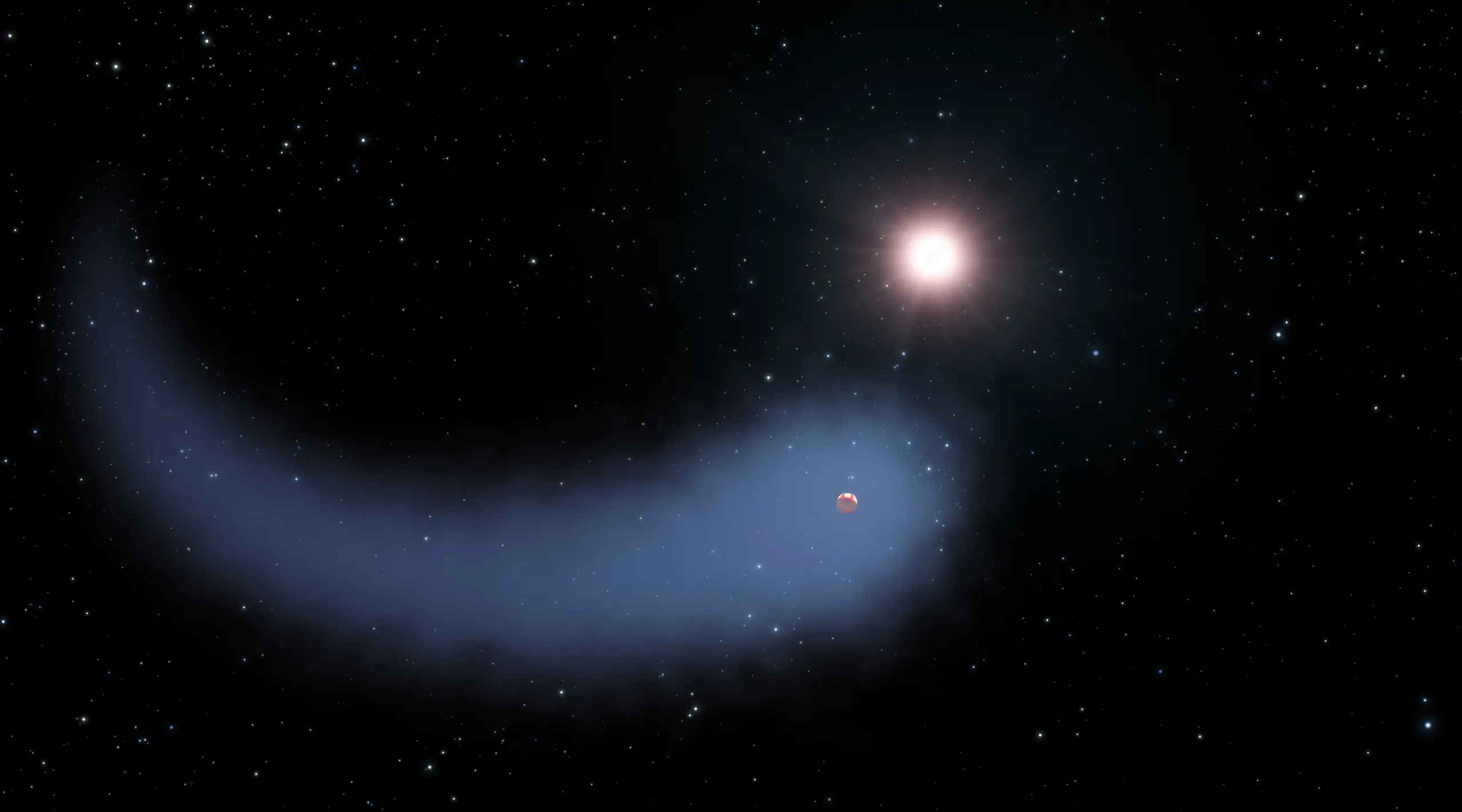 , open full size
Core-powered mass loss
A second mechanism needs no help from the star's XUV output. A newly formed planet is hot inside, and the heat leaking out of its core and envelope can itself drive the upper atmosphere away, with the star's ordinary light setting how easily the gas escapes. This core-powered mass loss works over a billion years rather than a hundred million 11 12. It predicts a valley in almost the same place as photoevaporation, which makes the two hard to tell apart.
One test is time. If the valley is carved over billions of years, older stars should host relatively more stripped super-Earths. Using Gaia-refined ages, Berger and colleagues found the ratio of super-Earths to sub-Neptunes rising from 0.61 around stars younger than a billion years to 1.00 around older ones, which favours a slow process 5. The evidence is not yet decisive, and both processes may act on the same planets.
Formation without loss, and water worlds
Two other ideas put some or all of the valley in place at birth. If some rocky planets assemble late, after the gas disc around the star has mostly dispersed, they never gather an envelope in the first place and can create a gap without any later loss 13. And if some sub-Neptunes formed beyond the snow line and migrated inward, their bulk could be rich in water rather than being rock with a little hydrogen. Formation models of this kind can reproduce the valley's position, with water-rich migrants above it and stripped rocky cores below; one widely cited model finds that the match to observations needs photoevaporation as well 14 15.
How the valley moves
The valley's shape carries the fingerprints of whatever made it.
With orbital period. Measured across periods of a few days to about 100 days, the centre of the valley falls slowly toward smaller radii as the orbit widens, as with between and 2 16. Planets farther out receive less energy, so only smaller, lighter cores are stripped there. Both mass-loss models predict a slope of this sign; gas-poor formation on its own predicts the opposite sign, which is one reason the mass-loss explanations are favoured for Sun-like stars 2.
With stellar mass. Around heavier stars both the valley and the sub-Neptunes above it shift to larger radii. Across host masses from 0.5 to 1.4 solar masses, the typical sub-Neptune grows from about 2.1 to 2.6 Earth radii 4 16.
Around red dwarfs. For the smallest stars the pattern changes. Around M dwarfs the valley's dependence on the flux a planet receives appears to reverse, and rocky planets outnumber non-rocky ones by a growing margin as the star gets smaller 17. Luque and Pallé (2022) argued that for M-dwarf planets a gap in density separates two groups better than radius does, one consistent with pure rock and one with roughly half rock and half water by mass 18. Others have shown that the same data can be fitted by rocky cores with thin hydrogen envelopes, so the case for a population of water worlds is not yet settled 19. See Ocean world for what a true water world would be like.
Why it matters
The valley ties the sizes of planets to the history of their stars. It says that most close-in super-Earths are probably the stripped cores of planets that were born with hydrogen, and that sub-Neptunes are, for the most part, rocky or water-rich cores carrying a small fraction of their mass as gas. It also marks the practical boundary for anyone looking for rocky worlds with a transit survey: below about 1.5 Earth radii a close-in planet is probably rock, and above 2 it probably is not.
In Pax Abyssi
Our generator builds small planets the way the valley says they come, as distinct populations rather than one smooth run of sizes. It first decides what a planet is, from its orbital zone and the chemistry of the disc its star formed in, and then sizes it with a mass-radius law made for that type: rocky super-Earths, icy super-Earths and mini-Neptunes each have their own. A rocky super-Earth comes out compact and dense, and a mini-Neptune carries a hydrogen envelope that makes it far larger for its mass, the same split the valley records. The Super-Earth and Mini-Neptune pages describe how our classes line up against it.
See also
- Super-Earth
- Mini-Neptune
- Ocean world
- Hot Neptune desert
- Atmospheric escape
- Planet classification
- Red dwarf
References
- 1Fulton, B. J. et al. (2017). The California-Kepler Survey. III. A gap in the radius distribution of small planets. The Astronomical Journal 154, 109. doi:10.3847/1538-3881/aa80eb
- 2Van Eylen, V. et al. (2018). An asteroseismic view of the radius valley: stripped cores, not born rocky. Monthly Notices of the Royal Astronomical Society 479, 4786-4795. doi:10.1093/mnras/sty1783
- 3Ho, C. S. K. and Van Eylen, V. (2023). A deep radius valley revealed by Kepler short cadence observations. Monthly Notices of the Royal Astronomical Society 519, 4056-4073. doi:10.1093/mnras/stac3802
- 4Fulton, B. J. and Petigura, E. A. (2018). The California-Kepler Survey. VII. Precise planet radii leveraging Gaia DR2 reveal the stellar mass dependence of the planet radius gap. The Astronomical Journal 156, 264. doi:10.3847/1538-3881/aae828
- 5Berger, T. A. et al. (2020). The Gaia-Kepler Stellar Properties Catalog. II. Planet radius demographics as a function of stellar mass and age. The Astronomical Journal 160, 108. doi:10.3847/1538-3881/aba18a
- 6Owen, J. E. and Wu, Y. (2017). The evaporation valley in the Kepler planets. The Astrophysical Journal 847, 29. doi:10.3847/1538-4357/aa890a
- 7Rogers, L. A. (2015). Most 1.6 Earth-radius planets are not rocky. The Astrophysical Journal 801, 41. doi:10.1088/0004-637X/801/1/41
- 8Owen, J. E. and Wu, Y. (2013). Kepler planets: a tale of evaporation. The Astrophysical Journal 775, 105. doi:10.1088/0004-637X/775/2/105
- 9Lopez, E. D. and Fortney, J. J. (2013). The role of core mass in controlling evaporation: the Kepler radius distribution and the Kepler-36 density dichotomy. The Astrophysical Journal 776, 2. doi:10.1088/0004-637X/776/1/2
- 10Ehrenreich, D. et al. (2015). A giant comet-like cloud of hydrogen escaping the warm Neptune-mass exoplanet GJ 436b. Nature 522, 459-461. doi:10.1038/nature14501
- 11Ginzburg, S., Schlichting, H. E. and Sari, R. (2018). Core-powered mass-loss and the radius distribution of small exoplanets. Monthly Notices of the Royal Astronomical Society 476, 759-765. doi:10.1093/mnras/sty290
- 12Gupta, A. and Schlichting, H. E. (2019). Sculpting the valley in the radius distribution of small exoplanets as a by-product of planet formation: the core-powered mass-loss mechanism. Monthly Notices of the Royal Astronomical Society 487, 24-33. doi:10.1093/mnras/stz1230
- 13Lee, E. J., Karalis, A. and Thorngren, D. P. (2022). Creating the radius gap without mass loss. The Astrophysical Journal 941, 186. doi:10.3847/1538-4357/ac9c66
- 14Venturini, J. et al. (2020). The nature of the radius valley. Astronomy & Astrophysics 643, L1. doi:10.1051/0004-6361/202039141
- 15Burn, R. et al. (2024). A radius valley between migrated steam worlds and evaporated rocky cores. Nature Astronomy 8, 463-471. doi:10.1038/s41550-023-02183-7
- 16Petigura, E. A. et al. (2022). The California-Kepler Survey. X. The radius gap as a function of stellar mass, metallicity, and age. The Astronomical Journal 163, 179. doi:10.3847/1538-3881/ac51e3
- 17Cloutier, R. and Menou, K. (2020). Evolution of the radius valley around low-mass stars from Kepler and K2. The Astronomical Journal 159, 211. doi:10.3847/1538-3881/ab8237
- 18Luque, R. and Pallé, E. (2022). Density, not radius, separates rocky and water-rich small planets orbiting M dwarf stars. Science 377, 1211-1214. doi:10.1126/science.abl7164
- 19Rogers, J. G., Schlichting, H. E. and Owen, J. E. (2023). Conclusive evidence for a population of water worlds around M dwarfs remains elusive. The Astrophysical Journal Letters 947, L19. doi:10.3847/2041-8213/acc86f