- On this page
- 2
- figures
- 1
- table
- 18
- references
Redirected from Io analogue
Planet class · TVO · T4-V
Volcanic world
ContentsShow
A volcanic world is a rocky world whose surface is continually remade by eruptions, powered by internal heat far greater than Earth's. Jupiter's moon Io is the extreme case: slightly larger than Earth's Moon, it erupts more lava than any other body in the Solar System, and its surface is so young that not one impact crater has been found on it. Io is heated by tides; most planetary volcanism, Earth's included, is driven instead by radioactive decay and heat left over from formation. Planets heated the same way around other stars are now being found, and the first hints of volcanic gases in their atmospheres have been reported.
Pax Abyssi sorts its volcanic worlds by surface temperature, because temperature decides what the eruptions leave behind: open lava, dark calderas, or Io's yellow and white sulfur frost.
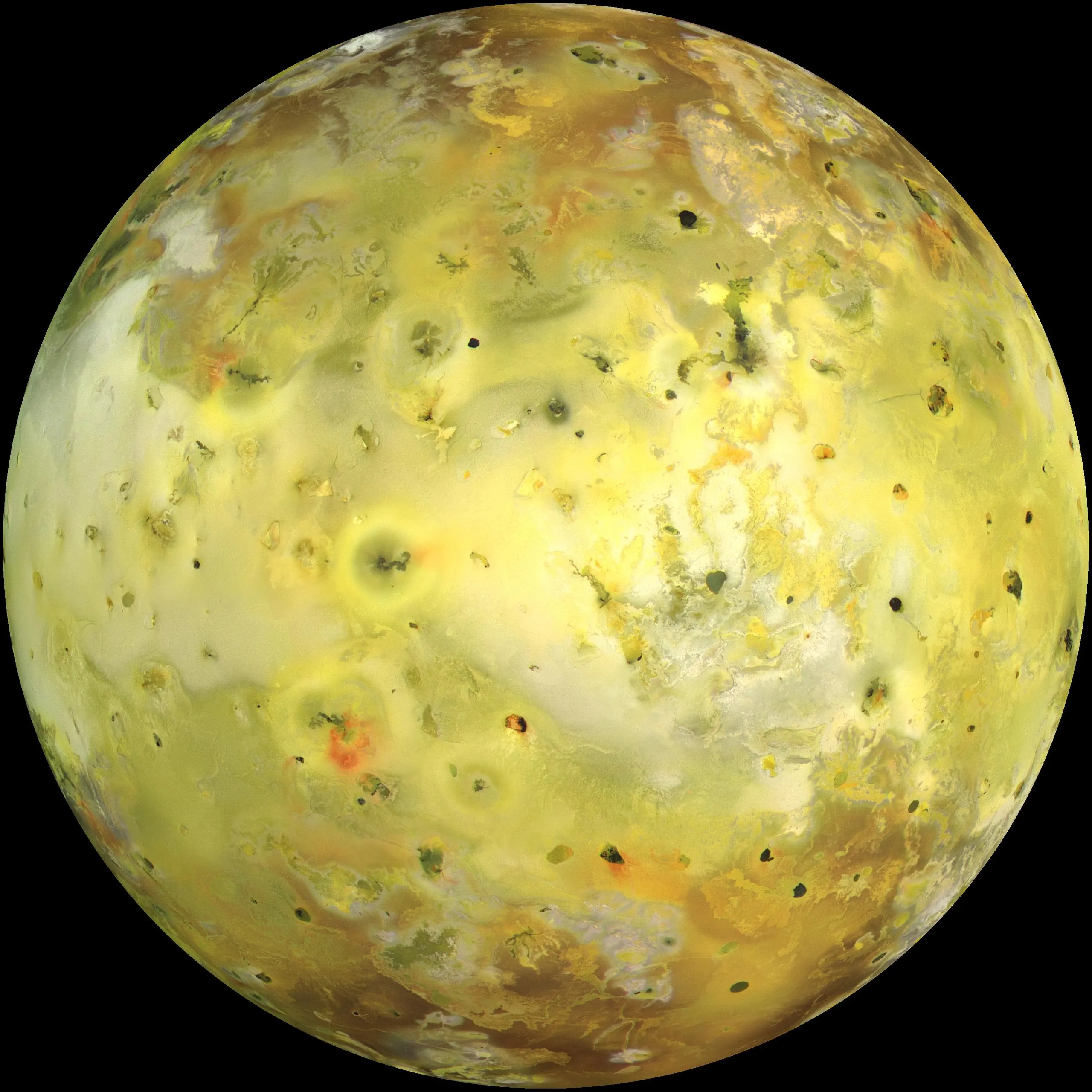 , open full size
Characteristics
Heat from tides
Io orbits Jupiter every 1.77 days on an orbit that is almost, but not quite, circular, with an eccentricity of 0.004 1. Jupiter's gravity raises a tidal bulge in Io's rock about 100 metres high, and as Io's distance from Jupiter changes over each orbit, the bulge grows, shrinks and shifts. The constant flexing is dissipated as heat inside the moon. The heating rate for a synchronously rotating moon is
where is the planet's mass, the moon's radius, and its orbital distance and eccentricity, its orbital angular speed, and a measure of how easily the moon deforms and how much of that work becomes heat. The steep dependence on distance, with adding a little more, is why tidal heating matters only for close orbits.
A lone moon would lose this heating quickly, because the same tides would make its orbit circular. Io's eccentricity is kept up by an orbital resonance: Io completes four orbits for every two of Europa's and one of Ganymede's, so the three moons line up at the same points again and again, and their regular tugs keep Io's orbit slightly stretched. Peale, Cassen and Reynolds worked this out and predicted widespread volcanism on Io in a paper published days before Voyager 1 flew past in March 1979 2. Days later, a Voyager navigation image showed an erupting plume 3.
How much heat
Io's orbit is slowly changing as it loses energy to tides, and measuring that drift from centuries of observations gives a dissipation of about 93 ± 19 terawatts 4. Adding up the infrared glow of its volcanoes gives about W, or about 2.5 watts per square metre of surface 5. For comparison, Earth loses about 47 terawatts through its whole surface, about 0.087 W/m² on average 6. Io, with less than a tenth of Earth's surface area, radiates about twice Earth's internal heat, nearly thirty times as much per square metre.
Volcanoes and lava
Juno's infrared camera has catalogued 242 hot spots on Io, 23 of them seen for the first time 7. The largest, Loki Patera, is a lava lake about 200 km across that alone produces nearly a tenth of Io's heat 5; its crust founders and sinks in waves that sweep across the lake over a period of months 8. Galileo measured eruption temperatures of at least 1,700 K, hotter than any lava erupting on Earth today and suggesting magnesium-rich lava like the komatiites of Earth's early history 9. Later analysis revised the typical temperature down to about 1,300 to 1,600 K, closer to hot basalt 10. Plumes of sulfur and sulfur dioxide rise hundreds of kilometres; New Horizons photographed one from Tvashtar reaching about 330 km as it passed Jupiter in 2007 11.
Atmosphere
Io's atmosphere is sulfur dioxide, first detected by Voyager's infrared spectrometer 12. It is thin, about a billionth of Earth's surface pressure, and patchy, fed partly by volcanoes and partly by frost evaporating in sunlight. When Io passes into Jupiter's shadow and the surface cools, much of the gas freezes out within minutes, and it returns when sunlight does 13.
Interior
A magnetometer on Galileo detected a signal at Io that was interpreted as a global layer of partly molten rock at least 50 km thick beneath the crust, a so-called magma ocean 14. Juno's close flybys in December 2023 and February 2024 tested this by measuring how much Io's shape and gravity respond to Jupiter's tides. The response was too small for a shallow liquid layer: Io's mantle is hot and partly molten, but it has no global magma ocean near the surface 15.
Formation and evolution
A volcanic world needs a source of internal heat stronger than a rocky planet's slowly fading radioactivity. The long-lived examples are tidally heated: moons of giant planets locked in orbital resonances, or planets in tight systems where neighbours keep each other's orbits slightly eccentric. Young planets are also volcanic, because they still hold much of the heat of their formation, and any rocky planet close enough to its star can have a molten surface regardless of its interior (see Lava world).
Io's volcanism is old. The isotopes of sulfur and chlorine in its atmosphere are heavily skewed toward the heavier forms, the result of billions of years of lighter atoms escaping from the top of the atmosphere while volcanoes kept cycling material through. The measured skew implies that Io has been volcanically active for most of the Solar System's history, and so that its resonance with Europa and Ganymede is also ancient 16.
How we know
Io was discovered by Galileo Galilei in 1610, but its volcanism was a prediction until Voyager 1 photographed an erupting plume in March 1979 3. Galileo orbited Jupiter from 1995 to 2003 and made several close passes of Io. Ground-based telescopes with adaptive optics now track its volcanoes from Earth, which is how Loki Patera's overturn cycles were followed 8. NASA's Juno flew within 1,500 km of Io in December 2023 and February 2024.
Around other stars, tidal volcanism can only be inferred so far. LP 791-18 d is an Earth-sized planet around a red dwarf, about 1.03 times Earth's radius. A more massive neighbour keeps its orbit slightly eccentric as it circles its star, so its tidal heating may make it as volcanically active as Io 17. L 98-59 b, with 0.84 times Earth's radius and 0.40 times its mass, is the first small exoplanet with evidence of a sulfur dioxide atmosphere: JWST spectra favour one at 3.6 standard deviations, which the authors interpret as a sign of volcanic outgassing on a tidally heated world 18. Neither result is yet a confirmed volcano.
Notable examples
| Body | Radius | Mass | Internal power | Notes |
|---|---|---|---|---|
| Io (Jupiter) | 1,821.6 km | 8.93 × 10²² kg | about 100 TW | 1:2:4 Laplace resonance; about 2.5 W/m² |
| Earth, for comparison | 6,371 km | 5.97 × 10²⁴ kg | about 47 TW | 0.087 W/m², mostly radioactive decay and primordial heat |
| LP 791-18 d | 1.03 R⊕ | about 0.9 M⊕ | unknown | tidally heated by an outer neighbour (candidate volcanic world) |
| L 98-59 b | 0.84 R⊕ | 0.40 M⊕ | unknown | SO₂ atmosphere favoured by JWST (candidate volcanic world) |
In Pax Abyssi
Our volcanic worlds (TVO) are rocky bodies with intense, global volcanism and thin atmospheres of volcanic gases. Most are of roughly Earth's mass, with a share of Io-sized bodies between 0.01 and 0.2 Earth masses. Three subtypes are set by surface temperature: magmatic worlds (TVO-MG) at 1,400 K and above, laced with lava; caldera worlds (TVO-CL) between 400 and 1,400 K, with scattered active calderas on a dark crust; and sulfuric worlds (TVO-SU) below 400 K, frosted yellow and white with sulfur like Io. A volcanic world that ends up too hot for a solid crust is moved to lava world when its system is built. In the committed system sheets, 59 of 8,742 generated planets are volcanic worlds, most of them caldera worlds. From orbit, each world wears the look of its subtype code.
Volcanism long finished is written into our barren worlds too. Our generator floods old basins with dark basalt, the lunar maria of barren worlds, and it can cut a world with a sinuous rille, the winding channel a lava flow carves as it runs, like Vallis Schröteri on the Moon.
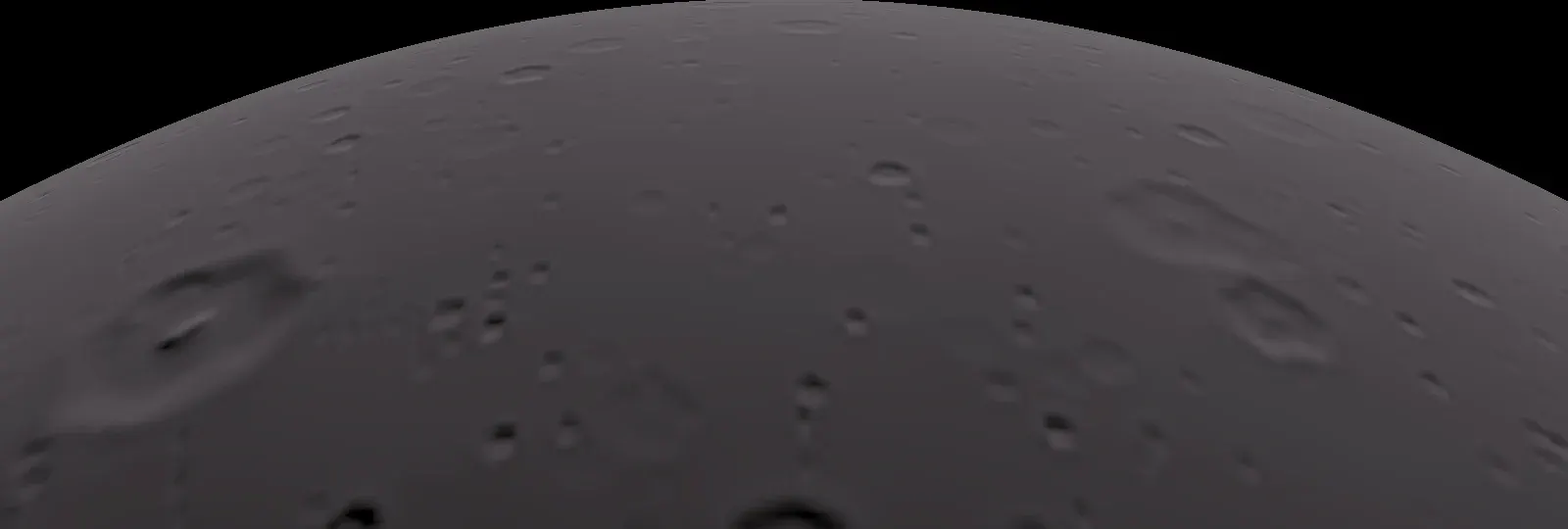 , open full size
Next, a volcanic biome for the worlds you can land on: dark basalt and lava crust underfoot, and the glow of active vents.
See also
- Lava world
- Subsurface ocean world
- Tidal heating
- Orbital resonance
- Natural satellite
- Super-Earth (volcanic super-Earths, SEV)
- Planet classification
References
- 1Williams, D. R.. Jovian Satellite Fact Sheet. NASA Space Science Data Coordinated Archive. nssdc.gsfc.nasa.gov/planetary/factsheet/joviansatfact.html
- 2Peale, S. J., Cassen, P. and Reynolds, R. T. (1979). Melting of Io by Tidal Dissipation. Science 203, 892-894. doi:10.1126/science.203.4383.892
- 3MORABITO, L. A. et al. (1979). Discovery of Currently Active Extraterrestrial Volcanism. Science 204, 972-972. doi:10.1126/science.204.4396.972
- 4Lainey, V. et al. (2009). Strong tidal dissipation in Io and Jupiter from astrometric observations. Nature 459, 957-959. doi:10.1038/nature08108
- 5Veeder, G. J. et al. (2012). Io: Volcanic thermal sources and global heat flow. Icarus 219, 701-722. doi:10.1016/j.icarus.2012.04.004
- 6Davies, J. H. and Davies, D. R. (2010). Earth's surface heat flux. Solid Earth 1, 5-24. doi:10.5194/se-1-5-2010
- 7Zambon, F. et al. (2023). Io Hot Spot Distribution Detected by Juno/JIRAM. Geophysical Research Letters 50, e2022GL100597. doi:10.1029/2022gl100597
- 8de Kleer, K. et al. (2017). Multi-phase volcanic resurfacing at Loki Patera on Io. Nature 545, 199-202. doi:10.1038/nature22339
- 9McEwen, A. S. et al. (1998). High-Temperature Silicate Volcanism on Jupiter's Moon Io. Science 281, 87-90. doi:10.1126/science.281.5373.87
- 10Keszthelyi, L. et al. (2007). New estimates for Io eruption temperatures: Implications for the interior. Icarus 192, 491-502. doi:10.1016/j.icarus.2007.07.008
- 11Spencer, J. R. et al. (2007). Io Volcanism Seen by New Horizons: A Major Eruption of the Tvashtar Volcano. Science 318, 240-243. doi:10.1126/science.1147621
- 12Pearl, J. et al. (1979). Identification of gaseous SO2 and new upper limits for other gases on Io. Nature 280, 755-758. doi:10.1038/280755a0
- 13Tsang, C. C. C. et al. (2016). The collapse of Io's primary atmosphere in Jupiter eclipse. Journal of Geophysical Research: Planets 121, 1400-1410. doi:10.1002/2016je005025
- 14Khurana, K. K. et al. (2011). Evidence of a Global Magma Ocean in Io’s Interior. Science 332, 1186-1189. doi:10.1126/science.1201425
- 15Park, R. S. et al. (2025). Io’s tidal response precludes a shallow magma ocean. Nature 638, 69-73. doi:10.1038/s41586-024-08442-5
- 16de Kleer, K. et al. (2024). Isotopic evidence of long-lived volcanism on Io. Science 384, 682-687. doi:10.1126/science.adj0625
- 17Peterson, M. S. et al. (2023). A temperate Earth-sized planet with tidal heating transiting an M6 star. Nature 617, 701-705. doi:10.1038/s41586-023-05934-8
- 18Bello-Arufe, A. et al. (2025). Evidence for a Volcanic Atmosphere on the Sub-Earth L 98-59 b. The Astrophysical Journal Letters 980, L26. doi:10.3847/2041-8213/adaf22