A star the width of a city
A neutron star packs more mass than the Sun into a ball about 24 kilometres across. X-ray timing has now measured that size from the way the star bends its own light, and in Pax Abyssi you can fly to seven of them, starting with the pulsar at the heart of the Crab Nebula.
By Pax Abyssi Science Desk

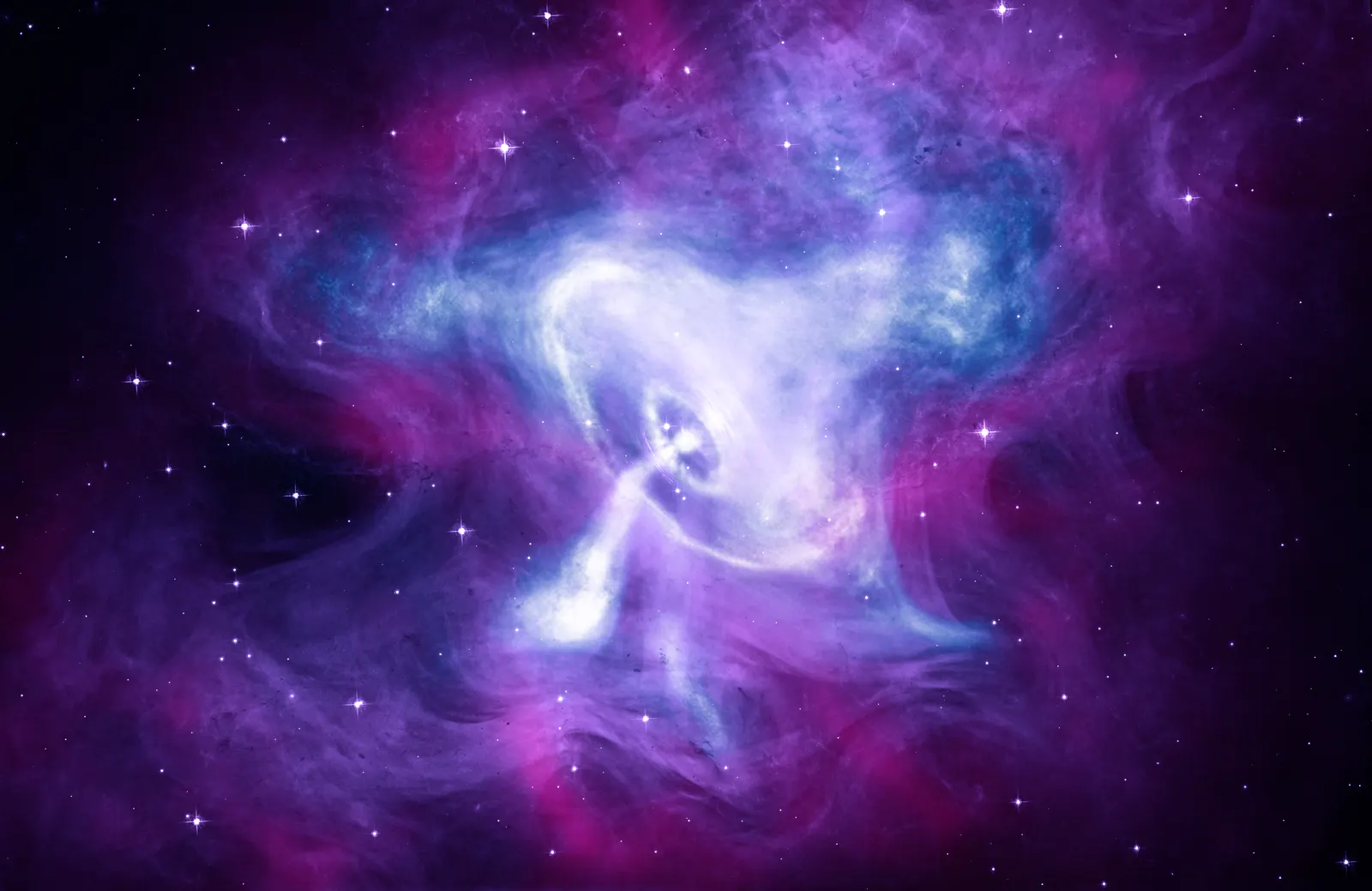
The Crab Nebula in X-rays from Chandra (blue and white), visible light from Hubble (purple) and infrared from Spitzer (pink). The bright ring and jet at the centre are the pulsar's wind, blowing out along its equator and its spin axis. Observation. Credit: X-ray: NASA/CXC/SAO; Optical: NASA/STScI; Infrared: NASA-JPL-Caltech.
X-ray: NASA/CXC/SAO; Optical: NASA/STScI; Infrared: NASA-JPL-CaltechPublic domain (NASA)
In the summer of 1054, astronomers in China recorded a new star in the constellation we call Taurus, bright enough to see in daylight for weeks. 1 Nine and a half centuries later the explosion's debris is the Crab Nebula, a tangle of glowing filaments about 13 light years across, and at its centre sits what the star left behind: a ball of neutrons about 24 kilometres wide that turns on its axis thirty times a second. Its slowing spin pours out about 5 × 10³¹ watts, more than a hundred thousand times the Sun's output, and that is what keeps the whole nebula shining. 1
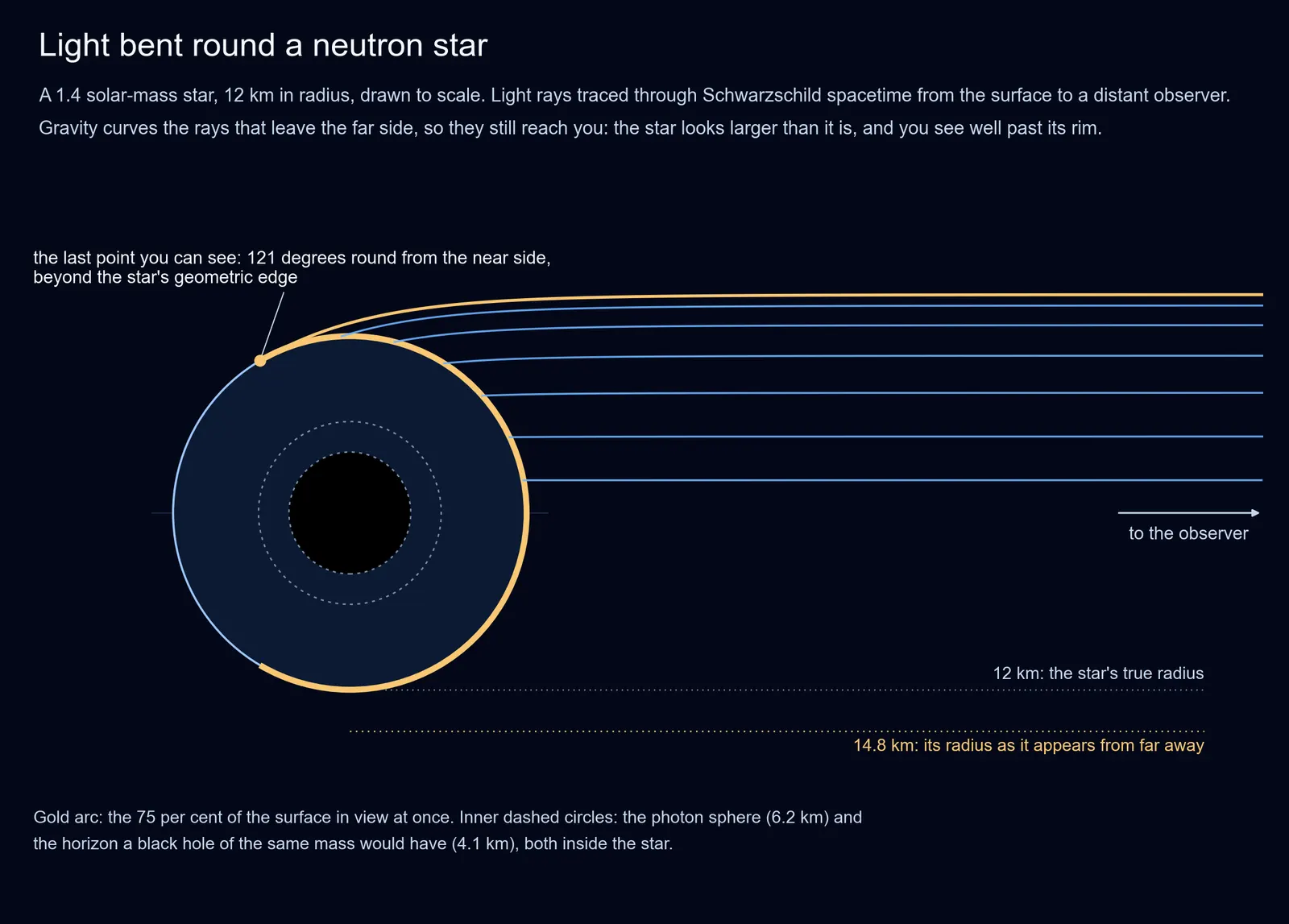
Stop the ship 75 kilometres from it and the Crab Pulsar fills a patch of sky more than twenty degrees across, a disc of even, pale blue light. The glow is a surface at about one and a half million degrees. The disc looks bigger than the star really is, and you can see further round it than you could see round any ordinary ball, because gravity this strong bends light. In Pax Abyssi the Crab is one of seven neutron stars you can fly to, and each is drawn from what astronomers have measured about it. This article is about what those measurements are, and what you would see.
Squeezing a star
A star much more massive than the Sun ends its life with an iron core that can no longer make energy. When the core passes about 1.4 solar masses its own gravity crushes it in less than a second. Electrons are forced into protons, the core becomes a sphere of neutrons packed as tightly as the nucleus of an atom, and the star's outer layers are blown away in a supernova. Walter Baade and Fritz Zwicky proposed in 1934, two years after the neutron was discovered, that supernovae make exactly such stars. 2
The numbers are hard to hold in the mind. A typical neutron star has about 1.4 times the Sun's mass in a sphere 12 kilometres in radius, a little longer from side to side than Manhattan Island. A teaspoon of its matter would weigh about two billion tonnes. Gravity at the surface is more than a hundred billion times Earth's, and anything leaving it needs nearly sixty per cent of the speed of light to escape.
What holds it up is not heat but the neutrons themselves, which resist being squeezed further, and how hard they resist is one of the open questions of physics. In 1939 Robert Oppenheimer and George Volkoff worked out that a star of free, non-interacting neutrons could weigh no more than about 0.7 solar masses before collapsing to a black hole. 3 Real neutron stars are much heavier than that, so the forces between neutrons must stiffen the matter. How stiff it is, the relation physicists call the equation of state, decides how large a star of a given mass is and how heavy one can get before it collapses: each proposed equation of state traces its own curve of mass against radius. That is why a single number, a neutron star's radius, is worth a space telescope. 4, 5
Measuring twelve kilometres
A neutron star 24 kilometres across at a distance of hundreds of light years is far too small for any telescope to see as a disc. Its size has to be inferred, and the method that works best uses the star's gravity as the ruler.
NASA's Neutron star Interior Composition Explorer, NICER, has been bolted to the outside of the International Space Station since 2017, timing the arrival of X-ray photons to within a fraction of a millionth of a second. It watches millisecond pulsars: old neutron stars spun up to hundreds of turns a second, with hot spots on their surfaces where particles from the magnetosphere rain down. As a star turns, its spots swing into and out of view, and the X-ray brightness rises and falls. How it rises and falls depends on how strongly the star bends the light of its spots, which depends on the ratio of its mass to its radius. Where the mass can be measured separately, by timing the pulsar's radio pulses as they pass close to a companion star, the shape of the pulse then pins down the radius; where it cannot, the pulse constrains both at once, their ratio most tightly.
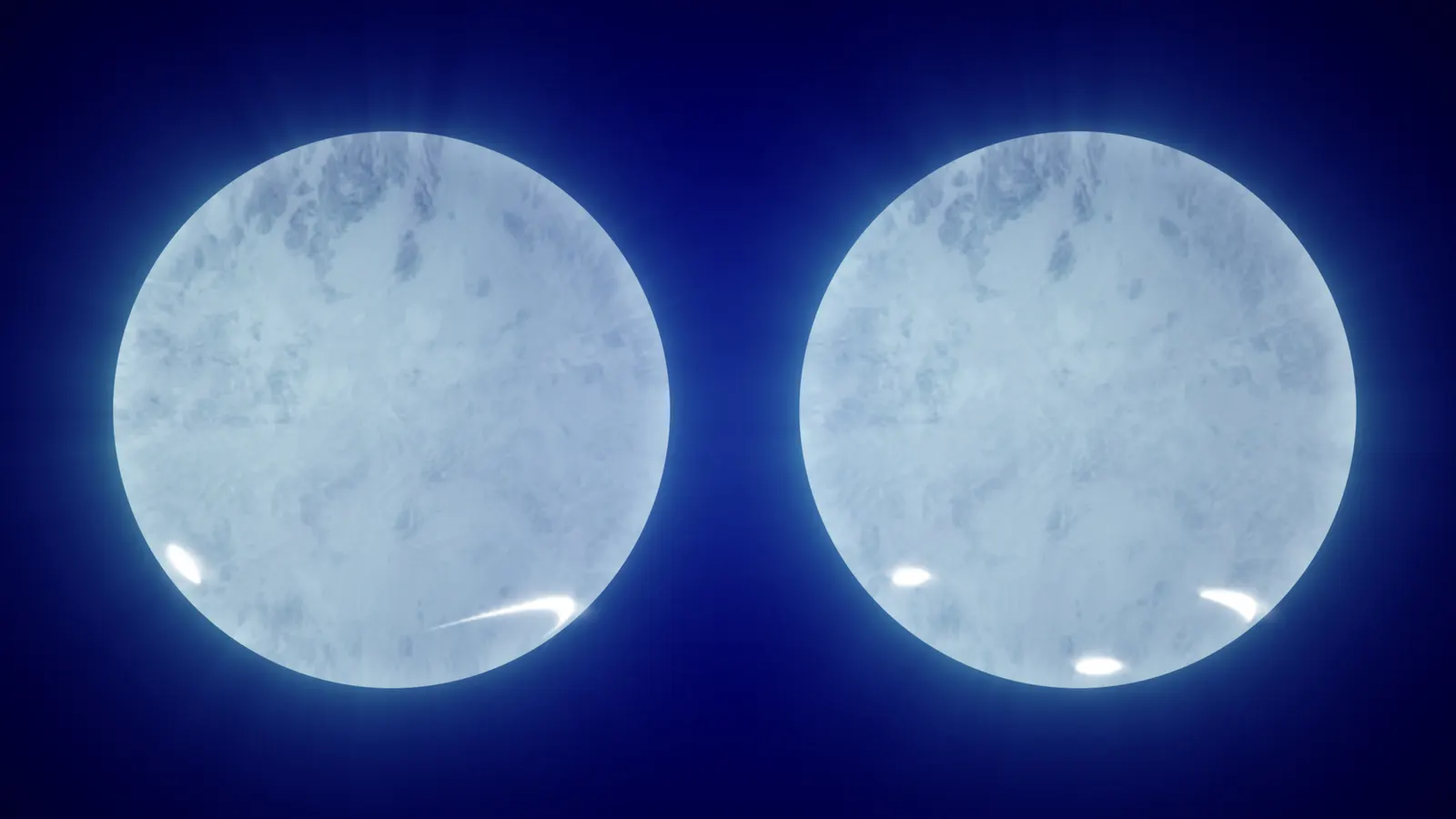
The first results came in December 2019, from two independent teams analysing the same star, PSR J0030+0451, which spins 205 times a second about 1,100 light years away. One found a radius of 12.7 kilometres, the other 13.0, each uncertain by a little over a kilometre. 8, 9 Both found something nobody had drawn in a textbook: the hot spots are not neat circles at opposite magnetic poles but lie together in the star's southern hemisphere, one of them stretched into a crescent or an oval.
Since then NICER has measured two more stars. PSR J0740+6620, weighed by radio timing at 2.08 solar masses, one of the heaviest neutron stars known, has a radius of about 12.4 to 13.7 kilometres. That is about the size of stars two thirds its mass, which means the matter inside resists compression even under that load. 10, 11, 12, 13 PSR J0437-4715, the nearest and brightest millisecond pulsar, 510 light years away and weighed at 1.418 solar masses, came out at 11.4 kilometres. 14, 15 The teams are candid that the answers depend on how the spots are modelled; a 2024 reanalysis of the J0030 data with more X-ray information found two quite different solutions. 16
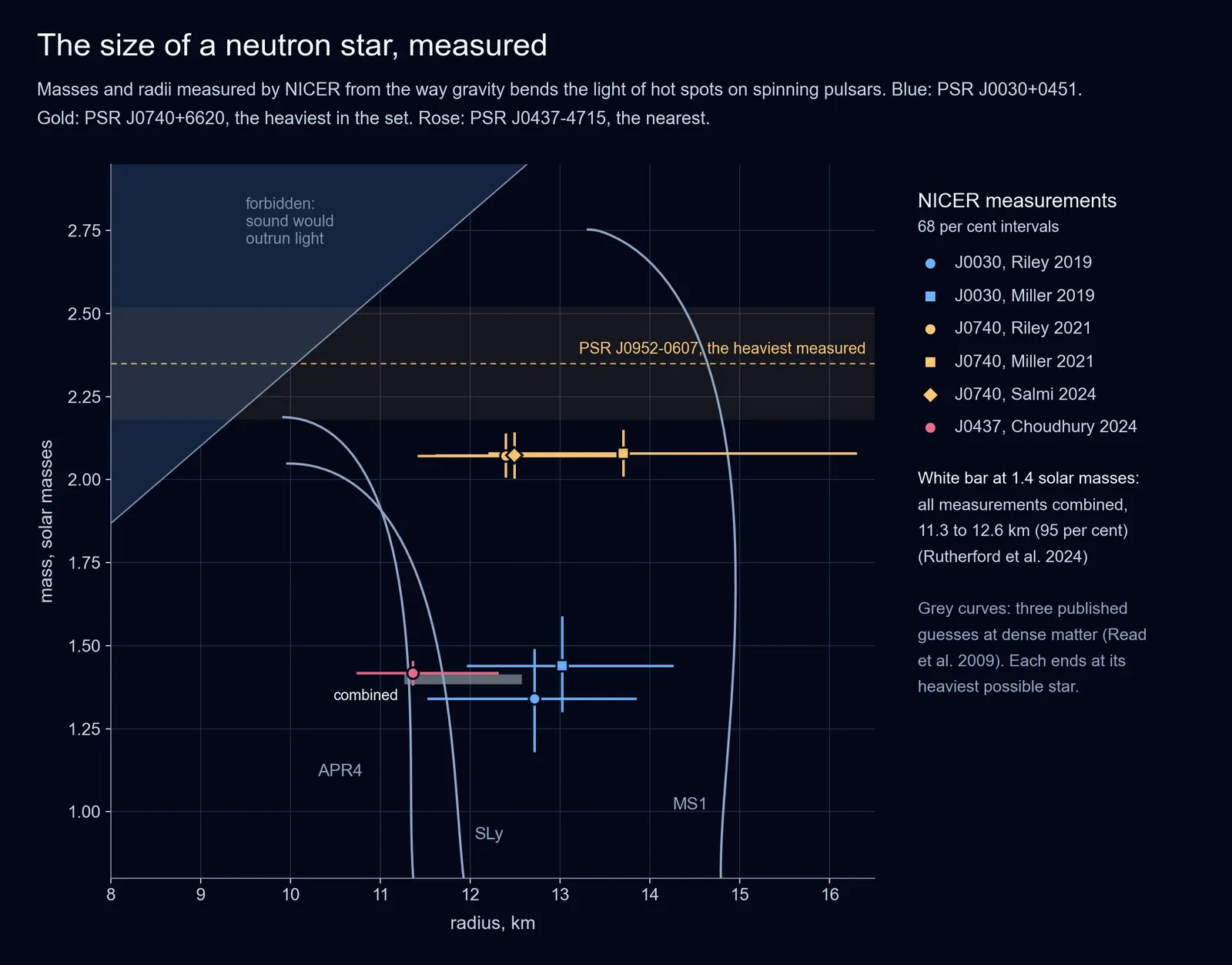
Put together with the gravitational waves from the neutron star merger GW170817, whose stars were deformed by each other's tides in a way that depends on their size, and with nuclear theory at lower densities, the measurements give a radius of 12.0 kilometres for a star of 1.4 solar masses, uncertain by less than a kilometre. 17, 18 Pax Abyssi uses that 12 kilometres for every neutron star. The heaviest neutron star weighed so far, PSR J0952-0607, has about 2.35 solar masses, so the limit must lie at about that or above. 19
Lighthouses, magnetars and quiet stars
Most neutron stars were found because they pulse. In 1967 Jocelyn Bell, a graduate student at Cambridge, noticed a signal that repeated every 1.34 seconds; it was the first pulsar. 20 A pulsar is a spinning neutron star with a magnetic field tilted to its spin axis. Charged particles accelerated along the field near the magnetic poles send out beams of radio waves, and each time a beam sweeps past Earth we see a pulse. In 1968 one was found in the Crab Nebula. 21
A pulsar's spin is among the most regular clocks in nature, but it slows. The rate at which it slows, together with the period, says how strong the field is and roughly how old the star is, and plotting the two against each other sorts the whole population. The Australia Telescope National Facility's catalogue now lists 4,393 pulsars, and all of them are on the Pax Abyssi galaxy map. 22
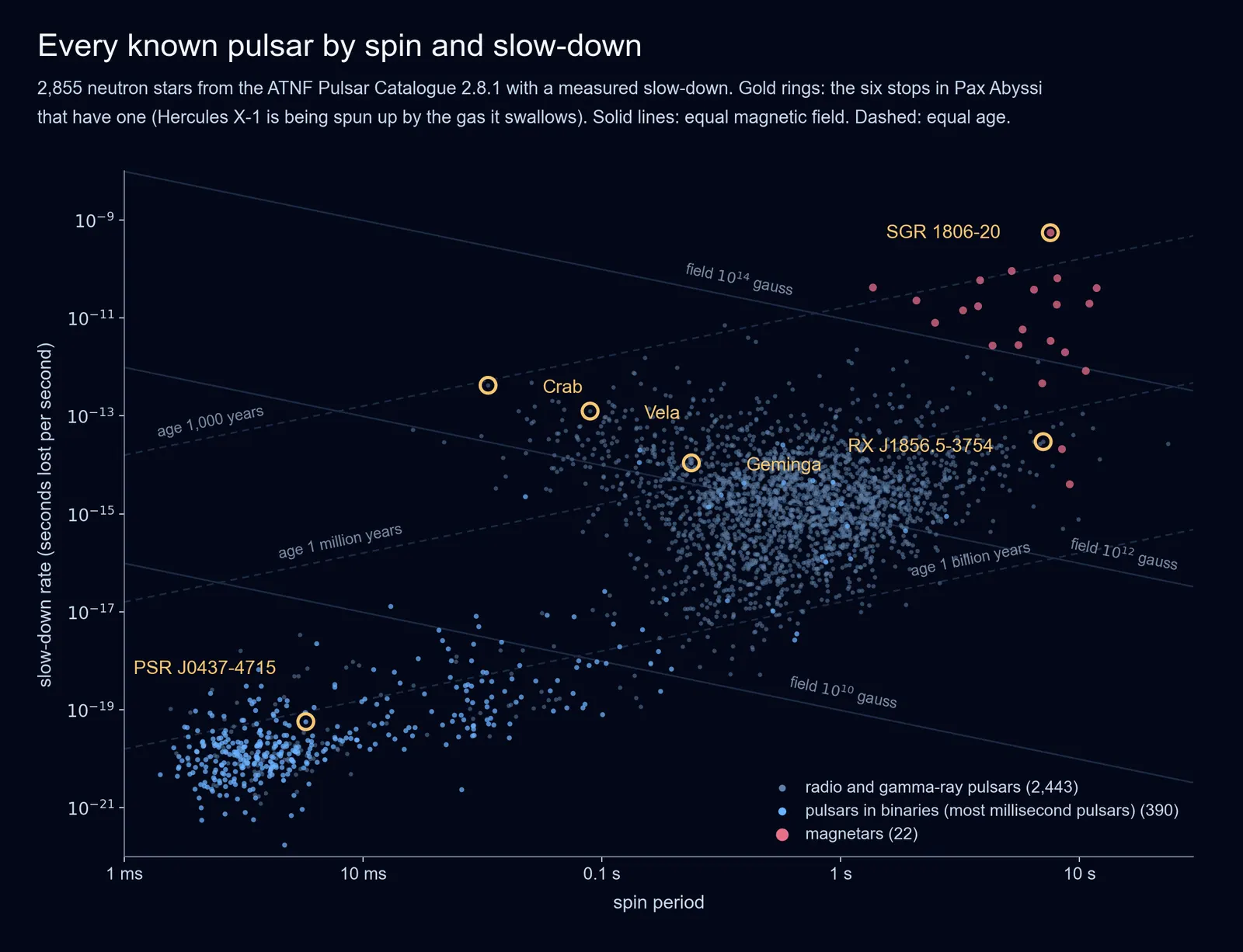
The diagram has three populations. The young, energetic pulsars sit at upper left: the Crab, and the Vela Pulsar, 11 turns a second and about 900 light years away. The great cloud in the middle holds ordinary pulsars like Geminga, older and slower. At lower left are the millisecond pulsars, old stars spun up again by gas from a companion to hundreds of turns a second, with weak fields and ages of billions of years. PSR J0437-4715, whose companion is now a white dwarf, is one of them.
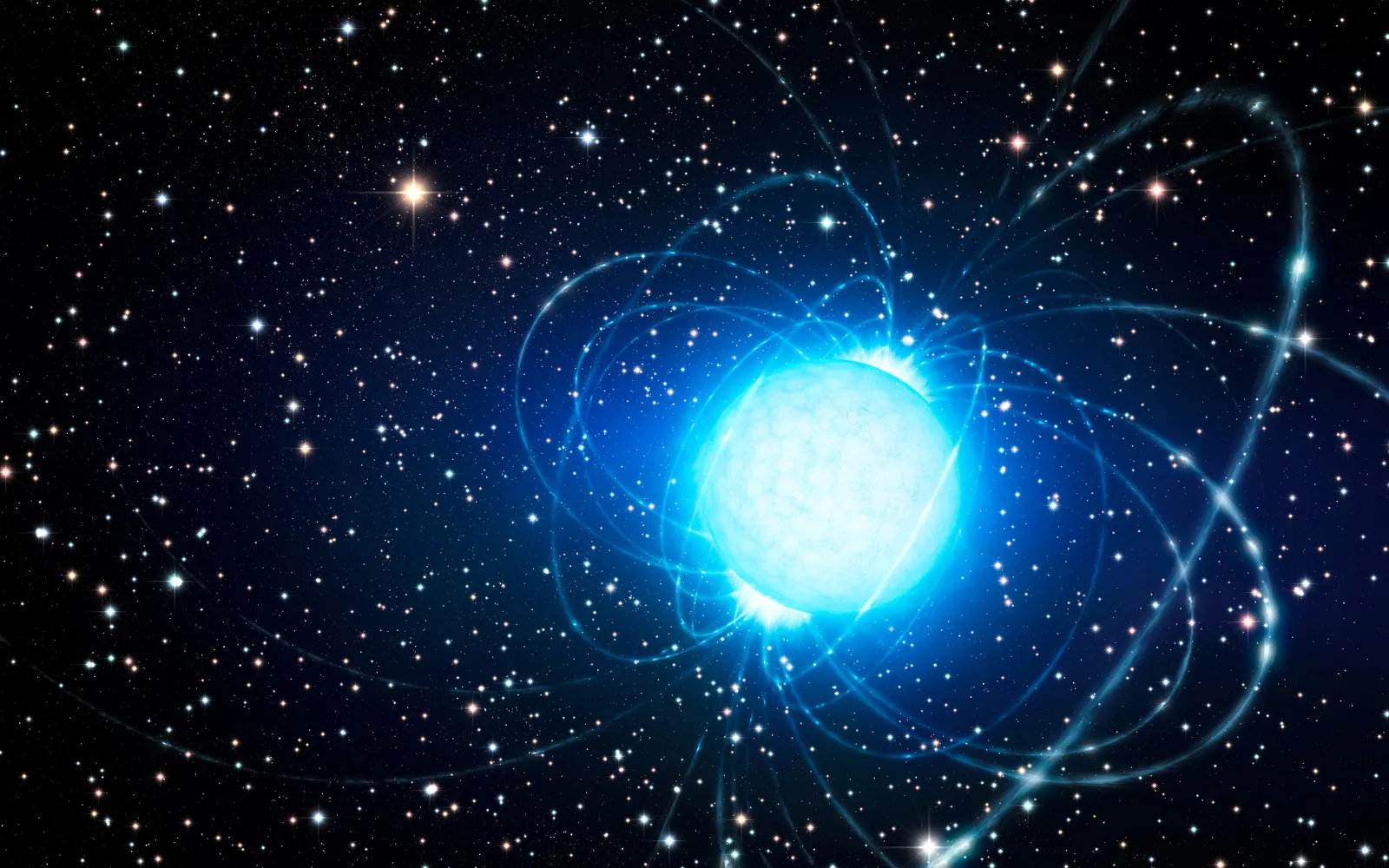
At upper right are the magnetars, whose fields reach a quadrillion gauss, predicted by Robert Duncan and Christopher Thompson in 1992. 23 SGR 1806-20 is the strongest known: its spin-down, measured in 1998, confirmed a field in the magnetar range, and the McGill catalogue now puts it at about 2 × 10¹⁵ gauss, billions of times stronger than any magnet built on Earth. 24, 25 On 27 December 2004 it released a giant flare, the brightest burst of light from beyond the Solar System ever recorded, which briefly swamped gamma-ray detectors on spacecraft across the Solar System. 26 At the magnetar's distance of about 28,000 light years, the flare released in under a second roughly as much energy as the Sun gives out in tens of thousands of years. 26, 27
Not every neutron star shows itself as a radio pulsar. RX J1856.5-3754, one of the nearest known at about 400 light years, spins once every seven seconds and was found by the glow of its surface in X-rays. 28 Its spectrum fits two temperatures, about 450,000 degrees across most of the star and warmer patches, as if two broad caps sit on a cooling surface. 29 And Hercules X-1 is not slowing down at all. It orbits a companion star every 1.7 days and swallows its gas, which spins it up and lands on its magnetic poles in spots of tens of millions of degrees.
What you would see from the helm
Start with the colour. Every surface in this article is hotter than about 100,000 degrees, and a black body that hot has the same colour to the eye whatever its exact temperature: the pale blue of the far tail of its spectrum. A neutron star is that blue. Its hot caps differ from the rest of the surface only in brightness, by roughly the ratio of their temperatures, and on the Crab they are only about half as bright again as the rest. The Crab turns thirty times a second, far faster than any eye or screen can follow, so its caps blur into a faint band round the star.
The surface does not pulse, its hot spots rotate.
Then the brightness. Square metre for square metre, a surface at a million degrees outshines the Sun's surface in visible light by thousands of times, because even the faint tail of so hot a spectrum carries a lot of light. A whole neutron star seen from the distance of the Earth from the Sun would be a point about as bright as the full Moon. RX J1856.5-3754 provides the check: its feeble visible light, measured from 400 light years away, scales to about that. 30
The beams are another matter. A pulsar's lighthouse beam is radio, and from inside it the eye would see nothing of it. The Crab is an exception of a different kind: its magnetosphere also sends out beamed pulses of visible light, found in 1969, twice every turn. 31 Seen from inside that beam at the distance of the Earth from the Sun, the Crab Pulsar would outshine our Sun, flashing sixty times a second, too fast to see as anything but a steady star. 32, 33
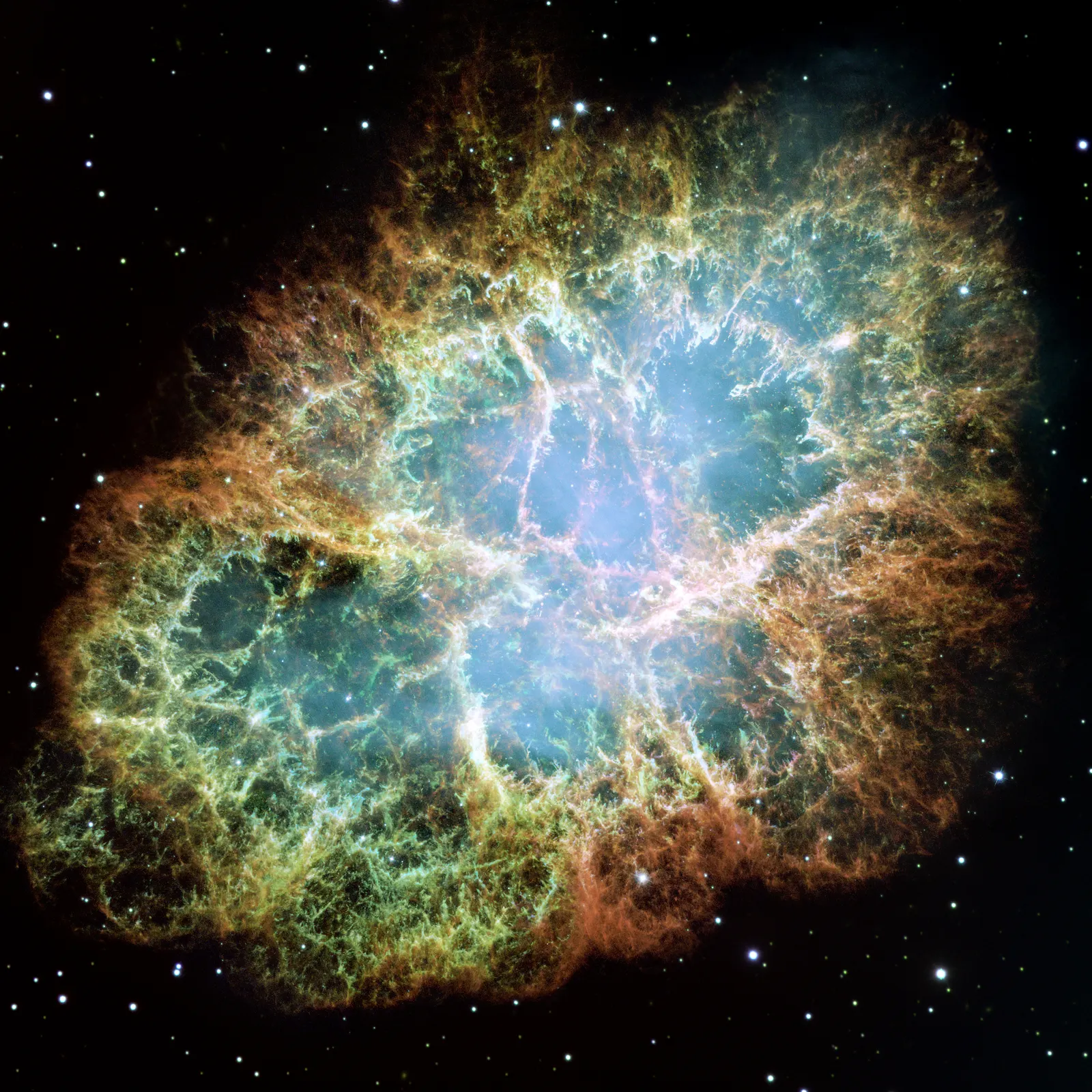
The nebula round it would be a disappointment from inside. Its light is spread over a volume light years across, and surface brightness does not change with distance, so from within it the Crab would be a faint glow at the edge of dark-adapted vision. In X-rays it is different: Chandra's images show a ring round the pulsar and a jet along its spin axis, from which the axis can be measured at about 61 degrees to our line of sight. 34, 35
And then the danger, which the game does not yet model. At the 75 kilometres where the Crab stop places you, the difference in the star's pull across a body two metres long would be well over a hundred thousand times Earth's gravity. In the game nothing happens to a ship that flies too close; what should happen is still a design question.
Seven stops
Pax Abyssi draws a neutron star with the same pass that draws its black holes, since outside any non-spinning, spherical body the spacetime is the same. The horizon is replaced by a hot surface, and each ray that reaches the star picks up the colour of the surface where it lands. The model behind the surface takes what the catalogues know about each star, its spin, its slow-down, its field and its age, and fills what they leave blank from published relations. A star's temperature comes from a table drawn through the neutron stars whose surfaces have been measured, as they cool over millions of years. 36 The hot caps on a pulsar are the size set by the field lines that open through its light cylinder, the radius at which the field would have to turn faster than light. 37 Magnetars glow all over. The Crab's own surface has never been seen through the glare of its magnetosphere, so its temperature is the table's value, under the measured upper limit. Each star's sky is rebuilt from its own place in the Galaxy.
| Star | What it is | Spin period | Distance(light years) | What to look for |
|---|---|---|---|---|
| Crab Pulsar | young pulsar in the Crab Nebula | 33.4 ms | 6,500 | Hot caps blurred into a band; the star is 1,484 years old in the game's year of 2538 |
| Vela Pulsar | young pulsar | 89.3 ms | 900 | A surface just under a million degrees with small hot caps |
| Geminga | older gamma-ray pulsar | 237 ms | 600 to 800 | A cooler surface; its radio beam misses Earth |
| RX J1856.5-3754 | isolated cooling neutron star | 7.06 s | 400 | Two broad warm caps turning once every seven seconds |
| PSR J0437-4715 | millisecond pulsar | 5.76 ms | 510 | Both hot caps in view at once, and a white dwarf companion 11 million km away |
| Hercules X-1 | accreting X-ray pulsar | 1.24 s | 23,000 | X-ray-hot spots where gas lands, a disk, and the companion HZ Her |
| SGR 1806-20 | magnetar | 7.55 s | 28,000 | The hottest surface of the seven, glowing all over |
The Crab is the one to start with. Its slowing spin is what lights the nebula round it, and in the game the pale blue disc in front of the ship is 1,484 years old and 24 kilometres wide.
References
- 1Hester, J. J. (2008). The Crab Nebula: An Astrophysical Chimera. Annual Review of Astronomy and Astrophysics 46, 127-155. doi:10.1146/annurev.astro.45.051806.110608
- 2Baade, W. and Zwicky, F. (1934). On Super-Novae. Proceedings of the National Academy of Sciences 20, 254-259. doi:10.1073/pnas.20.5.254
- 3Oppenheimer, J. R. and Volkoff, G. M. (1939). On Massive Neutron Cores. Physical Review 55, 374-381. doi:10.1103/PhysRev.55.374
- 4Lattimer, J. M. and Prakash, M. (2004). The Physics of Neutron Stars. Science 304, 536-542. doi:10.1126/science.1090720
- 5Read, J. S. et al. (2009). Constraints on a phenomenologically parametrized neutron-star equation of state. Physical Review D 79, 124032. doi:10.1103/PhysRevD.79.124032
- 6Beloborodov, A. M. (2002). Gravitational Bending of Light Near Compact Objects. The Astrophysical Journal 566, L85-L88. doi:10.1086/339511
- 7Synge, J. L. (1966). The Escape of Photons from Gravitationally Intense Stars. Monthly Notices of the Royal Astronomical Society 131, 463-466. doi:10.1093/mnras/131.3.463
- 8Riley, T. E. et al. (2019). A NICER View of PSR J0030+0451: Millisecond Pulsar Parameter Estimation. The Astrophysical Journal Letters 887, L21. doi:10.3847/2041-8213/ab481c
- 9Miller, M. C. et al. (2019). PSR J0030+0451 Mass and Radius from NICER Data and Implications for the Properties of Neutron Star Matter. The Astrophysical Journal Letters 887, L24. doi:10.3847/2041-8213/ab50c5
- 10Fonseca, E. et al. (2021). Refined Mass and Geometric Measurements of the High-mass PSR J0740+6620. The Astrophysical Journal Letters 915, L12. doi:10.3847/2041-8213/ac03b8
- 11Riley, T. E. et al. (2021). A NICER View of the Massive Pulsar PSR J0740+6620 Informed by Radio Timing and XMM-Newton Spectroscopy. The Astrophysical Journal Letters 918, L27. doi:10.3847/2041-8213/ac0a81
- 12Miller, M. C. et al. (2021). The Radius of PSR J0740+6620 from NICER and XMM-Newton Data. The Astrophysical Journal Letters 918, L28. doi:10.3847/2041-8213/ac089b
- 13Salmi, T. et al. (2024). The Radius of the High-mass Pulsar PSR J0740+6620 with 3.6 yr of NICER Data. The Astrophysical Journal 974, 294. doi:10.3847/1538-4357/ad5f1f
- 14Reardon, D. J. et al. (2024). The Neutron Star Mass, Distance, and Inclination from Precision Timing of the Brilliant Millisecond Pulsar J0437-4715. The Astrophysical Journal Letters 971, L18. doi:10.3847/2041-8213/ad614a
- 15Choudhury, D. et al. (2024). A NICER View of the Nearest and Brightest Millisecond Pulsar: PSR J0437-4715. The Astrophysical Journal Letters 971, L20. doi:10.3847/2041-8213/ad5a6f
- 16Vinciguerra, S. et al. (2024). An Updated Mass-Radius Analysis of the 2017-2018 NICER Data Set of PSR J0030+0451. The Astrophysical Journal 961, 62. doi:10.3847/1538-4357/acfb83
- 17Abbott, B. P. and LIGO Scientific Collaboration and Virgo Collaboration (2017). GW170817: Observation of Gravitational Waves from a Binary Neutron Star Inspiral. Physical Review Letters 119, 161101. doi:10.1103/PhysRevLett.119.161101
- 18Rutherford, N. et al. (2024). Constraining the Dense Matter Equation of State with New NICER Mass-Radius Measurements and New Chiral Effective Field Theory Inputs. The Astrophysical Journal Letters 971, L19. doi:10.3847/2041-8213/ad5f02
- 19Romani, R. W. et al. (2022). PSR J0952-0607: The Fastest and Heaviest Known Galactic Neutron Star. The Astrophysical Journal Letters 934, L17. doi:10.3847/2041-8213/ac8007
- 20Hewish, A. et al. (1968). Observation of a Rapidly Pulsating Radio Source. Nature 217, 709-713. doi:10.1038/217709a0
- 21Staelin, D. H. and Reifenstein, E. C. (1968). Pulsating Radio Sources near the Crab Nebula. Science 162, 1481-1483. doi:10.1126/science.162.3861.1481
- 22Manchester, R. N. et al. (2005). The Australia Telescope National Facility Pulsar Catalogue. The Astronomical Journal 129, 1993-2006. doi:10.1086/428488
- 23Duncan, R. C. and Thompson, C. (1992). Formation of very strongly magnetized neutron stars: Implications for gamma-ray bursts. The Astrophysical Journal 392, L9. doi:10.1086/186413
- 24Kouveliotou, C. et al. (1998). An X-ray pulsar with a superstrong magnetic field in the soft gamma-ray repeater SGR 1806-20. Nature 393, 235-237. doi:10.1038/30410
- 25Olausen, S. A. and Kaspi, V. M. (2014). The McGill Magnetar Catalog. The Astrophysical Journal Supplement Series 212, 6. doi:10.1088/0067-0049/212/1/6
- 26Hurley, K. et al. (2005). An exceptionally bright flare from SGR 1806-20 and the origins of short-duration gamma-ray bursts. Nature 434, 1098-1103. doi:10.1038/nature03519
- 27Bibby, J. L. et al. (2008). A downward revision to the distance of the 1806-20 cluster and associated magnetar from Gemini Near-Infrared Spectroscopy. Monthly Notices of the Royal Astronomical Society Letters 386, L23-L27. doi:10.1111/j.1745-3933.2008.00453.x
- 28Walter, F. M. et al. (2010). Revisiting the Parallax of the Isolated Neutron Star RX J185635-3754 Using HST/ACS Imaging. The Astrophysical Journal 724, 669-677. doi:10.1088/0004-637X/724/1/669
- 29Sartore, N. et al. (2012). Spectral monitoring of RX J1856.5-3754 with XMM-Newton. Astronomy & Astrophysics 541, A66. doi:10.1051/0004-6361/201118489
- 30van Kerkwijk, M. H. and Kulkarni, S. R. (2001). Optical spectroscopy and photometry of the neutron star RX J1856.5-3754. Astronomy & Astrophysics 378, 986-995. doi:10.1051/0004-6361:20011272
- 31Cocke, W. J., Disney, M. J. and Taylor, D. J. (1969). Discovery of Optical Signals from Pulsar NP 0532. Nature 221, 525-527. doi:10.1038/221525a0
- 32Sollerman, J., Lundqvist, P. and Lindler, D. (2000). Observations of the Crab Nebula and Its Pulsar in the Far-Ultraviolet and in the Optical. The Astrophysical Journal 537, 861-874. doi:10.1086/309062
- 33Trimble, V. (1973). The Distance to the Crab Nebula and NP 0532. Publications of the Astronomical Society of the Pacific 85, 579. doi:10.1086/129507
- 34Weisskopf, M. C. et al. (2000). Discovery of Spatial and Spectral Structure in the X-Ray Emission from the Crab Nebula. The Astrophysical Journal 536, L81-L84. doi:10.1086/312733
- 35Ng, C. Y. and Romani, R. W. (2004). Fitting Pulsar Wind Tori. The Astrophysical Journal 601, 479-484. doi:10.1086/380486
- 36Potekhin, A. Y. et al. (2020). Thermal luminosities of cooling neutron stars. Monthly Notices of the Royal Astronomical Society 496, 5052-5071. doi:10.1093/mnras/staa1871
- 37Goldreich, P. and Julian, W. H. (1969). Pulsar Electrodynamics. The Astrophysical Journal 157, 869. doi:10.1086/150119
Related in the wiki
Credits
- Pax Abyssi Science Desk
- Author
Spotted an error? Tell us in the forum thread or on the talk page of a related wiki article; corrections are noted at the top of the piece.