Four black holes, and why most of them are dark
Pax Abyssi lets you fly to four real black holes, from Cygnus X-1, fed by the wind of a blue supergiant, to the starved giant at the centre of the Milky Way. What you would see from each depends above all on what it eats.
By Pax Abyssi Science Desk

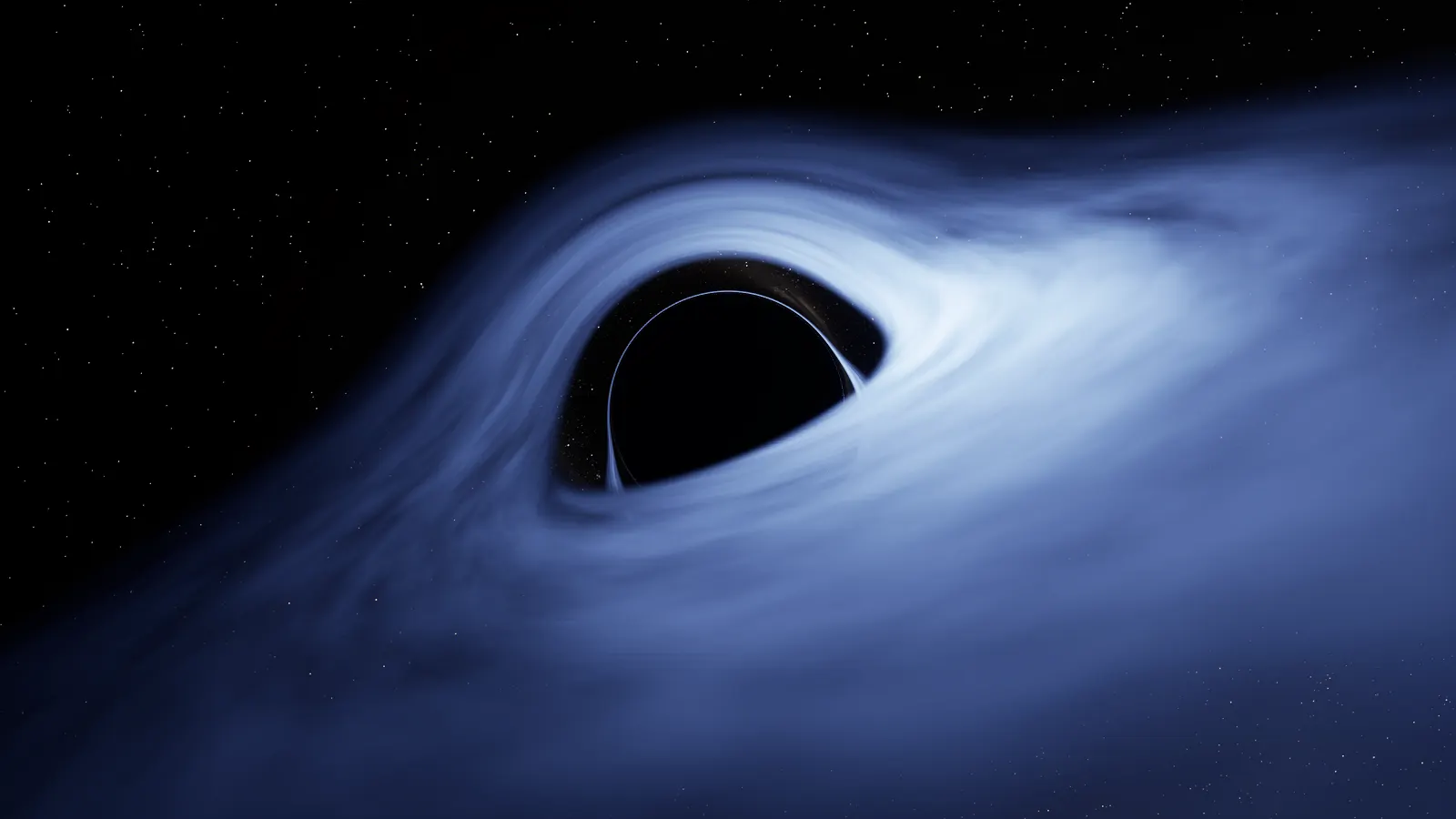
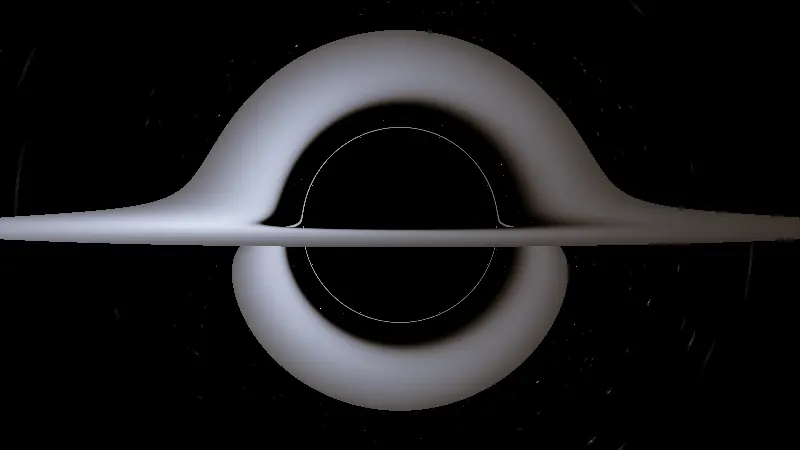
A ten-solar-mass black hole with a thin accretion disk, drawn by the Pax Abyssi black hole pass on the game's look-development stage, 16 Schwarzschild radii out. The far side of the disk is bent up over the shadow by gravity. Sim render.
Pax Abyssi (in-game render)Pax Abyssi, all rights reserved
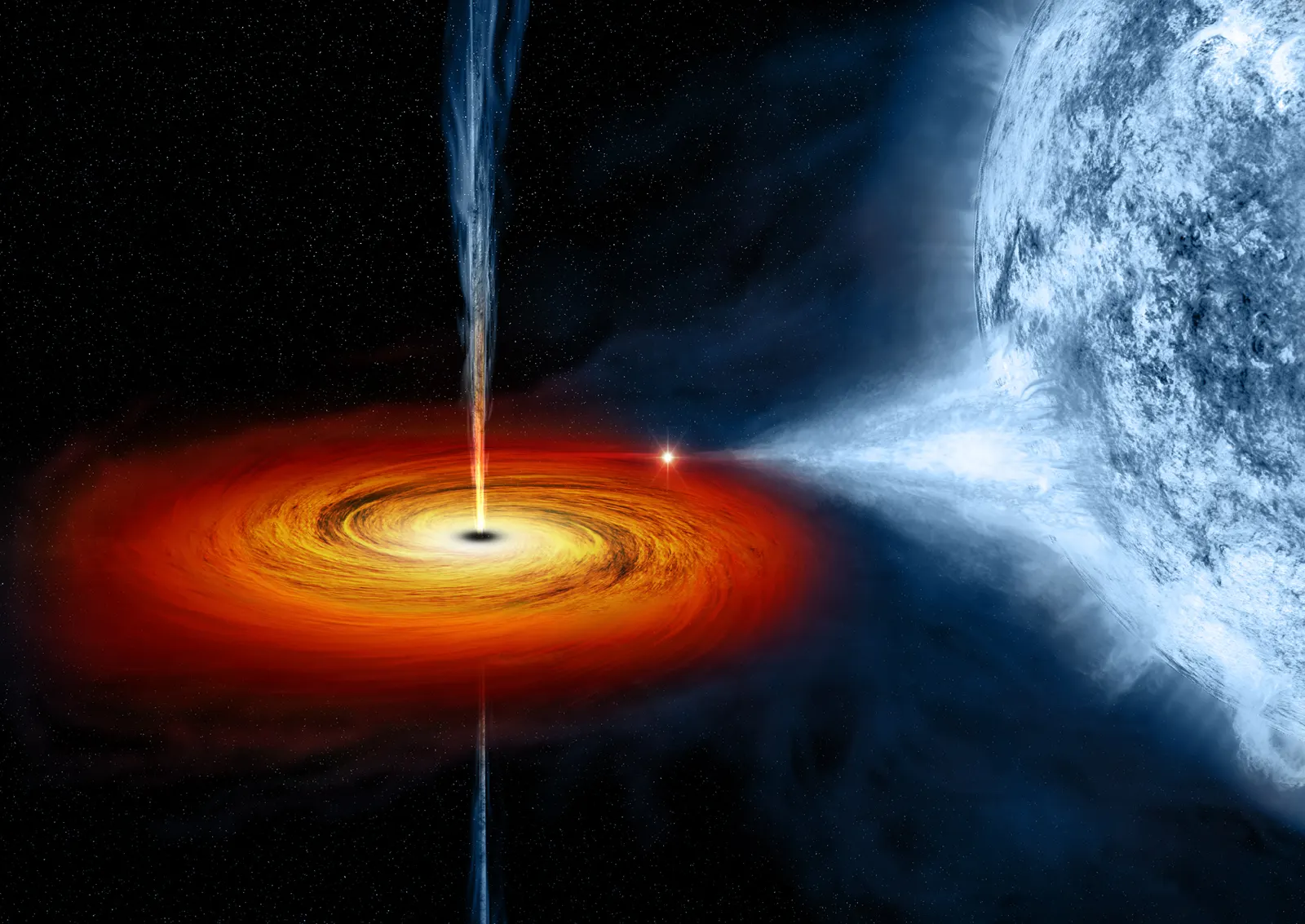
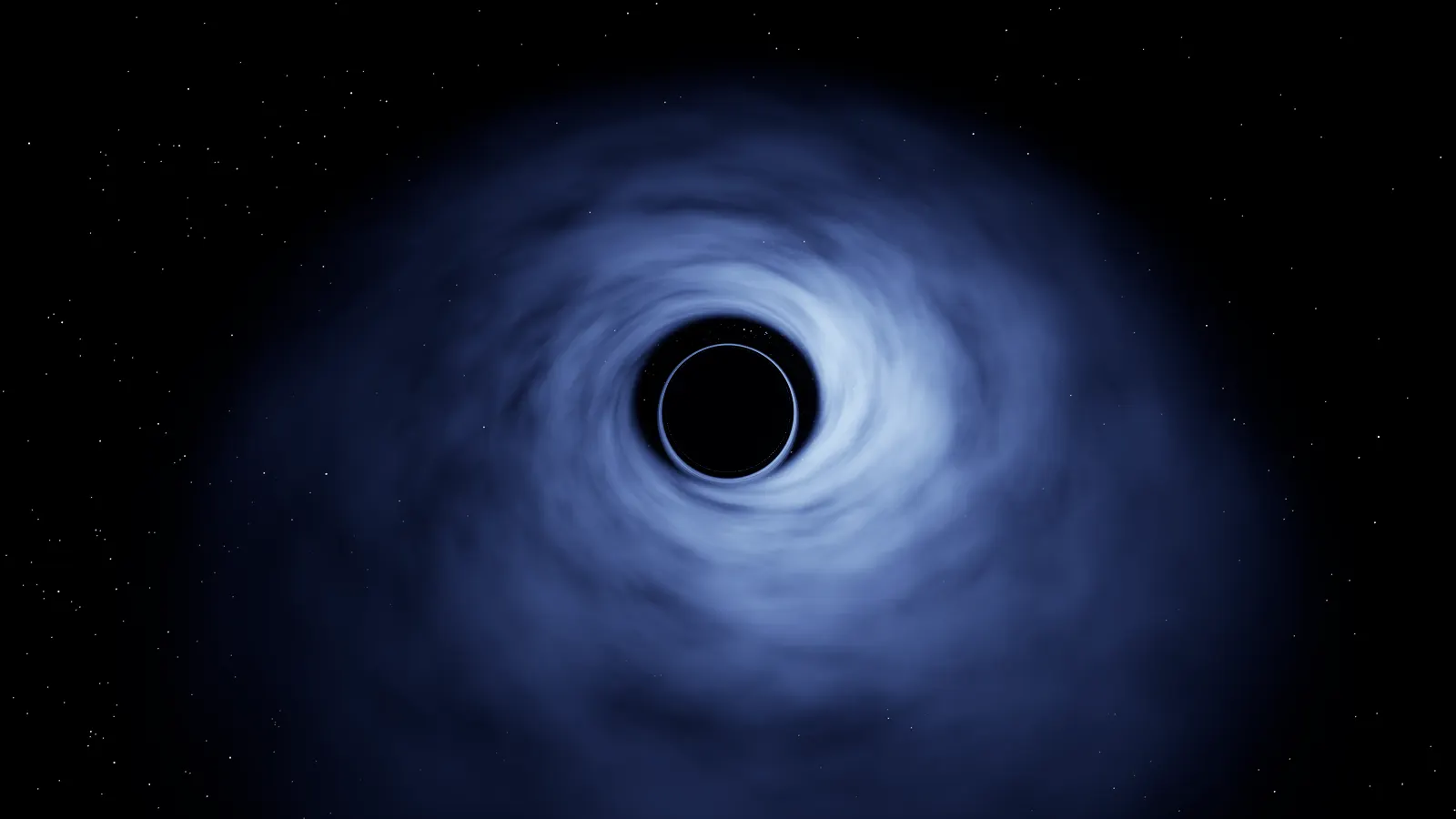
Cut the drive 1,550 kilometres from Cygnus X-1 and the first thing you notice is not the black hole. It is the star beside it: HDE 226868, a blue supergiant about 22 times the Sun's radius and some 300,000 times its luminosity, so close that it covers more than fifty degrees of your sky. The hull thermometer climbs at once, because the light falling on the ship is more than six million times the sunlight that reaches Earth. Against that glare hangs a disk of gas hot enough to shine blue-white, and at its centre a disc of perfect black about ten degrees across, nearly twenty times the width of the full Moon. Round its rim the stars behind it have been pulled into doubled, smeared arcs. 1
That view is one of five stops in Pax Abyssi at four real black holes: Cygnus X-1, seen from two positions, V404 Cygni, Gaia BH1 and Sagittarius A*, the giant at the centre of the Milky Way. Each is drawn at its measured mass and true place in the Galaxy, with the real star field bent round it by the game's own renderer, and they look very different from one another. A black hole emits nothing itself. What you see depends mostly on whether anything is feeding it, and most black holes are dark because most of them are starving.
Two numbers and three circles
General relativity allows a black hole very few properties. An uncharged hole, which is what nature seems to make, is described completely by its mass and its spin. Karl Schwarzschild found the solution for a hole that does not spin in 1916; Roy Kerr found the spinning one in 1963. 2
Mass sets the scale. The event horizon of a non-spinning hole, the surface from inside which nothing escapes, sits at the Schwarzschild radius, 2GM/c², which comes to 2.95 kilometres for every solar mass. For Cygnus X-1, at 17.5 solar masses, that is 52 kilometres; for Sagittarius A*, at 4.3 million solar masses, about 12.7 million kilometres, 18 times the Sun's radius. 3
Three other circles matter more to anyone looking at the hole. The first is the photon sphere, at one and a half Schwarzschild radii for a non-spinning hole, where light can circle the hole on an unstable orbit. The second is the shadow: the dark disc you actually see, which is 2.6 times the horizon's radius (see the box). The third is the innermost stable circular orbit, or ISCO, at three Schwarzschild radii. Inside it no orbit is stable, and gas that drifts across it plunges into the hole within a few turns. The ISCO is where a thin accretion disk ends. 4
Spin changes the picture. The Kerr solution drags space round with the hole, so a spinning hole's horizon shrinks, and orbits that go the same way as the spin can come closer than orbits that go against it. The spin is measured by a number a between zero and one; theory expects real holes to be spun up by the gas they swallow to no more than about 0.998. 8 At a = 0.9, the spin the game gives Cygnus X-1, the horizon falls to 0.72 of its non-spinning size and the prograde ISCO moves in from three Schwarzschild radii to 1.16. For Cygnus X-1 that puts the inner edge of the disk about 60 kilometres from the centre.
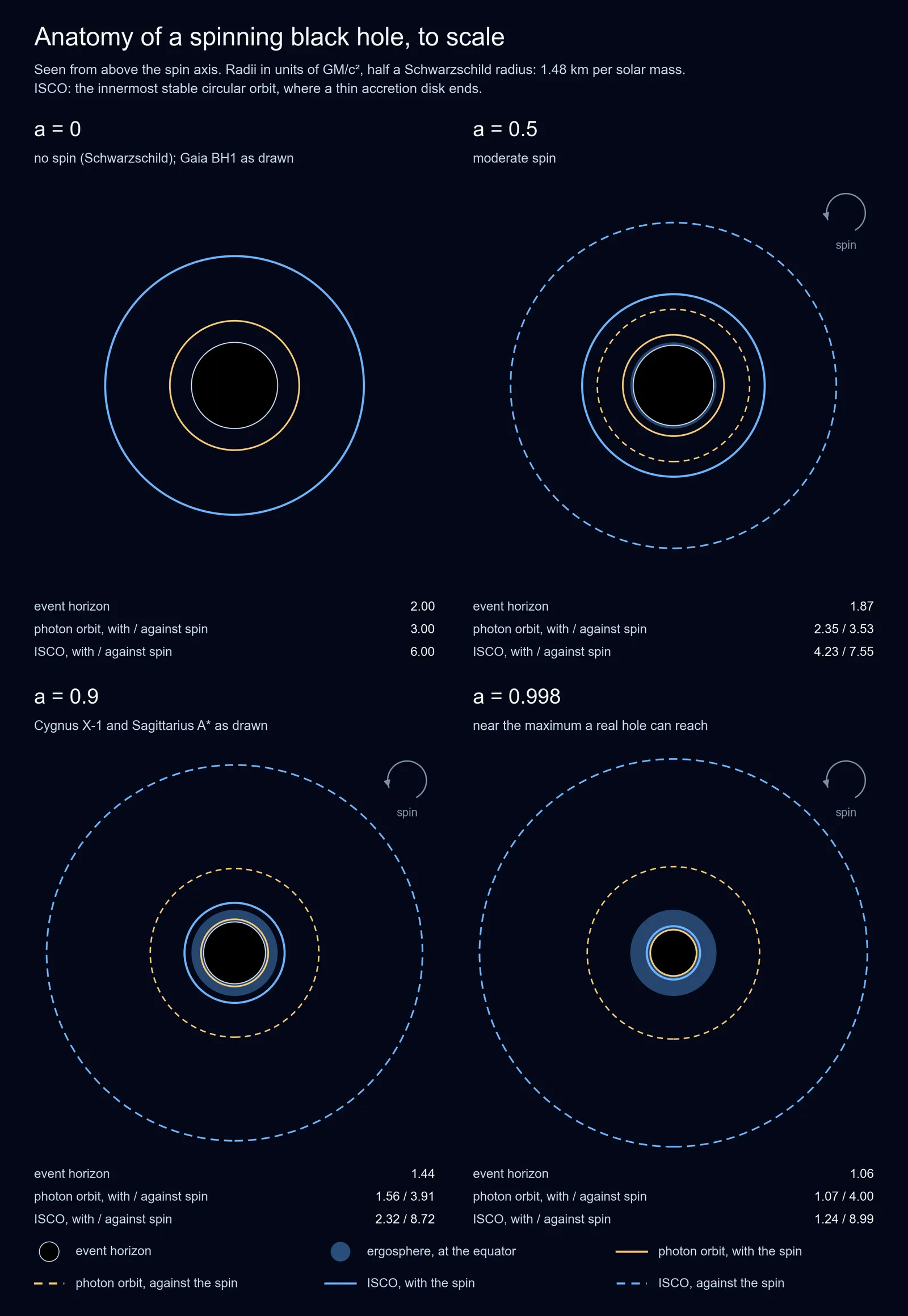
That last change is the one that matters most for what you see. Gas in a thin disk heats up as it spirals inward, because neighbouring rings of gas orbit at different speeds and rub against each other. The closer the inner edge sits to the hole, the deeper the gas falls before it is lost, and the more of its rest-mass energy it can radiate on the way. A disk round a non-spinning hole turns 5.7 per cent of the mass it swallows into light; at a = 0.9 the figure is 15.6 per cent, and for a hole spinning near the limit it passes 30 per cent. Nuclear fusion in the Sun manages 0.7 per cent. 9
A black hole shines only when it eats
That efficiency is only as good as the supply. The disk glows because gas is falling through it, and gas falls only if something delivers it. The standard picture of a thin, bright disk, worked out by Nikolai Shakura and Rashid Sunyaev in 1973, needs a companion star close enough to spill its outer layers onto the hole, or a wind dense enough to be captured. 10 A hole drifting alone through interstellar gas gathers so little that it is effectively invisible.
This is why the black holes astronomers know about are an odd sample. Population models suggest the Milky Way holds more than a hundred million black holes left behind by massive stars, and that only about seven per cent of them have a companion. 11 The galaxy map in Pax Abyssi carries 113 known and candidate black holes, every one with real observational evidence. Ninety-six of them are X-ray binaries: they were found because something was feeding them.
Cygnus X-1 and the supergiant's wind
Cygnus X-1 was the first black hole anyone identified. It had been known since the 1960s as one of the brightest X-ray sources in the sky, and in 1972 Louise Webster and Paul Murdin at the Royal Greenwich Observatory, and independently Tom Bolton in Toronto, found that the bright blue star HDE 226868 at the X-ray position swings back and forth every 5.6 days round an unseen companion too heavy to be a neutron star. 12, 13
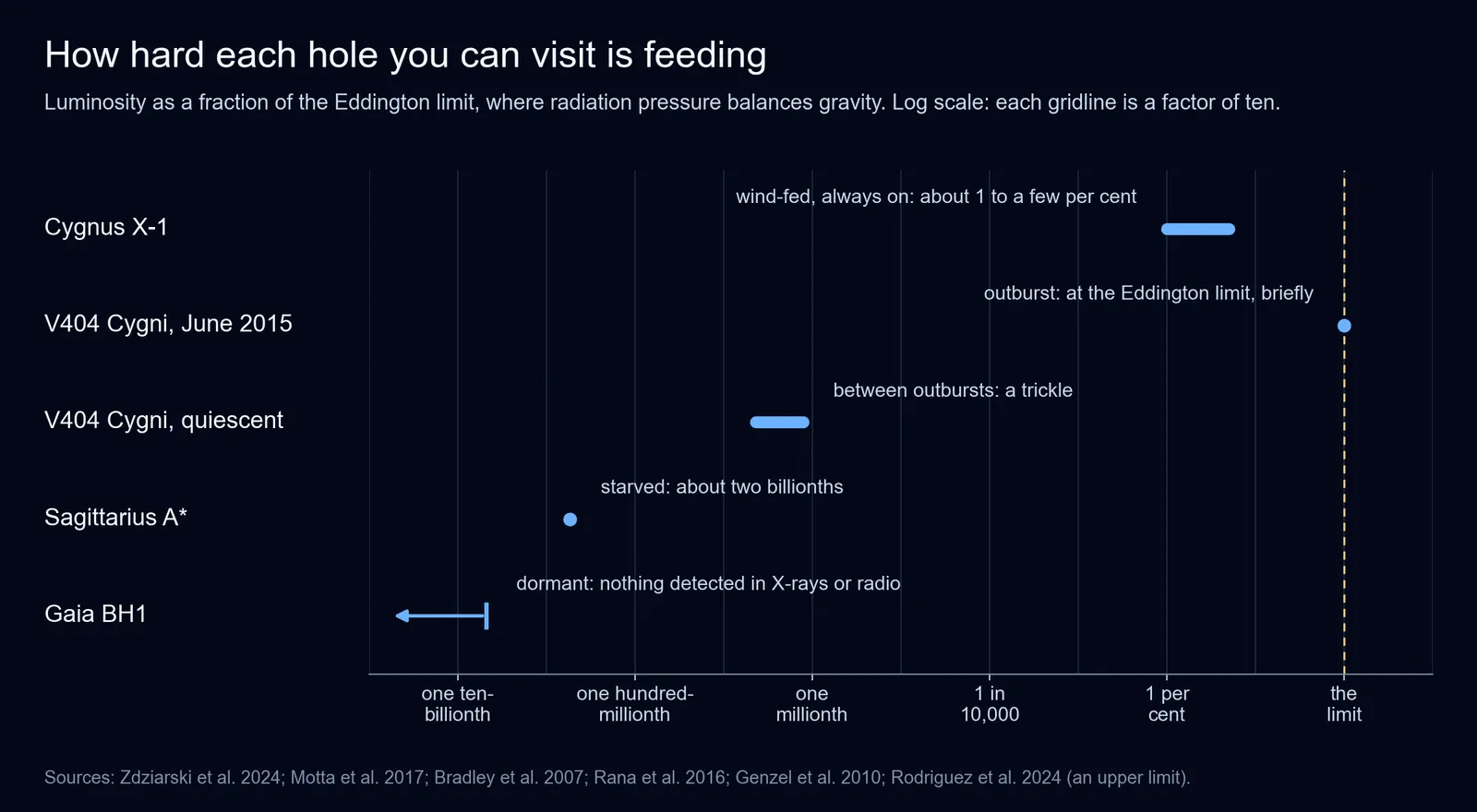
The supergiant is a type O9.7 star of about 29 solar masses and 29,000 kelvin, and it is shedding its outer layers as a fast wind: about three ten-millionths of a solar mass a year at 1,200 to 1,800 kilometres a second. It is so swollen that it almost fills the region within which its own gravity holds sway, so the wind is thickest on the side facing the hole. 1 The black hole, 0.22 astronomical units away, catches part of that stream. The captured gas forms a disk that shines at about one to a few per cent of the Eddington limit, enough to make Cygnus X-1 a steady X-ray source for as long as it has been observed. The hole also drives a jet, which has inflated a ring about five parsecs across in the surrounding gas; the jet shines in radio waves and would be invisible to the eye. 14
For such a famous object its mass has been surprisingly hard to pin down, and the reason is instructive. Astronomers cannot weigh the black hole directly. They measure the star's orbital speed and the tilt of the orbit, which together give a relation between the two masses, and then they need the star's own mass to solve for the hole's. That depends on how far away the system is and how the star's light is modelled. In 2011 the answer was 14.8 solar masses. 15 In 2021 a radio parallax put the system further away, at 2.22 kiloparsecs, which made the star more luminous and so more massive, and raised the hole to 21.2. 16 In 2025 Varsha Ramachandran and colleagues fitted the star's ultraviolet and optical spectra together for the first time, with its X-ray-lit wind included, and found a lighter star of 29 solar masses; the hole came down to 17.5 at the measured tilt of 27.5 degrees. 1
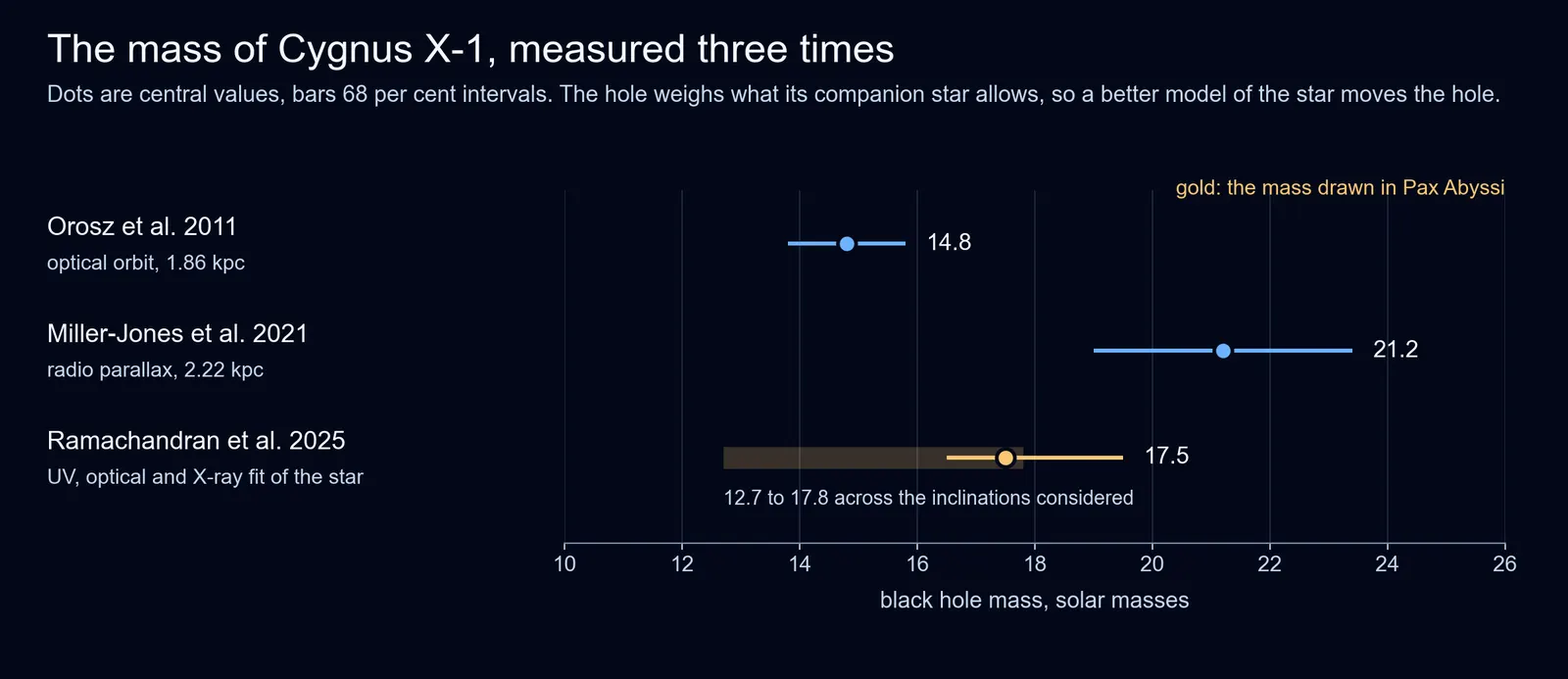
Pax Abyssi changed with it. The game's standing rule is that the newest measurement replaces an older catalogue figure, with its source recorded beside it, and the hole you fly to at Cygnus X-1 has weighed 17.5 solar masses since the day that rule was applied.
What is measured about spin, and what is chosen
Mass is hard; spin is harder. The two main methods both read the spin from how close to the hole the disk reaches, one from the shape of the disk's X-ray spectrum and the other from how gravity smears an iron emission line from gas near the ISCO. Both depend on models of the disk and of the hot corona above it. 17
For Cygnus X-1 the answers have ranged from almost nothing to almost the maximum. A 2021 fit of the disk's spectrum with the new distance found a spin above 0.9985. 18 Three years later Andrzej Zdziarski and colleagues fitted the same kind of data with three reasonable disk models and got 0.986, about 0.9, and about 0.1, depending on how the disk's surface layers are treated. 19 V404 Cygni's spin was measured during its 2015 outburst at above 0.92. 20 For Gaia BH1 there is no gas near the hole and no method applies. For Sagittarius A* the Event Horizon Telescope compared its images with simulations; models with spins of 0.5 and 0.94 passed and many others failed, which is a preference, not a measurement. 21
So the game has to choose, and it says what it chose. Cygnus X-1 and Sagittarius A* are drawn at a = 0.9, inside their measured or permitted ranges; V404 Cygni at 0.92, its measured lower limit; Gaia BH1 at zero, because nothing is known and, with no disk to show it, spin would change its shadow only slightly. When a new measurement settles any of these, the rule above applies.
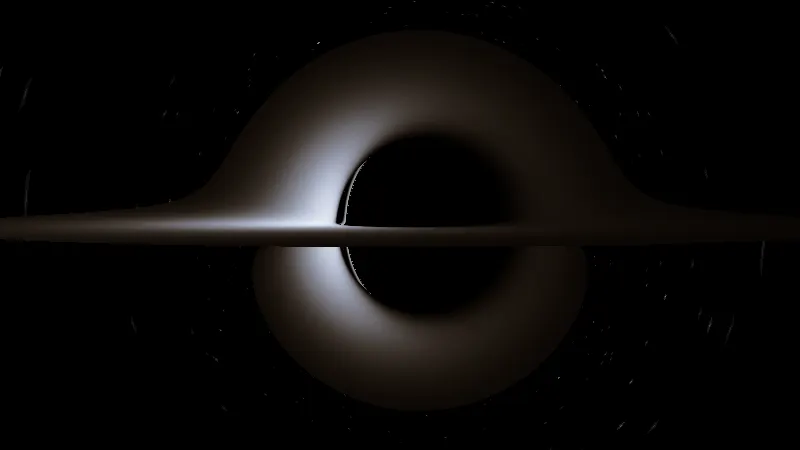
The spin shows most clearly when the disk is seen nearly edge-on. The spinning hole's disk runs in almost to the shadow on the side where the gas comes towards you, and the shadow itself is pushed sideways and flattened on that side.
Bending our own sky
The black holes in Pax Abyssi are drawn by a post-process pass the project wrote itself. For every pixel of sky behind the cockpit it works out which star or which patch of disk that light came from, and how much its frequency was shifted on the way.
For a hole that does not spin, the pass uses Eric Bruneton's 2020 method, which traces light through tables computed once when the hole appears. 22 For a spinning hole it uses a newer piece of mathematics. In 2020 Samuel Gralla and Alexandru Lupsasca showed that the path of any light ray outside a Kerr black hole can be written in closed form, with elliptic integrals and the Jacobi elliptic functions. 23 The game's shader evaluates those formulas for each pixel, so it knows where every ray ends without stepping along it. Checked against an offline reference that integrates the equations of motion step by step, the closed-form rays land within 0.013 of a pixel at the 99th per centile on a view 1,920 pixels wide. A conventional step-by-step march at 100 steps a pixel was tens of pixels off in the same tests, and would cost more.
Every black hole in the game, disk or not, is at minimum a black disc inside a ring of doubled and stretched stars.
The stars it bends are the real sky seen from where the hole actually is. Cygnus X-1 lies 2.2 kiloparsecs away, so its sky is not ours: the game rebuilds it from 375 catalogue stars that reach that far and 31,124 generated from its model of the Milky Way. The disk's colour and brightness come from one formula. The light from each patch of gas is shifted by a factor that combines gravitational redshift with the Doppler shift of gas orbiting at up to half the speed of light, and it is drawn as a black body at the shifted temperature, brighter by the fourth power of the shift. The side coming towards you is brighter and bluer because the physics makes it so. The effects team on the film Interstellar deliberately turned those shifts off for the screen, and said so in their paper; the game keeps them. 24
A few things are simplified, and the project lists them. The inner disk of a stellar black hole completes an orbit in a few thousandths of a second, faster than any screen can show, so the drawn rotation is slowed to a presentation speed. The black holes do not yet orbit their companions. And the pass's cost on the game's target graphics card has been estimated but not yet measured.
V404 Cygni sleeps between meals
V404 Cygni is a black hole of nine solar masses pulling gas from an orange giant star in an orbit of six and a half days. 25 It was the first black hole to have its distance measured by parallax, 2.39 kiloparsecs, from the tiny annual shift of its radio position against distant quasars. 26 Unlike Cygnus X-1 it is not fed steadily. Its companion fills its gravitational boundary, and the gas it spills collects in a cool, dim disk until the disk becomes unstable and dumps its contents onto the hole.
When that happens V404 Cygni becomes one of the brightest X-ray sources in the sky. In June 2015, after 26 quiet years, it flared to around its Eddington limit and threw off outflows of gas. 27 Between outbursts it drops to a few ten-millionths of that. 28, 29 A swing of a million or more is what makes such black holes hard to find: most of the time they look like nothing much. The game's stop draws its disk tilted at the measured 67 degrees, the giant a seventh of an astronomical unit behind you, and the hole at a spin of 0.92.
Gaia BH1 and the dormant holes
Gaia BH1 was found in 2022 by watching a star move. The European Space Agency's Gaia satellite measures stellar positions so precisely that it can see a star wobble round an unseen partner. One Sun-like star 480 parsecs away, about 1,560 light years, turned out to circle something of 9.62 solar masses every 186 days, something that gives off no light. It is the nearest black hole known. 30 Two more followed: Gaia BH2, of 8.9 solar masses with a red giant companion, and Gaia BH3, at 33 solar masses the most massive black hole of stellar origin yet found in the Galaxy. 31, 32
These holes are dormant. Their stars orbit too far away to spill gas onto them, and the Chandra X-ray Observatory and radio telescopes looked for any sign of the thin stellar wind falling in and found nothing. The limit for Gaia BH1 is below two ten-billionths of its Eddington luminosity. 33
So Gaia BH1 is the simplest stop in the game and the purest demonstration of what a black hole does to light. You arrive 15 Schwarzschild radii out, 426 kilometres from the centre. There is no disk and no glow, only a round black shadow nearly twenty degrees across, and round it a ring where the stars behind have been bent into arcs and doubled images. The Sun-like companion sits 1.4 astronomical units behind you. It is the one hole drawn on the non-spinning path.
Sagittarius A* on a starvation diet
Sagittarius A* is the black hole everyone has heard of: 4.3 million solar masses at the centre of the Milky Way, 8.3 kiloparsecs from the Sun. Its mass comes from the orbits of the stars that race round it, one of which, S2, passes within 120 astronomical units of the hole every 16 years at close to three per cent of the speed of light. 34, 3 In 2022 the Event Horizon Telescope published the image of its shadow: a ring 51.8 microarcseconds across, the size general relativity predicts for a hole of that mass at that distance. 35
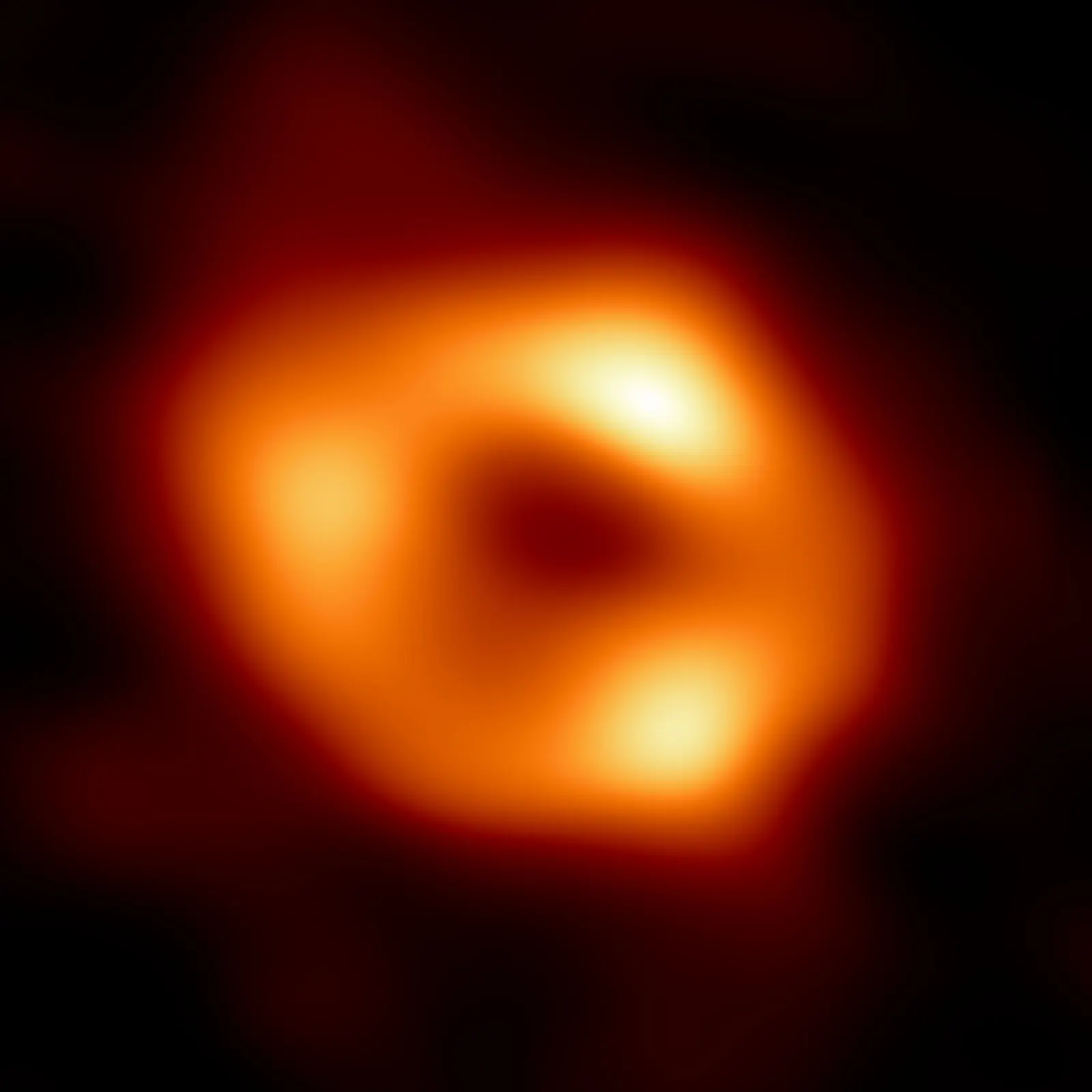
Surrounded by stars shedding gas, Sagittarius A* ought to be well fed. X-ray observations suggest about a hundred-thousandth of a solar mass a year comes within the hole's gravitational grasp. 36 Almost none of it arrives. Measurements of how the hole's radio light is polarised limit the flow near the horizon to a few per cent of that at most, and perhaps a hundredth of a per cent. 37 The gas is too hot and too thin to cool and settle into a disk. It stays a puffed-up flow of electrons at tens of billions of degrees that radiates poorly and is largely blown away. 38 The result is a luminosity of about 10²⁹ watts, a few hundred times the Sun's but only about two billionths of the hole's Eddington limit. 39
Sagittarius A* is surrounded by food and eats almost none of it.
What you would see from nearby is therefore mostly everything else. The hot flow shines in radio and infrared waves; to the eye it would be at most a faint, flickering reddish smudge hugging the shadow. From inside the nuclear star cluster the sky would be full of stars brighter than Venus in every direction. The game's stop puts you 30 Schwarzschild radii out, about 2.5 astronomical units from the centre, with S2 behind you as a blue-white point. The project lead's ruling was to draw the hole as the science says, nearly dark, a black disc in a blazing star cluster; any brighter version would be offered separately, named as a game version, never as the default.
The stop exists, but its picture is not ready. At present the combined light of the cluster overwhelms the exposure and the frame turns white, so there is no image of it here. It will be shown when it is fixed.
What the list leaves out
Four holes is a small sample from a hundred million, chosen because they span the range: a wind-fed binary, a sleeping transient, a dormant hole in a wide orbit and a starved giant. Mass and spin fix the geometry of each. The neighbourhood decides whether anything in it is lit.
Back at Cygnus X-1 the disk is bright because a supergiant is feeding it, the shadow is ten degrees wide because you are 1,550 kilometres away, and you can stay only because the ship has been lent a shield. It gives you about five minutes.
References
- 1Ramachandran, V., Sander, A. A. C. and Oskinova, L. M. (2025). Comprehensive UV and optical spectral analysis of Cygnus X-1: Stellar and wind parameters, abundances, and evolutionary implications. Astronomy & Astrophysics 698, A37. doi:10.1051/0004-6361/202554184
- 2Kerr, R. P. (1963). Gravitational Field of a Spinning Mass as an Example of Algebraically Special Metrics. Physical Review Letters 11, 237-238. doi:10.1103/PhysRevLett.11.237
- 3GRAVITY Collaboration et al. (2022). Mass distribution in the Galactic Center based on interferometric astrometry of multiple stellar orbits. Astronomy & Astrophysics 657, L12. doi:10.1051/0004-6361/202142465
- 4Bardeen, J. M., Press, W. H. and Teukolsky, S. A. (1972). Rotating Black Holes: Locally Nonrotating Frames, Energy Extraction, and Scalar Synchrotron Radiation. The Astrophysical Journal 178, 347. doi:10.1086/151796
- 5Synge, J. L. (1966). The Escape of Photons from Gravitationally Intense Stars. Monthly Notices of the Royal Astronomical Society 131, 463-466. doi:10.1093/mnras/131.3.463
- 6Bardeen, J. M. (1973). Timelike and null geodesics in the Kerr metric. Black Holes (Les Astres Occlus) 215-239.
- 7Event Horizon Telescope Collaboration (2019). First M87 Event Horizon Telescope Results. I. The Shadow of the Supermassive Black Hole. The Astrophysical Journal Letters 875, L1. doi:10.3847/2041-8213/ab0ec7
- 8Thorne, K. S. (1974). Disk-Accretion onto a Black Hole. II. Evolution of the Hole. The Astrophysical Journal 191, 507. doi:10.1086/152991
- 9Page, D. N. and Thorne, K. S. (1974). Disk-Accretion onto a Black Hole. Time-Averaged Structure of Accretion Disk. The Astrophysical Journal 191, 499. doi:10.1086/152990
- 10Shakura, N. I. and Sunyaev, R. A. (1973). Black holes in binary systems. Observational appearance. Astronomy and Astrophysics 24, 337-355. ui.adsabs.harvard.edu/abs/1973A%26A....24..337S
- 11Olejak, A. et al. (2020). Synthetic catalog of black holes in the Milky Way. Astronomy & Astrophysics 638, A94. doi:10.1051/0004-6361/201936557
- 12Webster, B. L. and Murdin, P. (1972). Cygnus X-1: a Spectroscopic Binary with a Heavy Companion?. Nature 235, 37-38. doi:10.1038/235037a0
- 13Bolton, C. T. (1972). Identification of Cygnus X-1 with HDE 226868. Nature 235, 271-273. doi:10.1038/235271b0
- 14Gallo, E. et al. (2005). A dark jet dominates the power output of the stellar black hole Cygnus X-1. Nature 436, 819-821. doi:10.1038/nature03879
- 15Orosz, J. A. et al. (2011). The Mass of the Black Hole in Cygnus X-1. The Astrophysical Journal 742, 84. doi:10.1088/0004-637X/742/2/84
- 16Miller-Jones, J. C. A. et al. (2021). Cygnus X-1 contains a 21-solar mass black hole: Implications for massive star winds. Science 371, 1046-1049. doi:10.1126/science.abb3363
- 17Reynolds, C. S. (2021). Observational Constraints on Black Hole Spin. Annual Review of Astronomy and Astrophysics 59, 117-154. doi:10.1146/annurev-astro-112420-035022
- 18Zhao, X. et al. (2021). Re-estimating the Spin Parameter of the Black Hole in Cygnus X-1. The Astrophysical Journal 908, 117. doi:10.3847/1538-4357/abbcd6
- 19Zdziarski, A. A. et al. (2024). What Is the Black Hole Spin in Cyg X-1?. The Astrophysical Journal Letters 967, L9. doi:10.3847/2041-8213/ad43ed
- 20Walton, D. J. et al. (2017). Living on a Flare: Relativistic Reflection in V404 Cyg Observed by NuSTAR during Its Summer 2015 Outburst. The Astrophysical Journal 839, 110. doi:10.3847/1538-4357/aa67e8
- 21Event Horizon Telescope Collaboration (2022). First Sagittarius A* Event Horizon Telescope Results. V. Testing Astrophysical Models of the Galactic Center Black Hole. The Astrophysical Journal Letters 930, L16. doi:10.3847/2041-8213/ac6672
- 22Bruneton, E. (2020). Real-time High-Quality Rendering of Non-Rotating Black Holes. arXiv. arxiv.org/abs/2010.08735
- 23Gralla, S. E. and Lupsasca, A. (2020). Null geodesics of the Kerr exterior. Physical Review D 101, 044032. doi:10.1103/PhysRevD.101.044032
- 24James, O. et al. (2015). Gravitational lensing by spinning black holes in astrophysics, and in the movie Interstellar. Classical and Quantum Gravity 32, 065001. doi:10.1088/0264-9381/32/6/065001
- 25Khargharia, J., Froning, C. S. and Robinson, E. L. (2010). Near-infrared Spectroscopy of Low-mass X-ray Binaries: Accretion Disk Contamination and Compact Object Mass Determination in V404 Cyg and Cen X-4. The Astrophysical Journal 716, 1105-1117. doi:10.1088/0004-637X/716/2/1105
- 26Miller-Jones, J. C. A. et al. (2009). The First Accurate Parallax Distance to a Black Hole. The Astrophysical Journal 706, L230-L234. doi:10.1088/0004-637X/706/2/L230
- 27Motta, S. E. et al. (2017). Swift observations of V404 Cyg during the 2015 outburst: X-ray outflows from super-Eddington accretion. Monthly Notices of the Royal Astronomical Society 471, 1797-1818. doi:10.1093/mnras/stx1699
- 28Bradley, C. K. et al. (2007). The Spectrum of the Black Hole X-Ray Nova V404 Cygni in Quiescence as Measured by XMM-Newton. The Astrophysical Journal 667, 427-432. doi:10.1086/520323
- 29Rana, V. et al. (2016). Characterizing X-ray and Radio Emission in the Black Hole X-ray Binary V404 Cygni during Quiescence. The Astrophysical Journal 821, 103. doi:10.3847/0004-637X/821/2/103
- 30El-Badry, K. et al. (2023). A Sun-like star orbiting a black hole. Monthly Notices of the Royal Astronomical Society 518, 1057-1085. doi:10.1093/mnras/stac3140
- 31El-Badry, K. et al. (2023). A red giant orbiting a black hole. Monthly Notices of the Royal Astronomical Society 521, 4323-4348. doi:10.1093/mnras/stad799
- 32Gaia Collaboration et al. (2024). Discovery of a dormant 33 solar-mass black hole in pre-release Gaia astrometry. Astronomy & Astrophysics 686, L2. doi:10.1051/0004-6361/202449763
- 33Rodriguez, A. C. et al. (2024). No X-Rays or Radio from the Nearest Black Holes and Implications for Future Searches. Publications of the Astronomical Society of the Pacific 136, 024203. doi:10.1088/1538-3873/ad228e
- 34GRAVITY Collaboration et al. (2018). Detection of the gravitational redshift in the orbit of the star S2 near the Galactic centre massive black hole. Astronomy & Astrophysics 615, L15. doi:10.1051/0004-6361/201833718
- 35Event Horizon Telescope Collaboration (2022). First Sagittarius A* Event Horizon Telescope Results. I. The Shadow of the Supermassive Black Hole in the Center of the Milky Way. The Astrophysical Journal Letters 930, L12. doi:10.3847/2041-8213/ac6674
- 36Baganoff, F. K. et al. (2003). Chandra X-Ray Spectroscopic Imaging of Sagittarius A* and the Central Parsec of the Galaxy. The Astrophysical Journal 591, 891-915. doi:10.1086/375145
- 37Marrone, D. P. et al. (2007). An Unambiguous Detection of Faraday Rotation in Sagittarius A*. The Astrophysical Journal 654, L57-L60. doi:10.1086/510850
- 38Yuan, F. and Narayan, R. (2014). Hot Accretion Flows Around Black Holes. Annual Review of Astronomy and Astrophysics 52, 529-588. doi:10.1146/annurev-astro-082812-141003
- 39Genzel, R., Eisenhauer, F. and Gillessen, S. (2010). The Galactic Center massive black hole and nuclear star cluster. Reviews of Modern Physics 82, 3121-3195. doi:10.1103/RevModPhys.82.3121
Related in the wiki
Credits
- Pax Abyssi Science Desk
- Author
Spotted an error? Tell us in the forum thread or on the talk page of a related wiki article; corrections are noted at the top of the piece.