The colours of the giants
In 2000, three astrophysicists predicted how giant planets should look at five temperatures, from cream-banded Jupiters to worlds wrapped in cloud made of rock. A quarter of a century on, telescopes have tested the ladder rung by rung. Pax Abyssi draws its own giants from the same physics, by stirring their clouds with wind.
By Pax Abyssi Science Desk

A cold, ammonia-banded giant drawn by Pax Abyssi's procedural generator, four planetary radii out with its star to the right. Its belts, festoons and swirls come from a modelled wind stirring the cloud layer. Sim render (in-game, look-development stage).
Pax Abyssi (in-game render)Pax Abyssi, all rights reserved
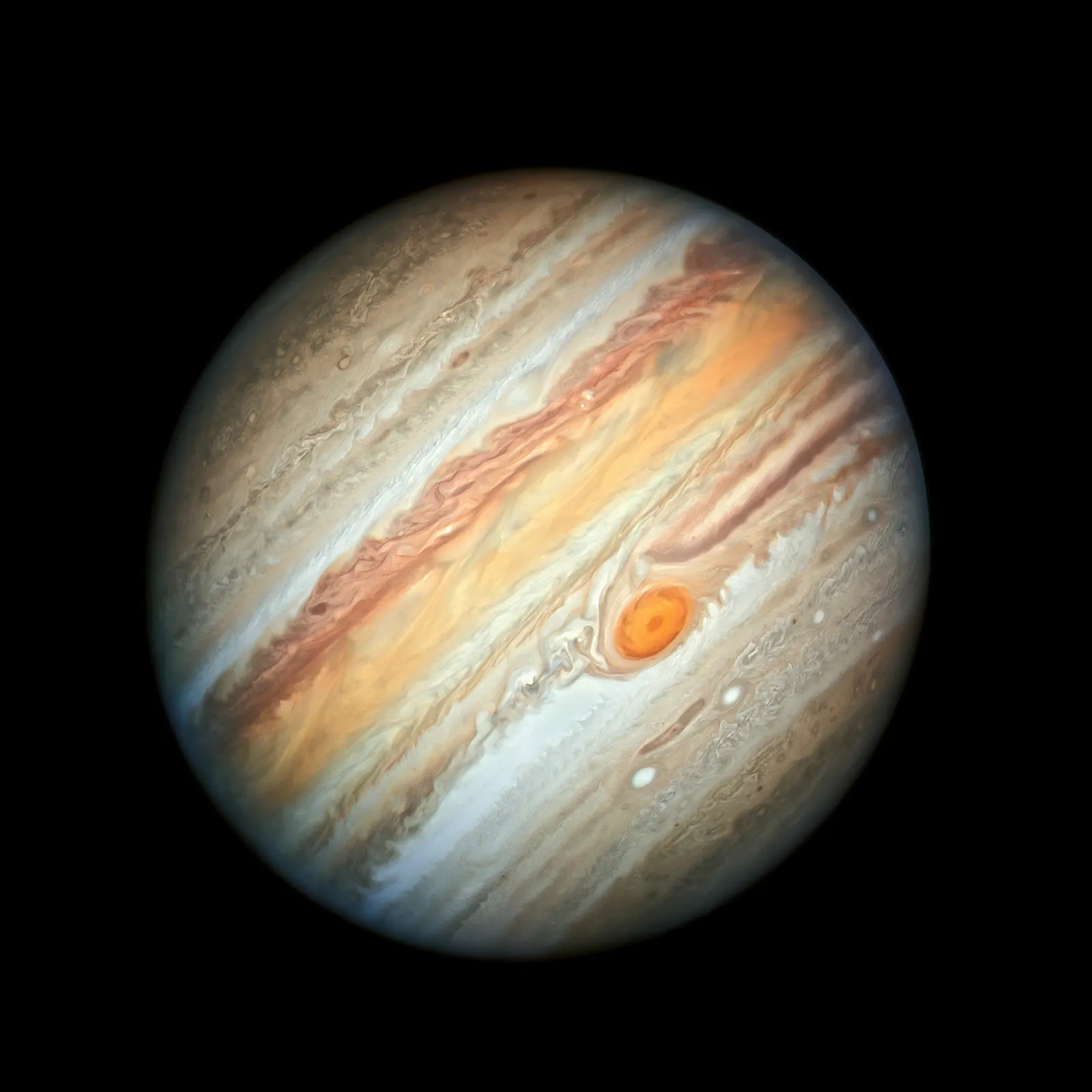
Through a small telescope Jupiter is cream and tan, crossed by brown belts and white zones, with a rust-red storm older than any living astronomer. Saturn is paler and more golden. For most of the history of astronomy these were the only giant planets anyone could study in reflected light, and it was easy to assume their colours were simply what giant planets look like.
In 1995 Michel Mayor and Didier Queloz found a planet at least half as massive as Jupiter circling the star 51 Pegasi every four days 1, closer to its star than Mercury is to the Sun. More giants followed, many of them as hot. In 2000, David Sudarsky, Adam Burrows and Philip Pinto asked what such planets would look like, and computed how much light, and which colours, giant planets should reflect across a wide range of temperatures 2. Their answer was a ladder of five classes, each defined by which substance forms the highest layer of cloud. It remains the best-known way to think about why a giant planet looks the way it does, and many players first met its numbering in Elite Dangerous, which has labelled its gas giants Class I to Class V since it launched in 2014.
A quarter of a century later the ladder can be tested. Hot giants have been caught in reflected light, and the James Webb Space Telescope has read the chemistry of dozens of giant atmospheres. Some predictions have held up well; one of the boldest has not.
A thermometer made of clouds
A giant planet has no surface. Deep down, its hydrogen and helium are hot from the heat left over from its formation, and the temperature falls with height until, high in the atmosphere, starlight warms the gas again. Mixed into that hydrogen are small amounts of heavier substances: ammonia, hydrogen sulfide and water in a cool planet; sodium, potassium, silicate rock and iron in a hot one. Each of them condenses into droplets or crystals wherever the air around it becomes cold enough, and the place where a planet's temperature first dips below that threshold, on the way up from the hot interior, is the base of a cloud deck.
Every substance has its own threshold, and the thresholds are spread across thousands of degrees. Ammonia freezes out of Jupiter-like air at about 140 kelvin (about -130 degrees Celsius), water at about 250 to 270 K, salts such as sodium sulfide near 1,000 K, silicate rock near 1,500 K and iron near 1,800 K. So a giant's temperature decides which of these clouds can exist, and the hottest one it can form is the one on top. That top deck scatters starlight back into space; whatever gas lies above it absorbs. Whether a giant is bright or dark, banded or plain, is decided in the top few bars of its atmosphere.
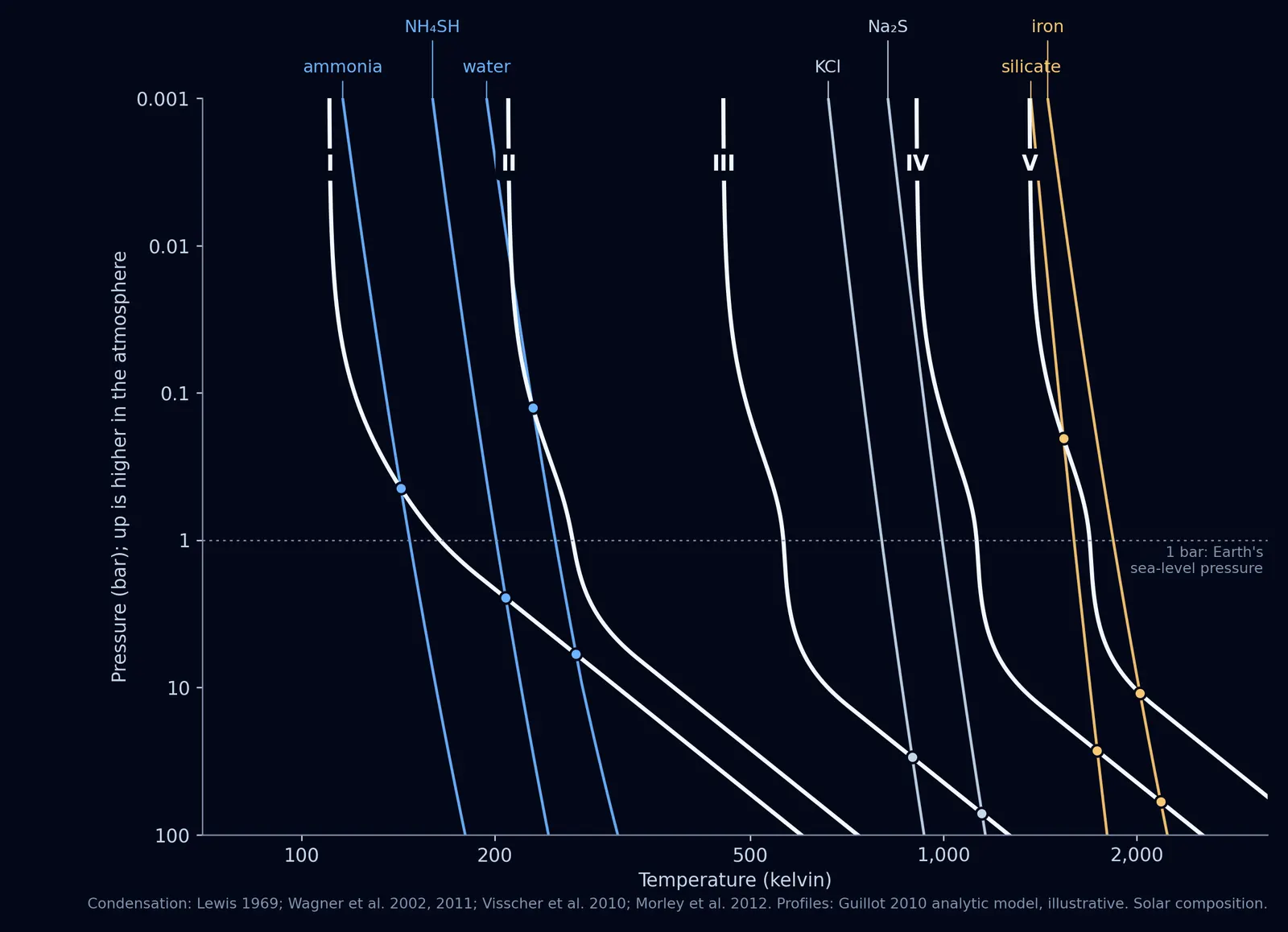
The diagram shows the idea at work, with temperature profiles from a standard analytic model of an irradiated atmosphere 3. The coolest profile, like Jupiter's, crosses the ammonia curve about half a bar down and meets ammonium hydrosulfide, made where ammonia and hydrogen sulfide combine, at 2 to 3 bar and water at about 6 bar. That is close to the cloud stack inferred for Jupiter itself 4. A warmer planet never gets cold enough for ammonia, and water becomes its highest cloud. Warmer still, around 500 K, there is nothing to condense anywhere near the top: the first clouds, of salts, lie tens of bars down. At 1,000 K rock condenses, but deep; at 1,500 K the silicate cloud rises to a fifth of a bar, high enough to be seen.
Five rungs
Sudarsky and colleagues named five classes after representative models rather than sharp boundaries, and gave each a predicted Bond albedo, the fraction of all the starlight falling on a planet that it reflects 2.
Class I, below about 150 K, is the ammonia-cloud Jovian class: Jupiter and Saturn. Ammonia ice is white. The browns and reds come from chromophores, small amounts of coloured material mixed into the clouds, whose chemistry is still not settled; one strong laboratory candidate is made when sunlight breaks up ammonia and the fragments react with acetylene 8. The model gave clean Class I planets a Bond albedo of 0.57.
Class II, near 250 K, is too warm for ammonia to condense, so the highest cloud is water ice. Water-ice cloud reflects nearly every colour, and there is little gas above it to absorb, so the paper predicted the brightest class of all, with a Bond albedo of 0.81: a larger, whiter Venus.
Class III, from about 350 K upward, has in the model no cloud in its upper atmosphere at all. Starlight sinks deep. Hydrogen molecules scatter blue light back out, as air does in Earth's sky, while methane, water and the alkali metals sodium and potassium absorb the red and infrared. The result is a dark planet, reflecting about 12 per cent of what falls on it, and a blue one.
Class IV, from about 900 K, is hot enough for rock to condense, but only 5 to 10 bar down. Above the silicate deck, sodium and potassium atoms soak up nearly all visible light. At a Bond albedo of 0.03 these are the darkest planets on the ladder.
Class V, above about 1,500 K, or cooler if the planet's gravity is weak enough to puff up its atmosphere, has its silicate cloud high enough to reflect before the alkali metals can absorb. The model's albedo climbs back to 0.55: a bright, grey-white roaster.
A 2003 follow-up computed full spectra for the planets then known and showed how the classes shift with the star's type, the planet's mass and its distance from its star 9. The authors were clear that these were models. An earlier set, from 1999, had given 500 K and 1,000 K giants much brighter albedos, and the difference came down to the chemistry each group put in 10.
Measured in reflected light
The first test is the Solar System. Cassini measured Jupiter's Bond albedo as 0.503 11, darker than the clean Class I model because the chromophores absorb blue and ultraviolet light. The ladder's first rung stands, with a stain.
The hot rungs can be tested because hot giants orbit so close to their stars that their reflected light can be picked out as they pass behind the star and reappear. The verdict so far is that they are dark. TrES-2 b, a hot Jupiter watched by the Kepler spacecraft, reflects at most about 2.5 per cent of the light in Kepler's band, and once its own heat glow is allowed for, probably less than 1 per cent 12: darker than coal. Most hot Jupiters Kepler could measure turned out dark 13. That fits Class IV.
The exceptions are the interesting part. HD 189733 b, with a dayside temperature of about 1,200 K, well into Class IV territory, reflects 40 per cent of the light between 290 and 450 nanometres but less than 12 per cent between 450 and 570 14. It is a deep blue, the first exoplanet whose colour was measured, and the colour Sudarsky's scheme gave to the cooler Class III. The likely cause is a high haze or cloud scattering blue light, with sodium absorbing the longer wavelengths. Kepler-7 b is unusually bright, with a geometric albedo of 0.35, and its brightest point sits west of the point facing its star, on the cooler morning side, where reflective clouds appear to gather 15. And the most reflective planet yet found is LTT 9779 b, about the size of Neptune and heated to about 2,000 K, which reflects 80 per cent of the light in the CHEOPS satellite's band, as much as Venus does. Models of its atmosphere call for very metal-rich air and clouds of silicate 16. Something like Sudarsky's bright Class V has turned up, in a planet much smaller than the Jupiters it was drawn for.
What JWST sees
JWST works mostly in the infrared, and for most giant exoplanets it reads composition rather than colour. When a planet passes in front of its star, a thin ring of starlight filters through its atmosphere, and each molecule leaves dark absorption bands in the spectrum: a transmission spectrum. When the planet passes behind the star, the drop in infrared light measures the planet's own glow. Together they reveal what the air is made of, how hot it is at different heights, and whether clouds hide the lower layers.
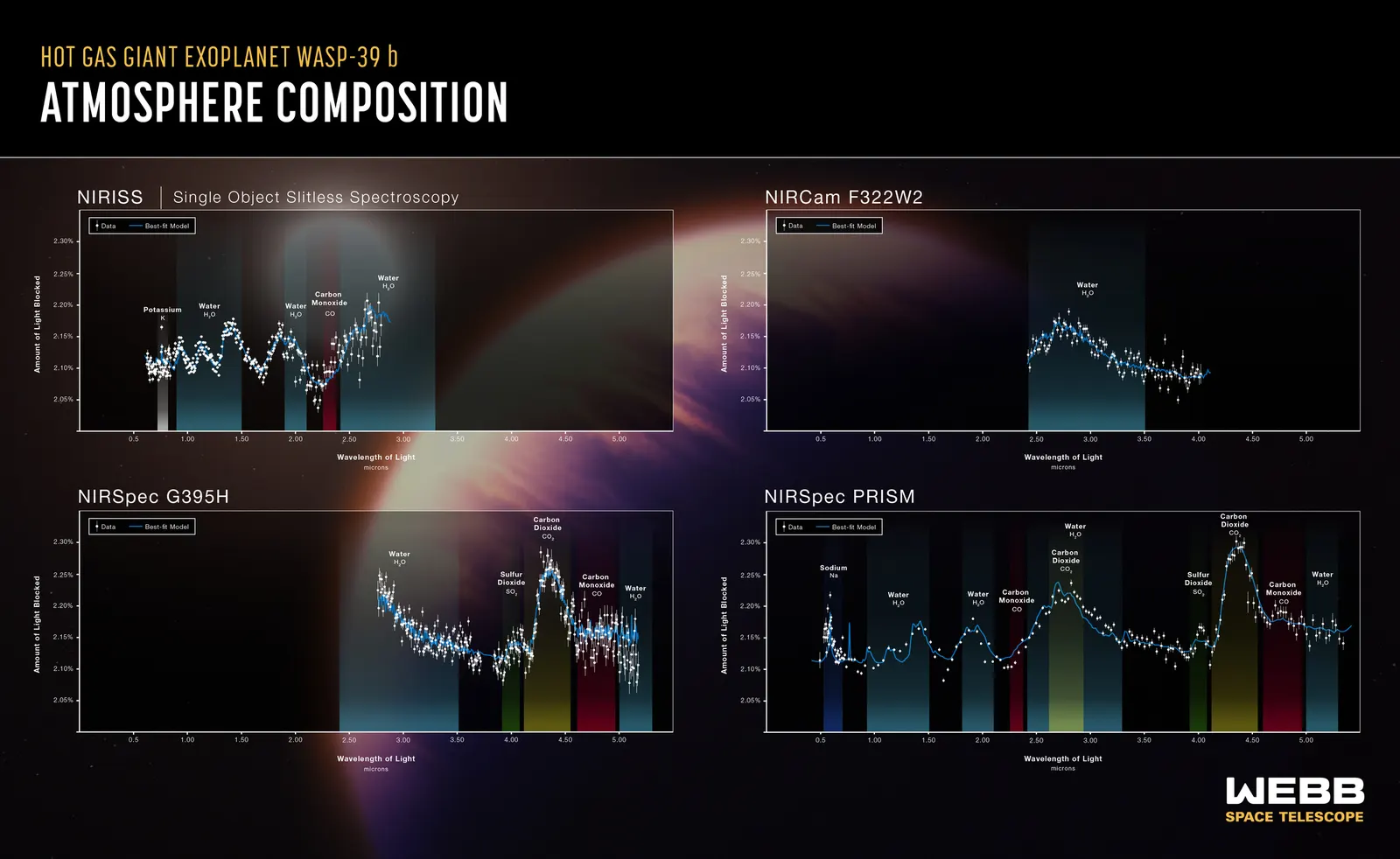
The first surprise came from WASP-39 b, a planet with the mass of Saturn and an equilibrium temperature of about 1,100 K. JWST's early observations showed carbon dioxide clearly for the first time in an exoplanet 17, and a feature at 4.05 micrometres that turned out to be sulfur dioxide. It could only have been made by photochemistry: starlight breaks up hydrogen sulfide, and the freed sulfur is oxidised step by step 18. The ladder's models assumed chemical equilibrium, a planet whose air is set by its temperature alone. Here the star was making new molecules.
Other results fill in the rungs. WASP-80 b, at about 825 K, near the boundary between Classes III and IV, shows methane throughout its atmosphere 19, the carbon carrier that the cooler rungs' chemistry expects. HD 189733 b holds hydrogen sulfide 20. And the rock that Class V needs has been caught directly. On WASP-17 b, at about 1,700 K, an absorption at 8.6 micrometres identifies clouds of quartz, silicon dioxide, made of particles about a hundredth of a micrometre across and reaching high into the atmosphere 21. On WASP-107 b, a warm, puffy planet nearly twice Neptune's mass, JWST found silicate clouds and sulfur dioxide and, unexpectedly, no methane 22.
The biggest lesson is that a hot giant is not one column of air. WASP-43 b turns the same face to its star for ever. JWST's mid-infrared instrument watched it all the way round its orbit and found a dayside averaging about 1,520 K with no clouds above the layer it could see, and a nightside near 860 K under thick cloud 23. By Sudarsky's rungs its two hemispheres belong to different classes. On the ultra-hot WASP-121 b, the dayside air holds silicon monoxide gas, rock that is too hot to form clouds at all, while methane appears on the night side, carried there by strong mixing 24.
The ladder got the order of the clouds right. What a one-dimensional model could not know is that a hot giant has two climates, one facing its star and one facing away.
The cold end has been reached too. JWST has imaged epsilon Indi A b, a giant several times Jupiter's mass circling a star 12 light years away, with a temperature of about 275 K 25. That is Class II territory, although the heat comes from inside the planet rather than from its star. JWST saw its thermal glow at 10 to 15 micrometres and nothing at 3.5 to 5, which points to an absorber the models do not include. Whether it hides brilliant water clouds is not yet known.
So the scorecard reads like this. The order of the condensates holds: ammonia, then water, then salts, then rock and iron, as temperature rises, and each has now been seen or inferred where the ladder puts it. The brightness predictions hold at the cool end and mostly fail at the hot end, where giants are darker than the models expected and where bright clouds, when they appear, depend on the side of the planet and the chemistry of the air. And the models left out two things that turn out to matter: starlight that makes new molecules, and winds that carry heat and chemicals between day and night.
Growing a giant
A giant planet's look is its weather. The belts and zones are the visible trace of jets; the scalloped edges between them are rows of vortices; storms are vortices big enough to see; and colour is the chemistry of whatever cloud each patch of air has risen or sunk to. Pax Abyssi draws its giants from that description.
The generator starts from a written target for each kind of giant, drawn from the game's science documents: 75 variants across cold, temperate and hot gas giants and ice giants, each with its band colours, the number of belts and zones, its storms, the chemistry of its cloud decks and the sources behind them. These are turned into 88 looks, and any of the 1,965 giants in the game's generated star systems can wear one, each with its own random seed so that no two planets of a kind are identical.
The look is made by a flow. The generator builds a wind field for the planet: a narrow jet at every band edge, eastward on the poleward side of each bright zone and westward on its equatorward side, so that zones turn one way and belts the other, as spacecraft have measured on Jupiter and Saturn 26. It flanks each jet with a staggered row of vortices, the pattern Voyager filmed along Jupiter's jets, adds eddies at many sizes, the storms from the written target, festoons trailing off the edges of belts and, on Saturn-like worlds, a six-sided wave around the pole. Then, for every point on the planet, it follows the wind backwards through forty steps of simulated time and reads the cloud layer where that parcel of air began. Band edges scallop because vortices rolled them up, and plumes grow sheared tails because the jets drew them out. Two further layers keep the result from looking like marbled paper: a separate staining field for the chromophores, and a younger, softer upper cloud.
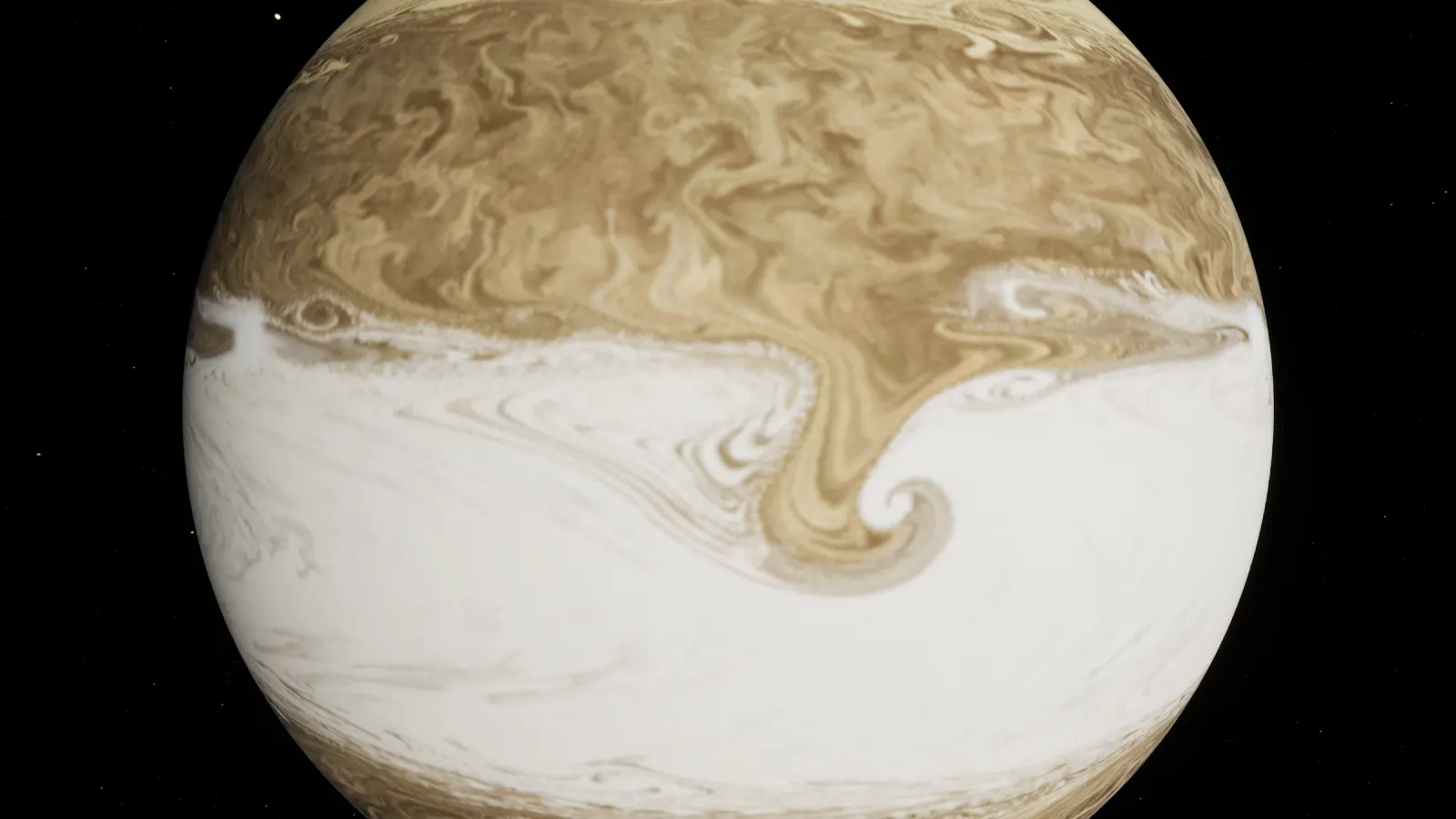
Two limits apply. The wind is a prescribed field built from the measured behaviour of real giants; the game does not solve the equations of fluid motion, as a weather forecast would. And the weather is frozen at one moment: storms do not yet drift or evolve while you watch, a step that is planned but not built.
The lighting follows measurement too. A giant's disc darkens toward its edge, and the game uses Minnaert's law for it 27, with a thin haze above the clouds that scatters light and tints the limb. The edge was judged against photographs, by measurement: at 98 per cent of the radius, the game's Jupiter-like giant falls to 0.66 of the brightness at its centre, against 0.58 in a Hubble image taken at a similar angle to the Sun. When the first versions drew a glowing halo outside the disc, the photographs showed none from a distance, and the halo was removed.
Because the weather is a calculation that can be run again at any resolution, it is recomputed at finer detail as the ship approaches. On a planet the size of Jupiter the game's global map has a pixel about 110 kilometres across; close in, it computes finer patches beneath the ship, down to about 210 metres a pixel.

The lineup above follows the ladder. The game's clear-blue giant, its reading of Class III, is drawn featureless and dark blue, because in the model there is no cloud to trace the wind: the jets and storms are still there, but invisible. Its hot giants grow darker as they grow hotter, as TrES-2 b and its kind have turned out to be, and none is drawn as a bright Class V world.
The generator is built and dresses giants in the game today, and five stops at three of them can be flown to, among them a generated Jupiter-class giant orbiting 14 Ceti, a real star about 190 light years away. It is still in development, with the project lead's final verdict on the look still to come, and about half of the generated giants still wear the older texture maps it sits beside, kept so that the two can be compared from the same seat.
The rung nobody has seen
Of Sudarsky's five classes, the brightest by prediction is the one with no confirmed member. A Class II giant would wear a deck of water-ice cloud reflecting four-fifths of its starlight, a planet-sized snowfield. Epsilon Indi A b has the right temperature, but its warmth comes from within, and JWST saw it only by its heat. In Pax Abyssi the water-cloud giant already exists, drawn as the model predicts: a brilliant, almost featureless white globe. Whether any real one looks like that waits on a telescope that can photograph a cold giant by the starlight it reflects.
References
- 1Mayor, M. and Queloz, D. (1995). A Jupiter-mass companion to a solar-type star. Nature 378, 355-359. doi:10.1038/378355a0
- 2Sudarsky, D., Burrows, A. and Pinto, P. (2000). Albedo and Reflection Spectra of Extrasolar Giant Planets. The Astrophysical Journal 538, 885-903. doi:10.1086/309160
- 3Guillot, T. (2010). On the radiative equilibrium of irradiated planetary atmospheres. Astronomy & Astrophysics 520, A27. doi:10.1051/0004-6361/200913396
- 4Atreya, S. K. et al. (1999). A comparison of the atmospheres of Jupiter and Saturn: deep atmospheric composition, cloud structure, vertical mixing, and origin. Planetary and Space Science 47, 1243-1262. doi:10.1016/S0032-0633(99)00047-1
- 5Lewis, J. S. (1969). The clouds of Jupiter and the NH3-H2O and NH3-H2S systems. Icarus 10, 365-378. doi:10.1016/0019-1035(69)90091-8
- 6Visscher, C., Lodders, K. and Fegley, B. (2010). Atmospheric Chemistry in Giant Planets, Brown Dwarfs, and Low-mass Dwarf Stars. III. Iron, Magnesium, and Silicon. The Astrophysical Journal 716, 1060-1075. doi:10.1088/0004-637X/716/2/1060
- 7Morley, C. V. et al. (2012). Neglected Clouds in T and Y Dwarf Atmospheres. The Astrophysical Journal 756, 172. doi:10.1088/0004-637X/756/2/172
- 8Carlson, R. W. et al. (2016). Chromophores from photolyzed ammonia reacting with acetylene: Application to Jupiter's Great Red Spot. Icarus 274, 106-115. doi:10.1016/j.icarus.2016.03.008
- 9Sudarsky, D., Burrows, A. and Hubeny, I. (2003). Theoretical Spectra and Atmospheres of Extrasolar Giant Planets. The Astrophysical Journal 588, 1121-1148. doi:10.1086/374331
- 10Marley, M. S. et al. (1999). Reflected Spectra and Albedos of Extrasolar Giant Planets. I. Clear and Cloudy Atmospheres. The Astrophysical Journal 513, 879-893. doi:10.1086/306881
- 11Li, L. et al. (2018). Less absorbed solar energy and more internal heat for Jupiter. Nature Communications 9, 3709. doi:10.1038/s41467-018-06107-2
- 12Kipping, D. M. and Spiegel, D. S. (2011). Detection of visible light from the darkest world. Monthly Notices of the Royal Astronomical Society: Letters 417, L88-L92. doi:10.1111/j.1745-3933.2011.01127.x
- 13Heng, K. and Demory, B. O. (2013). Understanding Trends Associated with Clouds in Irradiated Exoplanets. The Astrophysical Journal 777, 100. doi:10.1088/0004-637X/777/2/100
- 14Evans, T. M. et al. (2013). The Deep Blue Color of HD 189733b: Albedo Measurements with Hubble Space Telescope/Space Telescope Imaging Spectrograph at Visible Wavelengths. The Astrophysical Journal Letters 772, L16. doi:10.1088/2041-8205/772/2/L16
- 15Demory, B. O. et al. (2013). Inference of Inhomogeneous Clouds in an Exoplanet Atmosphere. The Astrophysical Journal Letters 776, L25. doi:10.1088/2041-8205/776/2/L25
- 16Hoyer, S. et al. (2023). The extremely high albedo of LTT 9779 b revealed by CHEOPS. Astronomy & Astrophysics 675, A81. doi:10.1051/0004-6361/202346117
- 17JWST Transiting Exoplanet Community Early Release Science Team, Ahrer, E. M. and et al. (2023). Identification of carbon dioxide in an exoplanet atmosphere. Nature 614, 649-652. doi:10.1038/s41586-022-05269-w
- 18Tsai, S. M. et al. (2023). Photochemically produced SO2 in the atmosphere of WASP-39b. Nature 617, 483-487. doi:10.1038/s41586-023-05902-2
- 19Bell, T. J. et al. (2023). Methane throughout the atmosphere of the warm exoplanet WASP-80b. Nature 623, 709-712. doi:10.1038/s41586-023-06687-0
- 20Fu, G. et al. (2024). Hydrogen sulfide and metal-enriched atmosphere for a Jupiter-mass exoplanet. Nature 632, 752-756. doi:10.1038/s41586-024-07760-y
- 21Grant, D. et al. (2023). JWST-TST DREAMS: Quartz Clouds in the Atmosphere of WASP-17b. The Astrophysical Journal Letters 956, L32. doi:10.3847/2041-8213/acfc3b
- 22Dyrek, A. et al. (2024). SO2, silicate clouds, but no CH4 detected in a warm Neptune. Nature 625, 51-54. doi:10.1038/s41586-023-06849-0
- 23Bell, T. J. et al. (2024). Nightside clouds and disequilibrium chemistry on the hot Jupiter WASP-43b. Nature Astronomy 8, 879-898. doi:10.1038/s41550-024-02230-x
- 24Evans-Soma, T. M. et al. (2025). SiO and a super-stellar C/O ratio in the atmosphere of the giant exoplanet WASP-121 b. Nature Astronomy 9, 845-861. doi:10.1038/s41550-025-02513-x
- 25Matthews, E. C. et al. (2024). A temperate super-Jupiter imaged with JWST in the mid-infrared. Nature 633, 789-792. doi:10.1038/s41586-024-07837-8
- 26Ingersoll, A. P. et al. (2004). Dynamics of Jupiter's atmosphere. Jupiter: The Planet, Satellites and Magnetosphere 105-128.
- 27Minnaert, M. (1941). The reciprocity principle in lunar photometry. The Astrophysical Journal 93, 403. doi:10.1086/144279
Related in the wiki
Credits
- Pax Abyssi Science Desk
- Author
Spotted an error? Tell us in the forum thread or on the talk page of a related wiki article; corrections are noted at the top of the piece.