A stars: Vega, Sirius and the white stars
The A stars are where hydrogen's spectral lines are strongest and where the sky's whitest bright stars live: Sirius, Vega, Altair, Fomalhaut. Pax Abyssi draws them from their measured data, and its generator gives them the wide, dusty systems real A stars are known for.
By The Pax Abyssi team

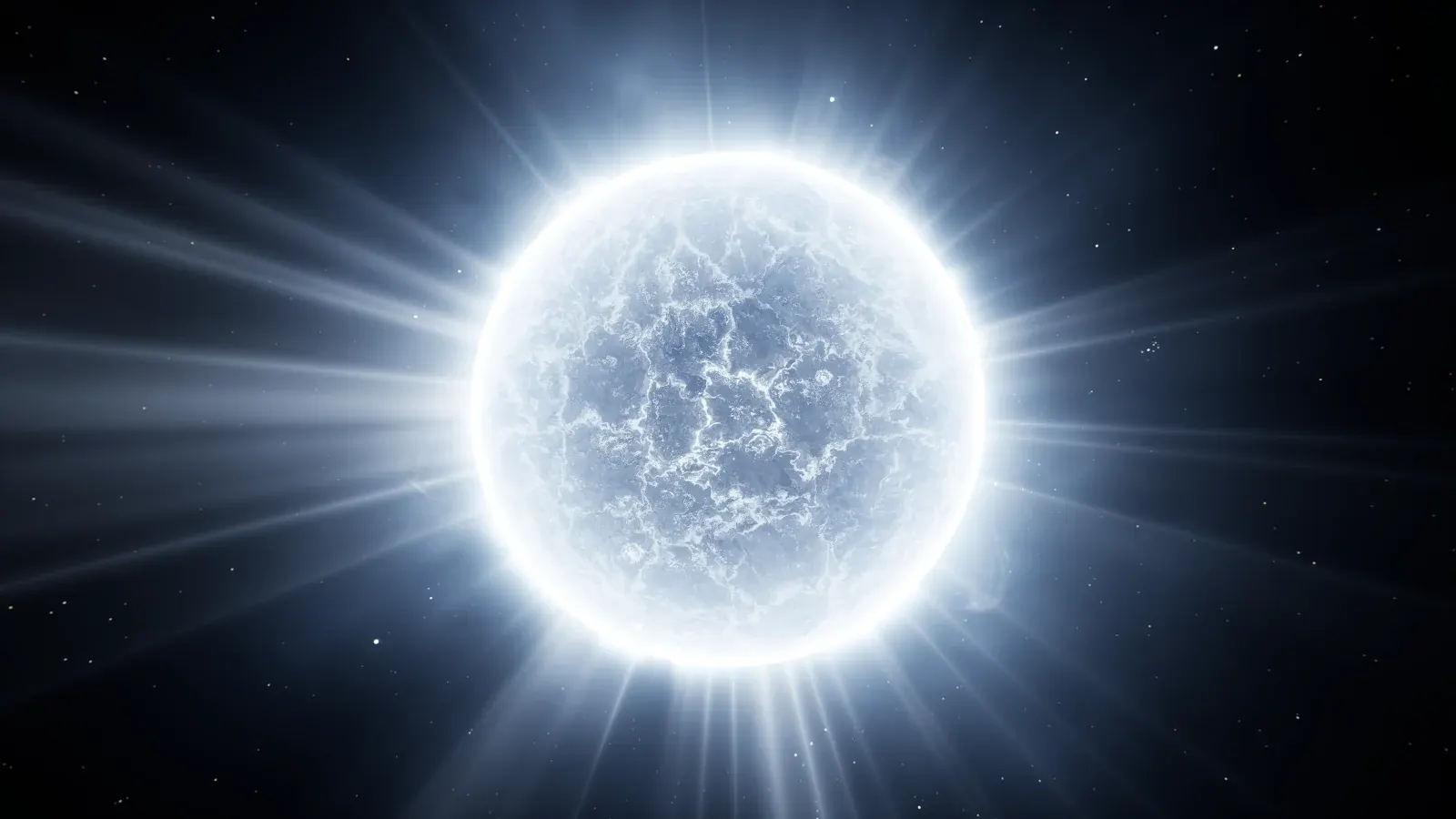
A 9,500 K star drawn by the game's own sun at three stellar radii on our look-development stage.
Pax Abyssi
Sirius, the brightest star in the night sky, is an A star, and so are Vega, Altair and Fomalhaut. In Pax Abyssi each of them is a real catalogue star with its own sheet, and the game builds both the star you arrive at and the system around it from that sheet. The temperature gives the colour of the surface, the glow and the light on every planet; the class gives the surface look, which for an A star is a white sphere with the faintest cool tint, a smooth radiative envelope and a clean edge. Around it the generator lays out a system in which cold giants, bare rock and wide belts of debris are common.
 , open full size
What makes a star an A star
The A class is defined by hydrogen. At surface temperatures near 10,000 K, a large share of the hydrogen atoms in the atmosphere sit in their first excited state, which is exactly the state that absorbs the visible Balmer lines, so those lines are stronger in A stars than anywhere else on the sequence. Hotter, and the hydrogen is ionised; cooler, and too few atoms are excited. On the main sequence the class runs from about 10,000 K at A0 to about 7,300 K at the boundary with F 1 2.
An A0 dwarf in Mamajek's table has about 2.2 times the Sun's mass, 2.2 times its radius and 38 times its luminosity; by the F boundary that has fallen to about 1.6 solar masses and 7 times the Sun's light 1. That mass range straddles an important change inside the star. Heavier A stars fuse hydrogen by the CNO cycle in a convective core, like the B stars; the envelope above is almost entirely radiative, with only thin convective layers near the surface in the cooler A stars. The quiet envelope lets elements sink or rise through the gas under gravity and the push of light, and some slowly rotating A stars end up with strange surface chemistry: the metallic-line Am stars and the magnetic Ap stars. Pax Abyssi's star sheets carry those flags, 92 Am and 43 Ap stars among them.
Lifetimes
Stellar models give a 2.5 solar-mass star roughly 600 million years on the main sequence and a 2 solar-mass star just over a billion 3. A late A star of 1.7 solar masses lasts closer to two billion. That is long enough for planets to form and settle, and much too short for the billions of years life took on Earth. After the main sequence an A star swells into a giant, sheds its outer layers and ends as a white dwarf. Sirius already has one for company.
Colour
Folded through the eye's response, an A0 star's light is white, with a faint trace of blue that is hard to see without a warmer star beside it for comparison 4. A stars look white in the sky because they are white; the whitest stars of all are the late F stars.
How common they are
The census of every star within 10 parsecs of the Sun, about 33 light years, finds four A stars among about 540 stars and brown dwarfs 5. Fewer than one main-sequence star in a hundred is an A star, but their brightness makes them prominent: the catalogue behind Pax Abyssi, built from the stars we can measure, holds 18,226.
The A stars you can fly to
Every sky star has a generated system: pick it on the galaxy map, lock it and jump.
- Sirius (alpha Canis Majoris), 8.6 light years away, the brightest star in the night sky. Sirius A has 2.06 times the Sun's mass; its companion, Sirius B, is a white dwarf with just over the Sun's mass packed into a body the size of Earth 6.
- Vega (alpha Lyrae), 25 light years away, long the zero point of the astronomer's magnitude scale. In 1983 the IRAS satellite found it wrapped in cold dust, the first debris disc known around another star 7. Vega also spins fast; we happen to see it almost pole-on 8.
- Fomalhaut (alpha Piscis Austrini), 25 light years away, circled by a sharp-edged dust ring about 130 times as far from the star as Earth is from the Sun 9.
- Altair (alpha Aquilae), 16.7 light years away, an A7 dwarf that turns in about nine hours. Interferometers have imaged its surface: the star is visibly flattened and its equator darker and cooler than its poles 10.
- Denebola, Merak and Mizar, the white stars of the Lion's tail and the Plough, all within about 90 light years.
Planets round an A star
Pax Abyssi builds every system through one simulation, in stages: the star, then an architecture for the system, then the orbits and the worlds that fill them. The chance of planets starts at 0.80 for an A star, against 0.90 for the Sun's class, and is then scaled by the star's metal content, companions, age and population. The architecture weights for A stars favour wide and very wide layouts and debris-dominated systems: a luminous star moves its snow line and its habitable zone outwards, and the systems we see around real A stars are rich in dust and wide-orbit giants.
Across the 621 A-type dwarfs among the catalogue's charted systems, 262 have planets, 915 in all. Barren rock is the commonest world, followed by cold ice giants, cold gas giants, cold mini-Neptunes, arid worlds and tidally locked lava worlds scorched on the side that faces the star. Fifty-two systems are debris-dominated, the architecture modelled on Vega and Fomalhaut: sparse planets inside broad belts of rubble.
Two of the famous systems are worth a look. Sirius's holds a world glowing in its own heat under a thick greenhouse atmosphere, a cold gas giant under a thin haze and a carbon planet. Altair's is fuller: a hot mini-Neptune, a volcanic arid world, a cold ocean world strung with island arcs, a storm-active cold gas giant and a pale helium planet. Vega's own generated system has no planets; its real system is known best for its dust.
 , open full size
The pictures
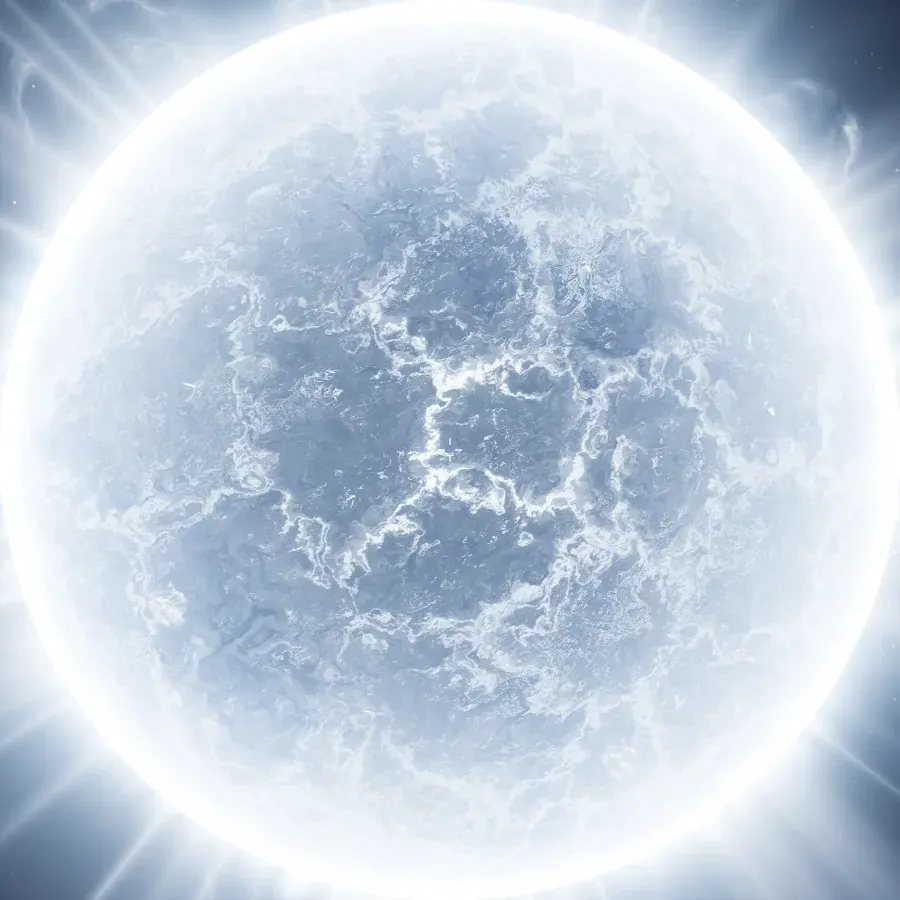
The render at the top is our look-development stage: the game's own sun set to 9,500 K and viewed from three stellar radii, the framing we use for every class in this series. The second picture is from the near-sun work, the ship parked so a 9,000 K star fills the screen. The glow is white with a cool edge, and the limb is bright and clean.
Both are in the game palette, one of three in Esc > Options > SPACE under the row "sun palette". Game gives hot stars the blue that people expect from films and paintings. The default, scientific, draws the surface at the true colour of the star's light, which for an A star is very nearly white. Vivid turns the game colours up further.
Beyond the catalogue
The catalogue's 18,226 A stars are the ones astronomers have measured. Around them the simulated Milky Way places the rest at their true rate, hundreds of millions of A stars, each with a system generated the moment you pick it on the galaxy map. Next in this series: the F stars, the whitest stars of all.
References
- 1Mamajek, E. E.. A Modern Mean Dwarf Stellar Color and Effective Temperature Sequence (version 2022.04.16). www.pas.rochester.edu/~emamajek/EEM_dwarf_UBVIJHK_colors_Teff.txt
- 2Pecaut, M. J. and Mamajek, E. E. (2013). Intrinsic Colors, Temperatures, and Bolometric Corrections of Pre-main-sequence Stars. The Astrophysical Journal Supplement Series 208, 9. doi:10.1088/0067-0049/208/1/9
- 3Ekström, S. et al. (2012). Grids of stellar models with rotation. I. Models from 0.8 to 120 M_sun at solar metallicity (Z = 0.014). Astronomy & Astrophysics 537, A146. doi:10.1051/0004-6361/201117751
- 4Harre, J. V. and Heller, R. (2021). Digital color codes of stars. Astronomische Nachrichten 342, 578-587. doi:10.1002/asna.202113868
- 5Reylé, C. et al. (2021). The 10 parsec sample in the Gaia era. Astronomy & Astrophysics 650, A201. doi:10.1051/0004-6361/202140985
- 6Bond, H. E. et al. (2017). The Sirius System and Its Astrophysical Puzzles: Hubble Space Telescope and Ground-based Astrometry. The Astrophysical Journal 840, 70. doi:10.3847/1538-4357/aa6af8
- 7Aumann, H. H. et al. (1984). Discovery of a shell around Alpha Lyrae. The Astrophysical Journal 278, L23-L27. doi:10.1086/184214
- 8Peterson, D. M. et al. (2006). Vega is a rapidly rotating star. Nature 440, 896-899. doi:10.1038/nature04661
- 9Kalas, P., Graham, J. R. and Clampin, M. (2005). A planetary system as the origin of structure in Fomalhaut's dust belt. Nature 435, 1067-1070. doi:10.1038/nature03601
- 10Monnier, J. D. et al. (2007). Imaging the Surface of Altair. Science 317, 342-345. doi:10.1126/science.1143205
Related in the wiki
Credits
- The Pax Abyssi team
- Author
Spotted an error? Tell us in the forum thread or on the talk page of a related wiki article; corrections are noted at the top of the piece.