B stars: the blue-white lamps of the constellations
Spica, Achernar, Regulus and most of Orion are B stars: hot, heavy, short-lived, and bright enough to be seen from hundreds of light years. Pax Abyssi draws each one from its measured data and builds the systems around them from the physics.
By The Pax Abyssi team

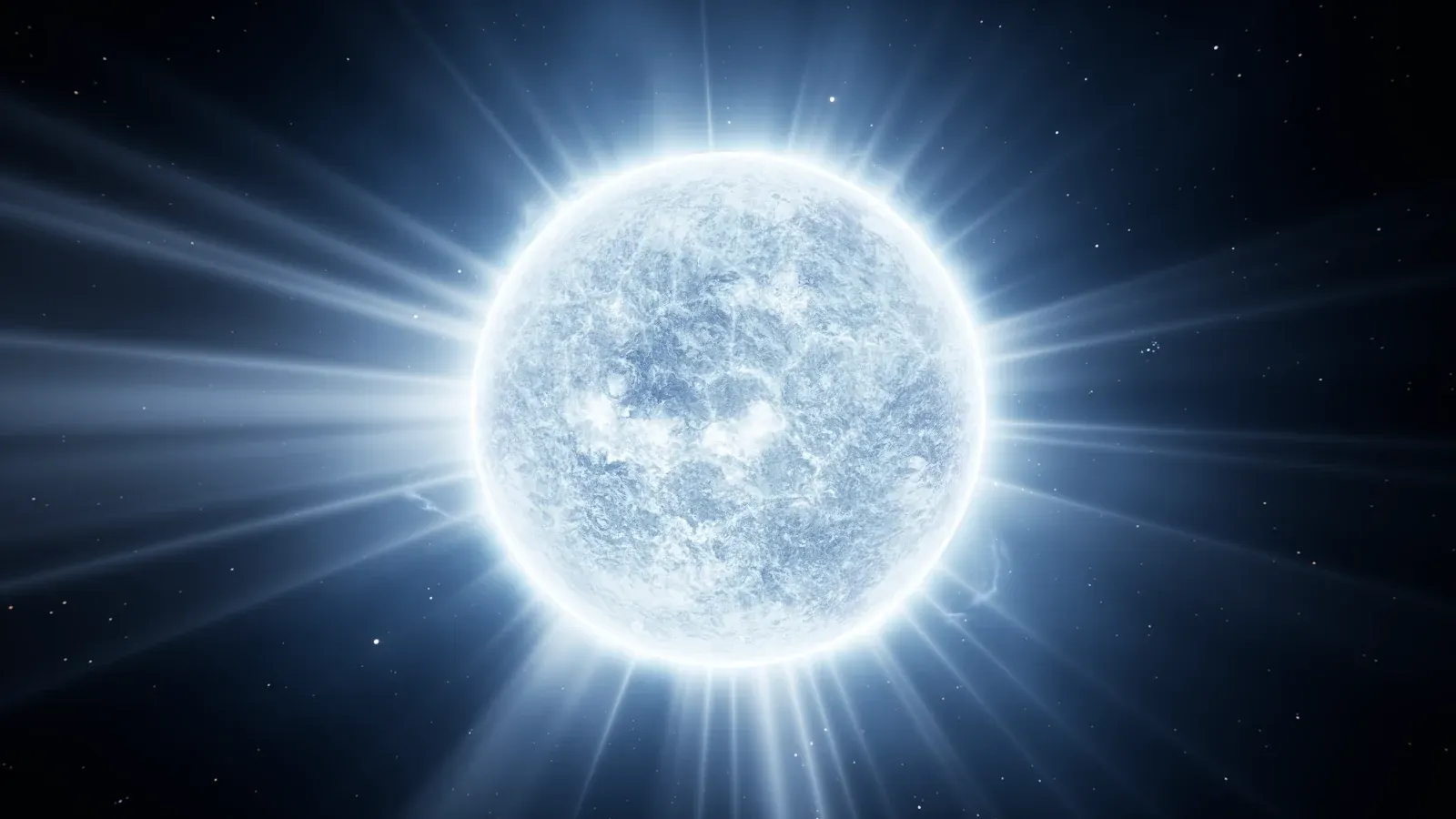
A 15,000 K star drawn by the game's own sun at three stellar radii on our look-development stage.
Pax Abyssi
Look up at Orion, Scorpius or the Southern Cross and most of the bright stars you see are B stars. In Pax Abyssi each of them is a real catalogue star with its own sheet of measured and derived properties, and the game draws the star you arrive at from that sheet. Temperature sets the colour of the surface, the glow and the light that falls on its planets; the star's class decides the surface look. For a B star that means a hot, blue-white sphere with a smooth, radiative envelope, a bright rim and a tight, cool-toned glow, and a planetary system shaped by the star's heat.
 , open full size
What makes a star a B star
B stars sit between the O stars and the A stars. Their spectra show lines of neutral helium, and the hydrogen lines grow stronger through the class towards their peak in the A stars. On the main sequence the class runs from about 31,500 K at B0 down to about 10,000 K at B9.5 1 2. In Mamajek's table a B0 dwarf has about 18 times the Sun's mass, 7 times its radius and some 45,000 times its luminosity; by late B the star is down to about two and a half solar masses and a few dozen times the Sun's light 1.
Like the O stars, B dwarfs fuse hydrogen by the CNO cycle in a convective core, and carry their energy through the outer envelope by radiation. That radiative envelope is quiet in the way the Sun's surface is not: there is no layer of boiling convection just under the visible surface, so B stars show no granulation and have weak or absent magnetic activity of the solar kind.
Lifetimes
Evolutionary models give a 15 solar-mass star about eleven or twelve million years on the main sequence, a 9 solar-mass star about twenty-five million, and a 3 solar-mass star a few hundred million 3. That spread matters. The most massive B stars end in supernovae, as O stars do; below about eight solar masses they shed their envelopes instead and end as white dwarfs.
Colour
A 15,000 K surface emits most of its energy in the ultraviolet. What reaches the eye is the blue end of the visible spectrum, slightly stronger than the red, and the colour a person would see from space is a pale blue-white 4. In the sky that tint survives only in the brightest B stars, such as Spica and Rigel, and even there it is faint.
How common they are
About one main-sequence star in a thousand is a B star 5. The census of every star within 10 parsecs, about 33 light years, finds none 6. B stars fill the naked-eye sky because they are so luminous: a mid-B dwarf outshines the Sun by a thousand times and can be seen from hundreds of light years. That is also why the game's catalogue, built from the stars we can measure, holds 11,102 of them.
Spinning tops and Be stars
Many B stars rotate fast, some close to the speed at which the equator would fling material off. Some of those, the Be stars, grow a thin disc of gas around the equator that glows in hydrogen emission lines and comes and goes over years 7. Achernar is the best-known example.
The B stars you can fly to
Every sky star has a generated system in Pax Abyssi: pick it on the galaxy map, lock it and jump. Some B stars worth the trip:
- Spica (alpha Virginis), about 250 light years away. It is a close pair of B stars circling each other every four days, the primary about 11 and the secondary about 7 solar masses, the primary near 25,000 K and pulsating 8.
- Achernar (alpha Eridani), a B6 Be star about 140 light years away and one of the flattest stars known: interferometry found its equatorial radius about one and a half times its polar radius 9.
- Regulus (alpha Leonis), a B8 subgiant about 79 light years away that turns once in under sixteen hours, fast enough that its equator is markedly cooler than its poles 10.
- Alkaid (eta Ursae Majoris), the B3 dwarf at the end of the Plough's handle, about 100 light years away.
- Acrab (beta Scorpii), a multiple system of B dwarfs in the head of the Scorpion, about 400 light years away.
Rigel, the brightest star in Orion, is also a B star, but a supergiant: it has left the main sequence, and it belongs with the giants.
Planets round a B star
Pax Abyssi generates each system in stages through one simulation: the star, then the system's architecture, then the orbits and the worlds that fill them. The chance that a system has planets at all starts from a base value per class, 0.55 for a B star against 0.90 for the Sun's class, and is then scaled by the star's metal content, its companions, its age and its population. The architecture weights for B stars favour wide and very wide systems and debris-rich ones, because a hot star's ultraviolet light clears its disc from the inside out and pushes any surviving worlds outwards.
Across the 513 B-type dwarfs among the catalogue's charted systems, 120 have planets, 442 of them in all. The commonest kinds are cold gas giants, cold ice giants, barren rock and ice worlds, followed by arid worlds and cold mini-Neptunes: a population weighted to the cold outer reaches, where the planets of a hot star can survive.
The habitable zone of a B star, the band where a world could hold liquid water, lies tens to hundreds of times further out than Earth's orbit, because the star is so bright. The game places it by the Kopparapu relations, scaled by each star's luminosity and temperature. Distance is not the only obstacle: a B star's whole life is shorter than the time it took life on Earth to begin.
 , open full size
The pictures
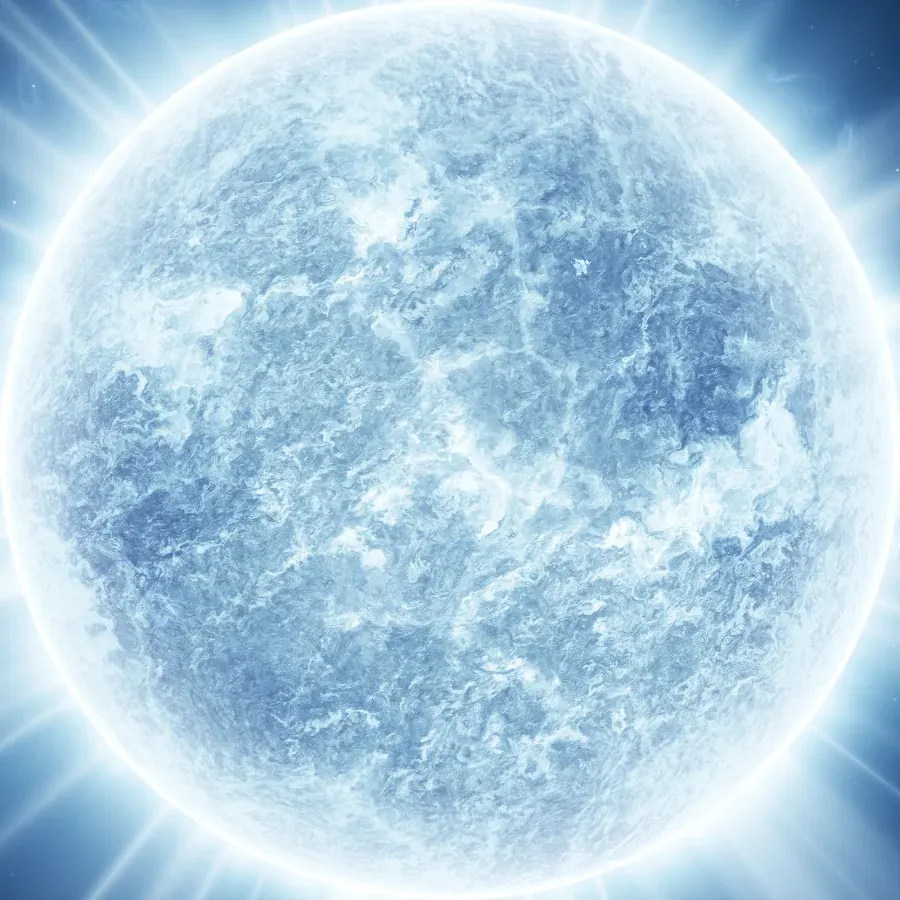
The render at the top is our look-development stage: the game's own sun set to 15,000 K and viewed from three stellar radii, the same framing we use for every class in this series. The second picture comes from the near-sun work, the ship parked so the star fills the screen, at 20,000 K. The glow is tighter and whiter than on the cooler stars, and the limb is bright and clean.
Both are shown in the game palette, one of three in Esc > Options > SPACE under the row "sun palette". Game paints hot stars a stronger blue, the way people tend to picture them. The default, scientific, draws the surface at the true colour of the star's light, which for a B star is a pale blue-white. Vivid pushes the game colours further still.
Beyond the catalogue
The catalogue's 11,102 B stars are the ones astronomers have measured. Around them the simulated Milky Way places the rest at their true rate, some eight million B dwarfs, crowded along the young spiral arms, each with a system generated the moment you pick it on the galaxy map. Next in this series: the A stars, Vega, Sirius and the white stars of the summer sky.
References
- 1Mamajek, E. E.. A Modern Mean Dwarf Stellar Color and Effective Temperature Sequence (version 2022.04.16). www.pas.rochester.edu/~emamajek/EEM_dwarf_UBVIJHK_colors_Teff.txt
- 2Pecaut, M. J. and Mamajek, E. E. (2013). Intrinsic Colors, Temperatures, and Bolometric Corrections of Pre-main-sequence Stars. The Astrophysical Journal Supplement Series 208, 9. doi:10.1088/0067-0049/208/1/9
- 3Ekström, S. et al. (2012). Grids of stellar models with rotation. I. Models from 0.8 to 120 M_sun at solar metallicity (Z = 0.014). Astronomy & Astrophysics 537, A146. doi:10.1051/0004-6361/201117751
- 4Harre, J. V. and Heller, R. (2021). Digital color codes of stars. Astronomische Nachrichten 342, 578-587. doi:10.1002/asna.202113868
- 5LeDrew, G. (2001). The Real Starry Sky. Journal of the Royal Astronomical Society of Canada 95, 32-33.
- 6Reylé, C. et al. (2021). The 10 parsec sample in the Gaia era. Astronomy & Astrophysics 650, A201. doi:10.1051/0004-6361/202140985
- 7Rivinius, T., Carciofi, A. C. and Martayan, C. (2013). Classical Be stars: Rapidly rotating B stars with viscous Keplerian decretion disks. The Astronomy and Astrophysics Review 21, 69. doi:10.1007/s00159-013-0069-0
- 8Tkachenko, A. et al. (2016). Stellar modelling of Spica, a high-mass spectroscopic binary with a beta Cep variable primary component. Monthly Notices of the Royal Astronomical Society 458, 1964-1976. doi:10.1093/mnras/stw255
- 9Domiciano de Souza, A. et al. (2003). The spinning-top Be star Achernar from VLTI-VINCI. Astronomy & Astrophysics 407, L47-L50. doi:10.1051/0004-6361:20030786
- 10McAlister, H. A. et al. (2005). First Results from the CHARA Array. I. An Interferometric and Spectroscopic Study of the Fast Rotator Alpha Leonis (Regulus). The Astrophysical Journal 628, 439-452. doi:10.1086/430730
Related in the wiki
Credits
- The Pax Abyssi team
- Author
Spotted an error? Tell us in the forum thread or on the talk page of a related wiki article; corrections are noted at the top of the piece.