F stars: the whitest suns
Slightly hotter and heavier than the Sun, F stars are the whitest stars in the sky and the hottest that still boil at the surface. In Pax Abyssi they are some of the busiest planetary hosts in the galaxy we fly, and Procyon is a jump away.
By The Pax Abyssi team

An F star at 6,800 K filling the view: a cream-white surface of granulation cells, a bright rim, and the corona's rays spreading into black space.
Pax Abyssi
Point the galaxy map at Procyon, the bright star beside Orion's shoulder, set it as your target and jump. You drop out of hyperspace beside a star half again as heavy as the Sun and about seven times as luminous, and its light is whiter than anything you have flown to in the Solar System. Procyon is an F star, and F stars are the subject of this fourth instalment of our series on the main sequence.
How Pax Abyssi draws an F star
Every star you can fly to in Pax Abyssi carries a sheet: its temperature, radius, mass, age, rotation, activity and more. For a catalogue star the sheet is derived from what astronomers have measured; for a star of the generated galaxy it comes from the same physics, starting from its class. The close-up sun is drawn from that sheet. Its size is the star's real radius, its colour comes from its temperature, and its surface is chosen by its class.
For an F star that means granulation. The hottest stars, the O, B and A classes, carry their heat outward by radiation almost to the surface and show a smooth face. F stars are the first on the way down the temperature scale with a convective outer layer, a skin of boiling gas in which hot cells rise, spread, cool and sink. We draw that as a fine, low-contrast mosaic of cells, finer and paler than the Sun's, with a gentle darkening towards the edge of the disc. That darkening is limb darkening: near the limb you look through the upper, cooler layers of the star, so it looks dimmer there. Our F stars use a limb coefficient of 0.50, a little less than the Sun's 0.60, because the effect weakens as a star gets hotter.
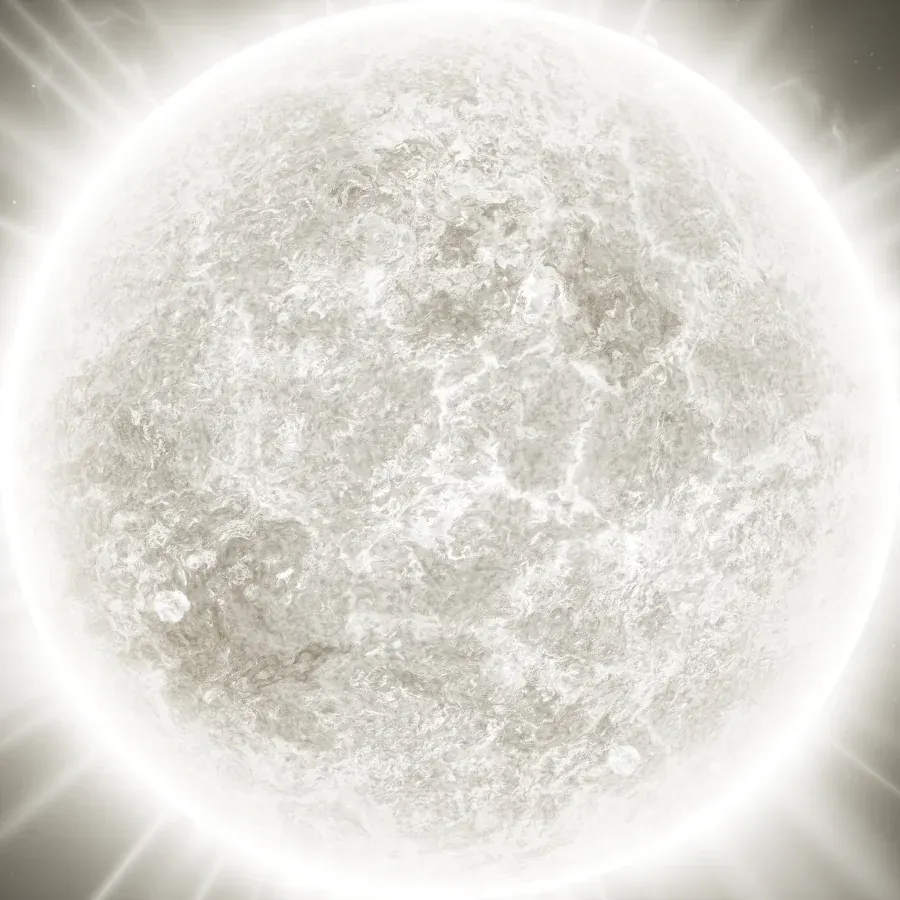 , open full size
The picture above is our renderer at 6,800 K, a mid F star, and it is the one close-up in this series that looks almost the same in every colour setting. The game offers three sun palettes, under Esc, Options, SPACE, in the SUN section. Scientific, the default, gives each star the true colour of its light. Game paints suns the way films and games do, a deep gold Sun and deep red cool stars. Vivid turns the game colours up again. An F star is so close to white that the three settings barely disagree about it.
What an F star is
F stars are the stars between about 7,200 and 6,000 kelvin. In Eric Mamajek's compilation of main-sequence stars, which builds on Pecaut and Mamajek (2013), an F0 dwarf has a surface temperature of about 7,220 K, 1.61 times the Sun's mass, 1.73 times its radius and about seven times its luminosity; by the end of the class the numbers have fallen to within about ten percent of the Sun's 1 2. Their spectra show hydrogen lines weaker than in A stars and the lines of ionised calcium and other metals growing stronger.
How long a star lives on the main sequence depends steeply on its mass, because a heavier star burns its hydrogen much faster than a lighter one. A useful rule of thumb puts the lifetime at about ten billion years times the star's mass in solar units to the power of minus 2.5. That gives an F0 star about 3 billion years and a late F star about 7 or 8 billion: long enough for planets to form, settle and age, though shorter than the Sun's span.
The whitest stars
The letter sequence tempts people to picture a rainbow of stars, but real star colours are pale. When Jan-Vincent Harre and René Heller folded model stellar spectra through the colour response of the human eye, the whitest stars turned out to be late F stars, not the hotter A stars: an A star already carries a faint blue tint, and a G star the faintest warmth 3. An F star seen from space is as close to pure white as a star gets.
The Kraft break
F stars sit on one of the sharpest lines in stellar physics. In 1967 Robert Kraft showed that stars hotter than about the middle of the F class spin fast, tens of kilometres per second at the equator, while cooler stars spin slowly 4. The reason is the convective envelope. In a cool star it is deep, and convection winds up a magnetic field; the field drives a wind that carries angular momentum away, and over hundreds of millions of years the star brakes. In a hotter F star the convective layer is too thin to build that brake, and the star keeps the spin it was born with. The dividing line, near 6,200 K, is now called the Kraft break.
How common they are
Not very. A census of every star within 10 parsecs of the Sun, about 33 light years, counts 8 F stars against 18 G stars, 38 K stars and 249 M dwarfs 5. About one star in forty near us is an F dwarf. They are over-represented in the naked-eye sky because they are luminous enough to be seen from far away.
F stars you can fly to
The catalogue's charted systems include 653 F stars, 385 of them main-sequence dwarfs, and the simulated Milky Way around them holds billions more. A few worth the jump:
- Procyon (Alpha Canis Minoris), 11.5 light years away, spectral type F5IV-V. Hubble astrometry gives it 1.48 solar masses, and it is not alone: a white dwarf, Procyon B, orbits it every 40.8 years 6. Procyon is slightly evolved, beginning to swell as its core runs short of hydrogen, which is what the IV in its spectral type records.
- Porrima (Gamma Virginis), a pair of nearly identical early F stars about 38 light years away, on a long, very eccentric orbit that takes almost 170 years.
- Tabit (Pi3 Orionis), an F6 dwarf 26 light years away and the brightest star of the arc that draws Orion's shield.
What their planets are like
Pax Abyssi generates the planetary system around every star it does not already know, from the star upward. The generator reads the star's sheet, places the habitable zone by the formula of Kopparapu and colleagues 7, sets the frost lines where ices condense, and then chooses an architecture: how many planets, how they are spaced and what kinds sit where. The chance that a system has planets at all starts at 0.87 for an F star and is then adjusted for the star's metallicity, its age and any companion star close enough to disturb the disc.
Across the catalogue's 385 F dwarfs, 213 have planets, 875 of them in all. The commonest are barren rock worlds, arid worlds and tidally locked lava worlds close to the star, then cold gas giants, clouded arid worlds and cold ice giants further out. Because an F star is more luminous than the Sun its habitable zone lies further out, and the whole layout stretches with it. The architectures favour giants gathered near the frost line and giant pairs; 27 of the systems come out with orbits spaced in a geometric progression like the Solar System's own, and 24 are debris-dominated, sparse in planets and rich in the rubble of collisions.
Next in the series
The next instalment moves one step cooler, to the G stars, and to the one we know best.
References
- 1Mamajek, E. E.. A Modern Mean Dwarf Stellar Color and Effective Temperature Sequence (version 2022.04.16). www.pas.rochester.edu/~emamajek/EEM_dwarf_UBVIJHK_colors_Teff.txt
- 2Pecaut, M. J. and Mamajek, E. E. (2013). Intrinsic Colors, Temperatures, and Bolometric Corrections of Pre-main-sequence Stars. The Astrophysical Journal Supplement Series 208, 9. doi:10.1088/0067-0049/208/1/9
- 3Harre, J. V. and Heller, R. (2021). Digital color codes of stars. Astronomische Nachrichten 342, 578-587. doi:10.1002/asna.202113868
- 4Kraft, R. P. (1967). Studies of Stellar Rotation. V. The Dependence of Rotation on Age among Solar-Type Stars. The Astrophysical Journal 150, 551. doi:10.1086/149359
- 5Reylé, C. et al. (2021). The 10 parsec sample in the Gaia era. Astronomy & Astrophysics 650, A201. doi:10.1051/0004-6361/202140985
- 6Bond, H. E. et al. (2015). Hubble Space Telescope Astrometry of the Procyon System. The Astrophysical Journal 813, 106. doi:10.1088/0004-637X/813/2/106
- 7Kopparapu, R. K. et al. (2013). Habitable Zones around Main-sequence Stars: New Estimates. The Astrophysical Journal 765, 131. doi:10.1088/0004-637X/765/2/131
Related in the wiki
Credits
- The Pax Abyssi team
- Author
Spotted an error? Tell us in the forum thread or on the talk page of a related wiki article; corrections are noted at the top of the piece.