Devlog 2: the whole Milky Way, the galaxies beyond it, and a ship that lands
The second devlog, covering 28 September to 6 October 2026. The Milky Way is filled to its full 111 billion stars, the galaxy map zooms out to the galaxies beyond it, the Calliope flies down to the ground and lands, and you can now dive into a gas giant until the pressure stops you.
By The Pax Abyssi team

Jupiter's Great Red Spot through the Calliope's canopy, 47,000 km above the cloud tops. Jupiter now wears its own procedural look in the game, built from the same weather engine as every other giant.
Pax Abyssi
Nine days, 470 commits, and 139 of them on Thursday 1 October alone. Devlog 1 promised more worlds to land on and a second flight for the gas giants. We got both, and then the scope grew to the size of the galaxy and past it. Here is what changed, area by area, and what comes next.
The whole Milky Way
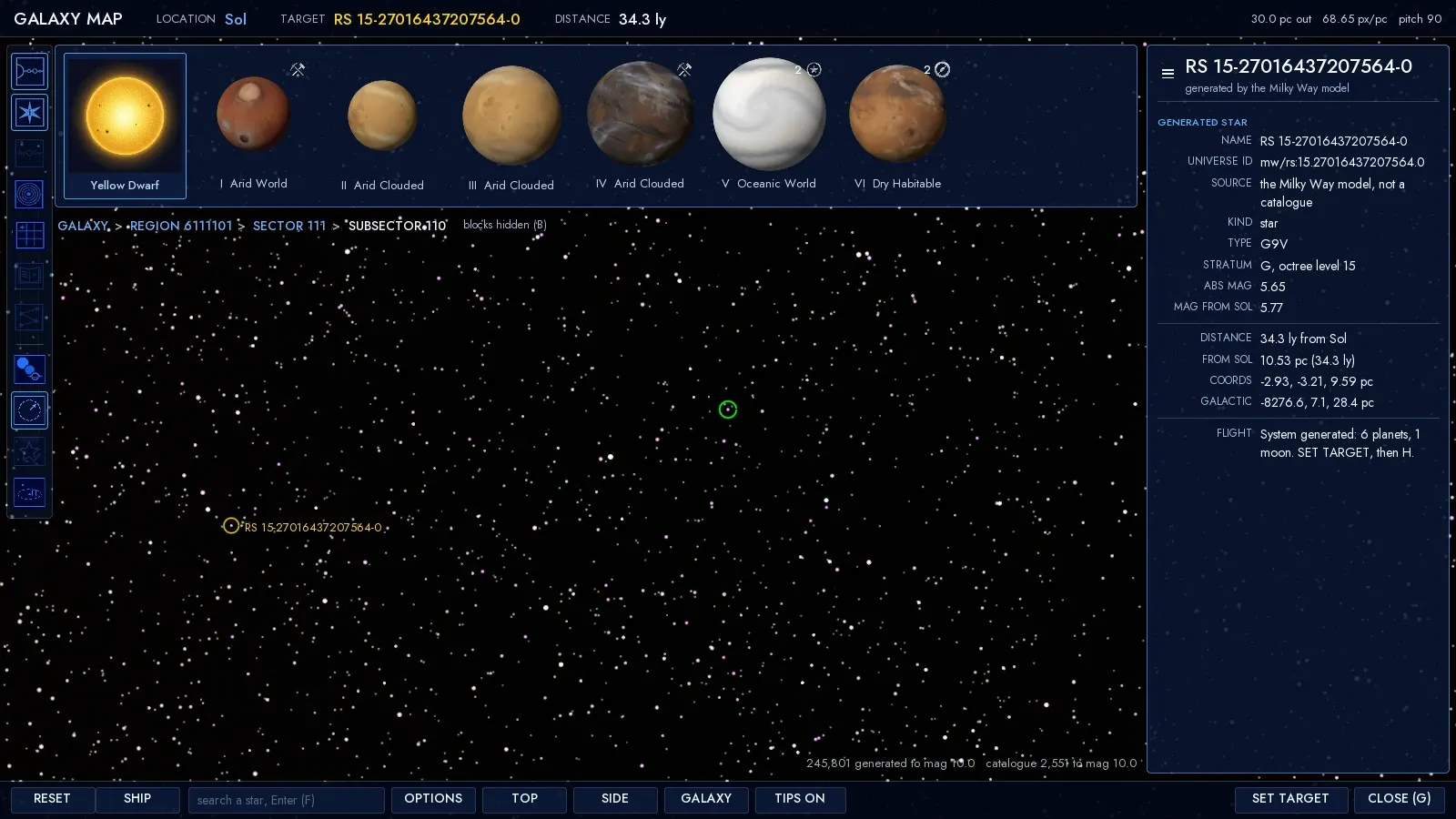
Until this week the galaxy map drew the stars of the real catalogue and a glow for everything else. Now the Milky Way is filled to its full complement from a published model of the Galaxy: about 111 billion stars, 22 billion brown dwarfs, 840 million neutron stars and 87 million black holes, laid out in one tree of space from the core to the halo. Where the catalogue has a star, the catalogue star stands. Where Earth's surveys missed one, the model places it, with the right odds that a real survey would have missed it. Free-floating rogue planets have their places in the same tree.
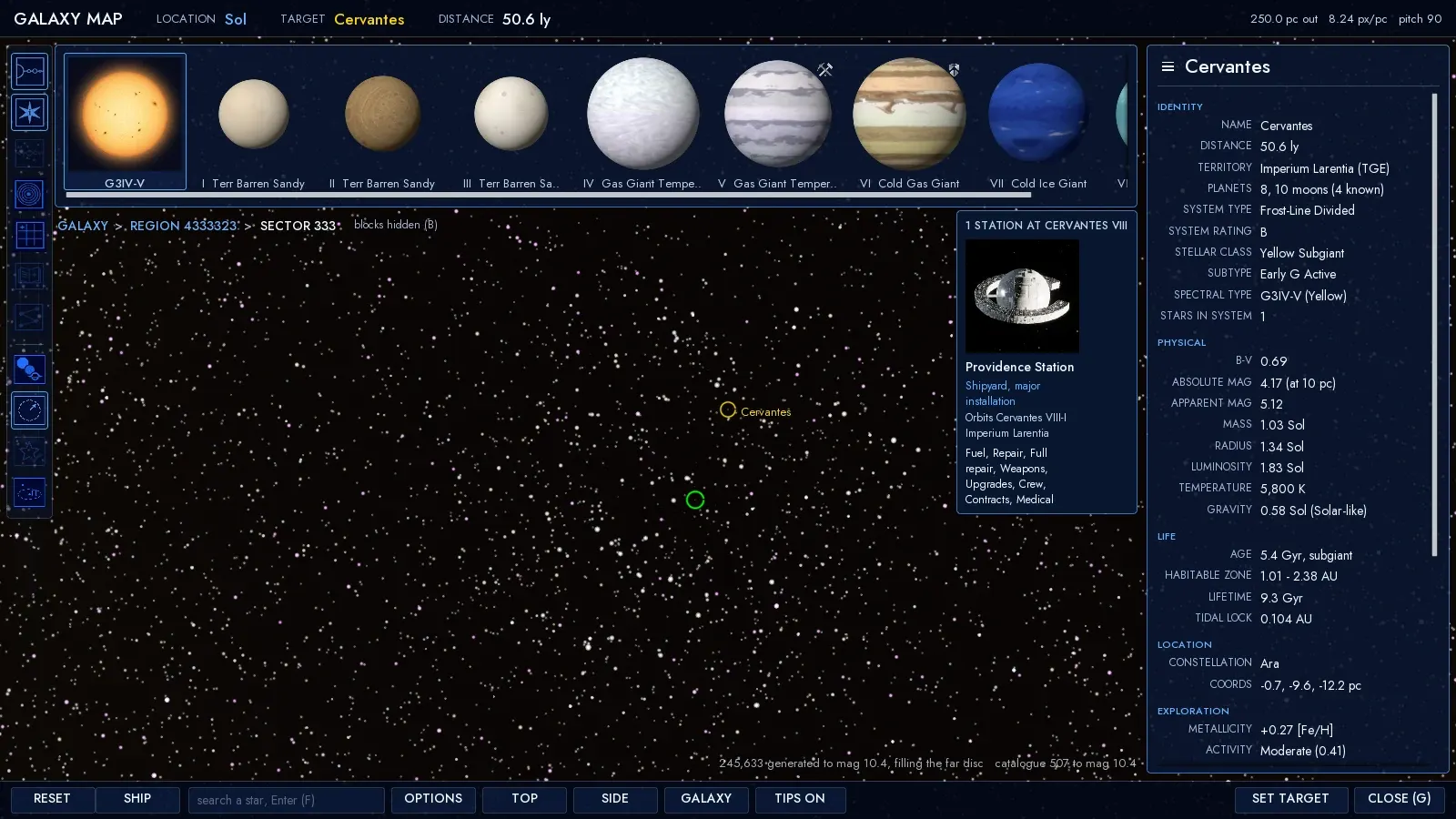
Every one of those generated stars can be hovered, clicked, carded and flown to. Click one and its system is generated on the spot: planets, moons and belts, the same every time for the same star. Last week that took many seconds a star. On Sunday it took between 0.02 and 0.12 seconds. By Monday the system generator had been ported into the game's own C++, stage by stage and checked against the simulation at every step, and every generated star is now built there: a G9V dwarf takes 0.05 seconds. The same code rebuilt every catalogue star and its system, 6,561 of them, in 50 seconds, matching the simulation byte for byte bar two digits rounded the other way.
 , open full size
 , open full size
The map itself got a lot of care. The STAR TYPES face filters every kind of star, generated ones included. LANDABLE WORLDS sits beside HABITABLE on the marker bar and rings the 653 systems with a world you can land on. Stations now show on the planet strip with a slide-out card each. Tooltips moved behind a TIPS button on the footer, so the map stays clear unless you ask.
The galaxies beyond
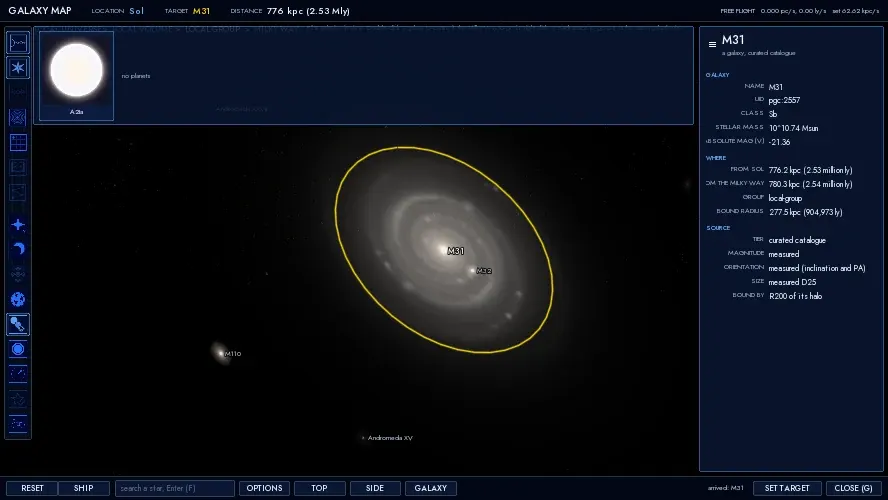
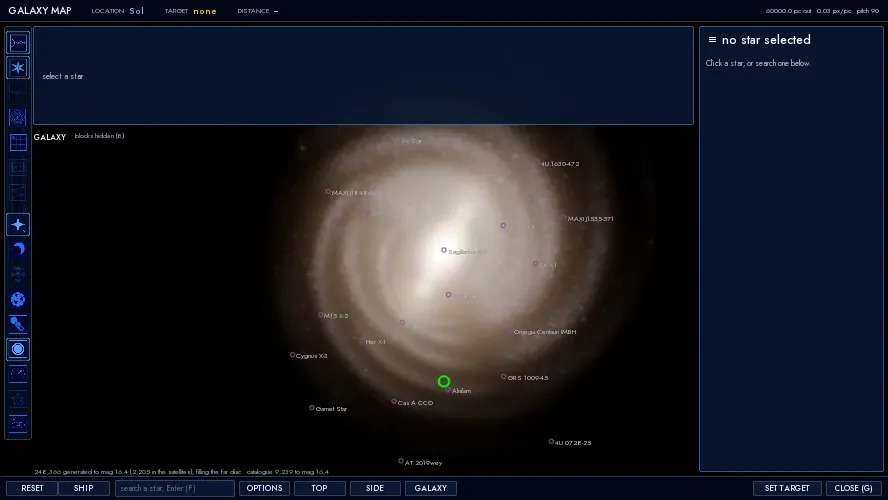
With the Milky Way full, we went outside it. Press G and keep scrolling out: the star map hands over to a universe view, the Milky Way drawn as a galaxy from its own model, then its satellites, the Local Group, the Local Volume and the cosmic web. There are 297 hand-built galaxies in 15 groups, 835 dwarfs and neighbours of the Local Volume, and 43,395 galaxies from the 2MASS Redshift Survey. Past the edge of every catalogue the universe goes on: endless blocks 100 megaparsecs on a side, each filled with galaxies by the measured galaxy mass function, so the procedural ones cluster the way real ones do. Each has a typeable name and a shape drawn from its class, with spiral arms, bars and dust lanes.
Press Tab on the map and you are in free flight: W A S D to move, the mouse wheel as a throttle from 0.02 parsecs to 600 megaparsecs a second, click any star or galaxy to read its card, and G to fly there. SET TARGET on a galaxy and the ship can jump to it, then jump home to the system she left.
 , open full size
 , open full size
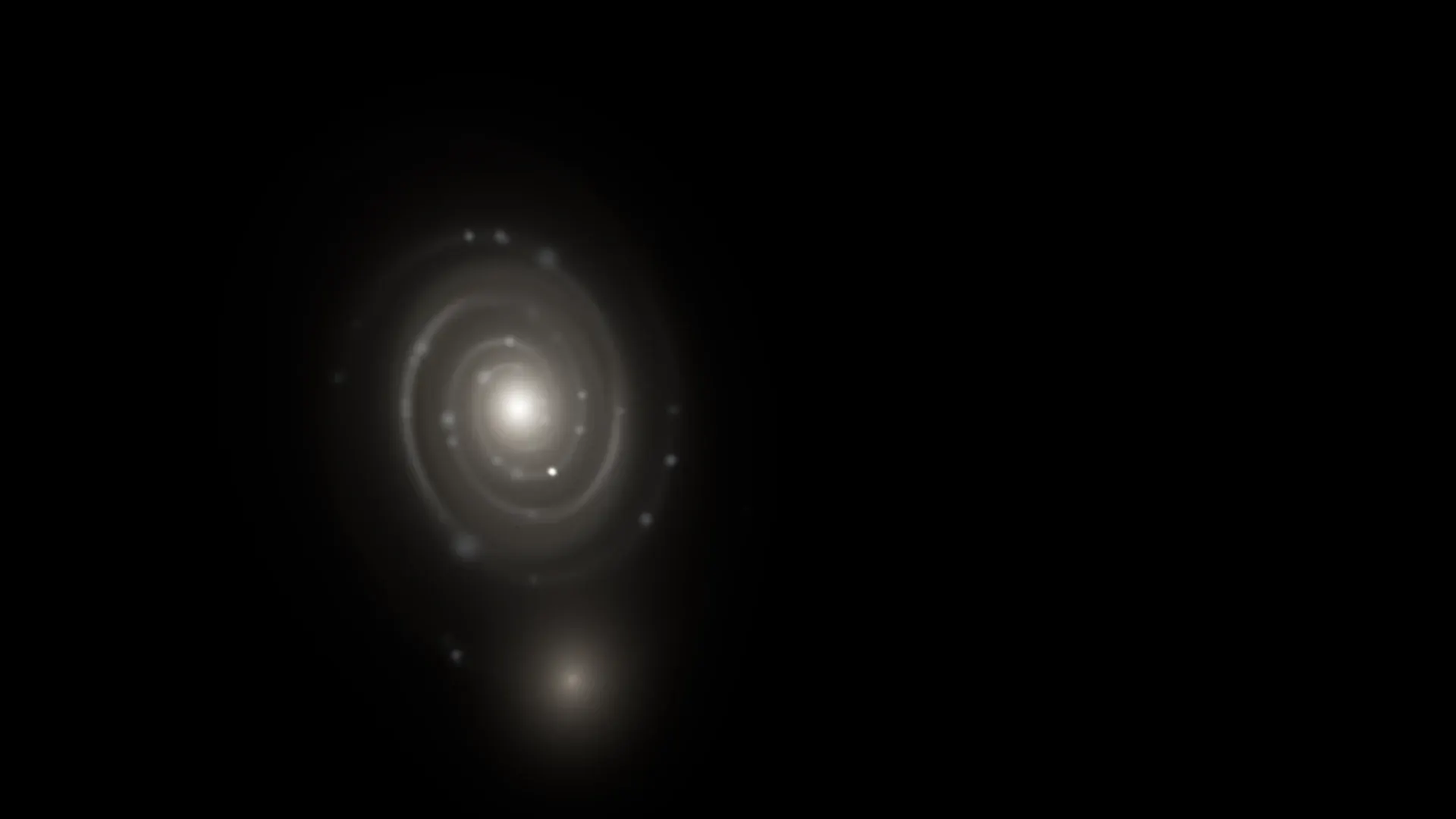
The Large and Small Magellanic Clouds and the Sagittarius dwarf are filled with stars of their own. From a kiloparsec off the centre of the Large Magellanic Cloud, the cockpit sky shows 16,849 of its stars to naked-eye brightness, and every one can be targeted and its system generated. Galaxies now hang in the cockpit sky too, at their true positions: from Sol, Andromeda and the Large Magellanic Cloud sit within a hundredth of a degree of where astronomers put them. Five new fast-travel stops take you above the Milky Way, into the Large Magellanic Cloud, 150 kiloparsecs off Andromeda, between the Local Group galaxies and out to a procedural galaxy 389 megaparsecs away.
 , open full size
Flying down and landing
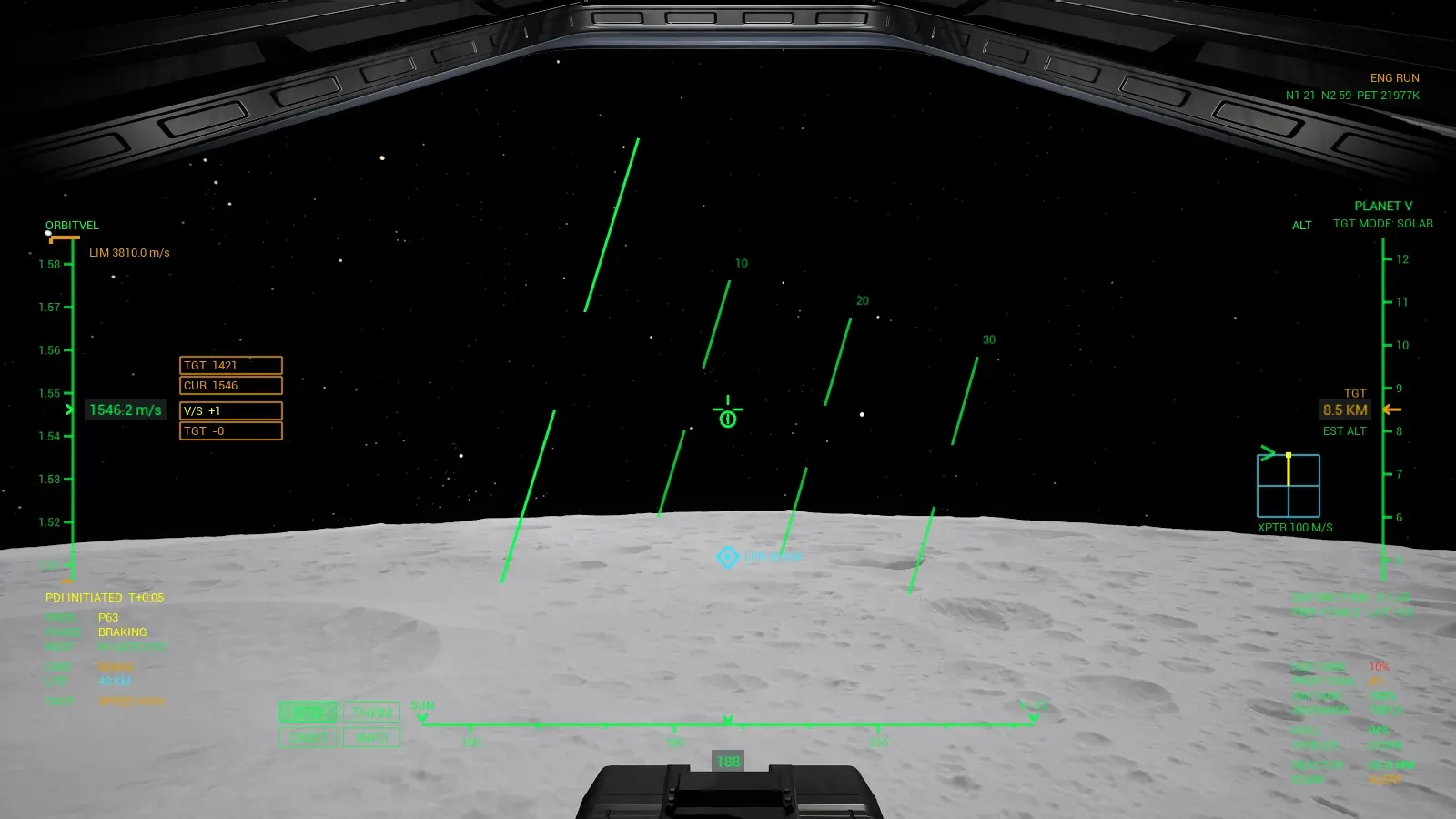
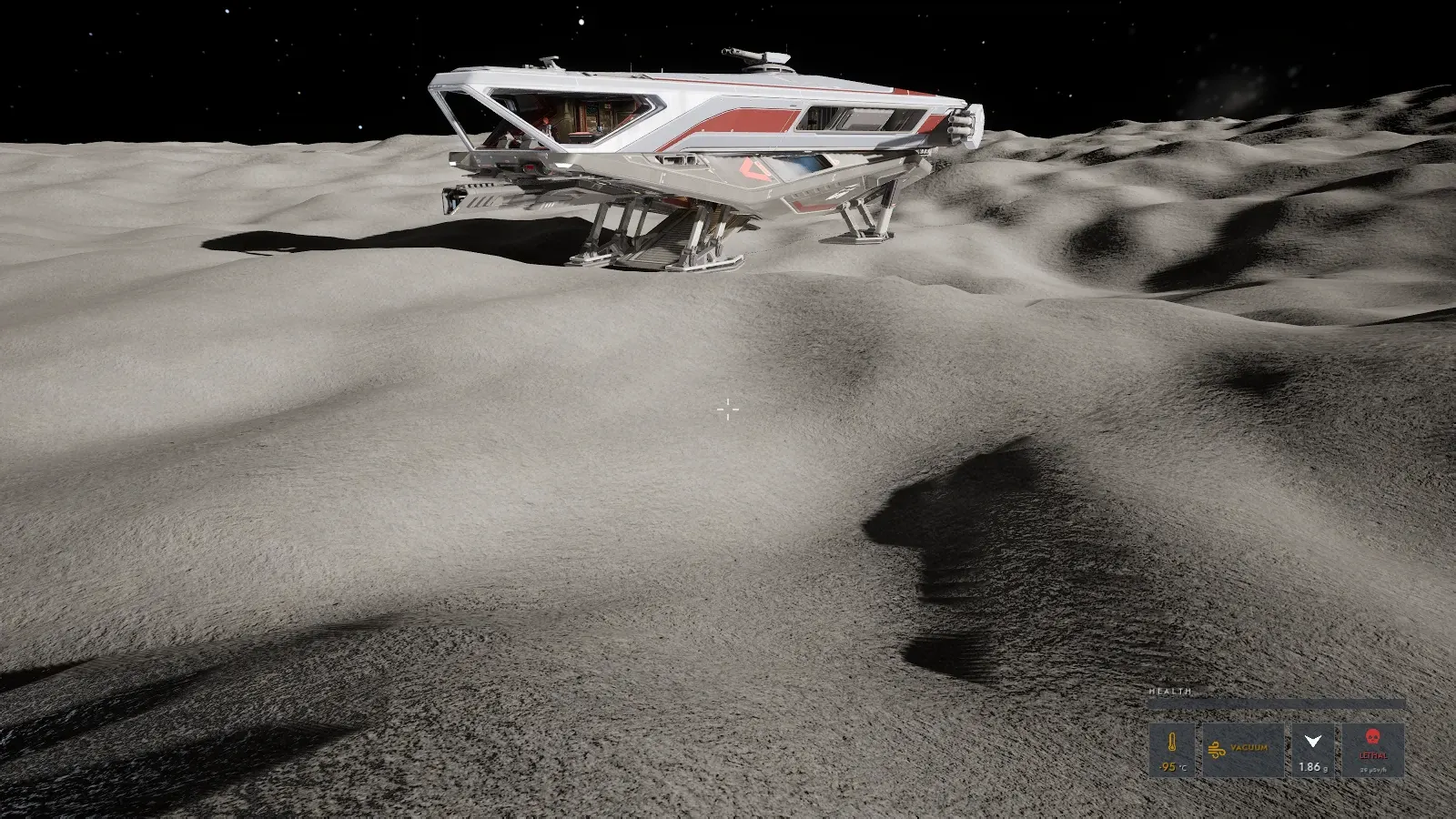
The Calliope now lands. Inside twelve radii of a landable world, gravity pulls on her by the inverse square law, and a new speed mode, APPROACHVEL, governs her descent rate to her height, the way the Apollo lunar module came down. The landing radar reads the real ground under her feet. Touchdown is graded SOFT, FIRM, HARD or CRASH against the lunar module's own 3 m/s, and a hard landing costs hull. Settle level for a second and the seat unlocks, the ramp opens and you walk out.
For pilots who want the full ritual, there is an orbital approach and a powered descent: settle into a pre-landing orbit, press INITIATE PDI, and the glass takes you through the braking, approach and vertical descent phases, showing target and current speed, the high and low gates and the landing point on the ground. It takes about two minutes from PDI to touchdown, with a voice call and a tone at every stage. For everyone else there is the direct descent: her lift thrusters give 5,500 kN over a 280 tonne hull, a thrust to weight of 13.7 on Halden Mare and 2.0 at one Earth gravity, and the glass warns HEAVY or NO HOVER when a world is too much for her.
 , open full size
 , open full size
On Monday the AUTOLAND key joined LAND mode: one press puts her under the transition altitude over the target and hands her to the landing program, and on the ground the same key reads TAKEOFF and lifts her to 2,000 metres. Every landable planet's card on the galaxy map carries a lander icon, so you can pick a world from the map, jump, and land.
 , open full size
In development: the planetary spin transition. Cross 16 km on the way down and the ship's computer calls "Planetary spin transition altitude", her speeds switch to the turning ground, and on a world with air the atmosphere takes her into step with its spin gradually, the way Apollo came home to Earth. It is built and goes on the test bench next, with atmospheric drag alongside it.
New worlds to land on
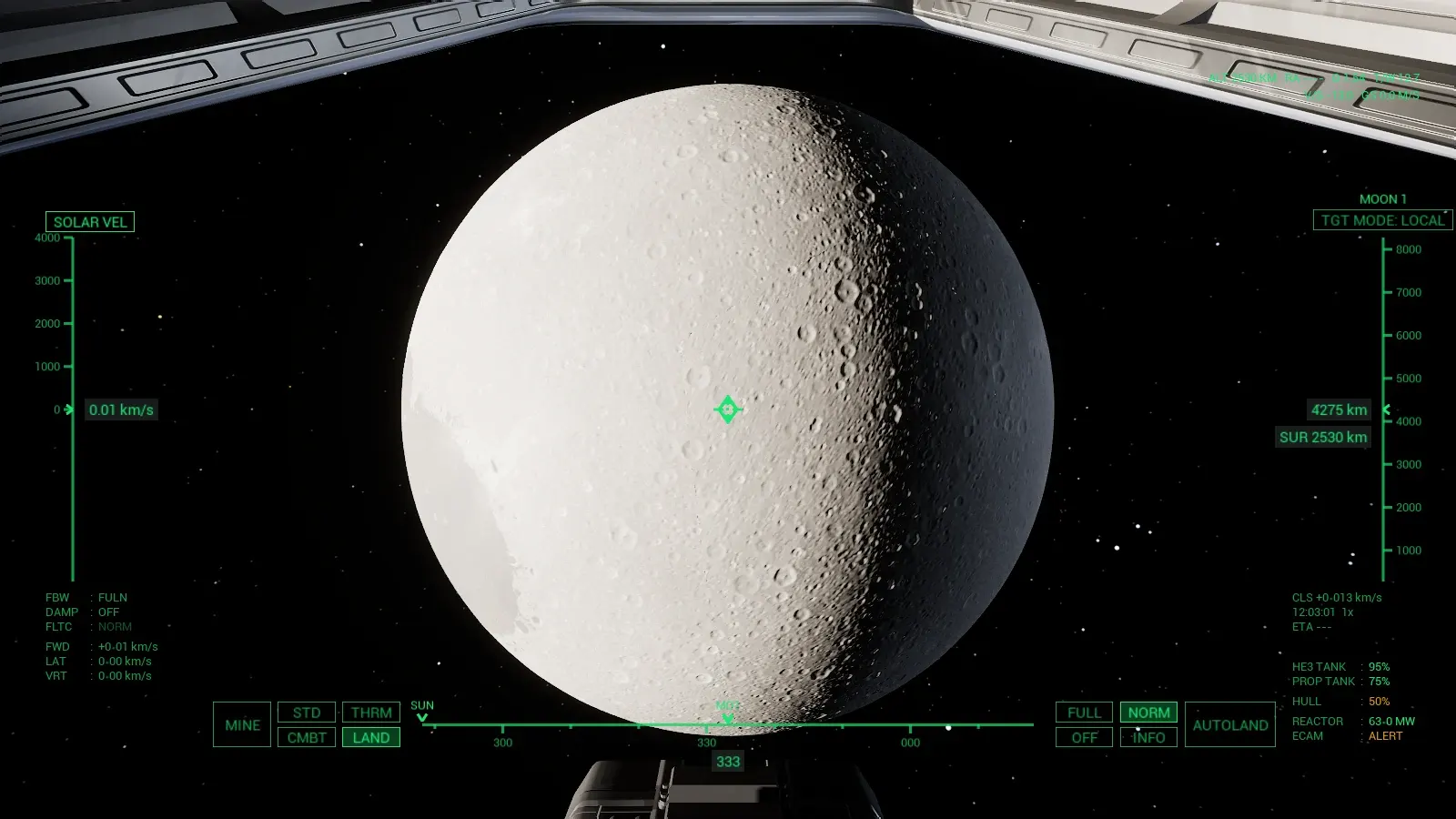
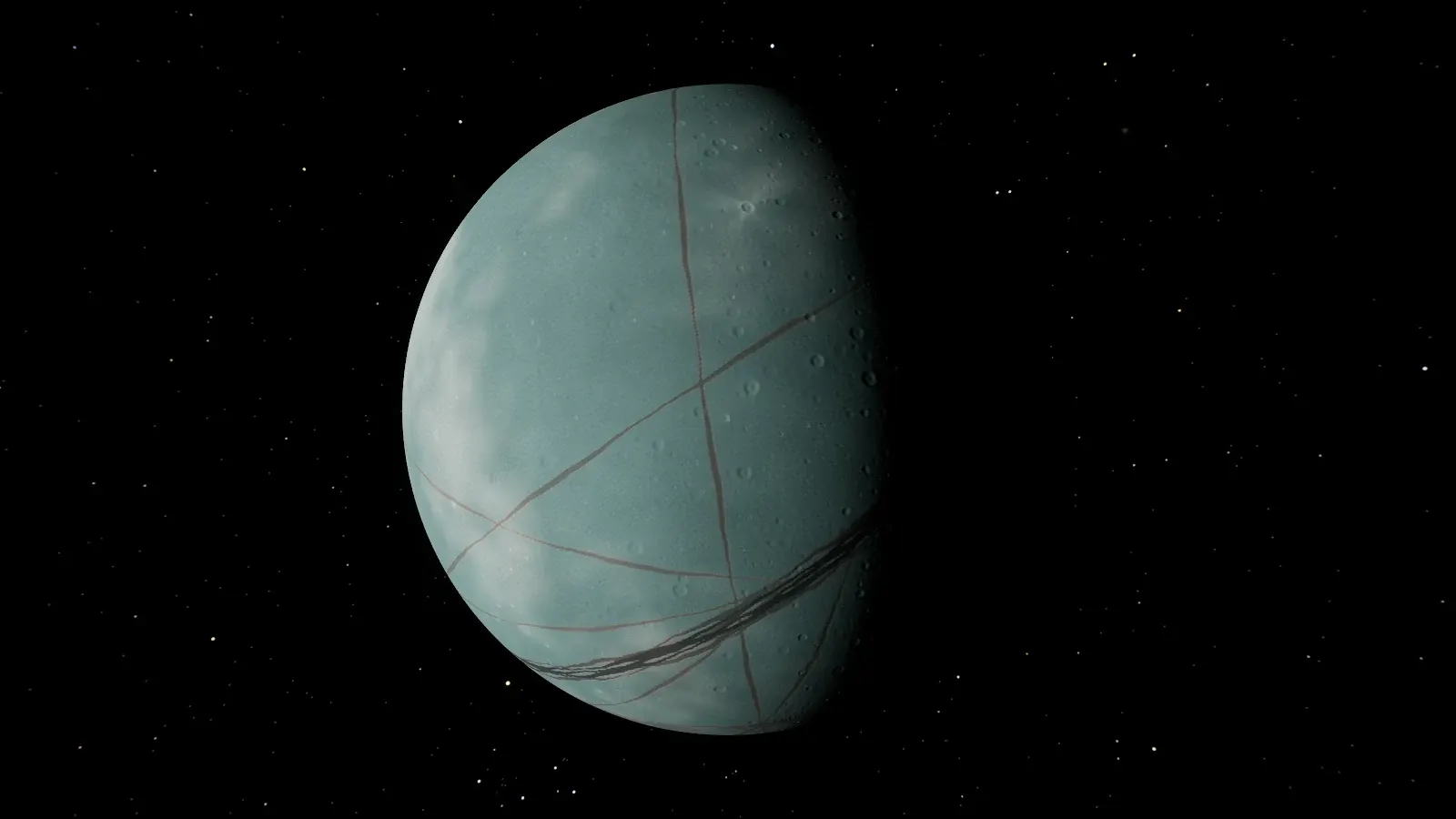
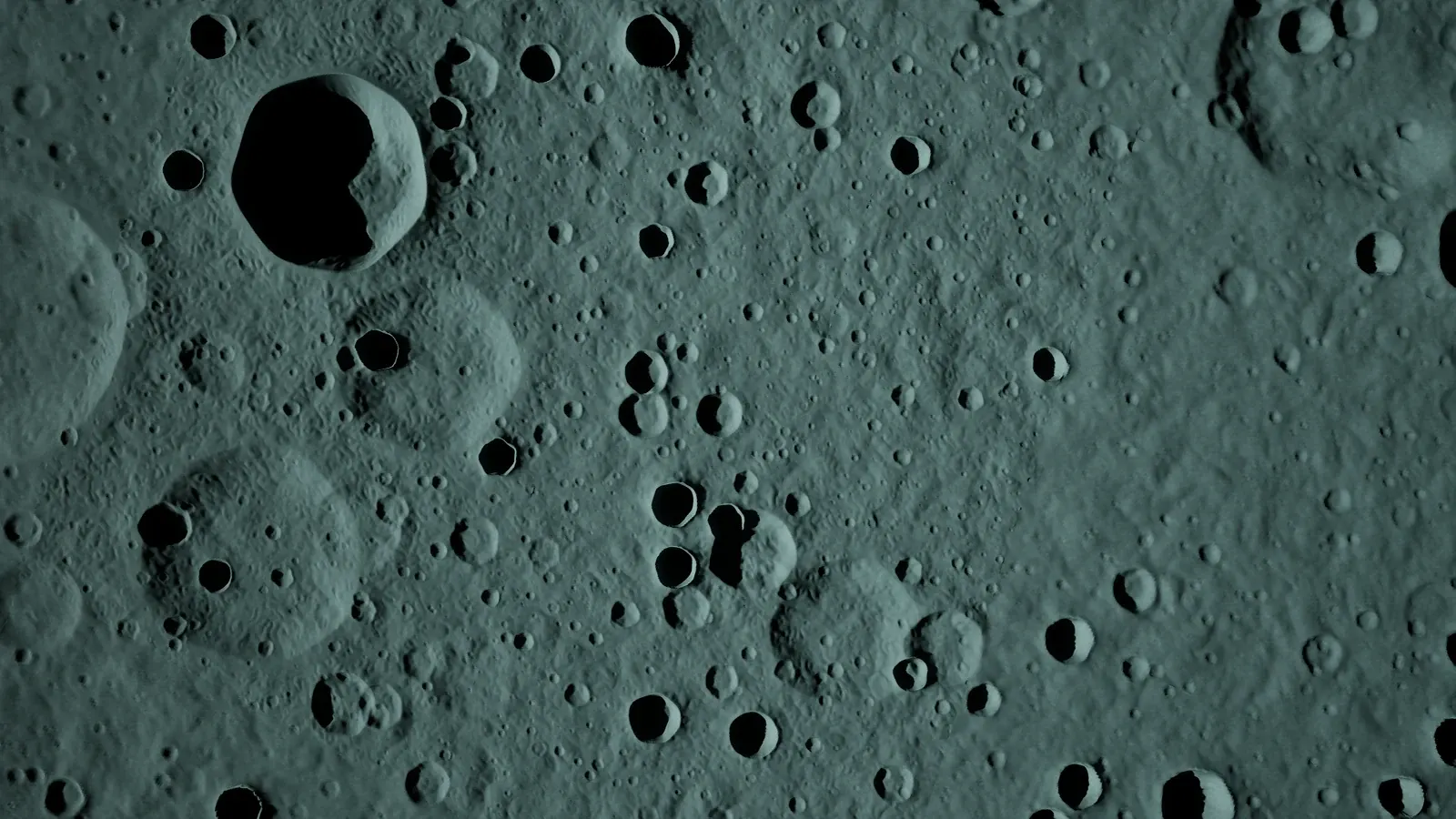
The barren and icy worlds came down from their galaxy-map pictures in numbers. Every standard barren moon is now landable, at its own radius and its own turn. So is every barren planet of the Mercury type. The first icy moon you can land on arrived on Sunday, a wispy ice moon like Dione and Rhea, and on Monday the first ice planet, a cratered ice world. By Tuesday thirteen ice templates were built, from rift-valley moons and plume worlds to a tholin-stained super-Earth with white nitrogen basins, and twelve of them pass every landing check. The icy moons' boulders are twelve stones of water ice from 0.22 to 5.8 metres, built in Blender to break the way ice breaks at 80 kelvin.
 , open full size
 , open full size
That second picture is new this week as well. The far sun now casts shadows on procedural worlds from orbit: the shadow map used to end 42 km from the camera, and now reaches 336 km, so craters and valleys read as relief from high up. And ships, stations, planets, moons and rings now all stand under one sun, so a hull beside a sunlit planet is lit as brightly as the planet.
Gas giants, inside and out
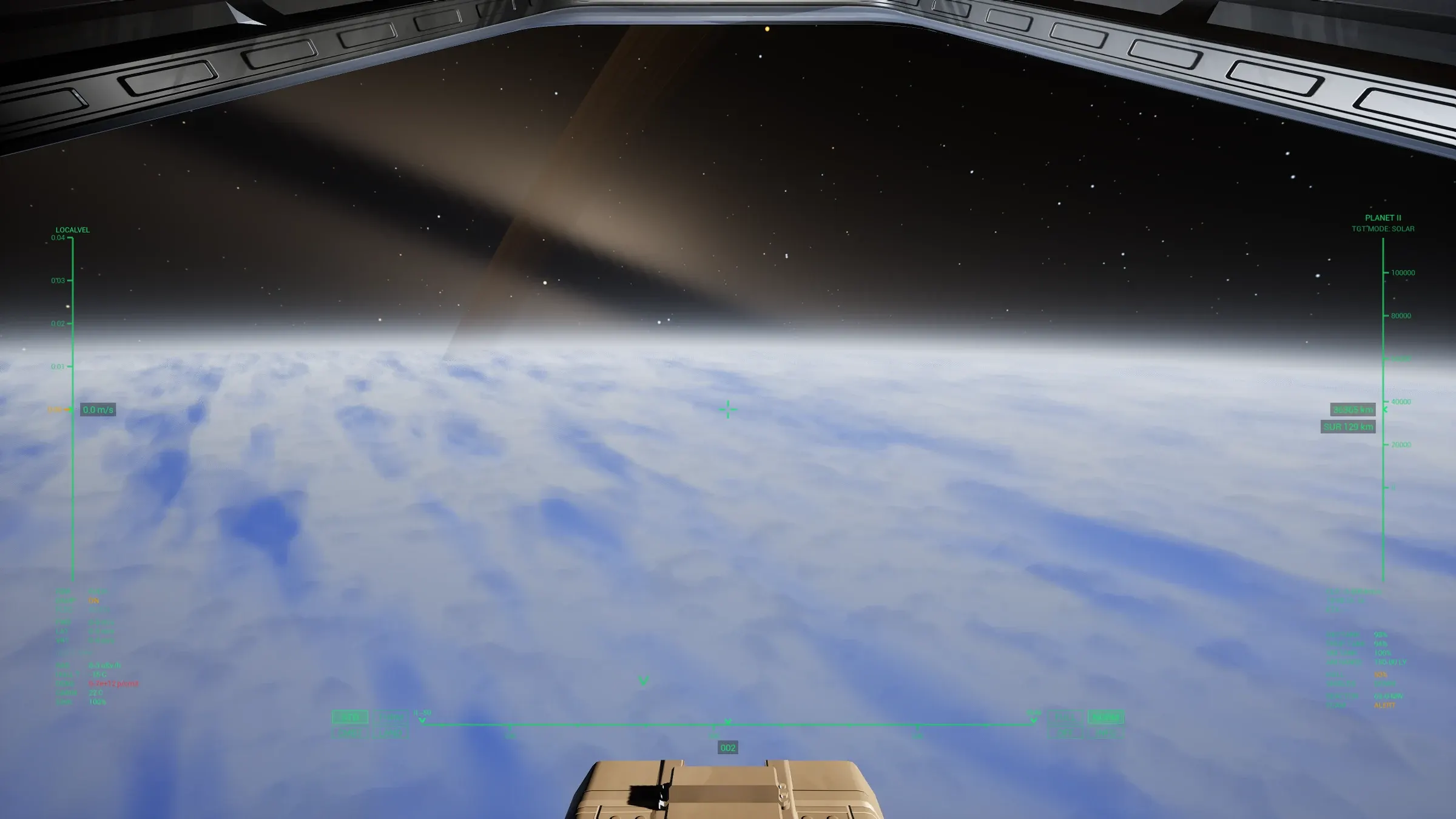
Last week we promised the gas giants a second flight. They got a floor. Fly into a giant and you descend through haze and wisps into a cloud deck in the giant's own colour, the view closing to a few hundred metres, the deck streaming past. Below the deck top the SUR readout goes negative, pointers show the way to the surface and the core, and the HUD reads the pressure from the giant's own atmosphere, checked against the Galileo probe's 22 bar at about 130 km down.
 , open full size
Every hull has a crush rating. Past three quarters of it the computer warns APPROACHING CRUSH DEPTH in amber; at the rating the hull starts to take damage and the alert turns red; at one and a half times it the ship implodes. The ship's computer has five crush calls, from CRUSH DEPTH and CLIMB to CLEAR OF CRUSH DEPTH, each with its own tone.
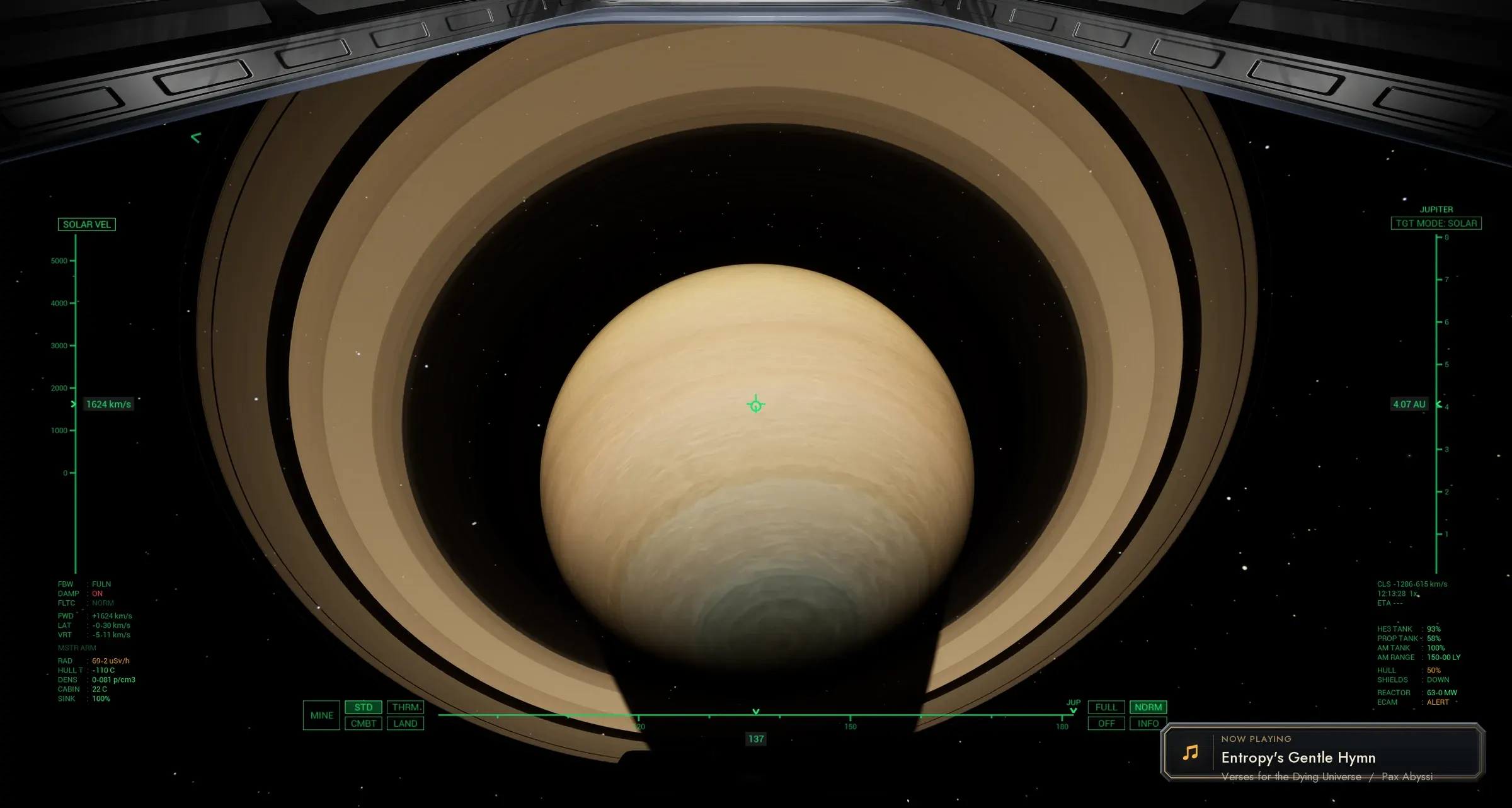
From outside, no giant is flat any more. The Uranus and Neptune classes, the hot Jupiters and the hot ice giants all gained bands, storms and texture that read even at thumbnail size. Sol's Jupiter now wears its own procedural look, Great Red Spot, festoons, dark belt threads and polar cyclones included, and every Jupiter-class giant in the galaxy gets a Jupiter of its own built on it. Saturn, Uranus and Neptune have procedural looks of their own on the way, with Saturn's hexagon drawn as its cloud bands bent by a standing wave, and four new fast-travel stops fly you out to Sol's giants.
 , open full size
Then there is science. A SCI key now sits under MINE and opens a science hub on whatever the nav has targeted: eight instruments for a giant (visible, spectrometer, 5 micron infrared, methane band, ultraviolet, microwave radiometer, magnetometer and gravity) and six for a star, modelled on the Juno and Solar Dynamics Observatory payloads. Scan a giant in infrared, methane, ultraviolet or microwave and the planet itself is redrawn in that instrument's light, from the same weather that draws it in visible light. Jupiter's ammonia clouds sit at 0.72 bar and its water clouds at 5.6 bar, where Galileo found them.
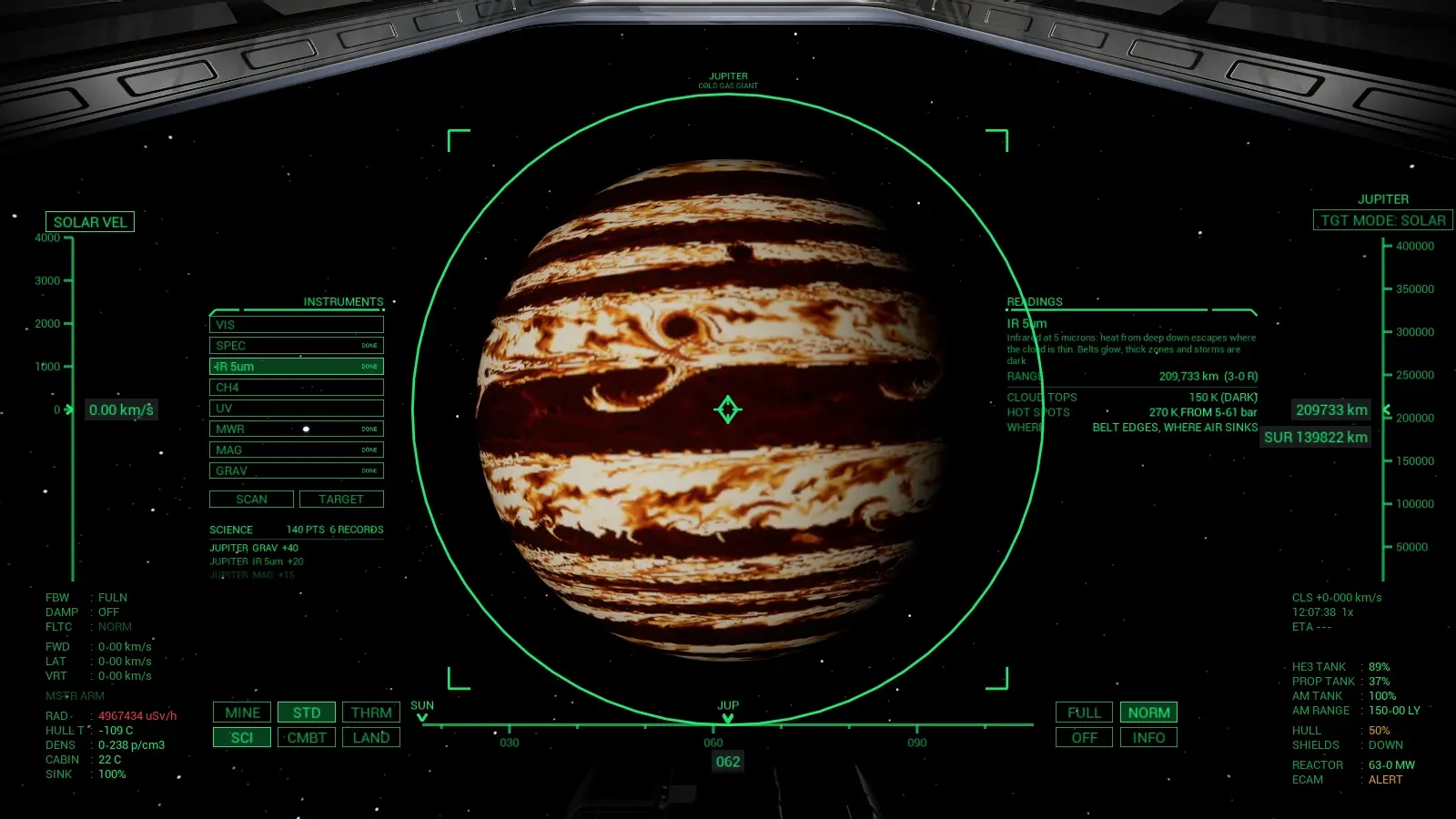 , open full size
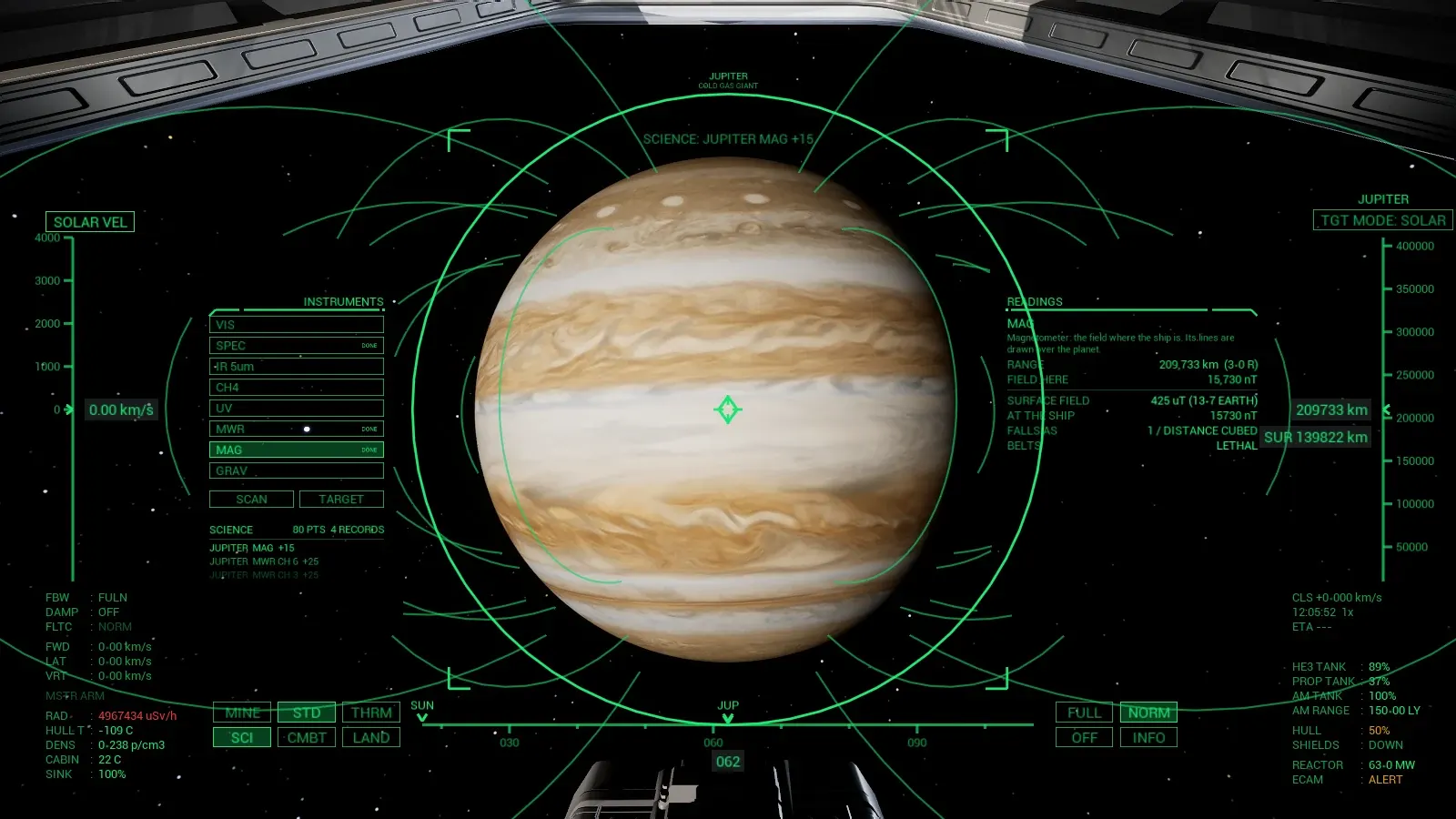 , open full size
In development: giant weather from science, so that every storm, band and haze a giant shows is derived from its own physics on its sheet, with nothing painted by hand.
Skies and clouds
The sky you see is now the sky from where you are. Every arrival redraws the stars as seen from the ship's own position, black holes and pulsars get skies of their own, the generated stars and the Milky Way's glow fill the cockpit sky at every system, and the next star's sky is built while you are still in the jump. On a world with air, which stars you can see depends on that air.
Every world you land on now has a sky built from its science: Rayleigh scattering by the gas column, dust, haze and absorption, each with its source. Land and the sky over you turns with the planet at the body's own rates, so the sun rises and sets, the stars wheel overhead and a moon crosses the sky at its real pace. On a world that turns in 19.63 hours, the sun is back in place after a solar day of about 19.7.
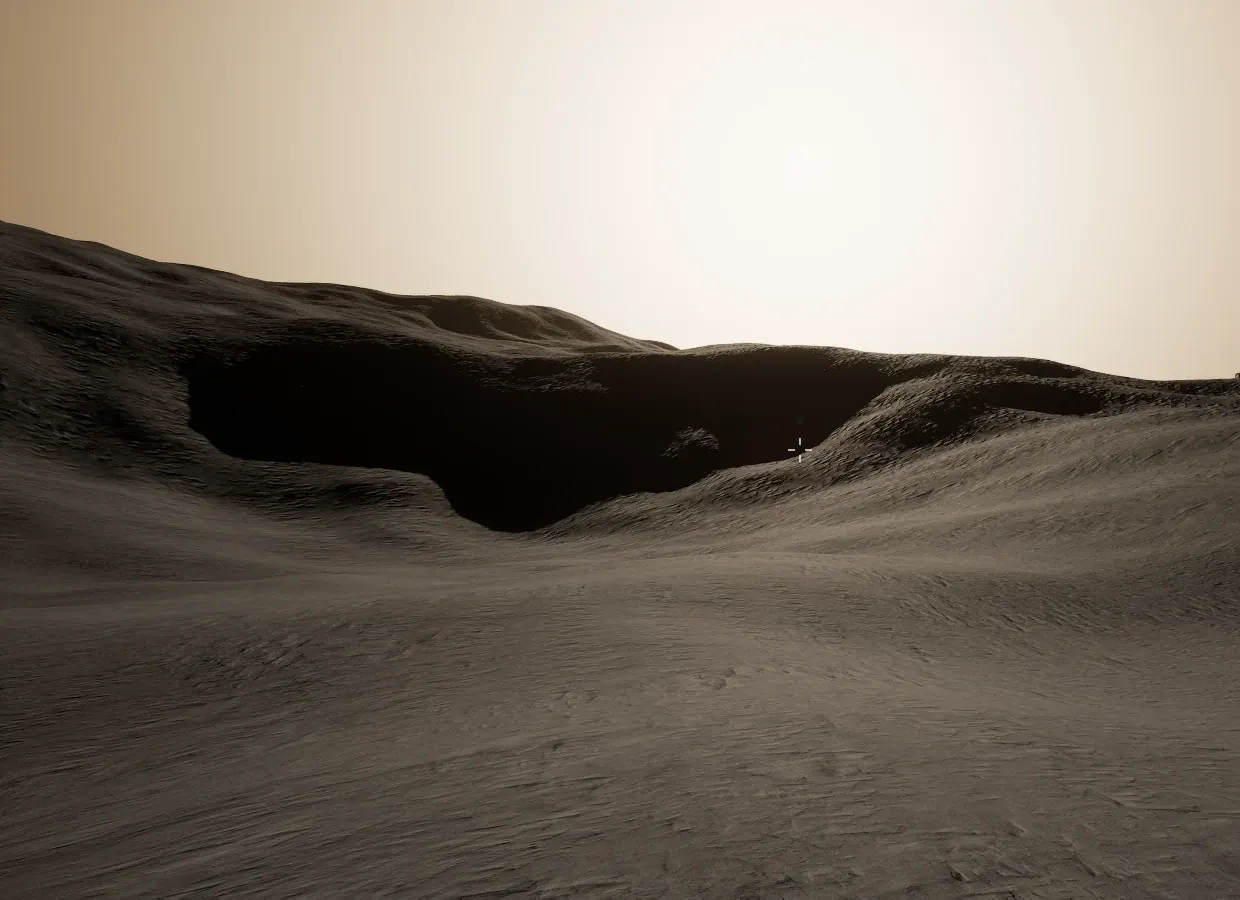 , open full size
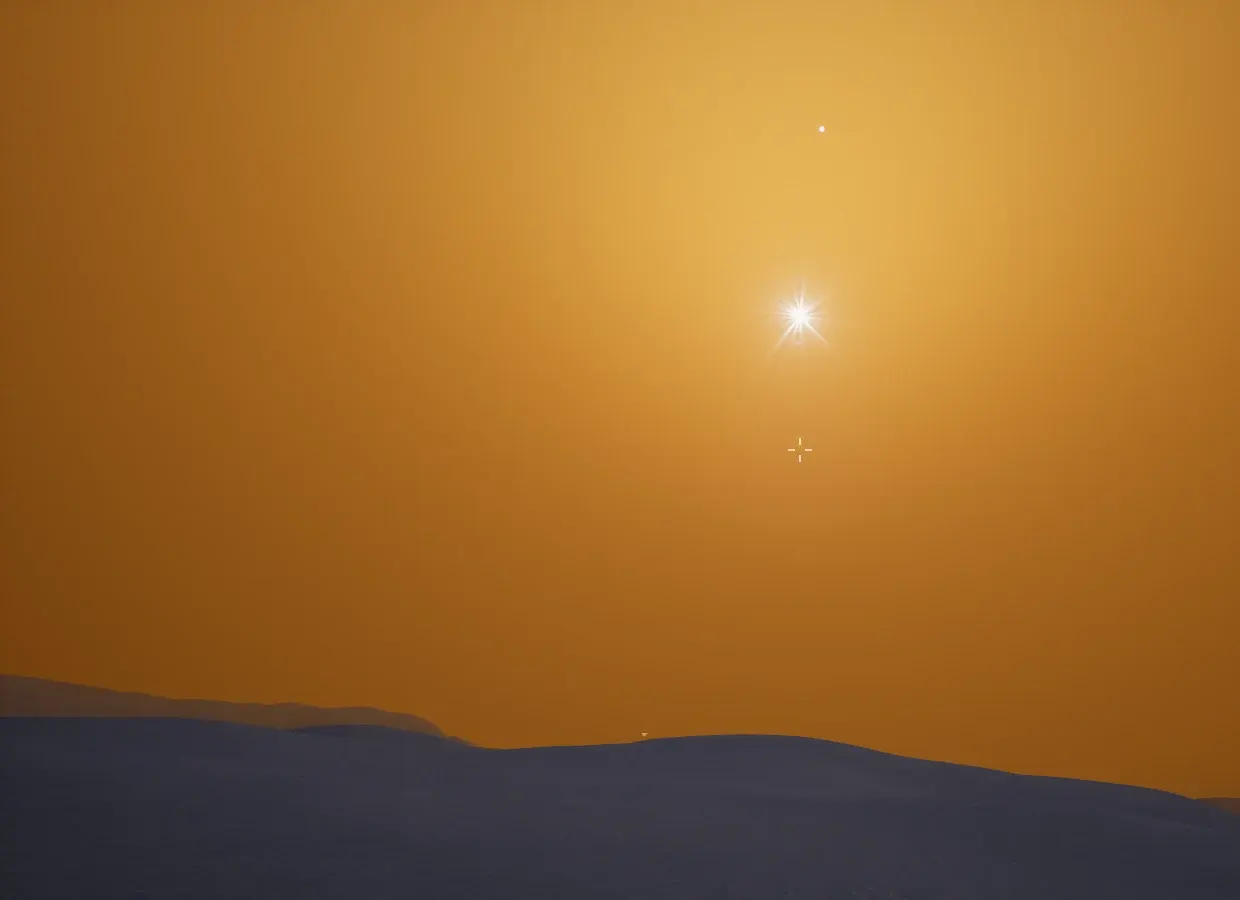 , open full size
Clouds come from science too. For each world we work out what condenses, where and how thickly, from the gas, the temperature and the vapour: Earth's water deck sits at 0.54 km, Mars's ice at 4.14 km, and 882 of the 1,054 landable worlds with cloud get a deck of their own. The decks are drawn in the game, seen from orbit, from the ground and flown through. Next on the clouds list: a tune for speed under the deck, and a volumetric option.
Asteroids and mining
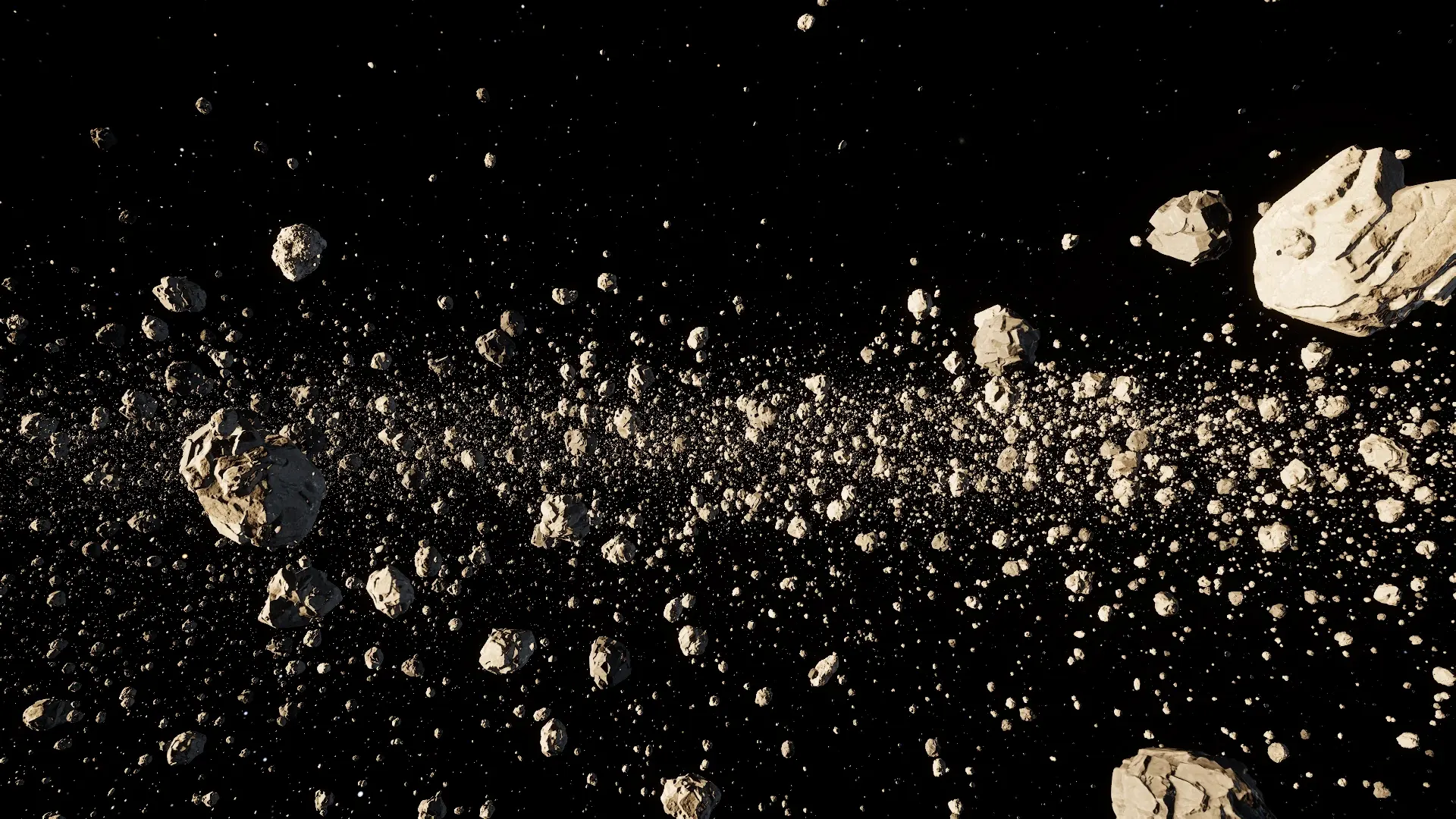
Belts now hold dense clusters, one to three in each: 20,000 rocks packed into a slab 12 km across and about 1.4 km thick, a rock every 180 metres or so, wrapped in a haze that fades in as you close. Rocks take their albedo from their family, so dark carbon rocks and bright metal ones read differently, and the orrery marks each belt and its clusters so you can find them. Sitting inside one in a Trojan cloud, we counted 10,023 rocks within 5 km.
 , open full size
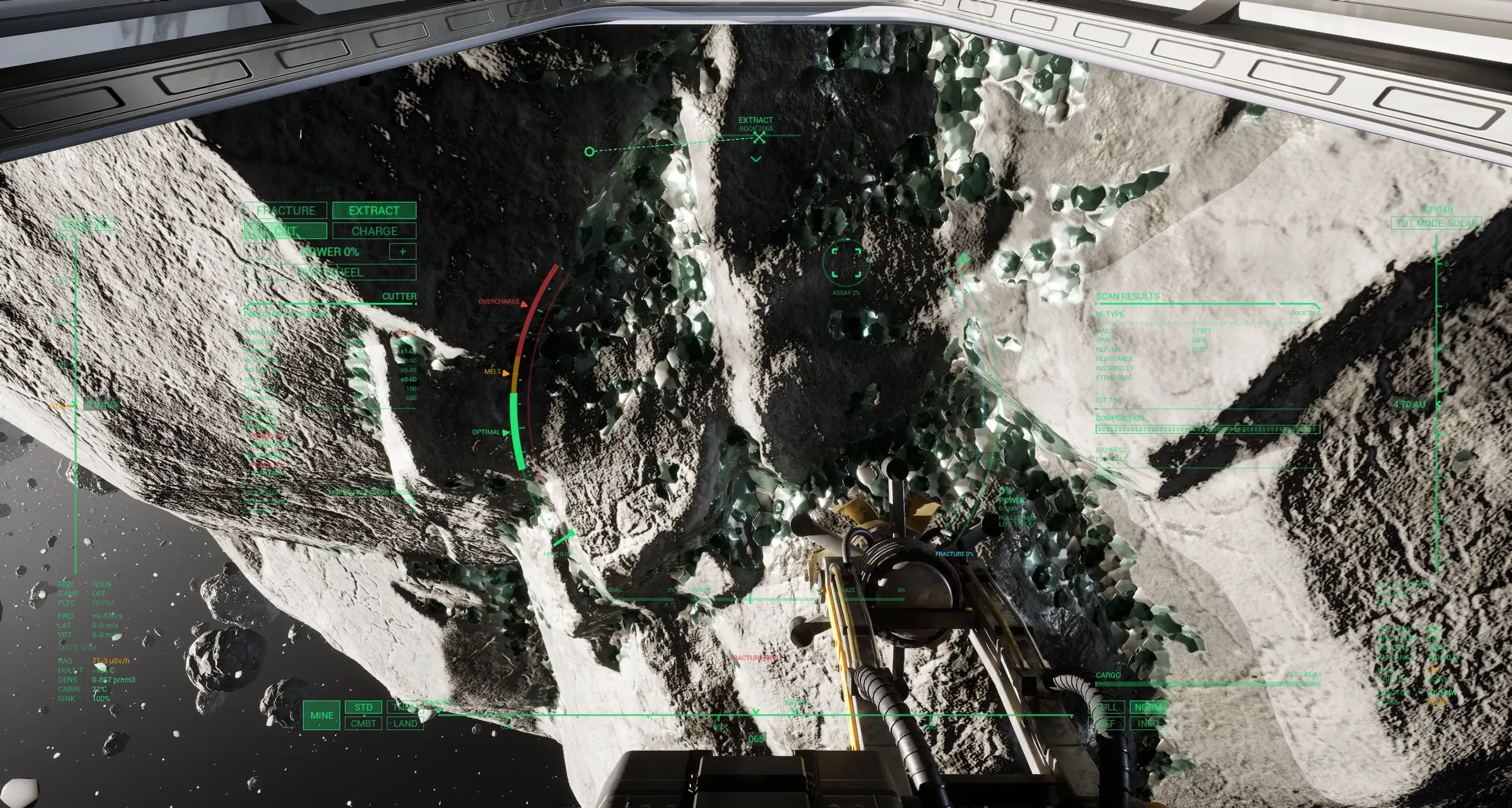
And you can mine them. Every rock is generated from its own id: one of eleven spectral classes from the meteorite science, its structure, seams, volatile pockets and ores. Press MINE at the helm and a twin-arm cutting rig, built in Blender, unfolds from the Calliope's chin in three seconds. Assay the rock, cut with the plasma cutter inside its heat band, fracture it into fragments that drift apart, and extract the ore into the hold. The tuning rewards technique: read the rock well and it pays.
 , open full size
Stations
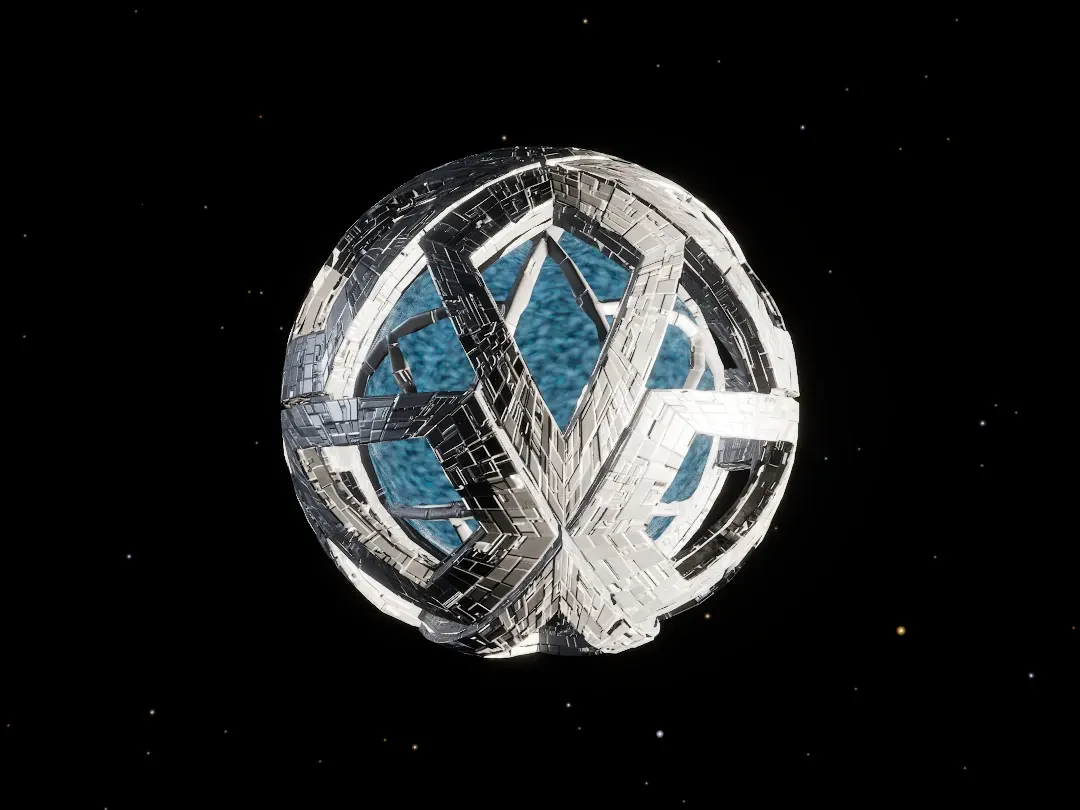
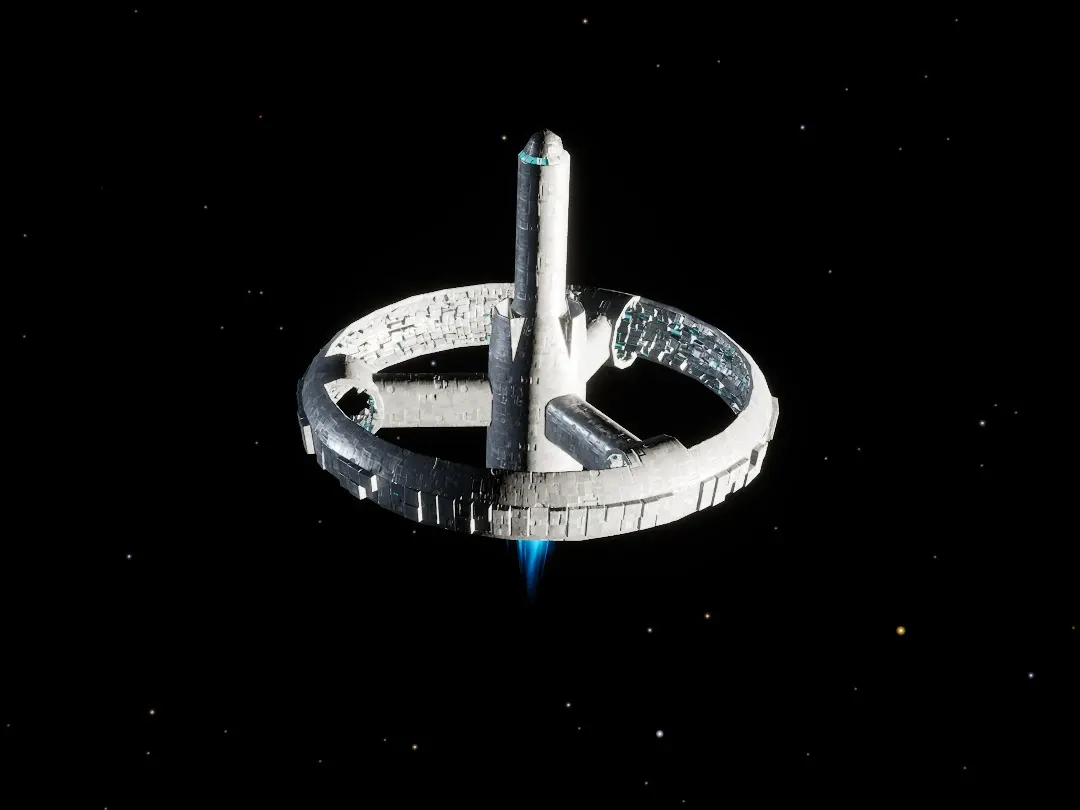
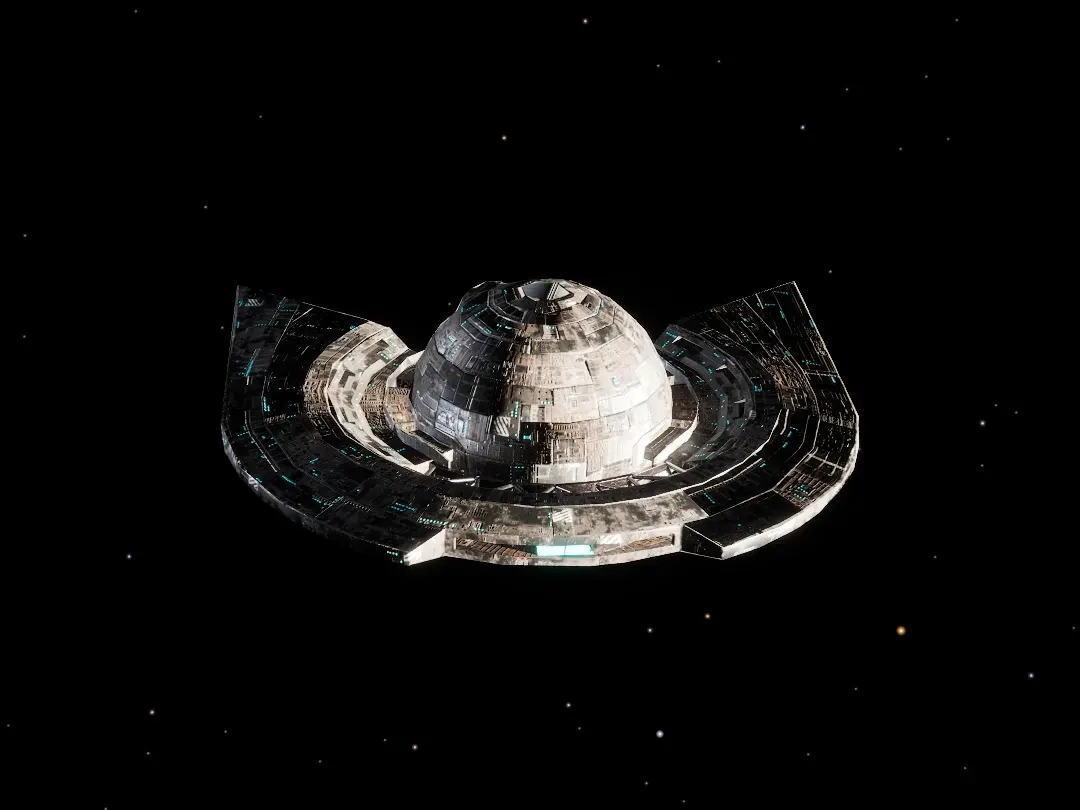
Twenty-one new station hulls went into the placement pools and were photographed in the game one by one. A whole-rules audit of where stations go found that no shipyard had ever been placed and quarantine stations almost never were. Both are fixed: shipyards went from none to 60, and quarantine stations from 2 to 10.
 , open full size
 , open full size
 , open full size
Also this week
- Our own joystick reader. The game now reads every HID stick, throttle and pedal set itself. Thrustmaster's TPR pedals read, PEDALS is a device of its own, and every hardware tab has a CHANGE DEVICE row.
- The Warthog's lights. Select reverse and the throttle's LEDs blink for five seconds, then hold.
- The stardrive, on to the cruise. The jump now opens a crossing of the star's real distance, flown on the triggers and paid in antimatter by the light year, with a 124 light year jump range and time acceleration up to x32,768 in FTL. Our own warp tunnel rides the jump, with the original kept as an option.
- Drift mode. The drift dampers now come in two kinds on Options > SHIP: flight, or Newtonian, which only ever shortens your velocity and never turns it.
- Ambient music. Press M for a music player with 123 ambient tracks, playlists, shuffle and ratings. It steps aside whenever a moment has music of its own, then fades back in where it left off.
- Combat ranges. Two new fast-travel stops: a derelict frigate to shoot, and an armed derelict that fires back. CMBT's INFO key now opens a live damage report.
- Built in Blender. Besides the mining rig and the ice boulders: a stepped airlock and ramp for the modular habitat, and a kit of wall instruments and base equipment for the moonbase interiors.
Next week
The planetary spin transition and atmospheric drag go on the test bench, then into flight. Giant weather from science moves from the plan into the code, and the clouds get their tune and a volumetric option. More ice and barren worlds come down from the map, and the last of the system generator's routes follow the rest of the generator into C++. On the universe map, we want to fly out of the Galaxy and watch the galaxies stream past. See you next week.
Related in the wiki
Credits
- The Pax Abyssi team
- Author
Spotted an error? Tell us in the forum thread or on the talk page of a related wiki article; corrections are noted at the top of the piece.