G stars: the Sun and its kind
The Sun is a G2 dwarf, a middling star in almost every way and the only one we can study up close. Pax Abyssi draws it from its measured properties and lets you choose its colour: white, as it is from space, or the gold of films and paintings.
By The Pax Abyssi team

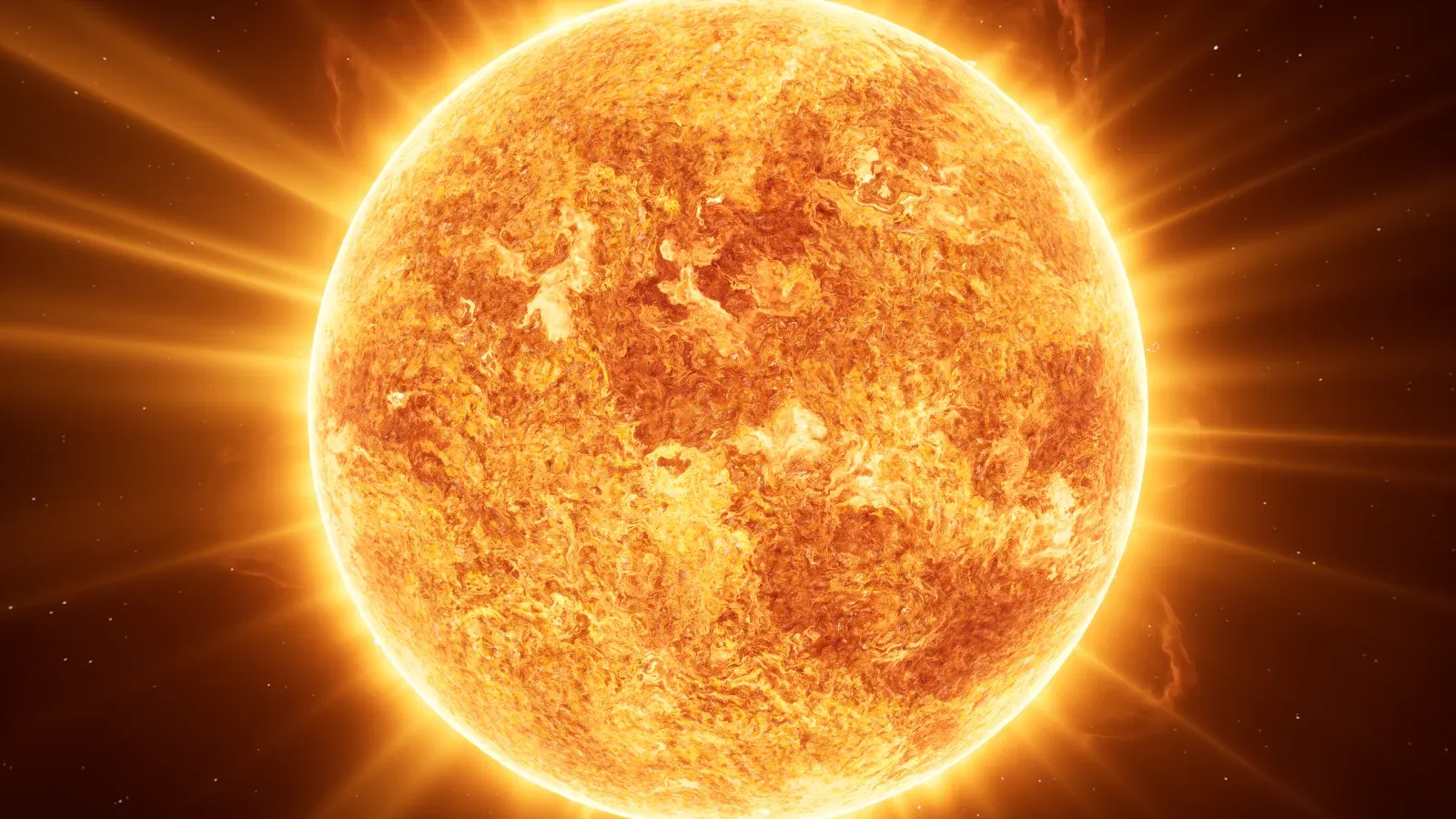
A 5,772 K star, the Sun's temperature, three stellar radii out, in the game sun palette: a gold, granulated disc with long rays.
Pax Abyssi
There is one star whose surface we can watch cell by cell, whose age we know from meteorites and whose planets we have walked on or landed probes on. It is a G star, and in Pax Abyssi you can park your ship above it. This fifth instalment of our series on the main sequence is about the Sun's class: what makes a star a G star, which of them you can fly to, and what we chose when we drew them.
How Pax Abyssi draws a G star
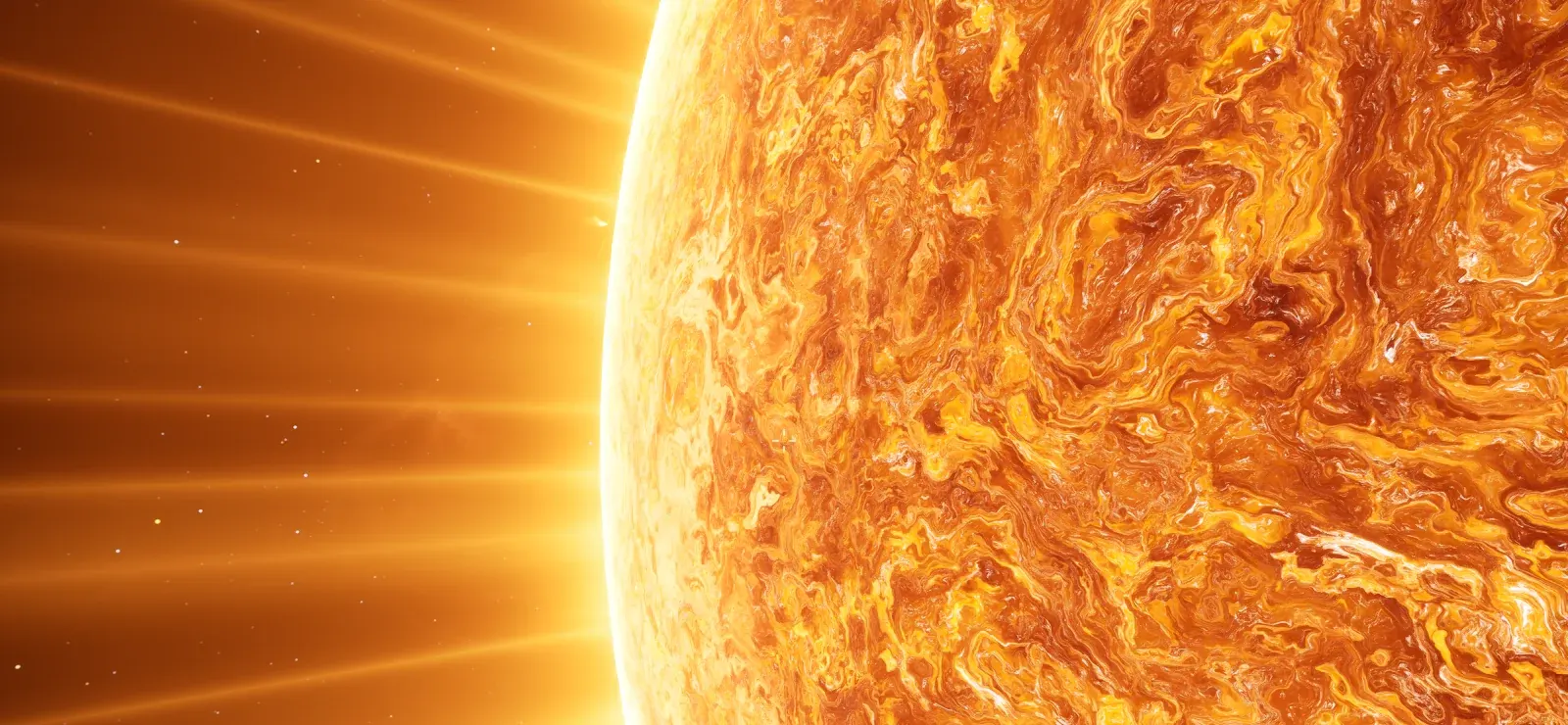
Every flyable star in the game carries a sheet of its measured and derived properties, and the close-up sun is drawn from it: the disc is the star's real radius, the surface pattern comes from its class and its activity, and its colour comes from its temperature. A G star has a deep convective envelope, so its surface boils. We draw a fine mosaic of granulation cells, hot cells that clip to white, darker cool lanes between them, a bright rim, and flames and coronal rays at the limb. The edge of the disc darkens with a limb-darkening coefficient of 0.60, which is close to what the real Sun shows in visible light.
 , open full size
Real granules are about 1,000 to 1,500 kilometres across and each lives for five to ten minutes before it is replaced 1. The Sun's disc holds millions of them, far too many to resolve at the distance you park at, so the cells we draw are a picture of convection at a scale the eye can read, modulated by each star's own granulation data. Two G stars never look quite the same, because their sheets differ.
The colour of the Sun, and our choice
Now the colour, because the picture above is gold and the Sun is not.
The Sun's surface temperature is 5,772 K 2. Its light, folded through the colour response of the human eye, is white with the faintest trace of warmth 3; converted to the colour space of a monitor, a blackbody at 5,772 K comes out at about (1.00, 0.88, 0.82), a white a photographer would call slightly warm. The Sun looks yellow from the ground because our atmosphere scatters blue light out of the direct beam and across the sky, and it looks orange or red at sunset because the beam then crosses far more air. Above the atmosphere those effects are gone. From space the Sun is white.
Pax Abyssi lets you choose how that is shown. In Esc, Options, SPACE, the SUN section has a row called sun palette with three settings:
- Scientific, the default: every part of the sun is given the true colour of a blackbody at its own temperature. Our Sun is white, cool stars peach and orange, hot stars pale blue.
- Game: suns painted as films and games paint them, a deep gold Sun, deep red cool stars and strong blue hot ones.
- Vivid: the game colours turned up further.
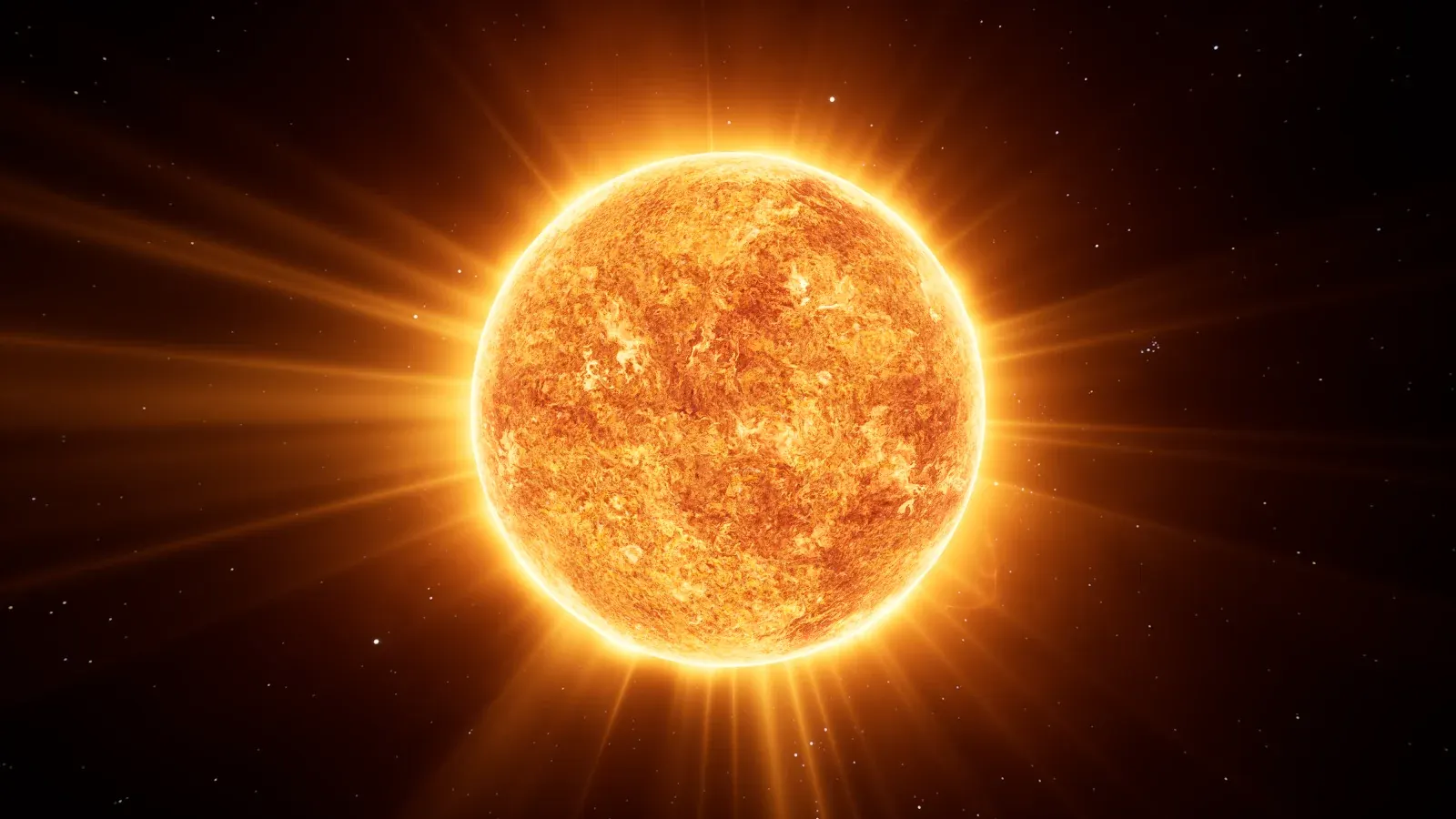
Every close-up in this article was taken in the game palette. We built it because a sun seen from a few radii away has to read as hot, and a surface that walks from deep orange through yellow into white as it brightens is how the eye reads heat. Scientific is the default because it is right. Both are drawn from the same star sheet; only the colour recipe changes.
 , open full size
What a G star is
G stars are the main-sequence stars between about 6,000 and 5,300 K. In Eric Mamajek's compilation, which builds on Pecaut and Mamajek (2013), a G2 dwarf like the Sun has 1.00 solar masses, 1.01 solar radii and 1.02 solar luminosities 4 5. Their spectra are dominated by metal lines and very strong lines of ionised calcium. A G star lives about 10 billion years on the main sequence; the Sun is about 4.6 billion years old, a little under halfway through.
Within 10 parsecs of the Sun there are 18 G stars, against 249 M dwarfs and 38 K dwarfs 6. About one nearby star in twenty is a G dwarf. The Sun is brighter and heavier than most of its neighbours.
 , open full size
G stars you can fly to
The catalogue's charted systems include 694 G stars, most of them giants, and 106 main-sequence dwarfs; the simulated Milky Way around them holds billions more. Among the catalogue's dwarfs:
- The Sun, in the game as itself: Sol, with its real planets on their real orbits.
- Rigil Kentaurus (Alpha Centauri A), 4.37 light years away, a G2 star about 1.1 times the Sun's mass and 1.22 times its radius, in a close orbit with the K star Toliman 7.
- Tau Ceti (52 Ceti), a G8 dwarf 11.9 light years away, poorer in heavy elements than the Sun and ringed by a debris disc about ten times as massive as the Kuiper Belt 8.
- Zeta1 and Zeta2 Reticuli, a wide pair of Sun-like stars about 39 light years away that you can fly between.
- Helvetios (51 Pegasi), 50 light years away, the first Sun-like star found to host a planet 9.
- Pi Mensae, a G0 dwarf about 60 light years away in the southern sky.
What their planets are like
For every star it does not already know, the game's generator builds a system from the star outward. It places the habitable zone by the formula of Kopparapu and colleagues 10, sets the frost lines, then picks an architecture. The chance of planets starts at 0.90 for a G star and is adjusted for metallicity, age and companions; the favourite architecture for a G star is giants gathered just beyond the frost line, which is the shape of the Solar System.
Around the catalogue's 106 G dwarfs, 74 have planets, 329 in all. The inner orbits are crowded with tidally locked lava worlds, barren rock and arid worlds; further out come cold mini-Neptunes, cold gas giants and ice giants, and between them hot mini-Neptunes and temperate super-Earths.
Tau Ceti shows how the star shapes the result. Metal-poor stars form fewer giants, and its generated system is compact: two chthonian worlds, the bared cores of planets that lost their envelopes; tidally locked lava worlds; and a volcanic terrestrial world with an active caldera.
The Sun's surface is not steady. Its magnetic field winds up and reverses about every eleven years, and the number of sunspots rises and falls with it; at the peak of a cycle the disc can carry hundreds of spots, at the minimum none for weeks. Other G stars have cycles of their own, longer or shorter depending on their rotation and age. In Pax Abyssi each star's sheet carries its activity level and its spot coverage, and the surface you see is drawn from both: an active young G star shows more spots and more bright flaring cells than a quiet old one.
Next in the series
The next instalment moves cooler again, to the orange K dwarfs, and to Alpha Centauri's second star.
References
- 1Nordlund, Å., Stein, R. F. and Asplund, M. (2009). Solar Surface Convection. Living Reviews in Solar Physics 6, 2. doi:10.12942/lrsp-2009-2
- 2Prša, A. et al. (2016). Nominal Values for Selected Solar and Planetary Quantities: IAU 2015 Resolution B3. The Astronomical Journal 152, 41. doi:10.3847/0004-6256/152/2/41
- 3Harre, J. V. and Heller, R. (2021). Digital color codes of stars. Astronomische Nachrichten 342, 578-587. doi:10.1002/asna.202113868
- 4Mamajek, E. E.. A Modern Mean Dwarf Stellar Color and Effective Temperature Sequence (version 2022.04.16). www.pas.rochester.edu/~emamajek/EEM_dwarf_UBVIJHK_colors_Teff.txt
- 5Pecaut, M. J. and Mamajek, E. E. (2013). Intrinsic Colors, Temperatures, and Bolometric Corrections of Pre-main-sequence Stars. The Astrophysical Journal Supplement Series 208, 9. doi:10.1088/0067-0049/208/1/9
- 6Reylé, C. et al. (2021). The 10 parsec sample in the Gaia era. Astronomy & Astrophysics 650, A201. doi:10.1051/0004-6361/202140985
- 7Kervella, P. et al. (2017). The radii and limb darkenings of α Centauri A and B. Interferometric measurements with VLTI/PIONIER. Astronomy & Astrophysics 597, A137. doi:10.1051/0004-6361/201629505
- 8Greaves, J. S. et al. (2004). The debris disc around τ Ceti: a massive analogue to the Kuiper Belt. Monthly Notices of the Royal Astronomical Society 351, L54-L58. doi:10.1111/j.1365-2966.2004.07957.x
- 9Mayor, M. and Queloz, D. (1995). A Jupiter-mass companion to a solar-type star. Nature 378, 355-359. doi:10.1038/378355a0
- 10Kopparapu, R. K. et al. (2013). Habitable Zones around Main-sequence Stars: New Estimates. The Astrophysical Journal 765, 131. doi:10.1088/0004-637X/765/2/131
Related in the wiki
Credits
- The Pax Abyssi team
- Author
Spotted an error? Tell us in the forum thread or on the talk page of a related wiki article; corrections are noted at the top of the piece.