K stars: the long-lived orange dwarfs
Smaller, cooler and far longer-lived than the Sun, the orange K dwarfs may be the best homes for life in the galaxy. Two of the nearest stars to Earth are K dwarfs, and in Pax Abyssi you can fly to both.
By The Pax Abyssi team

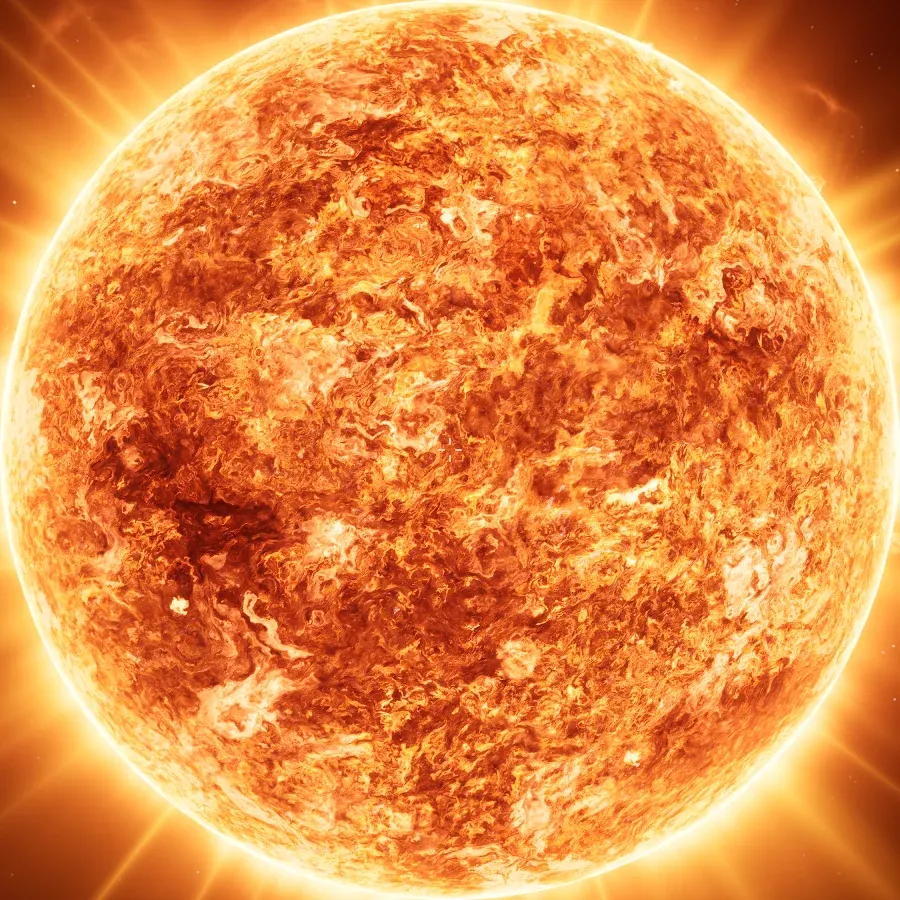
A 4,500 K orange dwarf filling the view, in the game sun palette: a boiling orange surface of convection cells and darker spots.
Pax Abyssi
The nearest stars to the Sun are a triple. Two of them, Rigil Kentaurus and Toliman, circle each other every 80 years, and the smaller of the pair, Toliman, is an orange K dwarf. Jump to Alpha Centauri in Pax Abyssi and you arrive between a Sun-like star and a smaller, warmer-coloured one. This sixth instalment of our series on the main sequence is about Toliman's class.
How Pax Abyssi draws a K star
Every flyable star in Pax Abyssi carries a sheet of measured and derived properties, and its close-up is drawn from that sheet: real radius, colour from temperature, and a surface chosen by class and modulated by the star's own granulation, activity and spot data. A K dwarf has a deeper convective envelope than the Sun, so its cells are larger and more contrasted. K dwarfs also stay magnetically active for longer than the Sun does, so spots are common. We draw an orange surface of big, boiling cells, with starspots in a cooler colour and a darker limb: the look table gives K dwarfs a limb-darkening coefficient of 0.70 against the Sun's 0.60, because the limb darkens more strongly on cooler stars.
 , open full size
Its true colour, and the choice we give you
The picture above is in the game sun palette, which paints cool stars a deep orange, the way films and games present them. The true colour of a 4,500 K star is gentler: folded through the colour response of the human eye, a K dwarf's light is a pale orange, closer to peach than to a ripe orange 1. Pax Abyssi's default palette, scientific, draws exactly that. You choose in Esc, Options, SPACE, under SUN, on the sun palette row: scientific (the default and the true colour), game (the deeper paint we used for these pictures, because a close star has to read as hot), or vivid (game turned up further).
What a K star is
K stars are the main-sequence stars between about 5,300 and 3,900 K. In Eric Mamajek's compilation, which builds on Pecaut and Mamajek (2013), a K0 dwarf has 0.88 solar masses, 0.81 solar radii and 0.46 solar luminosities; a K5 dwarf has 0.70 solar masses and 0.17 solar luminosities 2 3. Their spectra are full of the lines of neutral metals, and the first molecular bands appear.
A K dwarf burns so slowly that its main-sequence life runs from about 15 billion years for the earliest to several tens of billions for the latest. The universe is 13.8 billion years old, so every K dwarf ever born is still on the main sequence.
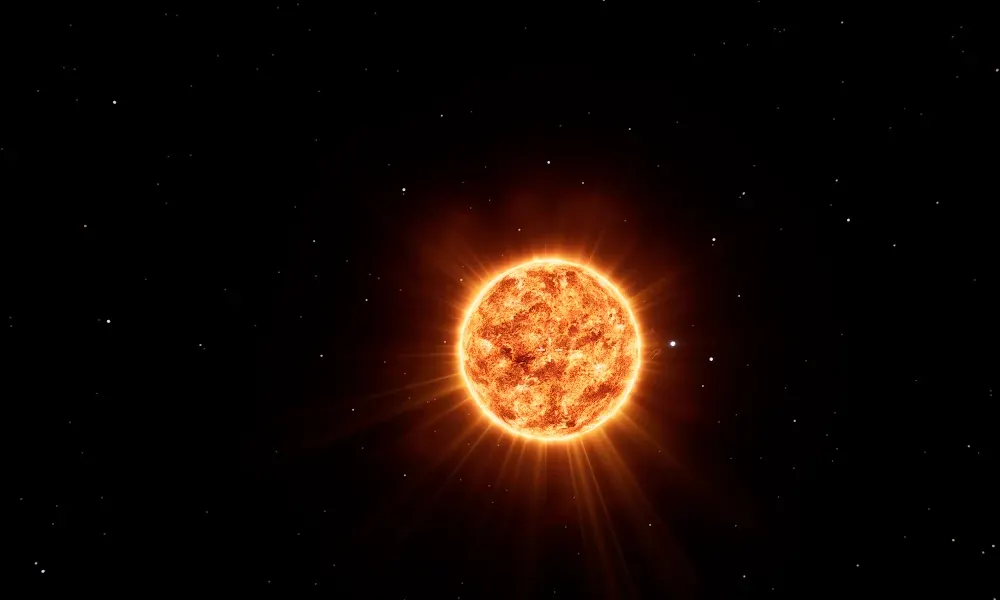
They are common. A census of every star within 10 parsecs of the Sun counts 38 K dwarfs, twice as many as G stars and about one star in nine 4.
 , open full size
Spots and cycles
Because a K dwarf's convective layer is deep, its magnetic dynamo is strong, and young K dwarfs are spotted and flaring. They calm down as they age and spin more slowly, but far more gradually than the Sun did. Many show activity cycles like the Sun's eleven-year cycle; Epsilon Eridani runs through a cycle of about three years, much shorter than the Sun's 5. In Pax Abyssi a star's activity level and spot coverage come from its sheet, so a young, active K dwarf is drawn with more spots and more bright flaring cells than an old, quiet one of the same temperature.
K stars you can fly to
The catalogue's charted systems include 1,363 K stars, most of them orange giants, because giants are luminous and a naked-eye catalogue favours them. The simulated Milky Way around them supplies the K dwarfs at their true rate, billions of them. Among the catalogue's dwarfs:
- Toliman (Alpha Centauri B), a K1 dwarf 4.37 light years away, about 0.94 times the Sun's mass and 0.86 times its radius 6. It and Rigil Kentaurus swing between about 11 and 35 astronomical units apart, so from a planet around either star the other would be a dazzling second sun, far brighter than the full Moon.
- Ran (Epsilon Eridani), a K2 dwarf 10.5 light years away. It is young, a few hundred million years old 7, and circled by a dust ring about 60 astronomical units out, which looks much as the young Solar System must have 8.
- Epsilon Indi, a K5 dwarf 11.9 light years away in the southern sky.
- 61 Cygni, a pair of K dwarfs 11.4 light years away. In 1838 Friedrich Bessel measured its parallax, the first distance to any star other than the Sun 9. Bessel chose it because it crosses the sky unusually fast, more than five seconds of arc a year, which marked it as close. He was right: it is one of the twenty nearest star systems, and its two orange dwarfs circle each other about 85 astronomical units apart.
- Keid (40 Eridani A), a K dwarf 16 light years away, with a white dwarf and a red dwarf as companions.
What their planets are like
The game's generator builds a system around every star it does not already know. It places the habitable zone by the formula of Kopparapu and colleagues 10 and sets the frost lines; the chance of planets starts at 0.92 for a K star and is then adjusted for metallicity, age and companions. The favoured architectures for a K dwarf are giants clustered near the frost line and compact rocky systems.
A K dwarf gives out between a tenth and a half of the Sun's light, so its habitable zone lies between roughly 0.3 and 0.9 astronomical units, depending on the star. A planet there is warm enough for liquid water and usually far enough out to keep its day and night, although the latest K dwarfs bring the zone in close enough for tides to start slowing a planet's spin.
Around the catalogue's 38 K dwarfs, 27 have planets, 142 of them. The layouts are tight and often resonant, and the commonest world is the tidally locked lava world, one face permanently towards its star. Then come arid worlds, barren rock and 11 dry habitable worlds, and chthonian worlds: the exposed cores of planets that lost their envelopes.
The neighbours show the range. Epsilon Indi's generated system is seven compact worlds, most of them lava worlds. Ran's is a furnace: ultra-hot lava worlds and a greenhouse planet so hot it glows by its own heat.
Next in the series
The last instalment goes to the coolest and commonest stars of all, the red dwarfs.
References
- 1Harre, J. V. and Heller, R. (2021). Digital color codes of stars. Astronomische Nachrichten 342, 578-587. doi:10.1002/asna.202113868
- 2Mamajek, E. E.. A Modern Mean Dwarf Stellar Color and Effective Temperature Sequence (version 2022.04.16). www.pas.rochester.edu/~emamajek/EEM_dwarf_UBVIJHK_colors_Teff.txt
- 3Pecaut, M. J. and Mamajek, E. E. (2013). Intrinsic Colors, Temperatures, and Bolometric Corrections of Pre-main-sequence Stars. The Astrophysical Journal Supplement Series 208, 9. doi:10.1088/0067-0049/208/1/9
- 4Reylé, C. et al. (2021). The 10 parsec sample in the Gaia era. Astronomy & Astrophysics 650, A201. doi:10.1051/0004-6361/202140985
- 5Metcalfe, T. S. et al. (2013). Magnetic Activity Cycles in the Exoplanet Host Star ε Eridani. The Astrophysical Journal Letters 763, L26. doi:10.1088/2041-8205/763/2/L26
- 6Kervella, P. et al. (2017). The radii and limb darkenings of α Centauri A and B. Interferometric measurements with VLTI/PIONIER. Astronomy & Astrophysics 597, A137. doi:10.1051/0004-6361/201629505
- 7Mamajek, E. E. and Hillenbrand, L. A. (2008). Improved Age Estimation for Solar-Type Dwarfs Using Activity-Rotation Diagnostics. The Astrophysical Journal 687, 1264-1293. doi:10.1086/591785
- 8Greaves, J. S. et al. (1998). A Dust Ring around ε Eridani: Analog to the Young Solar System. The Astrophysical Journal 506, L133-L137. doi:10.1086/311652
- 9Bessel, F. W. (1838). A letter from Professor Bessel to Sir J. Herschel, Bart., dated Konigsberg, Oct. 23, 1838. Monthly Notices of the Royal Astronomical Society 4, 152-161. doi:10.1093/mnras/4.17.152
- 10Kopparapu, R. K. et al. (2013). Habitable Zones around Main-sequence Stars: New Estimates. The Astrophysical Journal 765, 131. doi:10.1088/0004-637X/765/2/131
- 11Cuntz, M. and Guinan, E. F. (2016). About Exobiology: The Case for Dwarf K Stars. The Astrophysical Journal 827, 79. doi:10.3847/0004-637X/827/1/79
Related in the wiki
Credits
- The Pax Abyssi team
- Author
Spotted an error? Tell us in the forum thread or on the talk page of a related wiki article; corrections are noted at the top of the piece.