M stars: the red dwarfs that outnumber everything
Three stars in four are red dwarfs: small, cool, faint and nearly immortal. Not one is visible to the naked eye, yet the nearest star to the Sun is one of them. Pax Abyssi draws them from their measured data and builds the crowded little planetary systems around them.
By The Pax Abyssi team

A 3,200 K red dwarf three stellar radii out, in the game sun palette: a deep red, mottled disc with a bright rim and long red rays.
Pax Abyssi
Look up on the clearest night and you will not see a single red dwarf. Yet they are the commonest stars in the galaxy, and the nearest star to the Sun, Proxima Centauri, is one. This last instalment of our series on the main sequence is about the M dwarfs: small, cool, faint and so frugal with their fuel that not one has ever burnt out.
How Pax Abyssi draws a red dwarf
Every star you can fly to in Pax Abyssi carries a sheet of measured and derived properties, and the close-up sun is drawn from it: the real radius, a colour from the temperature, and a surface chosen by class and tuned by the star's own granulation, activity and spot data. A red dwarf is convective through and through, so its surface boils in large, high-contrast cells. Red dwarfs are also the most magnetically active stars on the main sequence, so their sheets carry high activity and heavy spot coverage, and we draw them that way: broad cool spots, bright flaring cells scattered across the face, and a deep glow around the disc.
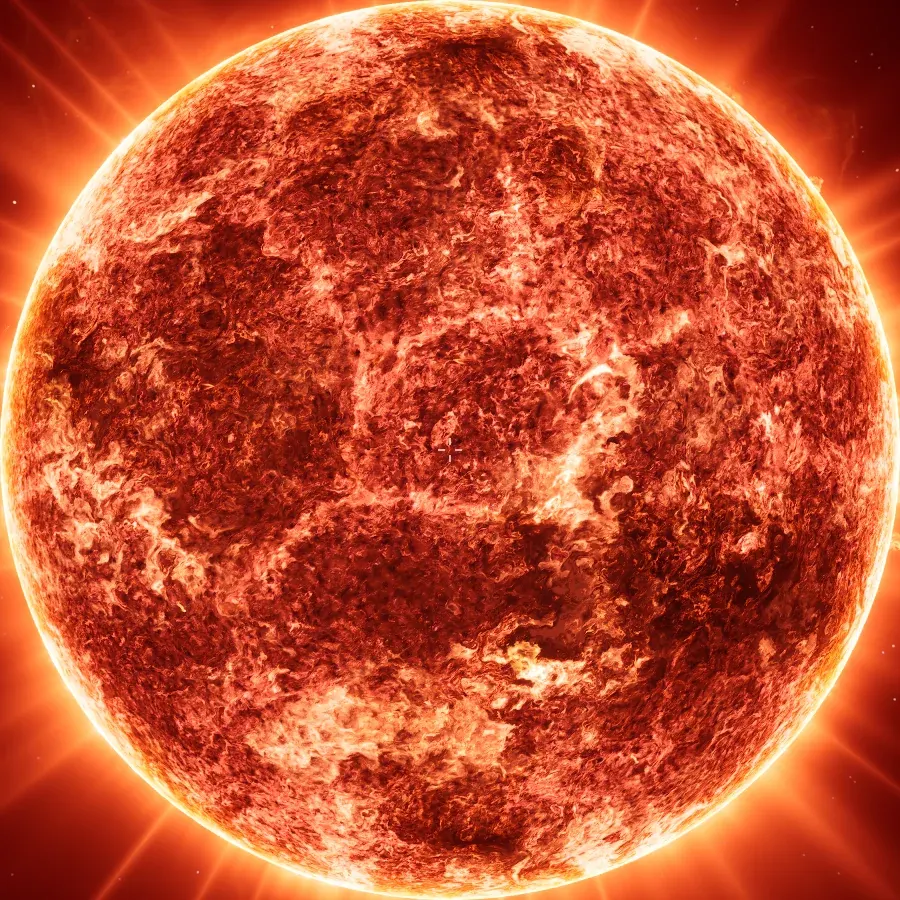 , open full size
Orange, not red
The name misleads. Folded through the colour response of the human eye, the light of an M dwarf is orange; not even the coolest main-sequence star is red in the way a traffic light is 1. Pax Abyssi gives you the choice. In Esc, Options, SPACE, the SUN section has a sun palette row. Scientific, the default, draws each star in the true colour of its light, so a red dwarf is orange. Game paints cool stars deep red, the way films and games show them, and it is the palette of every picture in this article: up close a sun has to read as hot, and a surface that climbs from deep red through orange into white reads as heat. Vivid turns the game colours up again.
What a red dwarf is
M dwarfs are the main-sequence stars from about 3,900 K down to about 2,350 K. In Eric Mamajek's compilation, which builds on Pecaut and Mamajek (2013), an M0 dwarf has 0.57 solar masses and 7 percent of the Sun's luminosity; an M5 dwarf has 0.16 solar masses and 0.3 percent; and an M9 dwarf, at the very bottom of the main sequence, has 0.079 solar masses and three hundredths of a percent 2 3. Below that mass an object cannot sustain hydrogen fusion at all, and is a brown dwarf. Their spectra are crossed by the bands of molecules such as titanium oxide, which only survive in cool gas.
Below about 0.35 solar masses a red dwarf is convective all the way to its centre 4. The churning mixes fresh hydrogen into the core, so the star can burn almost all of it, not only the central tenth or so that a star like the Sun uses. Together with its slow burning rate, that makes the smallest red dwarfs nearly immortal: a star of 0.1 solar masses stays on the main sequence for about six trillion years, hundreds of times the present age of the universe 5.
Red dwarfs are also violent for their size. Deep convection and fast rotation wind up strong magnetic fields, and the fields release flares that can briefly outshine the whole star in ultraviolet light. The TESS satellite recorded thousands of flares on M dwarfs in its first months of data 6.
And there are a great many of them. A census of every star within 10 parsecs of the Sun, about 33 light years, counts 249 M dwarfs, against 38 K stars, 18 G stars and 8 F stars 7. About three nearby stars in four are red dwarfs.
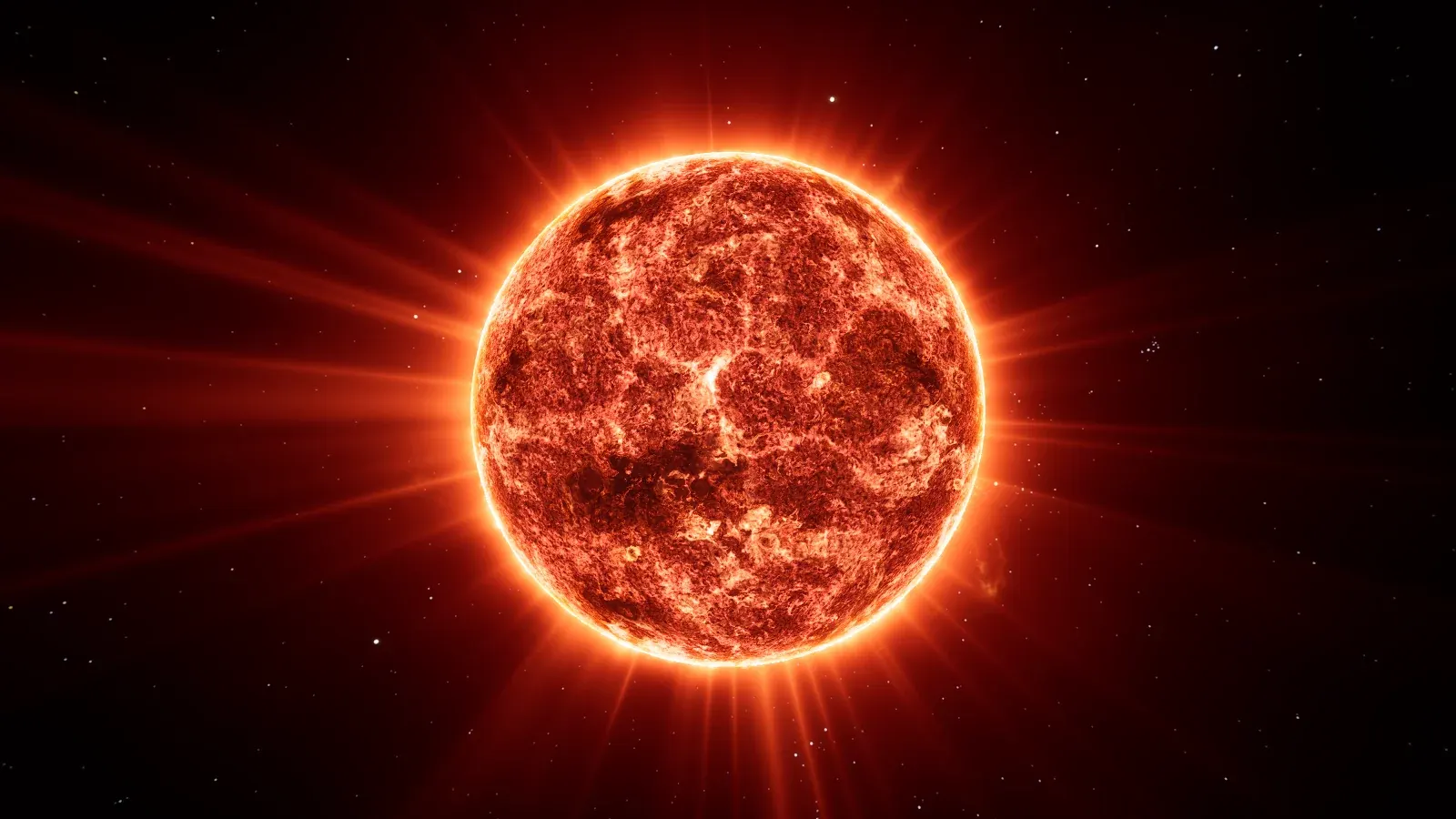 , open full size
Red dwarfs you can fly to
The letter M covers two very different kinds of star. The catalogue's charted systems include 315 M stars, and almost all of them are red giants: stars like the Sun near the ends of their lives, swollen to tens or hundreds of times their old size and bright enough to see across the galaxy. They share the dwarfs' cool surfaces and molecular spectra, and nothing else. A red dwarf is a star at the start of an almost endless life; a red giant is a star near the end of one.
Red dwarfs are too faint for a naked-eye catalogue, and the simulated Milky Way supplies them at their true rate: three stars in four in the generated galaxy are red dwarfs, tens of billions of them, and near the Sun the generator places the faint ones that surveys have yet to find. Pick any of them on the galaxy map and its system is built on the click. Two to visit:
- Proxima Centauri, 4.24 light years away and the nearest star to the Sun. It is an M5.5 flare star of 0.12 solar masses, bound to Alpha Centauri A and B on an orbit that takes about 550,000 years 8.
- Gliese 690.1, catalogued as an M2.5 dwarf, and home to one of the most striking systems the game has generated.
What their planets are like
The game's generator builds a planetary system from the star outward. It places the habitable zone by the formula of Kopparapu and colleagues 9, sets the frost lines and chooses an architecture. The chance of planets starts at 0.95 for an M star, the highest of any class, and then responds to metallicity, age and companions. The favoured architecture is compact and rocky, and its real-world model is TRAPPIST-1, an M8 dwarf 40 light years away with seven Earth-sized planets, all orbiting closer to their star than Mercury does to the Sun 10.
A red dwarf is so faint that its habitable zone lies only a few hundredths to a tenth of an astronomical unit out, and the whole system shrinks to fit. Gliese 690.1 shows it. Its seven generated planets all orbit within 0.3 AU: two bare rocky worlds close in, a clouded world of basalt highlands, another bare rock, and then, at 0.09 AU in the habitable zone, an ocean world with living seas and chains of volcanic islands. Beyond it lie a royal-blue cold mini-Neptune and a super-Earth wrapped in ice, resurfaced by cryovolcanoes.
The series
This completes our tour of the main sequence, from the blue O stars that live a few million years to the red dwarfs that will outlast them by a factor of a million. Every class is in Pax Abyssi, each with its own look and its own kinds of planet.
References
- 1Harre, J. V. and Heller, R. (2021). Digital color codes of stars. Astronomische Nachrichten 342, 578-587. doi:10.1002/asna.202113868
- 2Mamajek, E. E.. A Modern Mean Dwarf Stellar Color and Effective Temperature Sequence (version 2022.04.16). www.pas.rochester.edu/~emamajek/EEM_dwarf_UBVIJHK_colors_Teff.txt
- 3Pecaut, M. J. and Mamajek, E. E. (2013). Intrinsic Colors, Temperatures, and Bolometric Corrections of Pre-main-sequence Stars. The Astrophysical Journal Supplement Series 208, 9. doi:10.1088/0067-0049/208/1/9
- 4Chabrier, G. and Baraffe, I. (1997). Structure and evolution of low-mass stars. Astronomy & Astrophysics 327, 1039-1053. arxiv.org/abs/astro-ph/9704118
- 5Laughlin, G., Bodenheimer, P. and Adams, F. C. (1997). The End of the Main Sequence. The Astrophysical Journal 482, 420-432. doi:10.1086/304125
- 6Günther, M. N. et al. (2020). Stellar Flares from the First TESS Data Release: Exploring a New Sample of M Dwarfs. The Astronomical Journal 159, 60. doi:10.3847/1538-3881/ab5d3a
- 7Reylé, C. et al. (2021). The 10 parsec sample in the Gaia era. Astronomy & Astrophysics 650, A201. doi:10.1051/0004-6361/202140985
- 8Kervella, P., Thévenin, F. and Lovis, C. (2017). Proxima's orbit around α Centauri. Astronomy & Astrophysics 598, L7. doi:10.1051/0004-6361/201629930
- 9Kopparapu, R. K. et al. (2013). Habitable Zones around Main-sequence Stars: New Estimates. The Astrophysical Journal 765, 131. doi:10.1088/0004-637X/765/2/131
- 10Gillon, M. et al. (2017). Seven temperate terrestrial planets around the nearby ultracool dwarf star TRAPPIST-1. Nature 542, 456-460. doi:10.1038/nature21360
Related in the wiki
Credits
- The Pax Abyssi team
- Author
Spotted an error? Tell us in the forum thread or on the talk page of a related wiki article; corrections are noted at the top of the piece.