What colour is a star?
Every star shines with the colour of its temperature, and almost every star looks white. The Sun seen from space is white too. This feature explains the physics of star colour, how Pax Abyssi draws it, and the two settings that let you choose between the sky as it is and the sky as films have taught us to expect it.
By The Pax Abyssi team

The Sun from five solar radii, about 3.5 million km out, drawn by Pax Abyssi under the game sun palette.
Pax Abyssi
Look up on a clear night and the sky is full of white points. A few stand out: Betelgeuse a faint orange at Orion's shoulder, Antares redder still, Rigel and Vega a cool blue-white. Yet every one of those stars is shining with a definite colour, set by the temperature of its surface, and the difference between them is larger than the eye suggests. A red dwarf's surface is at about 3,000 K; the hottest stars reach 40,000 K and more.
Pax Abyssi has to put all of that on a monitor: the naked-eye sky of a simulated Milky Way of some 111 billion stars, and the star you are flying towards, which fills the canopy when you arrive. This article is about how a star gets its colour, why the colours we see are so pale, and what we do about it.
A body that glows
Anything hot glows. Heat a poker and it goes dull red, then orange, then yellow-white. The colour follows the temperature because of the way a hot, opaque body sheds energy: its light is spread over every wavelength in a smooth hump, the blackbody spectrum Max Planck derived in 1900 1. As the temperature rises the hump grows taller and its peak slides to shorter wavelengths. Wien's law puts the peak at
A star is not a perfect blackbody: atoms and molecules in its atmosphere cut dark absorption lines into the spectrum, and those lines are what astronomers use to classify it. But the overall shape of a star's light is close to a blackbody, and its colour is set by the temperature of the layer we see, the photosphere. For the Sun that temperature is 5,772 K 2, and Wien's law puts its peak at about 502 nm, in the blue-green.
That fact surprises people, because nobody has ever seen a green star. The reason is that the hump is broad. The Sun pours out nearly as much light at 450 nm as at 650 nm, and the eye, which has three kinds of colour receptor with broad, overlapping sensitivities, adds all of it up. A spectrum that spans the whole visible range, with no strong tilt, reads as white.
What the eye makes of a temperature
To turn a spectrum into a colour, you pass it through the response of the human eye. The standard way to do that is the CIE 1931 colour-matching functions, measured on real observers and adopted as an international standard that year 3. Fold the blackbody curve through them and you get the colour a person would see, for every temperature. Plotted on a chart of all colours, those points trace a smooth arc called the Planckian locus: deep orange at 2,000 K, through peach and cream, white near 6,500 K, and on into ever paler blues as the temperature climbs.
Three consequences surprise almost everyone.
- There are no green or purple stars. The locus never reaches them. A green star would need a spectrum peaked sharply in the green, and a blackbody's hump is far too wide for that.
- The Sun is white. Folding the Sun's own measured spectrum through the eye's response gives a white with the faintest trace of warmth 4. It looks yellow from the ground because the air scatters blue light out of the direct beam (which is why the sky is blue), and it looks orange at sunset because the beam then crosses so much air. Above the atmosphere, astronauts see a white Sun.
- The ends are gentler than the names suggest. A "red" dwarf at 3,000 K is orange to the eye; the hottest O stars are a pale blue. Harre and Heller computed the colour of every spectral type this way and found the whitest stars among the late F types, with the Sun just on the warm side of white 4.
Why the night sky looks white
If stars have colours, why does the sky look like a field of white points? Because starlight is dim. The eye has two kinds of receptor: cones, which see colour and need plenty of light, and rods, which are far more sensitive but colour-blind. In the dark the eye hands over to its rods, and a faint star arrives as brightness with no hue. Only the brightest stars push enough light into the cones for a colour to register, which is why the colours you can see with the naked eye all belong to first-magnitude stars, and why a telescope, which gathers more light, shows colours the eye alone misses.
Cameras have the opposite problem. A long exposure collects plenty of light, but a bright star overfills the sensor: all three colour channels hit their maximum and the pixel records pure white. In deep-sky photographs the colour of a bright star lives in the soft glow around it, not in its burnt-out centre.
How Pax Abyssi draws the sky
The sky of Pax Abyssi is the measured sky inside a fully simulated galaxy. Our catalogue holds 119,626 real stars from the HYG database, corrected against the Hipparcos and Gaia surveys, and 5,070 of them are bright enough to see with the naked eye from Earth. Around them the simulation places the rest of the Milky Way at its true density, some 111 billion stars, so the sky stays full and correct wherever you fly. For each catalogue star we take its B-V colour index, the difference between its brightness through a blue filter and a yellow one, and turn it into a temperature with Ballesteros's formula, which is derived from the blackbody itself 5. The temperature becomes a blackbody colour, and that colour becomes the star's tint. A generated star already has a temperature from its spectral class, and goes through the same steps.
Two systems draw stars in Pax Abyssi, and it helps to keep them apart. The first draws the sky: the points of light around you wherever you fly. The second draws the one star you are flying up to, once it is close enough to show a disc. This part is about the points.
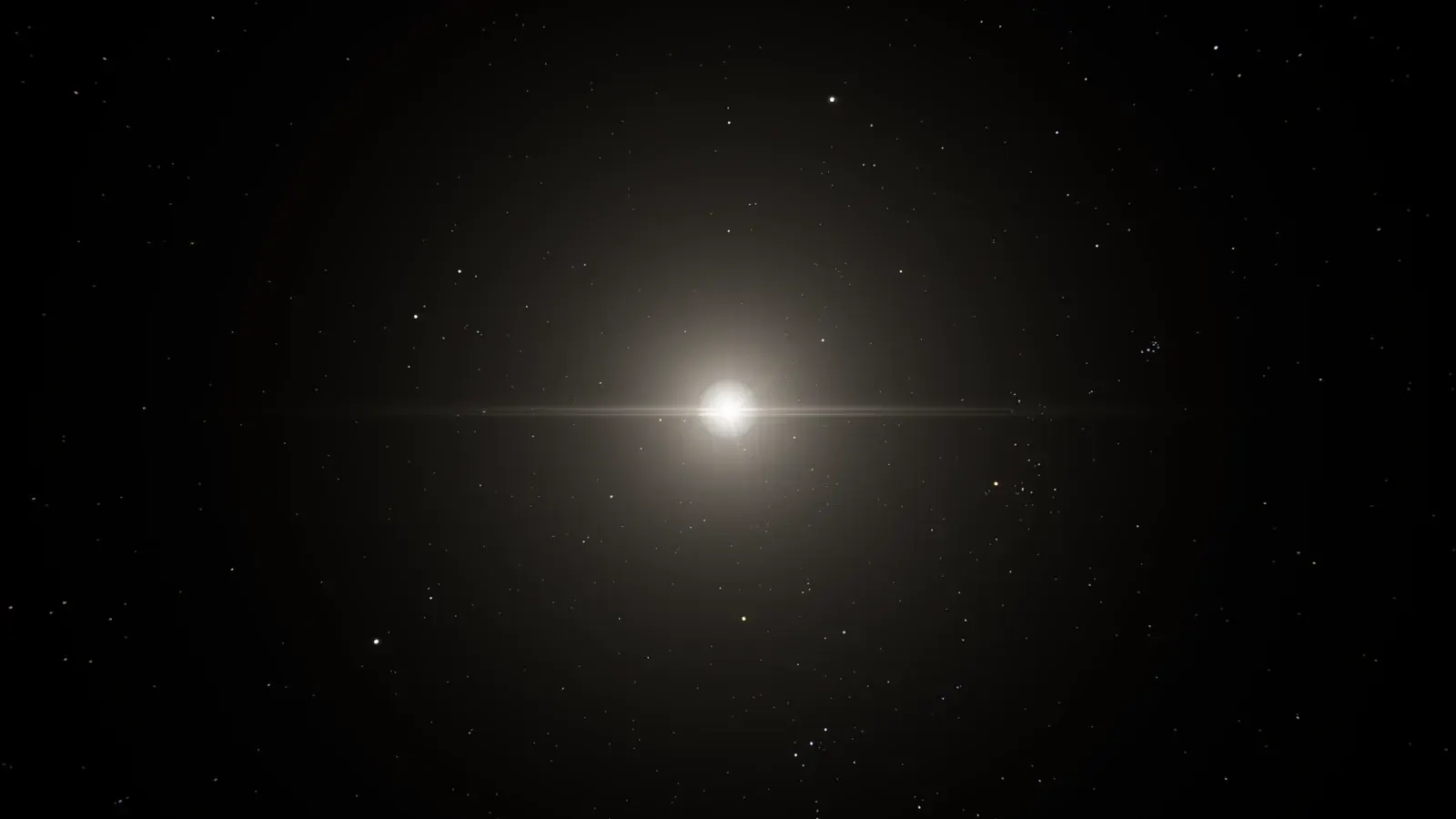
A star in the sky is a white-hot centre inside a coloured glow. Look at the glow: that is where the colour lives, in the game as in a photograph.
A white core in a coloured halo
Sirius, the brightest star in the night sky, arrives at the centre of its disc at about 400 times the brightness the screen can show as white. Like a camera, the screen clips it. So each star is drawn as two parts: a tight core, pulled three quarters of the way towards white, as a camera's burnt-out centre would be, inside a wide halo that carries the star's colour at about a sixth of the core's brightness. The halo sits below the white point, so its colour survives.
At the default setting, then, a star point in our sky is paler overall than its true blackbody colour. A 3,000 K star, whose true colour is a clear orange, reads as a pale apricot point. That is faithful to what you would see: the naked eye shows the night sky almost colourless, and a camera shows bright stars with white centres. The colour is in the halo, and there we give it a little help. The halo's tint is pushed away from grey by a factor of 1.35, which moves each star towards its own colour: blue stars bluer, orange ones more orange, white ones unchanged. Our reference for the look was a sky of small, softly glowing stars, "subtle, but slightly accentuated", and the push is what keeps a sky of pale points from reading as a sheet of identical white dots.
The numbers tell you where to look. Of the 5,070 naked-eye catalogue stars in the sky from Earth, 936, about one in five, have a core that clips; every star with a proper name is among them. The other 4,134 sit wholly below white. So when you look at Betelgeuse or Rigel, look at the glow, not the centre.
The colour ladder
How much colour you want in the sky is a matter of taste, so the star colour row under Esc > Options > SPACE gives you ten rungs.
| Rung | What it is | Core pulled to white | Saturation |
|---|---|---|---|
| 1 (default) | The palest: close to the sky the eye sees, colour in the glow | 75% | 1.00 |
| 2 to 4 | The core takes more of the star's own colour at each step | 55%, 36%, 18% | 1.10, 1.25, 1.45 |
| 5 | Accentuated but believable: colour in the sky that still looks real | 0% | 1.70 |
| 6 to 9 | Stronger colour at each step | 0% | 2.05 to 4.60 |
| 10 | Deliberately too much | 0% | 7.00 |
The first five rungs walk the star's own colour into its core; by rung 5 every star wears at least its full blackbody colour, and more. From rung 6 up the ladder only adds saturation, and the steps get bigger as they climb, because each extra unit buys less visible change once a colour channel has reached zero; uneven numbers give even-looking steps. A star's peak brightness never moves on any rung, so the brightest stars stay the brightest. Rung 10 is built to look wrong: Betelgeuse loses its blue channel entirely and Rigel turns a vivid cyan. No real sky does that, and with rung 10 beside it, rung 5 has something to be believable against.
The ladder always pushes each star towards its own truth. Sirius and Rigel get cooler as you climb; Betelgeuse and Aldebaran get warmer. Nothing gets redder for the sake of it.
When the star fills the window
Out in the sky a star is a point. Drop out of your jump beside one and it becomes a world of fire filling the canopy, and that close-up star has its own colour settings.
 , open full size
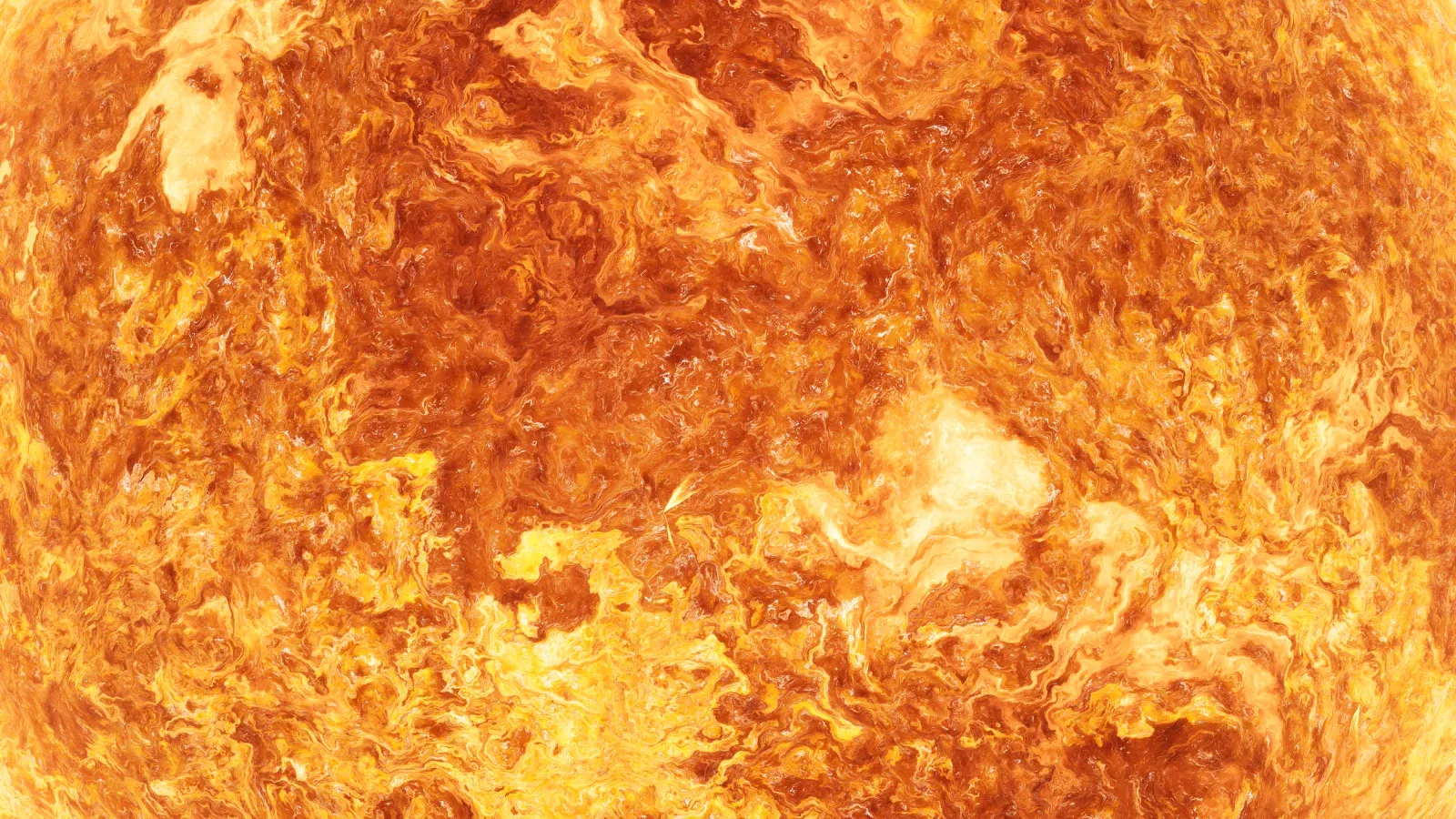
Close up, the surface is alive, and it is driven from the star's own data. Every flyable star carries a sheet of more than a hundred measured and derived properties, and the surface reads the ones that decide its look: temperature, the size of its convection cells, how active it is, how much of it is covered in starspots, how fast it turns, and how strongly its disc darkens towards the edge. A red dwarf wears a few large, high-contrast cells and heavy spots; a Sun-like star a fine mosaic; the hot O, B and A stars, whose outer layers carry heat by radiation rather than convection, a calmer face and a tighter, bluer glow.
 , open full size
The sun palette: scientific, game and vivid
The sun palette row, in the SUN section of Esc > Options > SPACE, sets the colours of that surface, of the distant disc and of the lens flare. It has three settings.
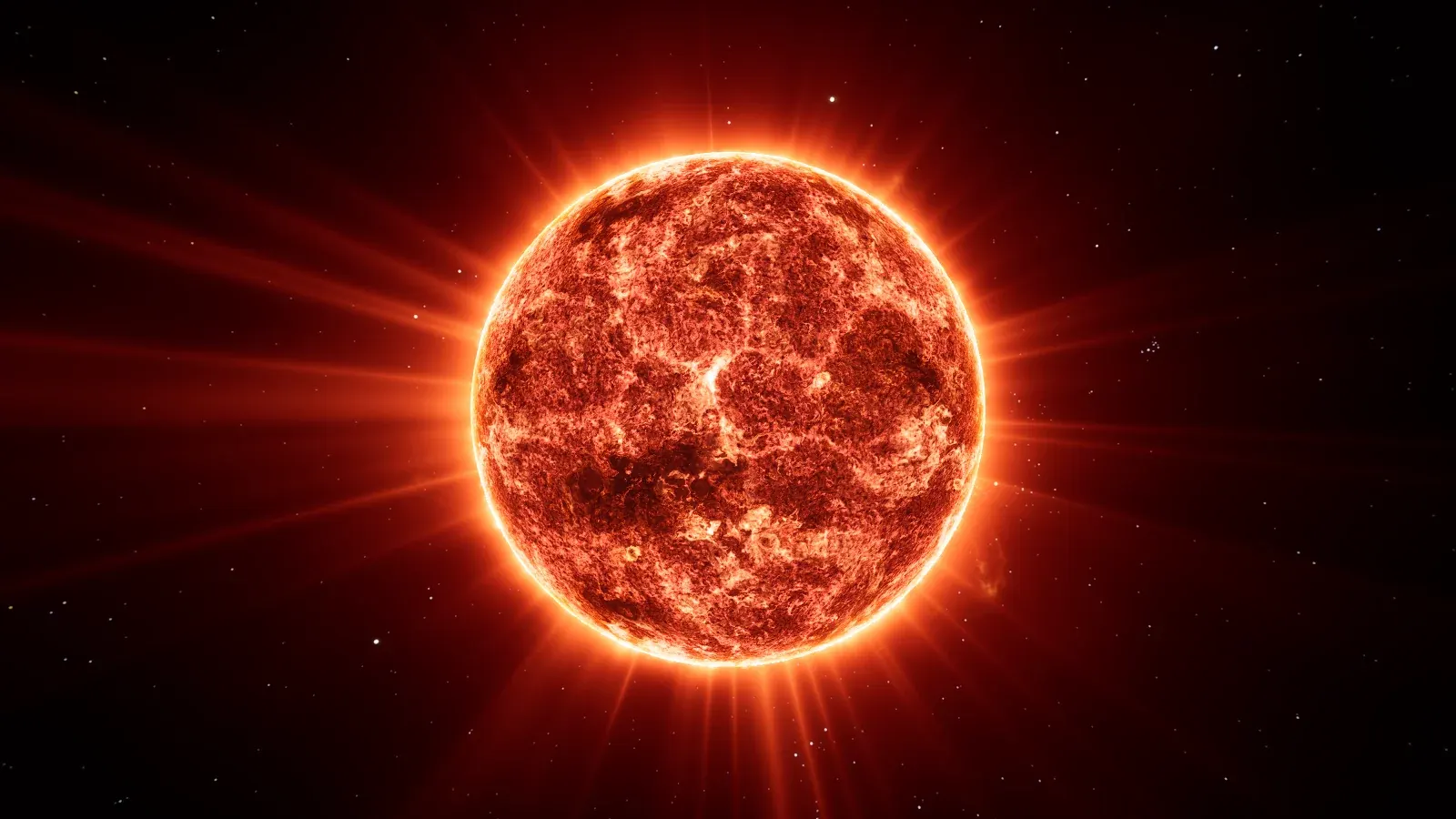
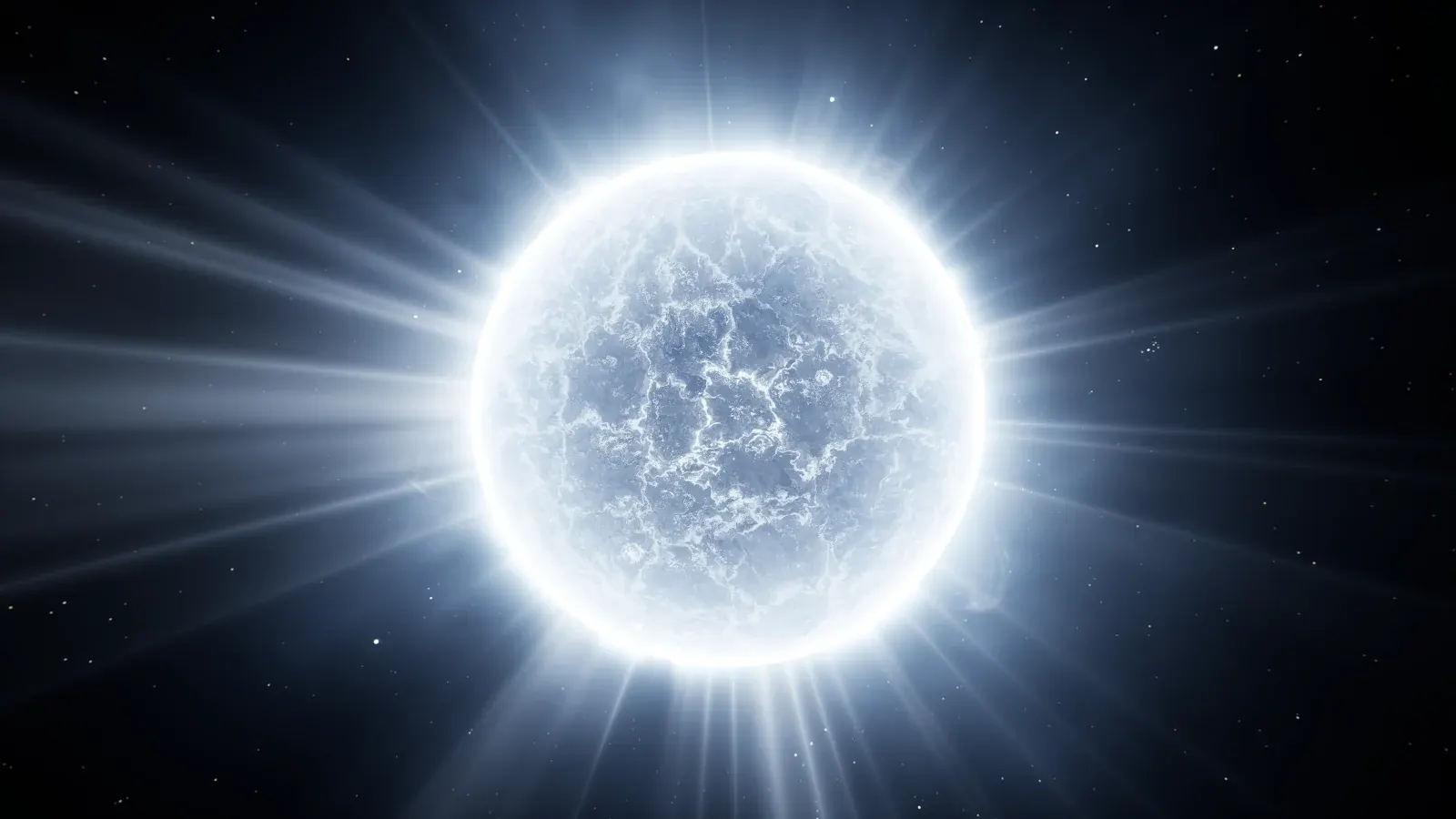
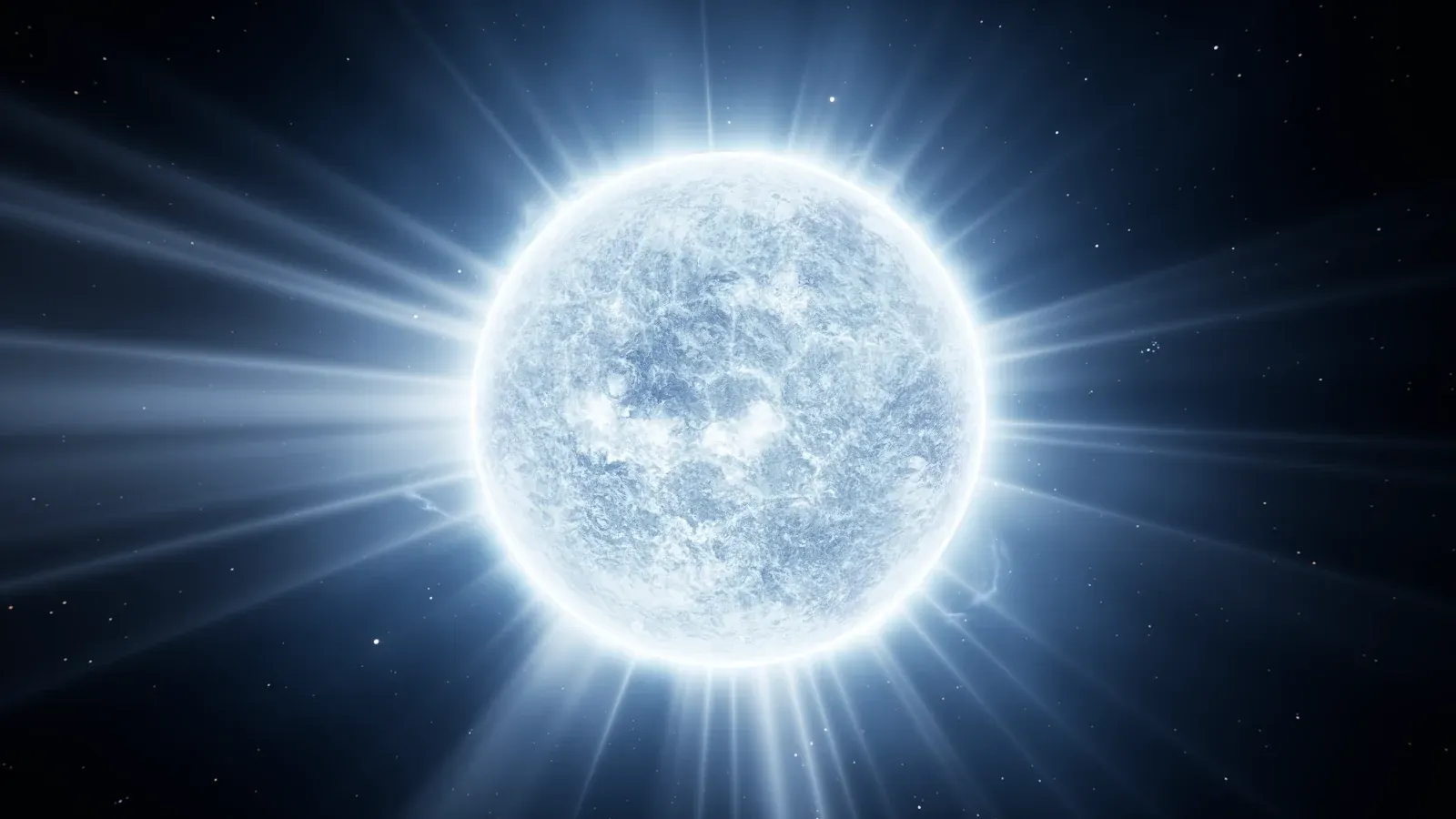
Scientific is the default. Every layer of the surface takes the true colour of a glowing body at its own temperature, calculated from Planck's law through the CIE 1931 observer into screen colour, exactly as in the first half of this article. The dark lanes between convection cells are drawn at 93 percent of the star's temperature, the umbra of a starspot at 72 percent, the hot cells a little above it, and a white-light flare at 1.6 times, the 9,000 to 10,000 K that real solar flares reach. The prominences arching from the limb are the one exception, and a good one: they glow in the red line of hydrogen, so they take the pink of eclipse photographs whatever the star. Under this setting the Sun is white, a 3,600 K giant is peach, and hot stars are a pale blue.
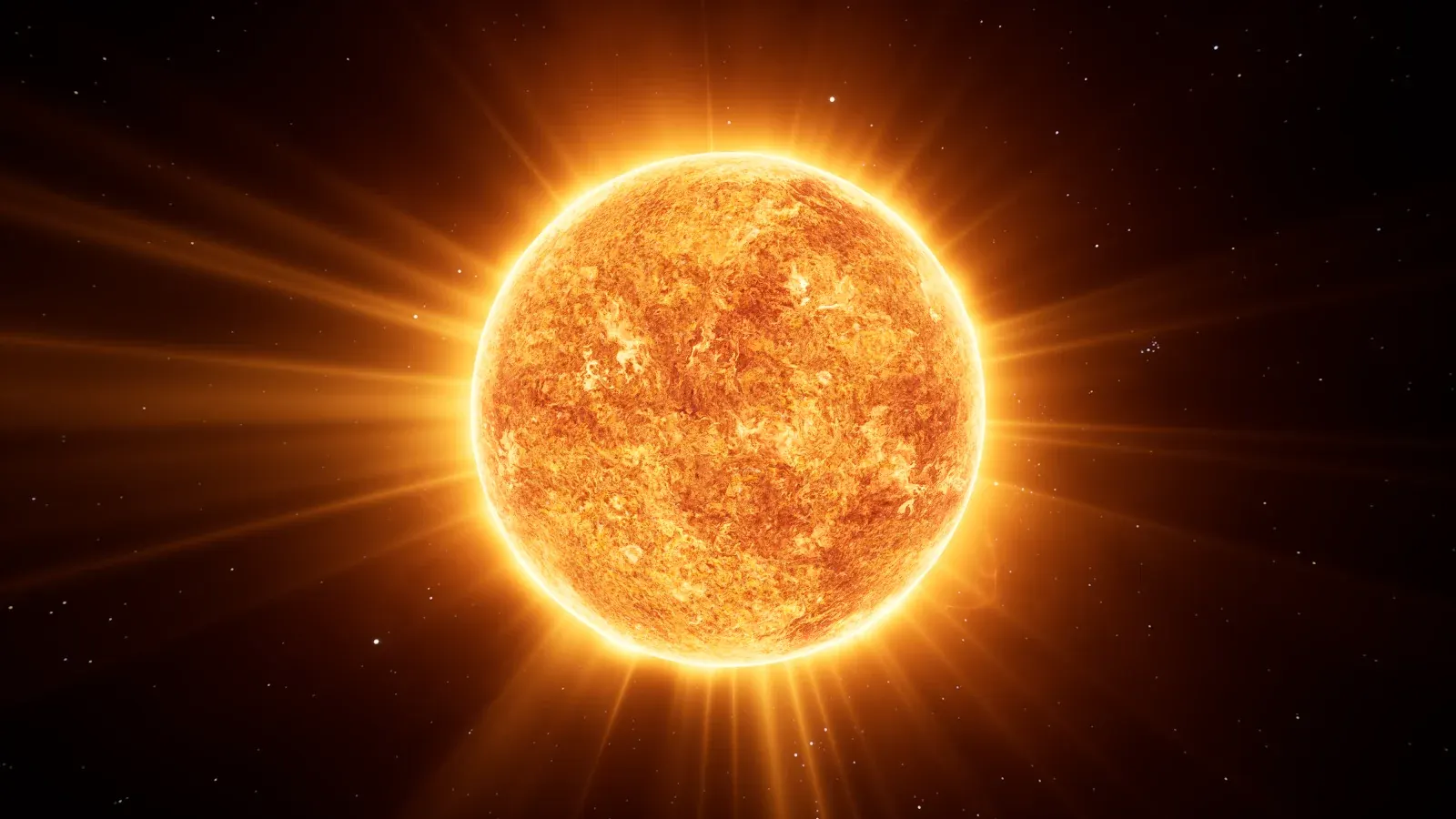
Game is the palette of films and games: a golden Sun, deep red dwarfs and electric blue giants. It exists because a close sun has to look hot, and a gold surface walking into white at its brightest cells reads as heat in a way that a white disc does not. The difference is large. Under the game palette the Sun's surface is painted (1, 0.18, 0) in screen colour, a deep orange; the scientific palette gives (1, 0.88, 0.82), white with a trace of warmth. Both are one setting away.
Vivid turns the game colours up further for anyone who wants the full poster.
Every in-game picture of a star in this article and its companion series was taken under the game palette. Switch to scientific and the same stars come out as the first half of this article says they should.
 , open full size
 , open full size
 , open full size
 , open full size
Two defaults, one principle
The sky and the close star are separate systems with separate settings, and both default towards what you would actually see. Out in the dark, a star is a point, and the eye sees points almost without colour, so the sky starts at its palest rung with the colour held in the glow. Up close, a star is a huge, bright disc, bright enough for the eye's colour vision to work in full, so the surface starts at its true colour: white for the Sun. The ladder takes the sky from there towards more colour; the sun palette takes the close star to the familiar gold and beyond.
Choosing your sky
If you want the real thing, leave both settings where they are: star colour at 1, sun palette at scientific. If you want colour you can read across the room, set star colour to 5, which keeps the sky believable, and try the game sun palette for the close approach. And if you want to see why the real sky is pale, set star colour to 10 for a minute, then step back down. The stars are the same either way, each in its true place, with the colour its temperature gives it.
References
- 1Planck, M. (1901). Ueber das Gesetz der Energieverteilung im Normalspectrum. Annalen der Physik 309, 553-563. doi:10.1002/andp.19013090310
- 2Prša, A. et al. (2016). Nominal Values for Selected Solar and Planetary Quantities: IAU 2015 Resolution B3. The Astronomical Journal 152, 41. doi:10.3847/0004-6256/152/2/41
- 3Smith, T. and Guild, J. (1931). The C.I.E. colorimetric standards and their use. Transactions of the Optical Society 33, 73-134. doi:10.1088/1475-4878/33/3/301
- 4Harre, J. V. and Heller, R. (2021). Digital color codes of stars. Astronomische Nachrichten 342, 578-587. doi:10.1002/asna.202113868
- 5Ballesteros, F. J. (2012). New insights into black bodies. EPL (Europhysics Letters) 97, 34008. doi:10.1209/0295-5075/97/34008
Related in the wiki
Credits
- The Pax Abyssi team
- Author
Spotted an error? Tell us in the forum thread or on the talk page of a related wiki article; corrections are noted at the top of the piece.