Seas of molten rock
Put a rocky planet close enough to its star and its day side melts. Pax Abyssi now grows every lava world around its catalogue stars from its own heat: 705 planets, each with a sea, a shore and a coastline of its own.
By Pax Abyssi Science Desk

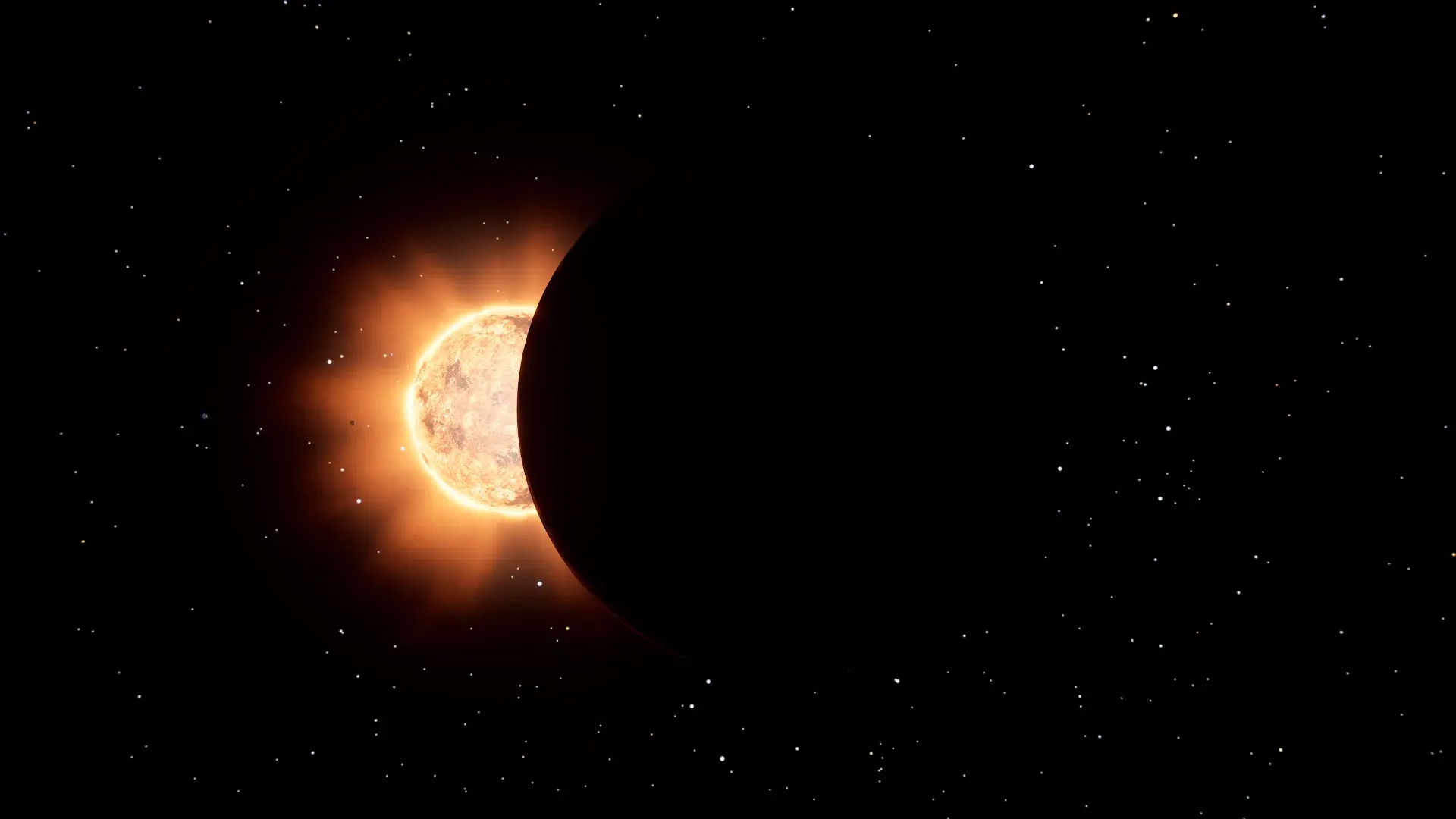
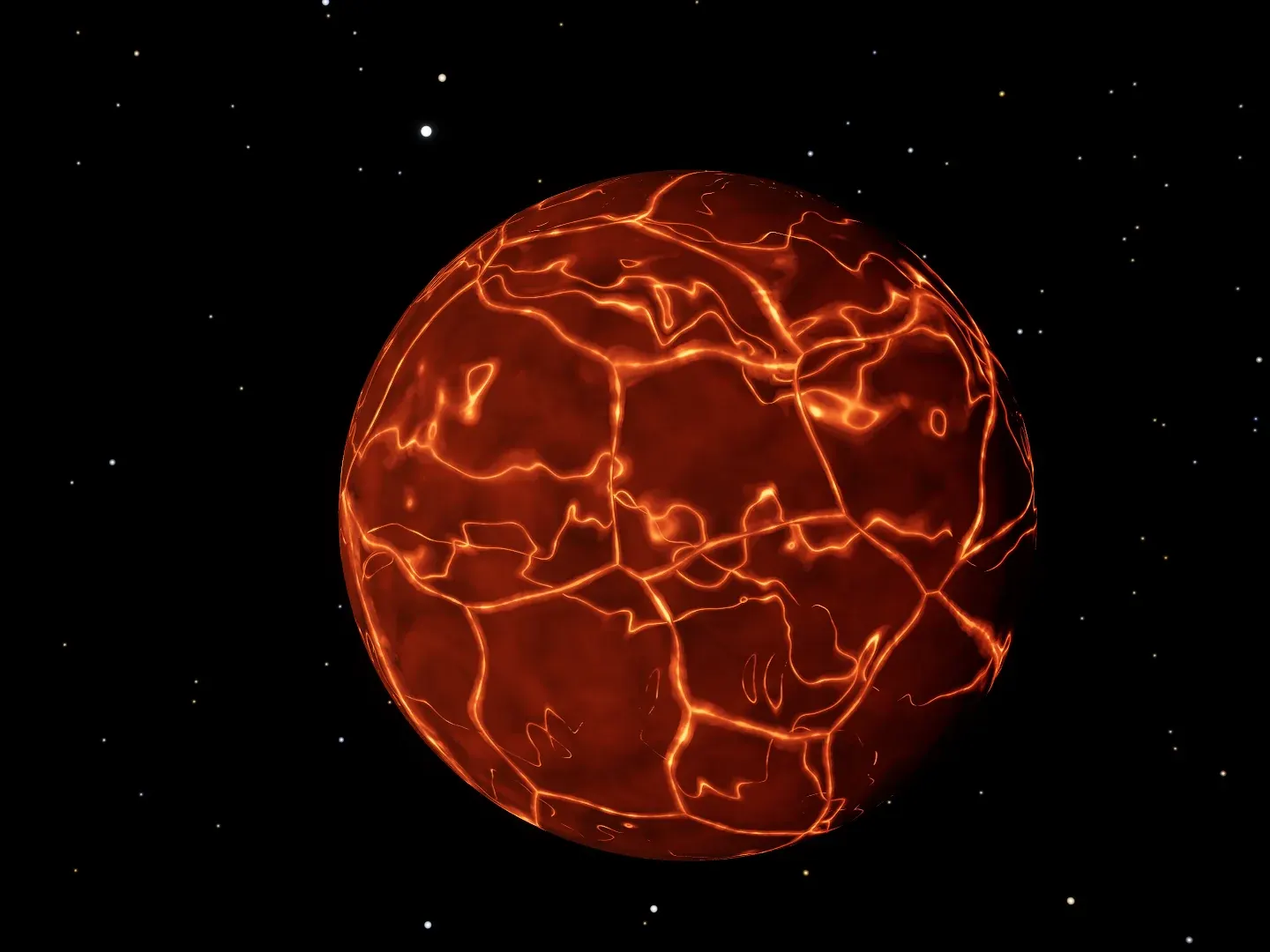
A hot lava world with a warm night side, type LWTL-HT-GL, in the game. Rafts of dark crust split by glowing cracks drift on its sea, and past the terminator the night side still glows a dull red.
Pax Abyssi
The first lava worlds were found by their shadows. In 2009 the CoRoT satellite caught CoRoT-7 b crossing the face of its star every 20.5 hours, and it became the first rocky planet outside the Solar System with a measured size 1. Kepler-10 b, on a 20.1 hour orbit, followed in 2011 2. Both circle their stars so closely that the rock on their day sides should be molten. Dozens of such planets are known today, and the James Webb Space Telescope has begun to measure the heat of their day sides and the air above them. To a telescope each one is a point of light. What their surfaces look like is a question for physics.
Pax Abyssi answers it planet by planet. Lava worlds are rare: Kepler found a small planet on an orbit of less than a day around about one Sun-like star in two hundred 3, and our system generator places them at that rate. Around the catalogue stars of our galaxy that makes 705 lava worlds in 369 systems, and our planet generator grows each one from its own numbers: how hot its day side is, how cold its night, how much crust floats on its sea. Sixteen kinds of lava world come out of a single process, and two more, new to the catalogue this week, are joining them. This is the science of that process, and what it shows.
How hot is hot enough
Almost every known lava world is tidally locked. Tides raised by its star have slowed its spin until it turns exactly once per orbit, so one hemisphere faces the star for ever and the other never sees it. With only a wisp of atmosphere and no water to carry heat, each patch of ground settles at the temperature where the heat it radiates equals the starlight it absorbs. Directly beneath the star, at the substellar point, that is about 1.4 times the planet's equilibrium temperature for dark rock. Away from that point the starlight arrives at a slant and the ground is cooler.
 , open full size
The fall is gentler than intuition suggests. The power a hot surface radiates rises as the fourth power of its temperature, so temperature follows only the fourth root of the sunlight. Where the star stands 30 degrees above the horizon the ground receives half the light it gets at the substellar point, yet it is 84 per cent as hot. At 10 degrees above the horizon it is still 65 per cent as hot. On a planet whose substellar point sits at 2,250 K, the ground stays above 1,200 K until the star is about five degrees from setting.
Temperature follows only the fourth root of the sunlight, so the rock stays molten almost to the terminator.
That number matters because rock does not melt at one temperature. Basalt, the dark volcanic rock of the Moon's seas and of Hawaii, is a mixture of minerals that melt over a range of a few hundred degrees. In a cooling Hawaiian lava lake, the rock was still about two thirds melt at 1,070 °C, and the last of the melt froze close to 980 °C, about 1,250 K 4. The mantle rock beneath a crust, peridotite, begins to melt near 1,390 K at the low pressures of a planet's surface 5. A planet whose substellar point is hotter than that holds at least a pool of magma, and on most known lava worlds the whole day side is hot enough.
A sea, a shore and rafts of crust
Molten rock behaves like any liquid in one respect: it finds its level. In the game, wherever melt rules, the ground drops to the level of the sea, so a lava sea is flat, and a raft of crust rides 50 metres above it. Models of CoRoT-7 b put such an ocean of lava across its day side 6.
The rafts come from what happens on real lava lakes. On a lake of basalt the surface cools and skins over, and the skin breaks into plates. The plates drift, pull apart where fresh lava wells up between them and override one another where they meet. Watching the lava lake in the crater of Mauna Ulu on Kilauea in 1971, the geologist Wendell Duffield saw spreading ridges, transform faults and margins where one slab of crust sank beneath another: the whole vocabulary of plate tectonics on the floor of a crater 7.
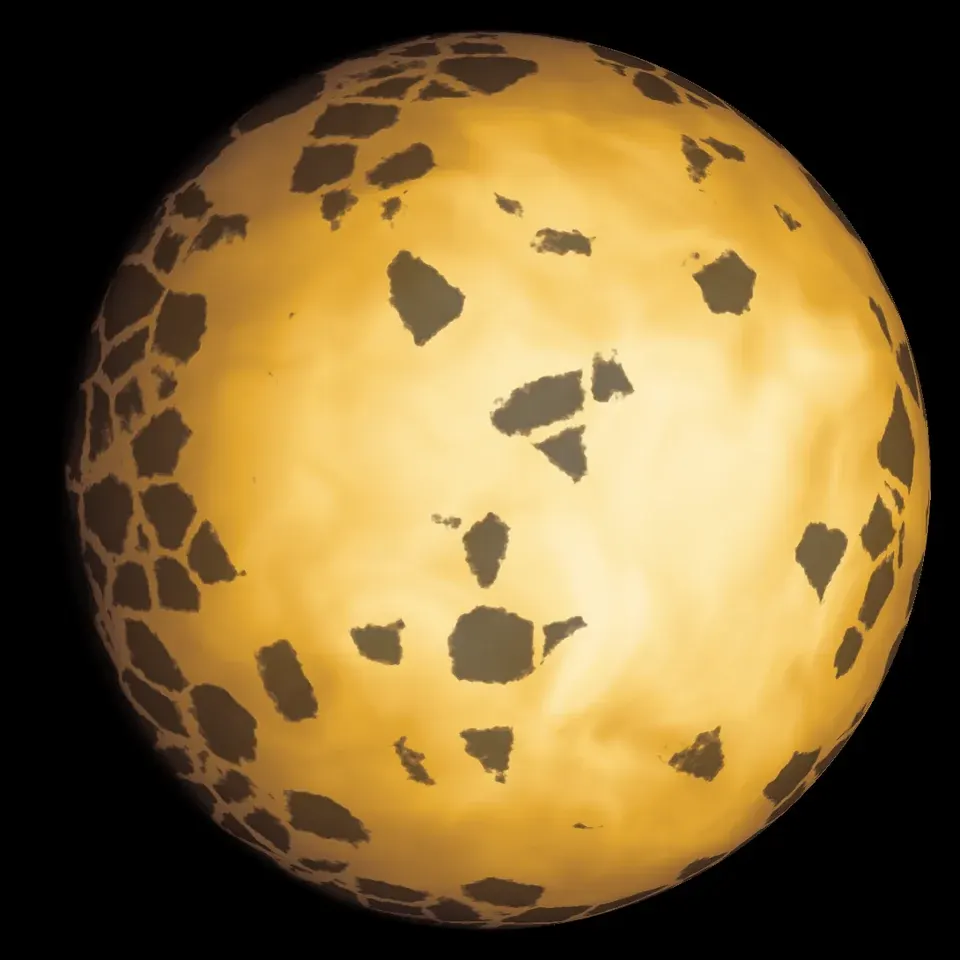
Our lava field draws crust the same way. Crust floats as plates, and each plate is decided whole at its own centre, so a plate is either crust or sea, never half of each. The share of the surface the plates cover starts at the planet's own raft coverage at the hottest point and climbs to complete crust at the shore, gathered into clumps by a slow, large-scale field and given torn edges. Between the plates runs a lane of lava, broad out in the sea and narrowing to a crack on land. A crack glows only where melt lies close beneath it; further out on the crust, the cracks go dark.
 , open full size
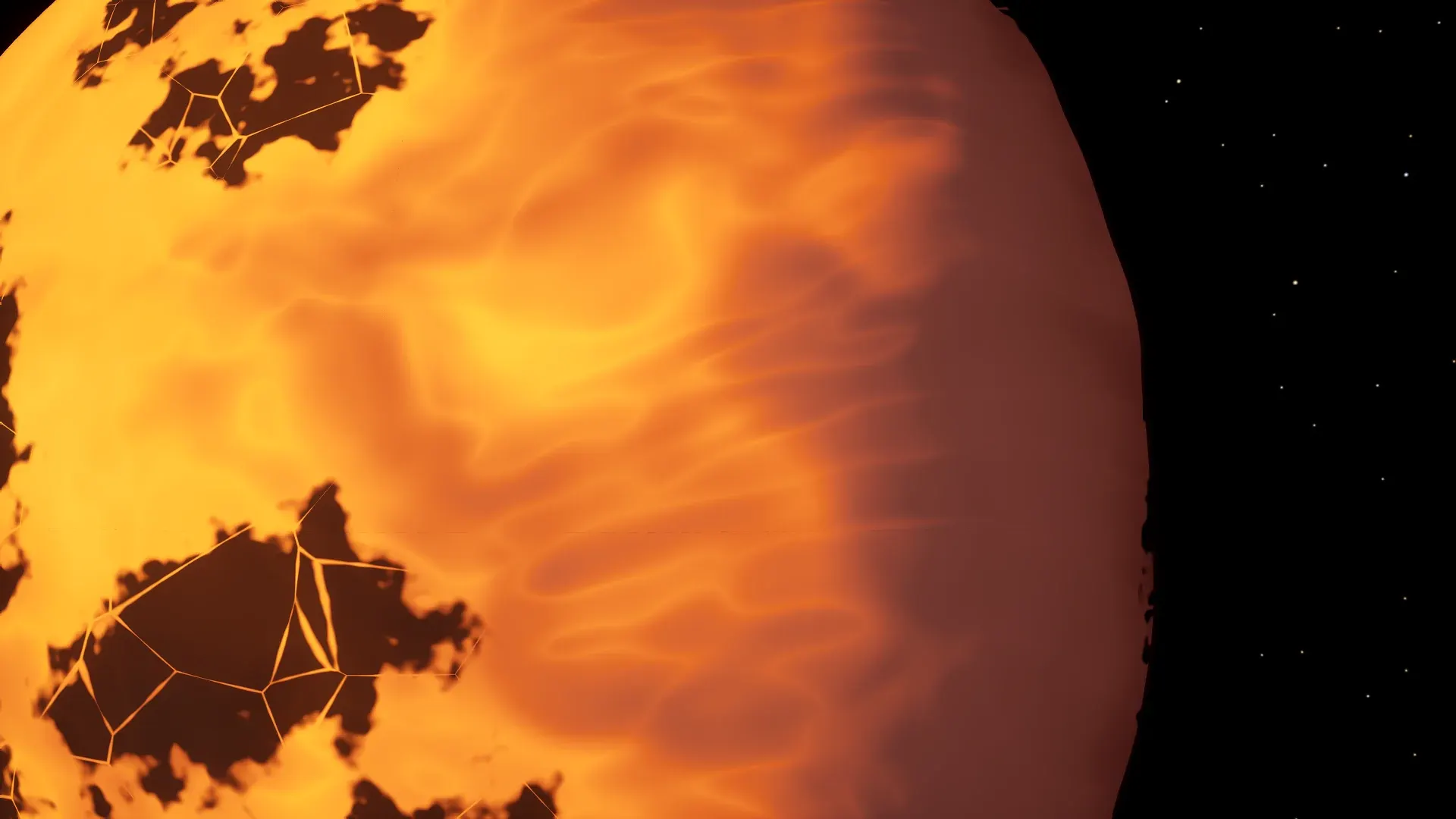
The sea also moves. A convecting magma ocean carries heat sideways, so its surface sits between the local balance and the mean temperature of the whole sea. Models of these magma pools find currents strong enough to keep a pool's composition well mixed wherever the substellar point is cooler than about 2,400 K 8. Without that mixing, a lava sea in the game would fade to a dull red long before its shore. With it, the shore stays orange, and the crust meets a sea that is still well above its melting point.
 , open full size
Sixteen kinds of lava world
Our planet classification splits lava worlds first by spin, because spin decides whether the magma is a permanent sea on one face or something the whole planet shares. The locked worlds, LWTL, divide by the heat of their day sides: ultra-hot above 2,500 K, hot from 2,000 to 2,500 K and moderate below 2,000 K, with a fourth group, volatile-rich, whose atmospheres are thick enough to veil the surface. The unlocked worlds, LWN, still turn and are heated by latitude all the way round. Each group divides again by what its surface is doing. The commonest type, the cool magma end, holds 168 planets; the rarest, two.
| Type | Planets | Day side | What you see |
|---|---|---|---|
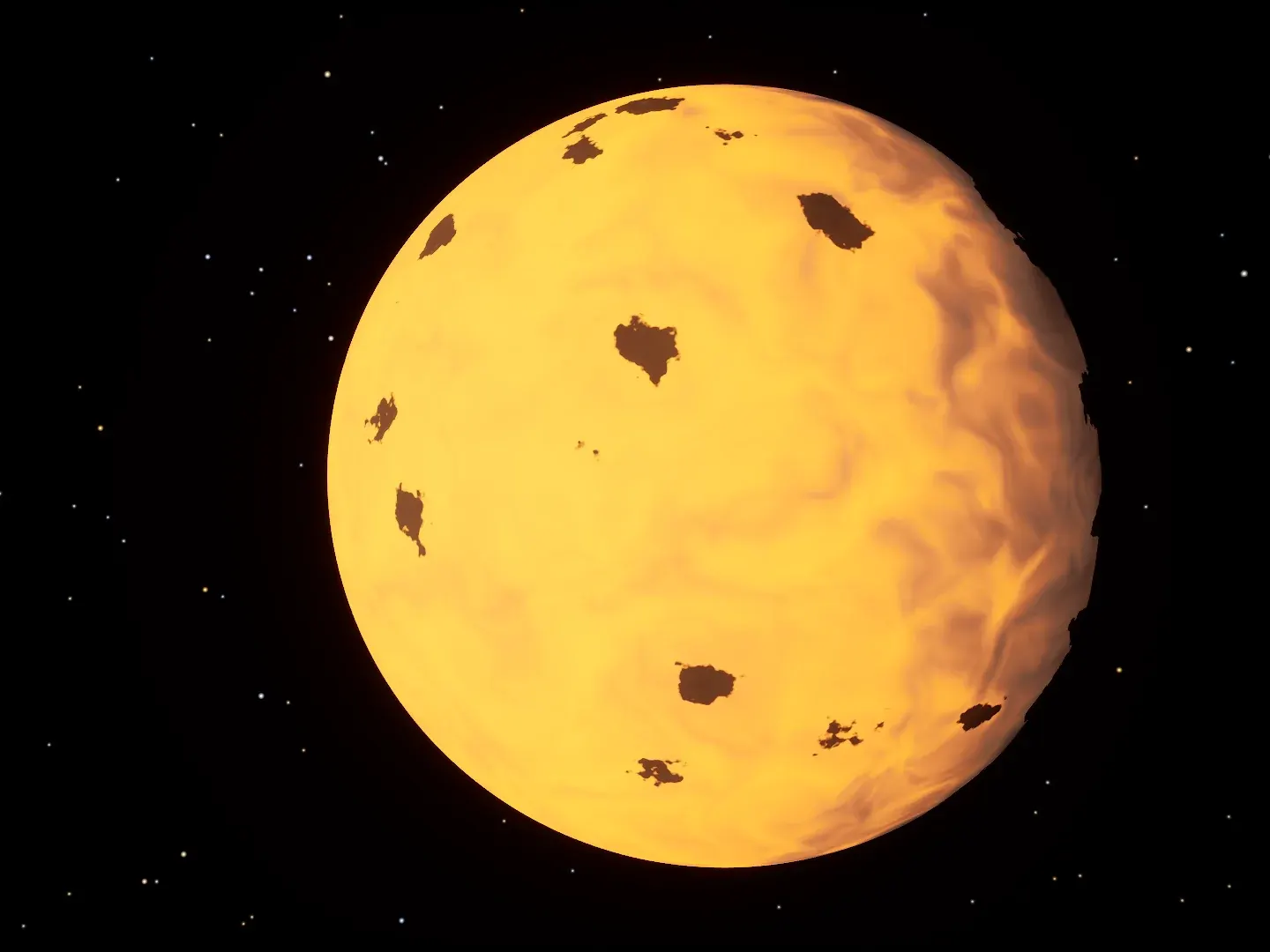
| Pristine magma ocean, LWTL-UH-PR | 20 | 2,675 K | A gold-white disc of open magma, swirled, with crust only at the rim |
| Magma ocean with crustal rafts, LWTL-UH-VN | 24 | 2,767 K | Gold-white sea, rafts packed towards the shore |
| Classic magma ocean, LWTL-HT-CL | 22 | 2,243 K | An orange swirled sea with dark floes and a torn shore |
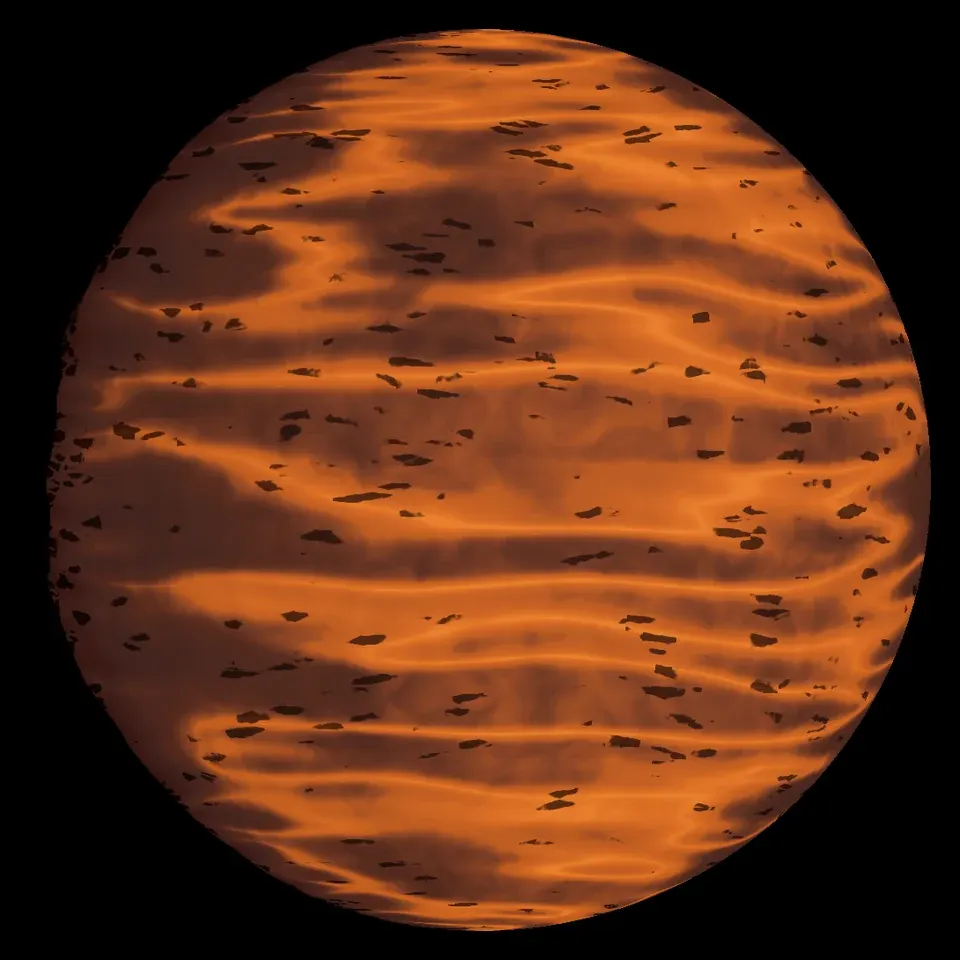
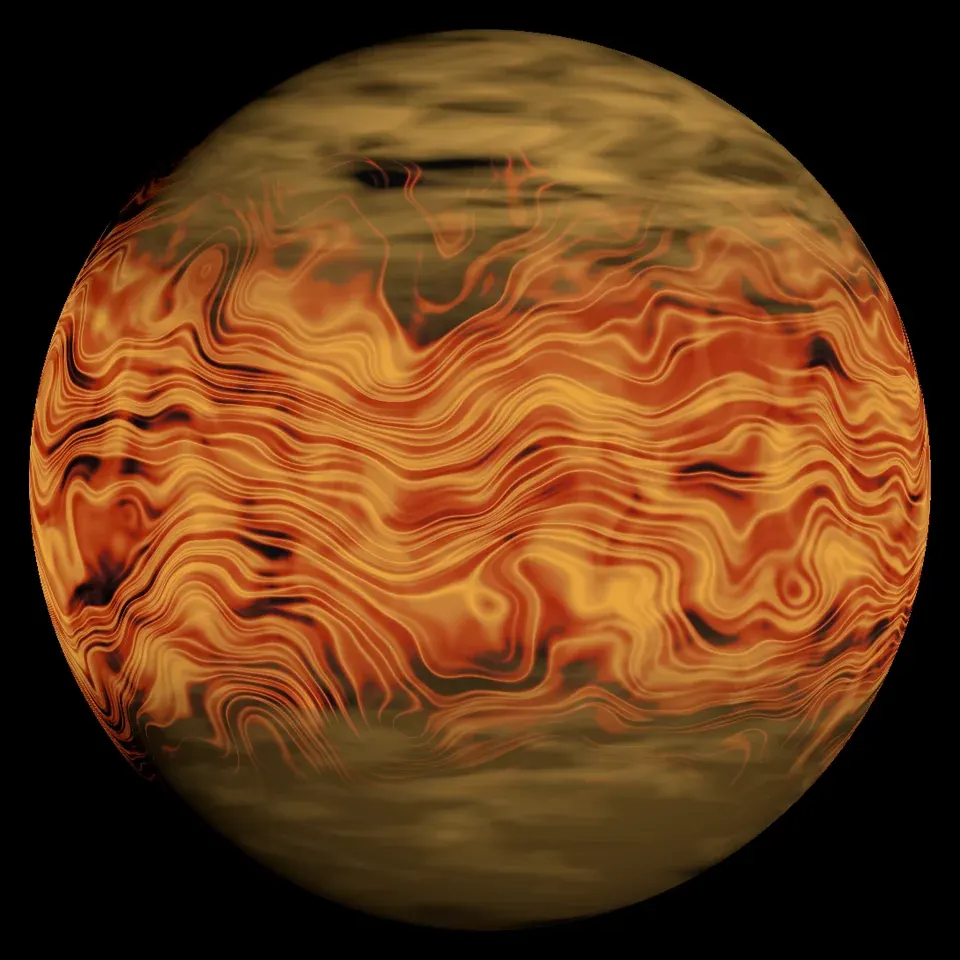
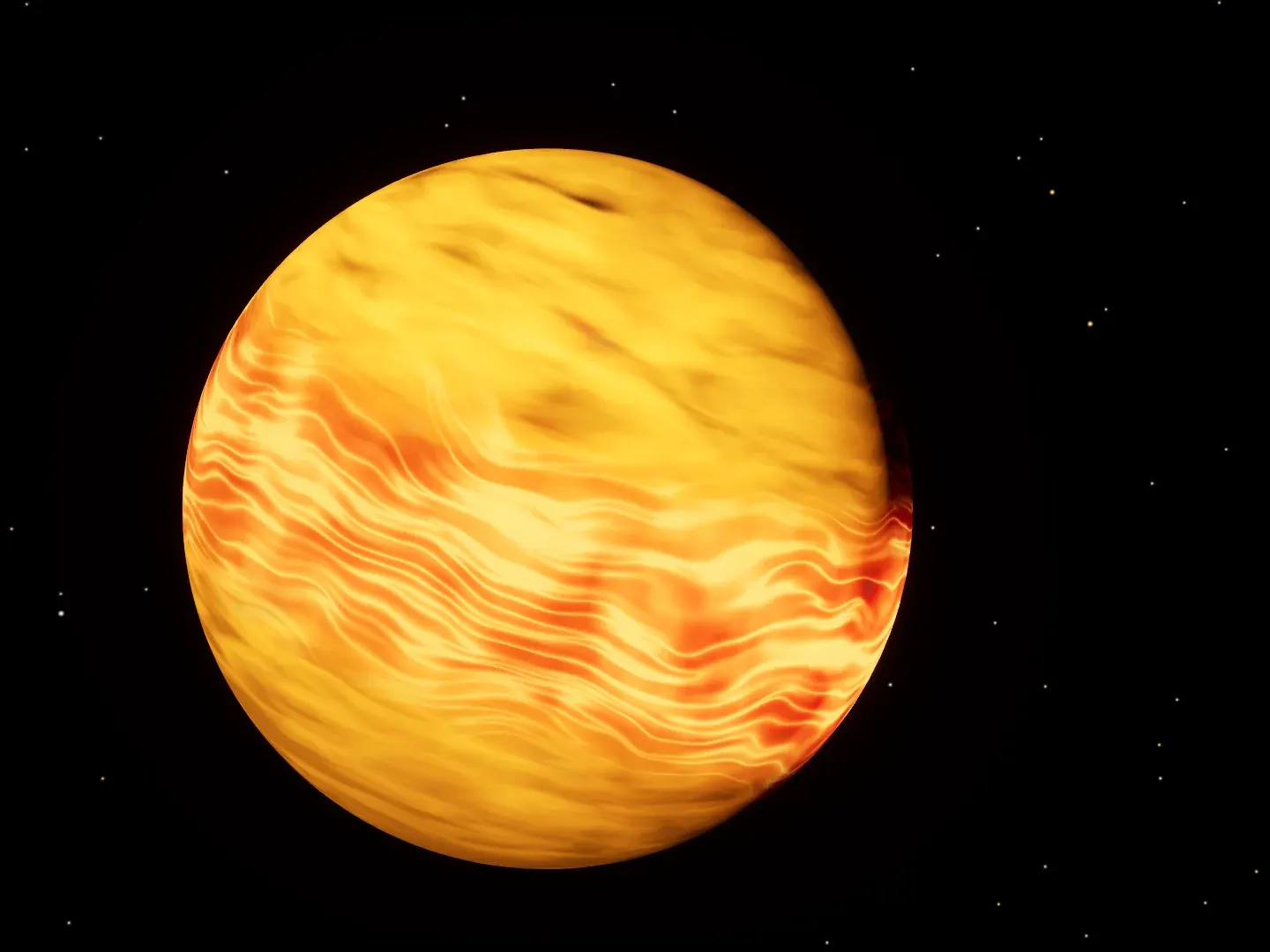
| Strong surface currents, LWTL-HT-FL | 43 | 2,219 K | A sea in a band, bright east-west filaments, raft slivers |
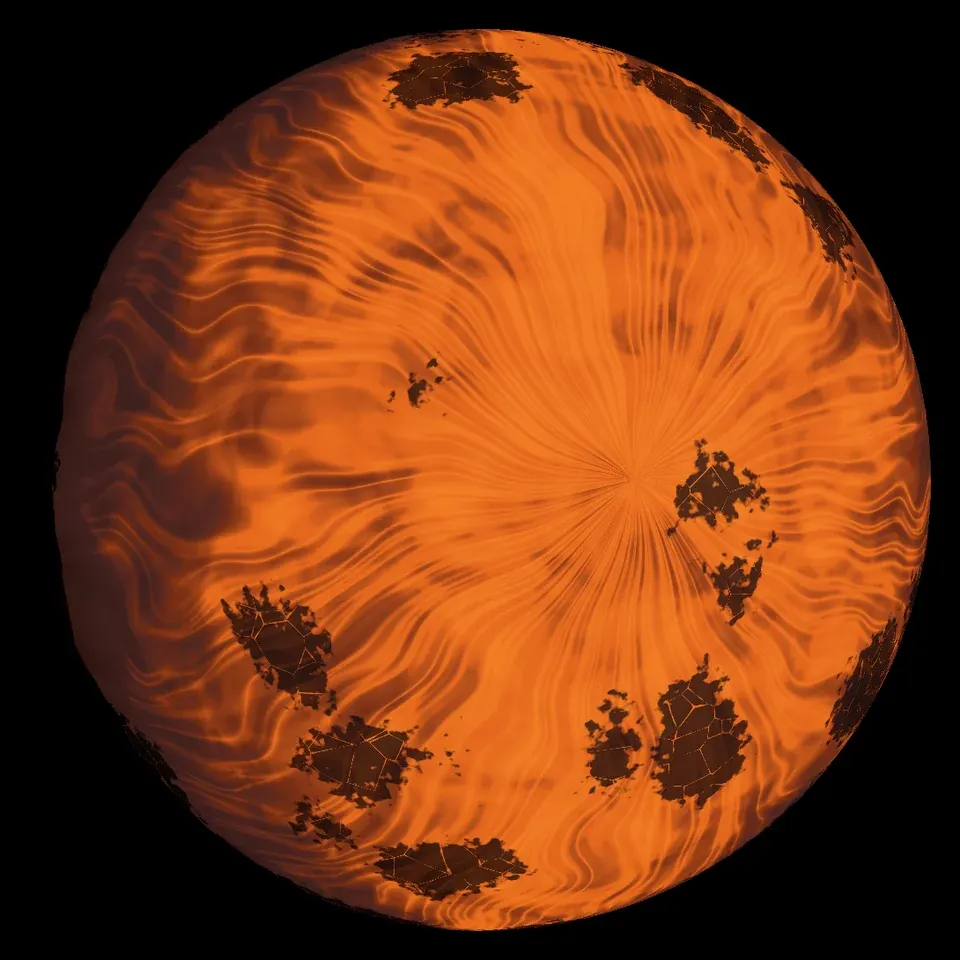
| Warm night side, LWTL-HT-GL | 40 | 2,129 K | Streaks fanning out from beneath the star; rock past the shore glows red |
| Hot magma end, LWTL-MD-MH | 72 | 1,900 K | A red-orange swirled sea in a band, a broad smeared shore |
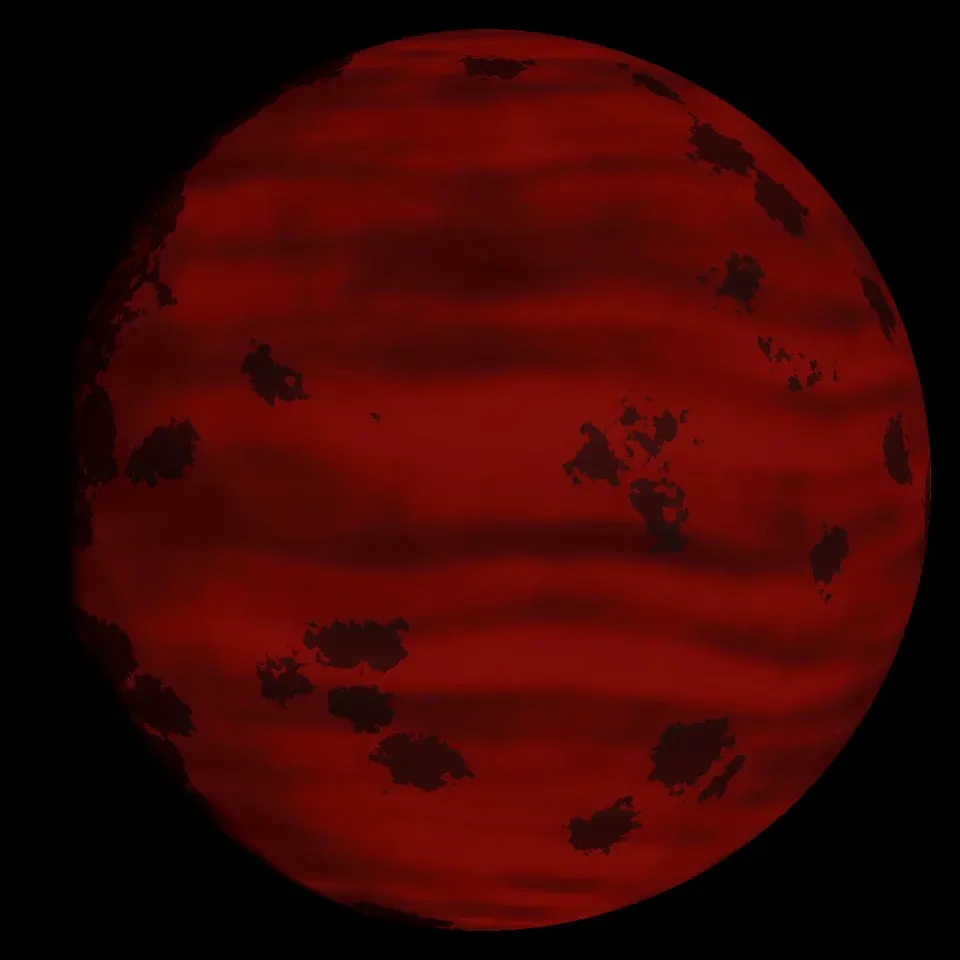
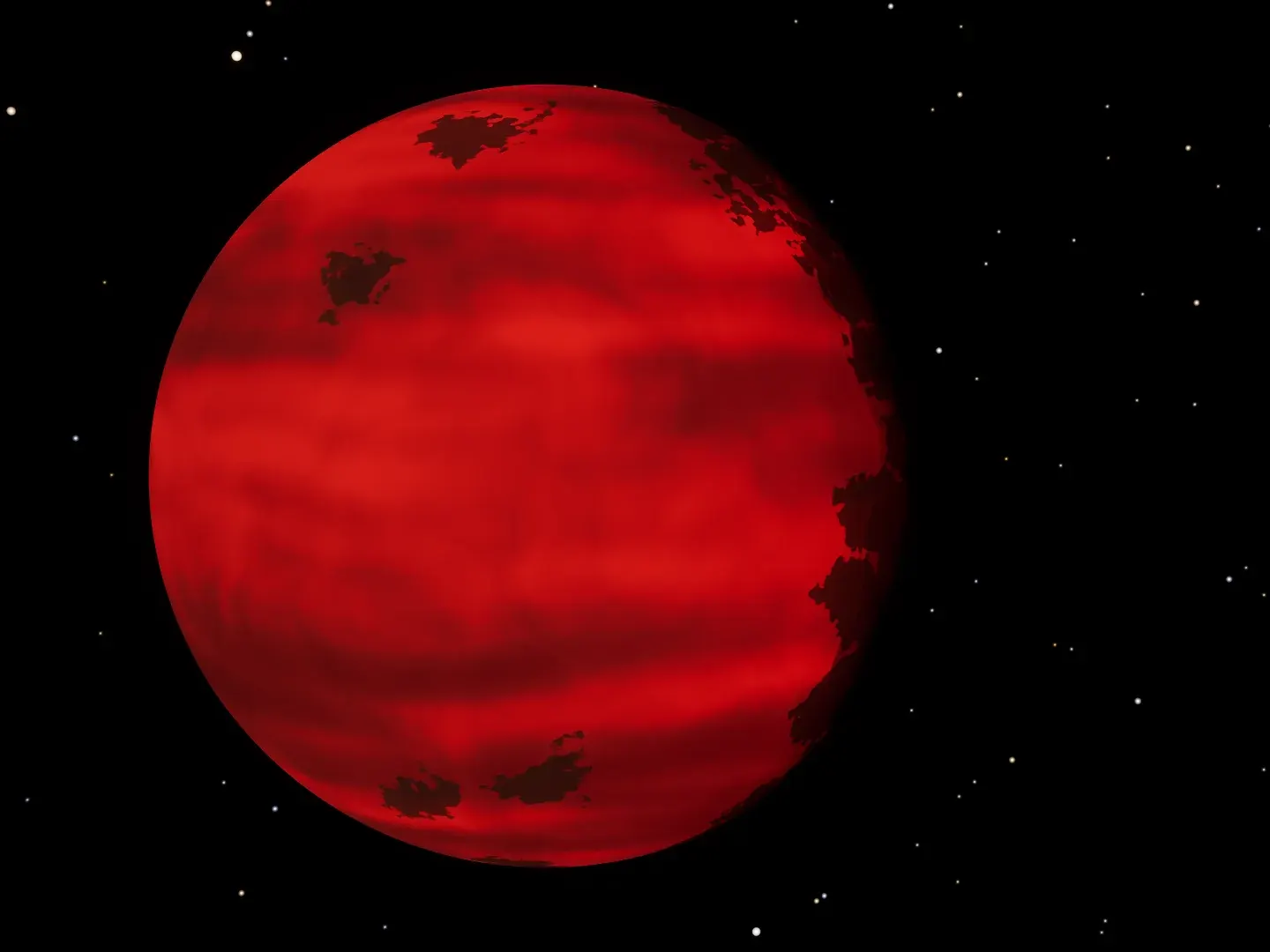
| Cool magma end, LWTL-MD-MC | 168 | 1,585 K | A viscous crimson band with dark east-west smears |
| Mixed plates and lava, LWTL-MD-MX | 29 | 1,419 K | Big dark floes in broad glowing channels |
| Dense vein network, LWTL-MD-VN | 62 | 1,364 K | Dark plates cut by wandering glowing veins with red halos |
| Heavily crusted, LWTL-MD-CR | 51 | 1,304 K | Layered flow fronts of crust over small central pools |
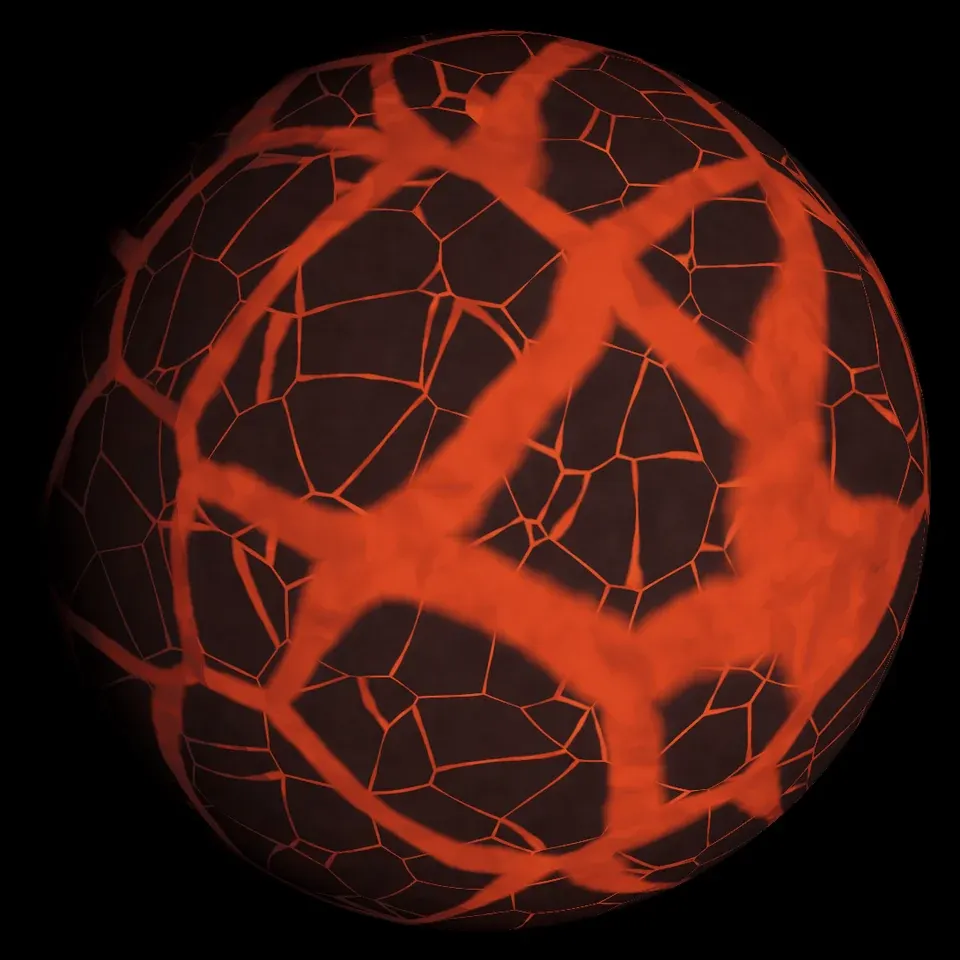
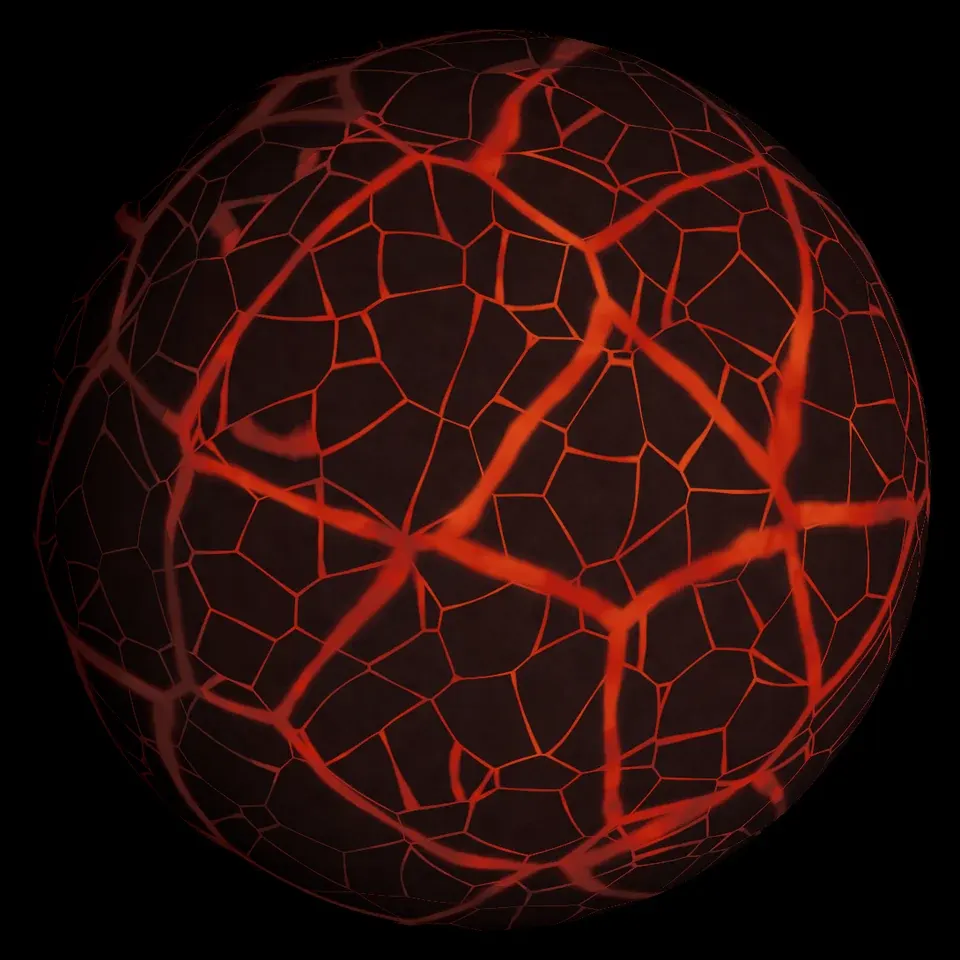
| Nearly dormant, LWTL-MD-FR | 35 | 1,268 K | Frozen plates with pale ridges and a few red lakes |
| Volatile-rich, cool atmosphere, LWTL-VR-CL | 2 | 2,742 K | A grey-tan veil, the glow a dim red patch beneath the star |
| Volatile-rich, warm atmosphere, LWTL-VR-WM | 8 | 3,012 K | A banded tan veil over an orange glow |
| Hot crusted, LWN-HC-SD | 24 | 1,354 K | A web of glowing veins all the way round |
| Volatile haze, LWN-HV-SD | 8 | 2,292 K | A purple haze banked towards the poles over a dark veined band |
| Silicate haze, LWN-HH-SD | 2 | 3,061 K | A swirled lava band under a golden haze |
| Ultra-hot magma, LWN-UM-SD | 74 | 1,595 K | An open sea that still turns, its weather ridged into hot seams |
| Moderate crusted, LWN-MC-SD | 21 | 1,253 K | Golden crust grained by a fine bright web of cracks |
Several of these types follow what telescopes have found. Spitzer's map of 55 Cancri e put its hottest point to one side of the substellar point and its night side at about 1,400 K, far too warm for bare rock, so something on that planet carries heat round to the dark side 9. Our warm night-side worlds hold their nights at about 1,100 to 1,200 K, and on them the rock beyond the shore glows a dull red of its own. K2-141 b, on a 6.7 hour orbit, shows the opposite case: a day side of about 2,050 K and a night side too cold for Spitzer to detect 10. And Webb's measurements of 55 Cancri e point to an atmosphere of carbon dioxide or carbon monoxide, probably outgassed from its magma 11, the kind of envelope our volatile-rich worlds wear.
 , open full size
 , open full size
 , open full size
 , open full size
 , open full size
 , open full size
The streaked types come from the air and the magma together. Where the sea is hottest the rock itself evaporates into a thin atmosphere of sodium, potassium, silicon monoxide and oxygen 12. That atmosphere is thickest beneath the star and thins towards the terminator, and the pressure difference drives winds from day to night 13. On K2-141 b models put those winds above 5,000 km/h 14. Our strong-current worlds show the sea caught up in that flow from day to night, its crust stretched into slivers and its heat into bright filaments running east to west.
Every world its own
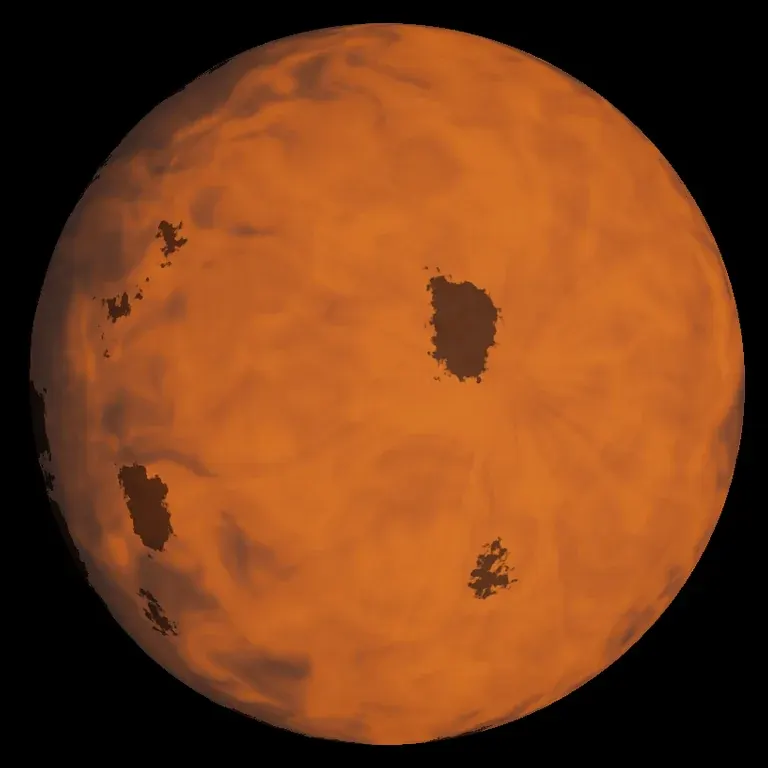
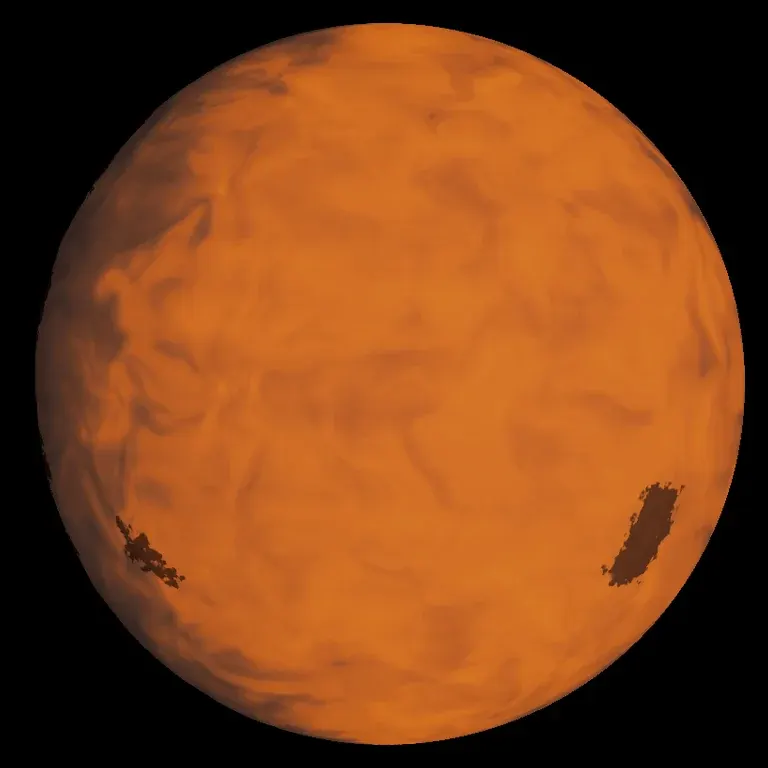
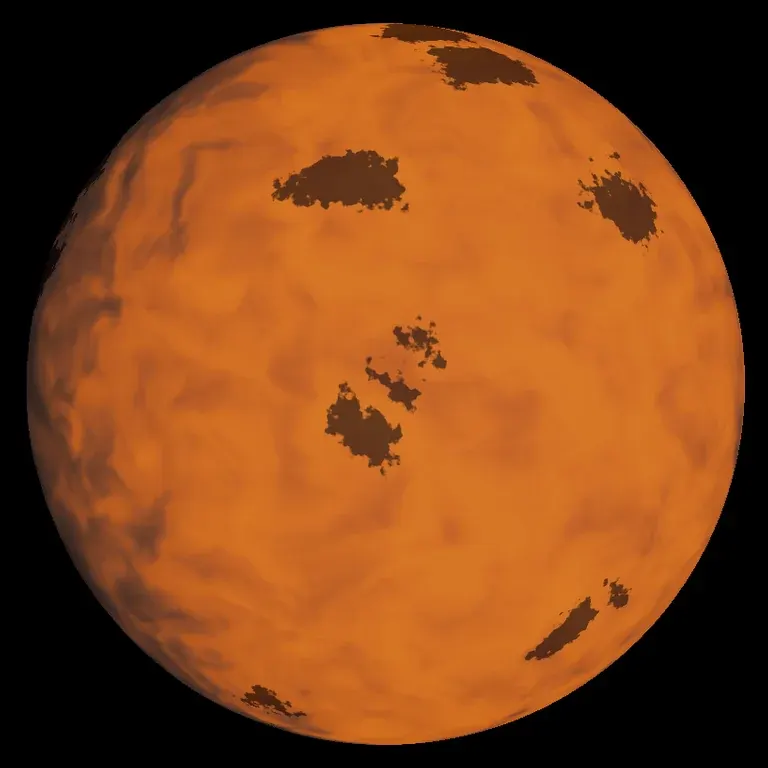
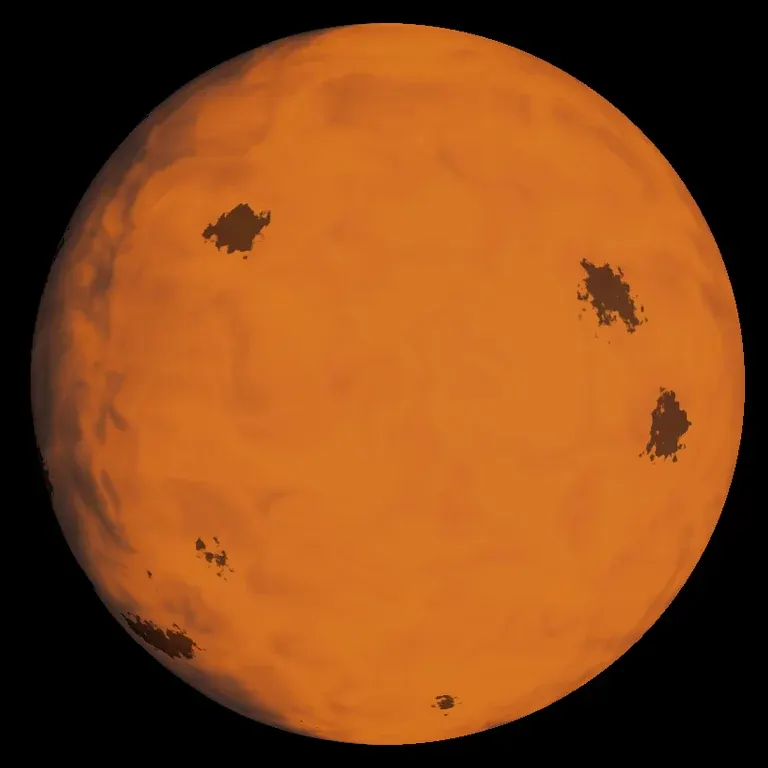
A type is a family, not a copy. Each of the 705 lava planets wears its type's look with its own science: its own day-side and night-side temperatures and its own raft coverage, read from the simulation, and its own seed, which places every coastline, every raft and every crack. A cooler planet of a type shows a smaller sea in the same colours; a hotter one shows a larger sea, and a brighter one. On top of that, each type carries a set of shape dials, raft size, how the rafts gather, how ragged the shore runs, how the streaks bend, and each planet draws its own setting of every dial from its seed, inside the bounds the type allows.
 , open full size
 , open full size
 , open full size
 , open full size
In the game all of this is one planet template wearing a different block of numbers for each body. The planet's heat, crust, seed, radius and palette are packed into a small texture of its own, and both halves of the world read it: the ground's height, so the sea is level where that planet's own sea lies, and the surface's colour and glow. The lock is solved exactly, so every sea faces its star. Measured in the game on four planets, the centres of their seas sat 1 to 5 degrees from the point beneath the star.
How bright is molten rock?
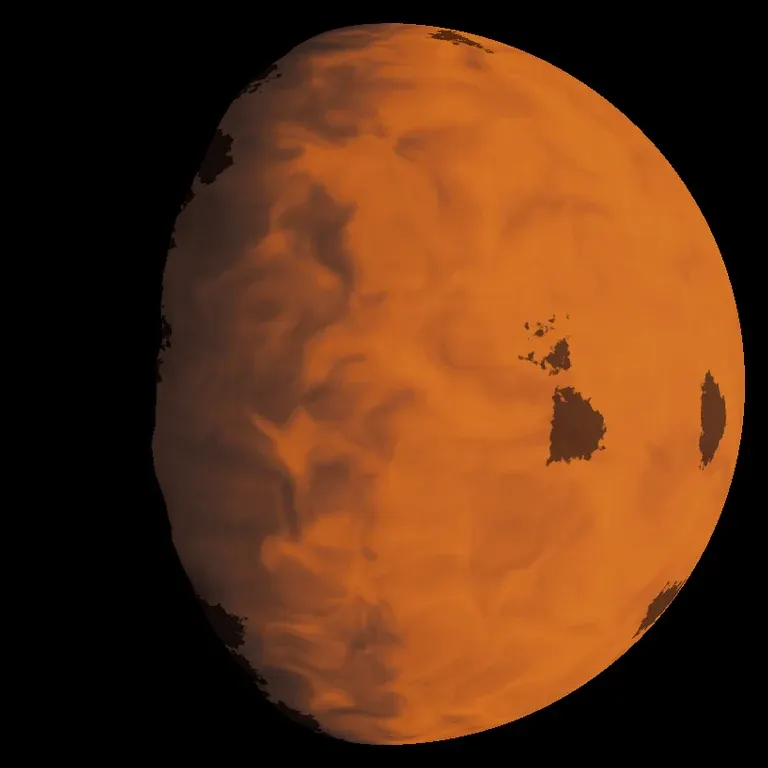
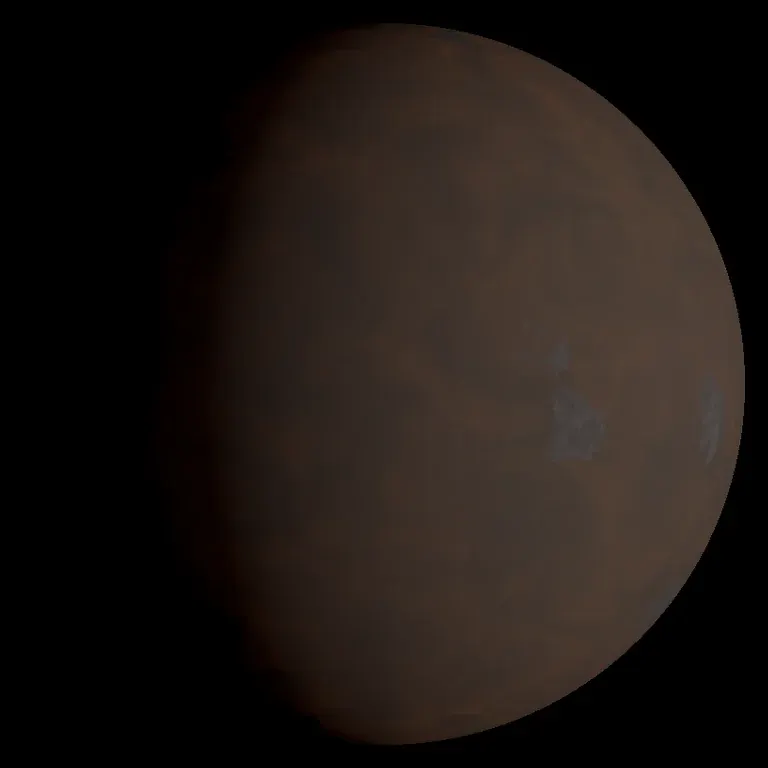
Molten rock glows with the colour of its temperature, the colour of a black body: gold-white at 2,700 K, orange at 2,250 K, crimson at 1,600 K and a dull red at 1,300 K, fading out of sight below about 800 K. How bright that glow looks is another matter, because a lava world's day side is also lit by its star, and the star is very bright indeed.
Pax Abyssi gives you both pictures. By default a lava world is drawn the way our painted studies of each type show it, with each type's glow fitted to those paintings so the sea and its rafts read at a glance from orbit. The fit keeps the physics underneath: a hotter patch of sea is still a brighter one, and the colours run from crimson to gold-white in the order of the black body. One row in the options, LAVA LOOK on the SPACE page, switches to the scientific look, the black body at its true luminance against the light of the star.
 , open full size
 , open full size
Veils and rotating worlds
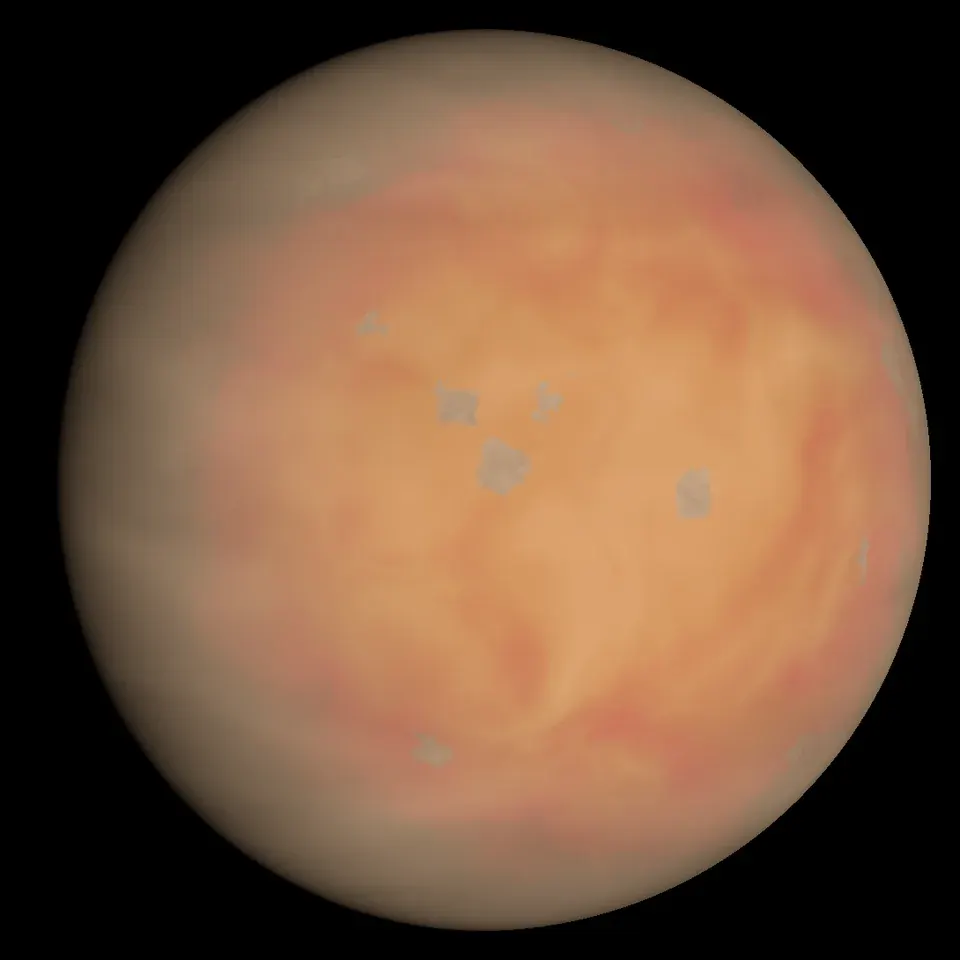
Four of the eighteen types wear a haze. The volatile-rich worlds have kept more than rock vapour: a thicker envelope of volatiles, drawn as a veil over the surface, grey-tan on the cool-atmosphere worlds and banded tan over an orange glow on the warm ones. The unlocked worlds turn, so no one face holds a permanent sea. They are heated by latitude rather than from one point, so their lava runs all the way round: a web of veins on the hot crusted worlds, and a band about the equator under the haze decks of the other two, purple on the volatile-haze worlds and golden on the silicate-haze worlds.
 , open full size
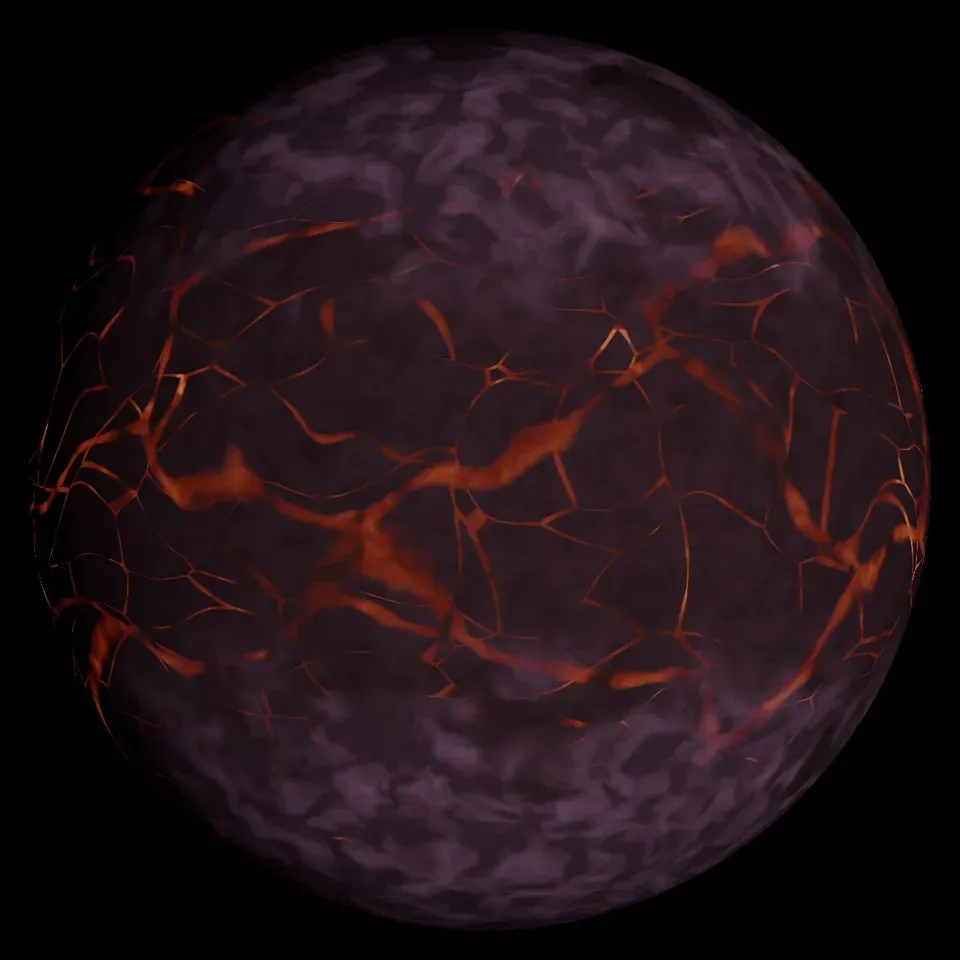 , open full size
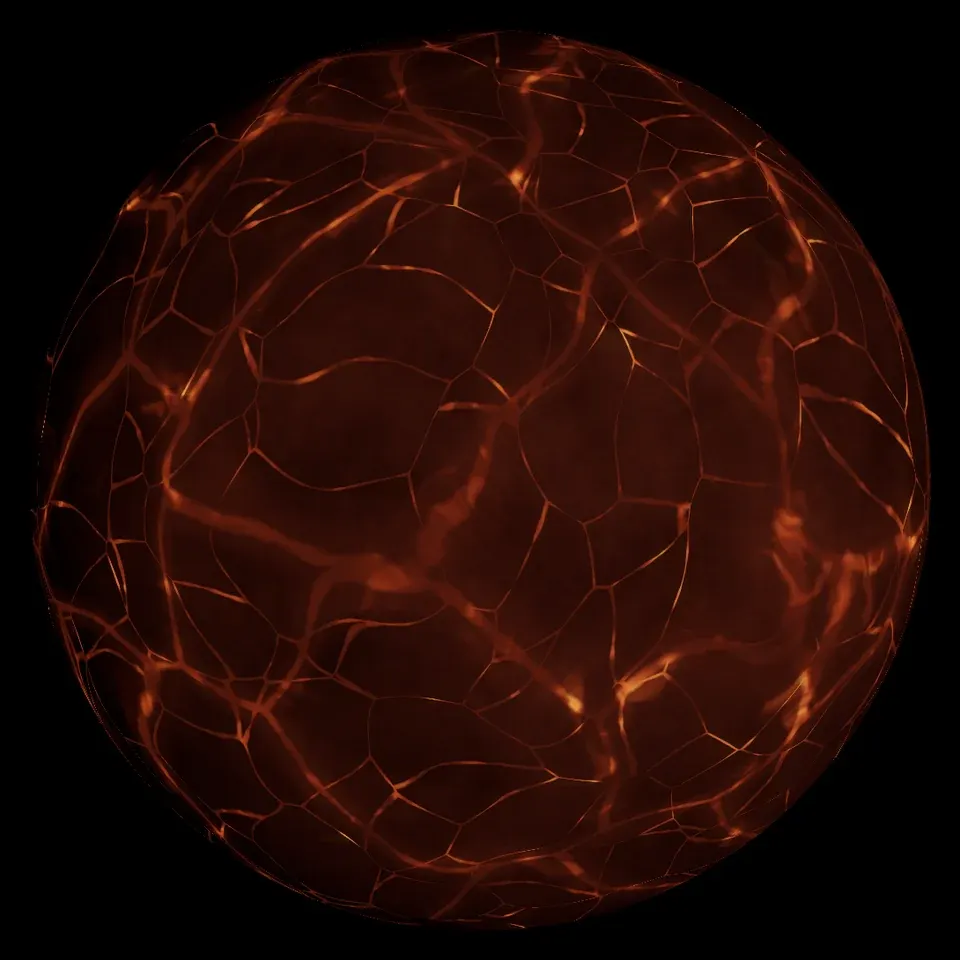 , open full size
Flying to one
Every one of the 705 lava planets is in the game, from the 168 cool magma seas to the two silicate-haze worlds, and every type has a stop in the fast-travel menu. Far off, a lava world shows our painted study of its type; closer in, the live planet takes over, its sea, rafts and cracks drawn from its own numbers. Fly down and land on a raft at the shore: the sea beside you is level ground, 50 metres below the raft's edge.
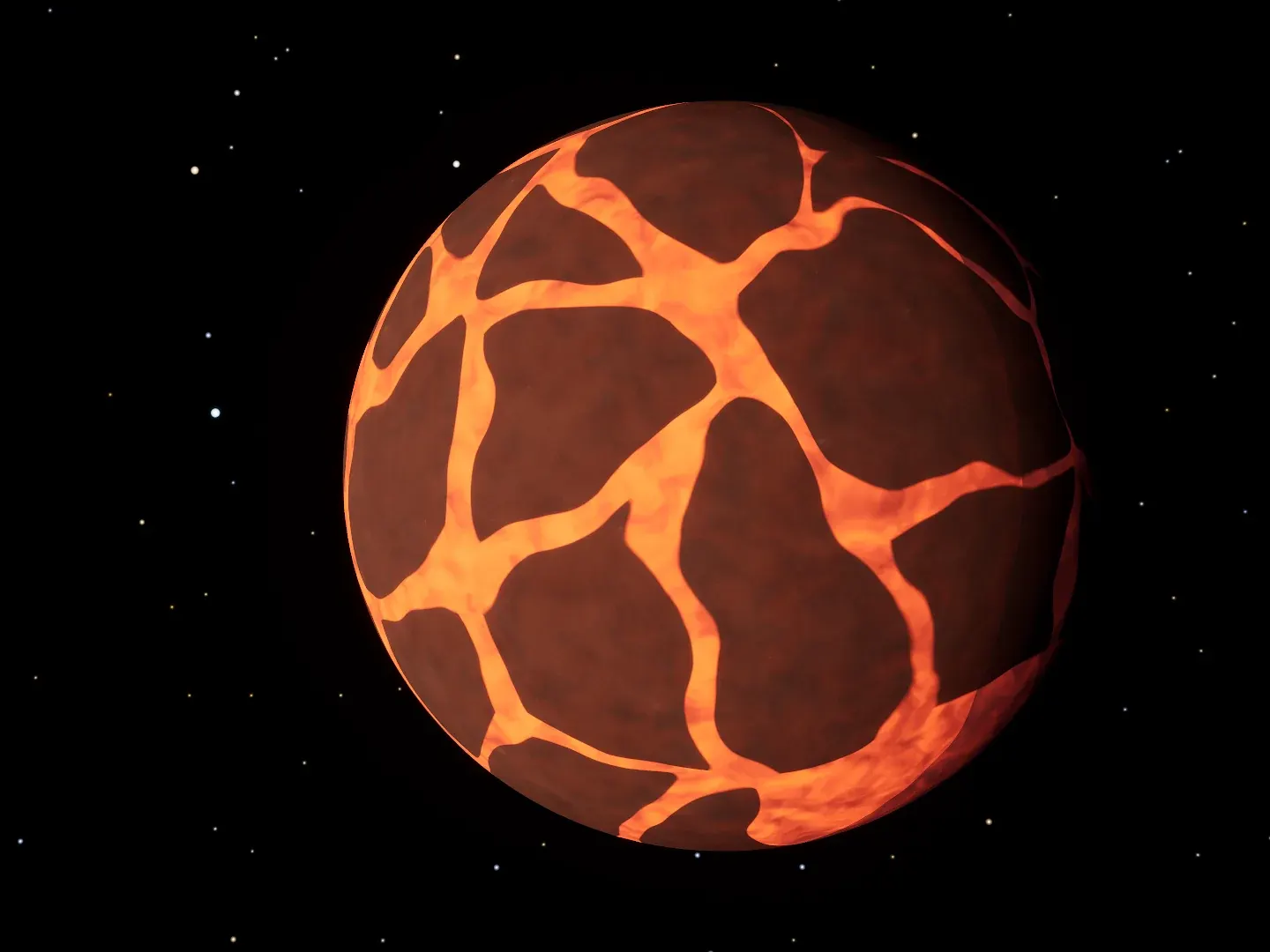 , open full size
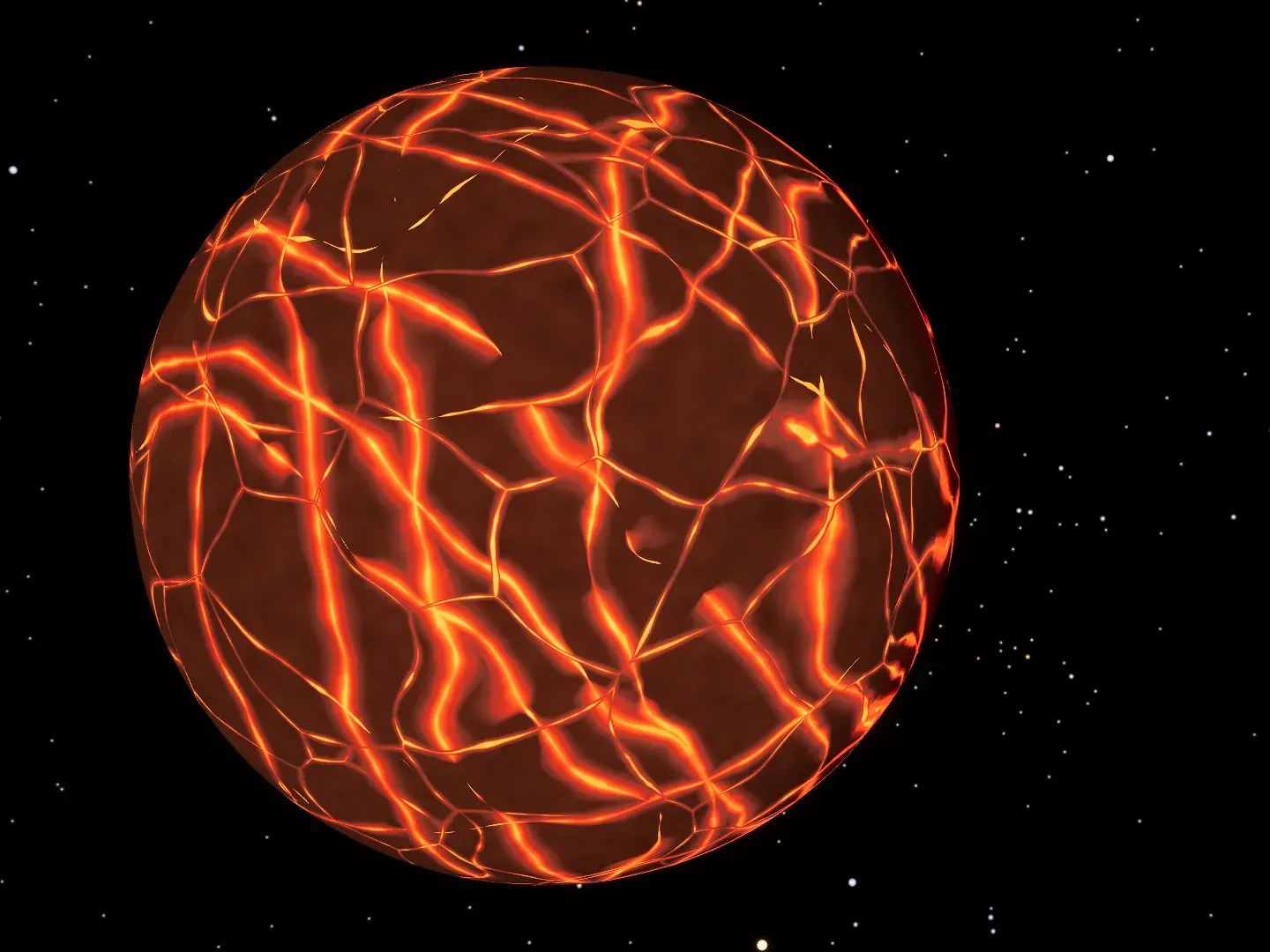 , open full size
 , open full size
 , open full size
 , open full size
 , open full size
The lava worlds have a page of their own, with large frames from the game and every type on its wall: see Lava worlds. For the observations behind them, from CoRoT-7 b to Webb's spectrum of 55 Cancri e, read Lava world.
References
- 1Léger, A. et al. (2009). Transiting exoplanets from the CoRoT space mission. VIII. CoRoT-7b: the first super-Earth with measured radius. Astronomy & Astrophysics 506, 287-302. doi:10.1051/0004-6361/200911933
- 2Batalha, N. M. et al. (2011). Kepler's first rocky planet: Kepler-10b. The Astrophysical Journal 729, 27. doi:10.1088/0004-637x/729/1/27
- 3Sanchis-Ojeda, R. et al. (2014). A study of the shortest-period planets found with Kepler. The Astrophysical Journal 787, 47. doi:10.1088/0004-637x/787/1/47
- 4Peck, D. L., Wright, T. L. and Moore, J. G. (1966). Crystallization of tholeiitic basalt in Alae Lava Lake, Hawaii. Bulletin Volcanologique 29, 629-655. doi:10.1007/BF02597182
- 5Hirschmann, M. M. (2000). Mantle solidus: Experimental constraints and the effects of peridotite composition. Geochemistry, Geophysics, Geosystems 1, 2000GC000070. doi:10.1029/2000gc000070
- 6Léger, A. et al. (2011). The extreme physical properties of the CoRoT-7b super-Earth. Icarus 213, 1-11. doi:10.1016/j.icarus.2011.02.004
- 7Duffield, W. A. (1972). A naturally occurring model of global plate tectonics. Journal of Geophysical Research 77(14), 2543-2555.
- 8Kite, E. S. et al. (2016). Atmosphere-interior exchange on hot, rocky exoplanets. The Astrophysical Journal 828, 80. doi:10.3847/0004-637x/828/2/80
- 9Demory, B. O. et al. (2016). A map of the large day-night temperature gradient of a super-Earth exoplanet. Nature 532, 207-209. doi:10.1038/nature17169
- 10Zieba, S. et al. (2022). K2 and Spitzer phase curves of the rocky ultra-short-period planet K2-141 b hint at a tenuous rock vapor atmosphere. Astronomy & Astrophysics 664, A79. doi:10.1051/0004-6361/202142912
- 11Hu, R. et al. (2024). A secondary atmosphere on the rocky exoplanet 55 Cancri e. Nature 630, 609-612. doi:10.1038/s41586-024-07432-x
- 12Schaefer, L. and Fegley, B. (2009). Chemistry of silicate atmospheres of evaporating super-Earths. The Astrophysical Journal 703, L113-L117. doi:10.1088/0004-637x/703/2/l113
- 13Castan, T. and Menou, K. (2011). Atmospheres of hot super-Earths. The Astrophysical Journal 743, L36. doi:10.1088/2041-8205/743/2/l36
- 14Nguyen, T. G. et al. (2020). Modelling the atmosphere of lava planet K2-141b: implications for low- and high-resolution spectroscopy. Monthly Notices of the Royal Astronomical Society 499, 4605-4612. doi:10.1093/mnras/staa2487
- 15Essack, Z., Seager, S. and Pajusalu, M. (2020). Low-albedo surfaces of lava worlds. The Astrophysical Journal 898, 160. doi:10.3847/1538-4357/ab9cba
Related in the wiki
Credits
- Pax Abyssi Science Desk
- Author
Spotted an error? Tell us in the forum thread or on the talk page of a related wiki article; corrections are noted at the top of the piece.