- On this page
- 4
- figures
- 1
- table
- 22
- references
Redirected from Barren rock
Planet class · TBR · T0-B1
Barren rock world
ContentsShow
A barren rock world is a rocky planet with no real atmosphere. Its surface lies open to space: starlight heats it directly, the night side cools freely, and meteorites, cosmic rays and the stellar wind strike the ground unimpeded. What gas it has is an exosphere, a scattering of atoms so thin that they bounce between surface rocks without ever colliding with one another. Mercury is the Solar System's example, and the James Webb Space Telescope has now found several bare rocks around other stars. They matter as the baseline against which any rocky planet's atmosphere has to be measured.
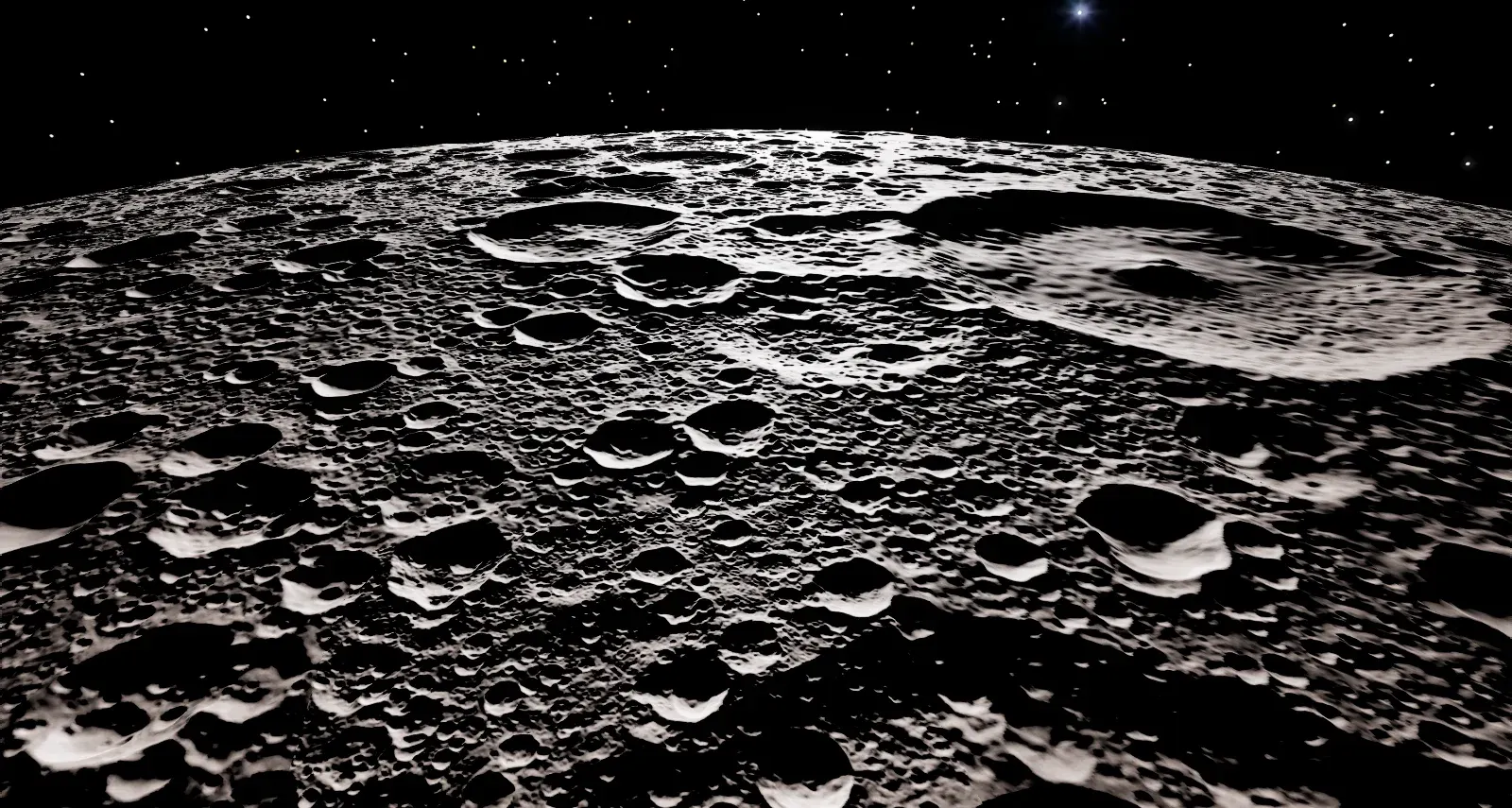
Pax Abyssi sorts airless rocky worlds by what their bare surface is made of, because with no air, wind or water the rock is all there is to see. Barren rock is the commonest of five barren planet types, and every barren type in our galaxy has its own look row for our procedural world generator: the numbers for its albedo, craters, basins, scarps and rays, taken from the science. Three barren worlds built that way are in the game to fly to and walk on.
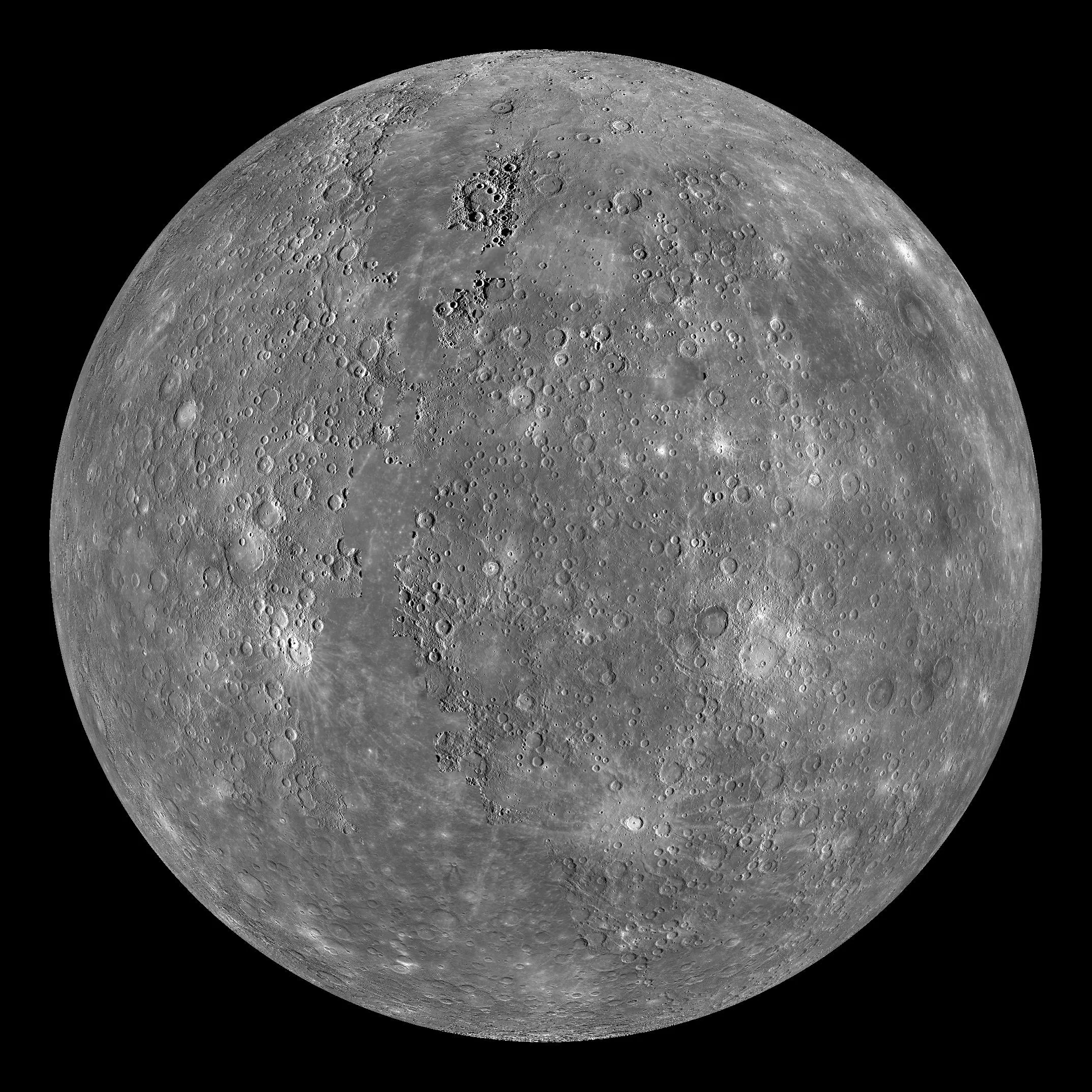 , open full size
Characteristics
Why some rocky planets have no air
A planet loses gas when molecules in its upper atmosphere move fast enough to escape its gravity, and when stellar radiation and wind strip gas away. Whether an atmosphere survives therefore depends on two numbers: how strongly the planet holds on, measured by its escape velocity , and how much energy it receives from its star. Zahnle and Catling (2017) plotted every body in the Solar System on those two axes and found a sharp dividing line, which they called the cosmic shoreline. Bodies with atmospheres lie on one side and airless bodies on the other, with the boundary running roughly as
where is the insolation 1. Mercury, with an escape velocity of 4.3 km/s at 0.39 AU from the Sun, falls on the airless side; Titan, with a lower escape velocity but far from the Sun, keeps a thick atmosphere. Planets close to red dwarfs sit near the line, because those stars emit strongly in X-rays and ultraviolet and flare often, and they are also the easiest rocky planets to observe, so that is where the line is being tested.
Temperature without an atmosphere
With no air to move heat around, a barren world's temperature is set point by point by the sunlight it absorbs. Mercury's surface reaches about 700 K at noon and falls to about 100 K before dawn, the widest swing of any planet 2. Its equilibrium temperature, the average from the formula on Planet classification, is 440 K, a figure no place on its surface actually holds for long.
For a tidally locked exoplanet the simplest prediction is for the dayside. If the ground re-radiates heat where it absorbs it and none reaches the night side, the dayside's average temperature is
about 1.28 times the planet's equilibrium temperature. An atmosphere carries heat to the night side and lowers the dayside temperature, so measuring the dayside's glow is a way to test for one 3.
Surfaces
Without wind or water, the surface records its history. Craters accumulate, and the soil, called regolith, is a layer of rock ground up by impacts. Space weathering, the bombardment of the soil by micrometeorites and charged particles, darkens it over time by coating grains with tiny particles of metallic iron. Mercury's surface is also darkened by graphite, possibly the remains of its original crust 4, and its Bond albedo, the fraction of all sunlight reflected, is only 0.068 2.
The planet's interior still shapes the surface. As Mercury's large iron core cooled over four billion years, the planet shrank, and its crust buckled into thrust faults, cliffs hundreds of kilometres long called lobate scarps. More than 5,900 such landforms have been mapped, recording a shrinkage in radius of up to about 7 km 5. MESSENGER also found hollows: shallow, bright, flat-floored pits that look fresh, apparently formed where a volatile component of the rock is escaping to space today 6.
Interior and magnetic field
Mercury is dense for its size, 5.43 g/cm³, almost as dense as Earth, which is far larger and more compressed. Its iron core is about 2,020 km in radius, some 83 per cent of the planet's radius, under a silicate shell only about 400 km thick 7, and part of the core is solid 8. That core still drives a weak magnetic dynamo, about 1 per cent of the strength of Earth's field at the surface, with its centre offset about 480 km north of the planet's centre 9. Magnetised rocks in the crust show the dynamo has run for at least 3.7 billion years 10.
Formation
A barren rock world can start barren or become barren. A small planet may never gather much gas, and a planet close to a young, active star loses whatever it has to stellar X-rays, ultraviolet light and wind.
Mercury's large core is the part that needs explaining. The leading idea is a giant impact early in the Solar System's history that stripped away much of a larger planet's rocky mantle 11. MESSENGER complicated the story. Mercury's surface has a ratio of potassium to thorium, a measure of volatile elements, similar to the other rocky planets, which rules out models in which Mercury was heated so strongly that volatiles boiled off 12. Its surface is also rich in sulfur and poor in iron, a sign that it formed from unusually oxygen-poor material 13. How Mercury ended up with so much iron, and yet kept its volatiles, remains open.
How we know
Mercury. Mariner 10 made three flybys in 1974 and 1975. NASA's MESSENGER orbited Mercury from 2011 to 2015 and mapped its surface, chemistry, gravity and magnetic field. Neutron measurements showed that craters near the poles, whose floors never see sunlight, hold water ice, despite Mercury being the planet closest to the Sun 14. The exosphere of sodium, potassium, calcium, magnesium, oxygen, hydrogen and helium has been watched from Earth and from spacecraft, with a total pressure below about bar 15 2. ESA and JAXA's BepiColombo, launched on 20 October 2018, is due to reach Mercury orbit at the end of 2026, with routine science from April 2027 16.
Exoplanets. A bare rock around another star is found by elimination. When a transiting planet passes behind its star, the drop in infrared light measures the dayside's glow, and a dayside as hot as the bare-rock formula above leaves no room for an atmosphere to carry heat away. The first such result came from the Spitzer Space Telescope: LHS 3844 b, a planet 1.3 times Earth's radius on an 11-hour orbit around a red dwarf, has a dayside of about 1,040 K, as hot as a bare rock can be, ruling out any atmosphere thicker than about 10 bar 17.
JWST has since measured several more. TRAPPIST-1 b's dayside, about 500 K at 15 micrometres, first suggested bare rock 18; adding a second wavelength showed that the data fit either a bare, dark rock surface or a carbon dioxide atmosphere with a warm upper layer, so the question is still open 19. Its neighbour TRAPPIST-1 c, at about 380 K, has no thick carbon dioxide atmosphere like Venus's, though a thin one is possible 20.
Notable examples
| Planet | Radius | Mass | Orbit | Result |
|---|---|---|---|---|
| Mercury | 0.383 R⊕ | 0.055 M⊕ | 88 days, 0.39 AU | airless; exosphere below 5 × 10⁻¹⁵ bar |
| LHS 3844 b | 1.30 R⊕ | not measured | 11 hours, red dwarf | dayside about 1,040 K; bare rock (Spitzer, 2019) |
| TRAPPIST-1 b | 1.12 R⊕ | 1.37 M⊕ | 1.5 days, ultracool dwarf | dayside about 500 K; bare rock or thin CO₂ atmosphere (JWST) |
| GJ 367 b | 0.70 R⊕ | 0.63 M⊕ | 7.7 hours, red dwarf | dark, airless and very dense (JWST, 2024) |
GJ 367 b is a super-Mercury. Its density of about 10 g/cm³ implies an iron core making up most of its mass 21, and JWST found a dayside at about 1,700 K with no sign of heat being carried to the night side, consistent with bare rock and no atmosphere 22. See Exotic worlds for iron planets.
In Pax Abyssi
How we classify barren worlds
The planet science behind Pax Abyssi gives every airless rocky body a type code from its surface composition. There are five barren planet types: barren rock (TBR), the subject of this page, iron-rich (TBI), anorthosite highland (TBS), basalt plains like the lunar maria (TBB) and metallic (TBM). Barren moons carry their own codes: M0-B1 for a rocky moon like our own and M0-B2 for an iron-rich one like a small Mercury.
A barren rock world is an airless planet of 0.3 to 1.5 Earth masses, placed wherever an airless world is likely, from hot inner orbits to cold outer ones. Its subtype is chosen by the geology the physics engine computes for it: heavily cratered worlds (TBR-HC) with saturated highlands, ray craters or old basins; scarped worlds (TBR-SC) whose cooling cores have buckled their crusts into lobate scarps, as Mercury's has; worlds of volcanic plains (TBR-VP) where lava has buried the old craters; and dark worlds (TBR-DK) darkened by graphite or titanium-rich minerals. Each subtype splits again, so a saturated highland (TBR-HC-SH), a basin-scarred world (TBR-HC-BS) and a scarp network (TBR-SC-SN) each get a look of their own. If a barren world's rock begins to melt, the sim moves it to lava world. In the committed system sheets, 407 of 8,742 generated planets are barren rock worlds, and the five barren types together make up about a fifth of all planets.
From type to world
A type code becomes a world through a look row: a short table of the physical numbers that make that type look the way it does, such as the albedo of its highlands and its lava plains, the size range of its basins, how saturated its craters are, and whether it carries scarps, graben or rays. A converter turns each row into the data our in-game generator builds from. Every one of the 39 barren types carried by bodies in the galaxy now has a row, 54 rows in all, and every row converts into game data.
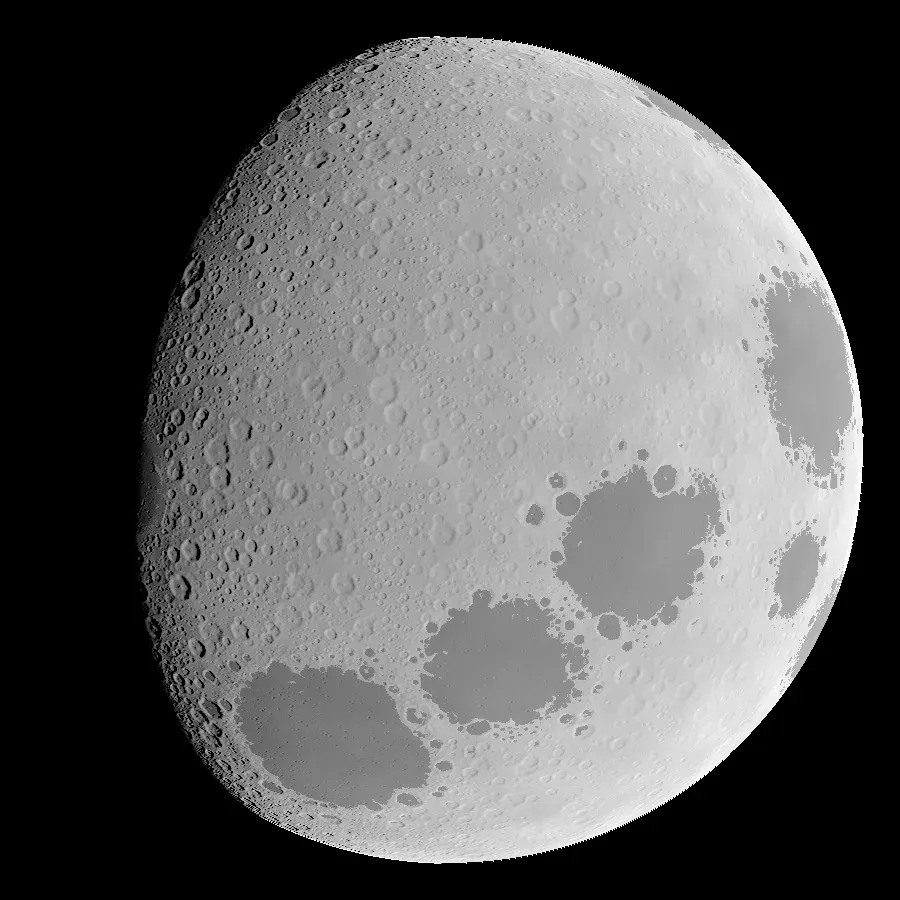 , open full size
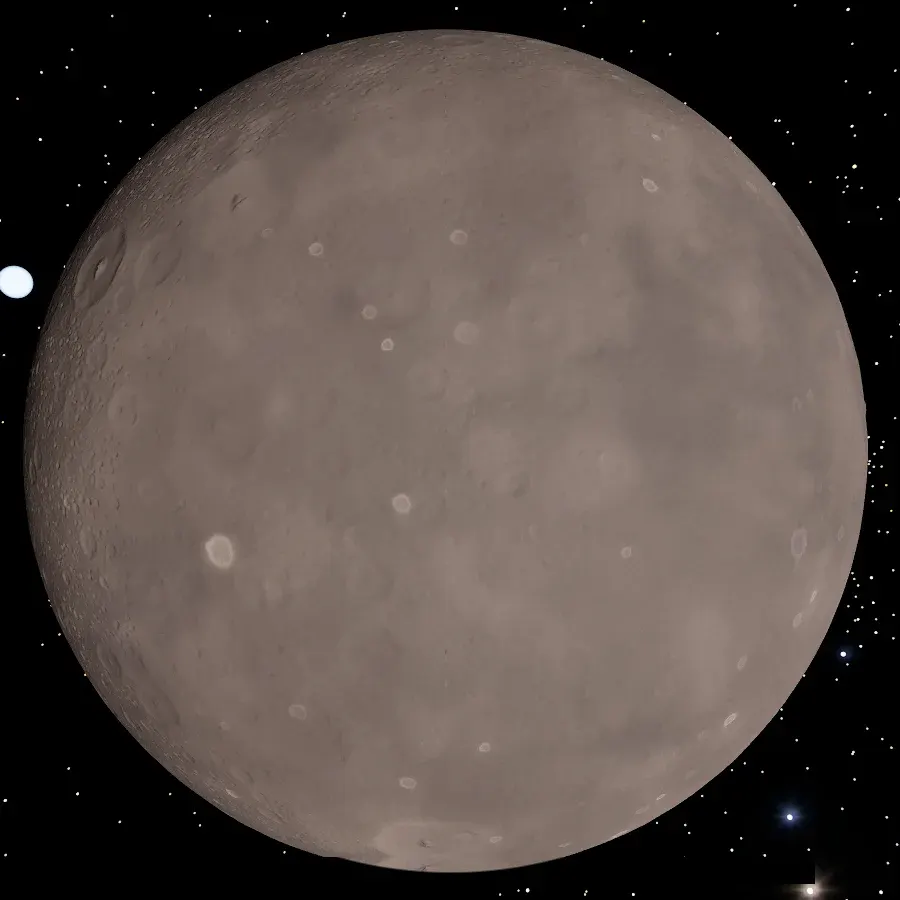 , open full size
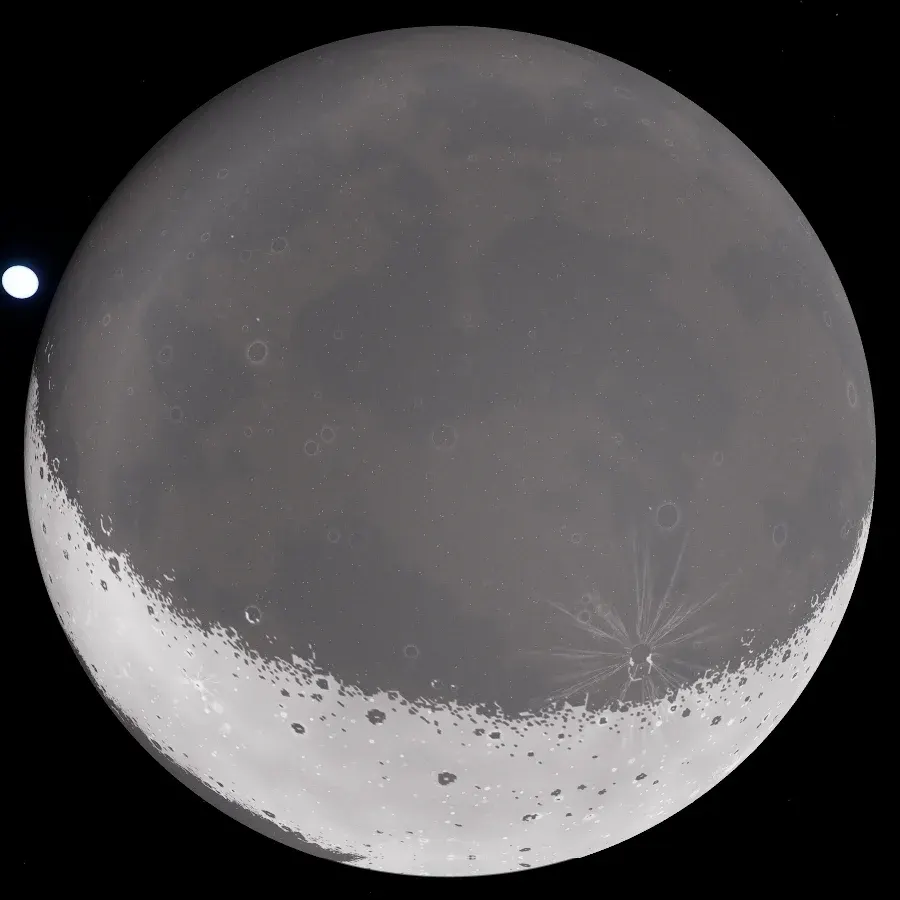 , open full size
The first of them, Halden Mare, was built to the Moon's own numbers (1,737.4 km in radius, 0.1654 g, no air) and judged side by side with Artemis photographs of the Moon from orbit. Its maria have an albedo of 0.075 against 0.14 for its highlands, the Moon's own contrast; they cover 16.8 per cent of the sphere against the Moon's 16; its craters follow a size-frequency slope of -1.99 and -2.01 against the lunar target of -2; and their depths follow Pike's measured depth-to-diameter ratios. Carrow Maria was the first world built from a body on the galaxy map, HYG 98924 IV in the Delta Pavonis system. Merrin Rupes is an iron-rich moon named for its scarp, the kind of fault cliff this page describes on Mercury, and you can stand at its foot.
 , open full size
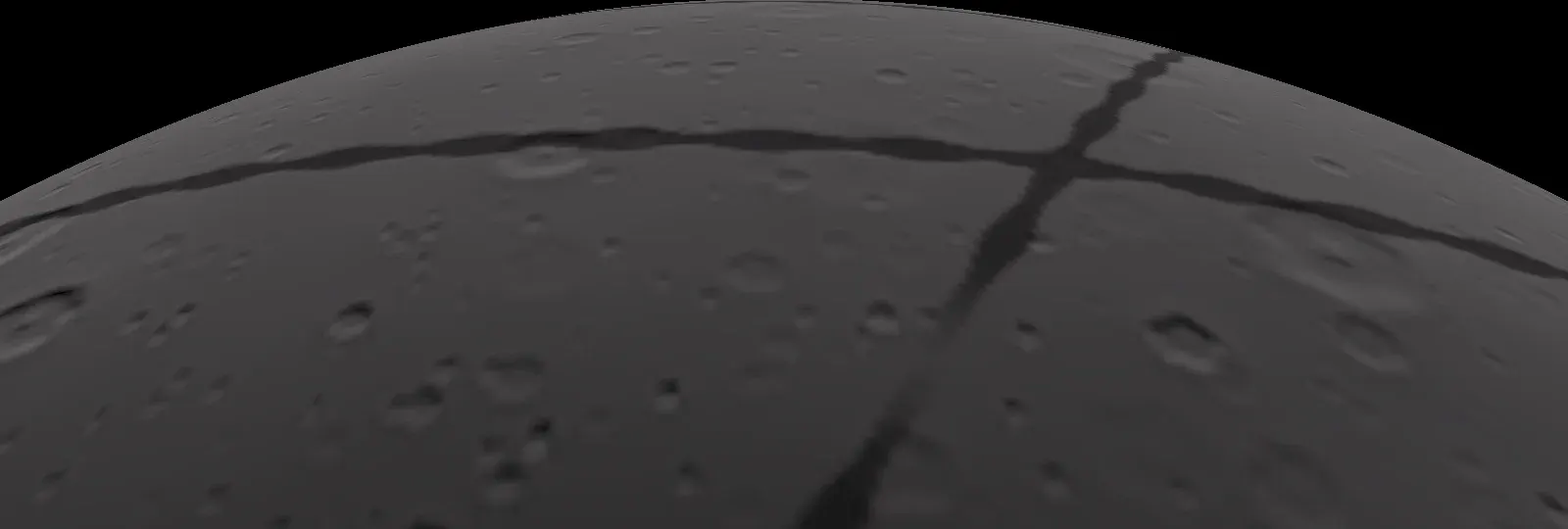
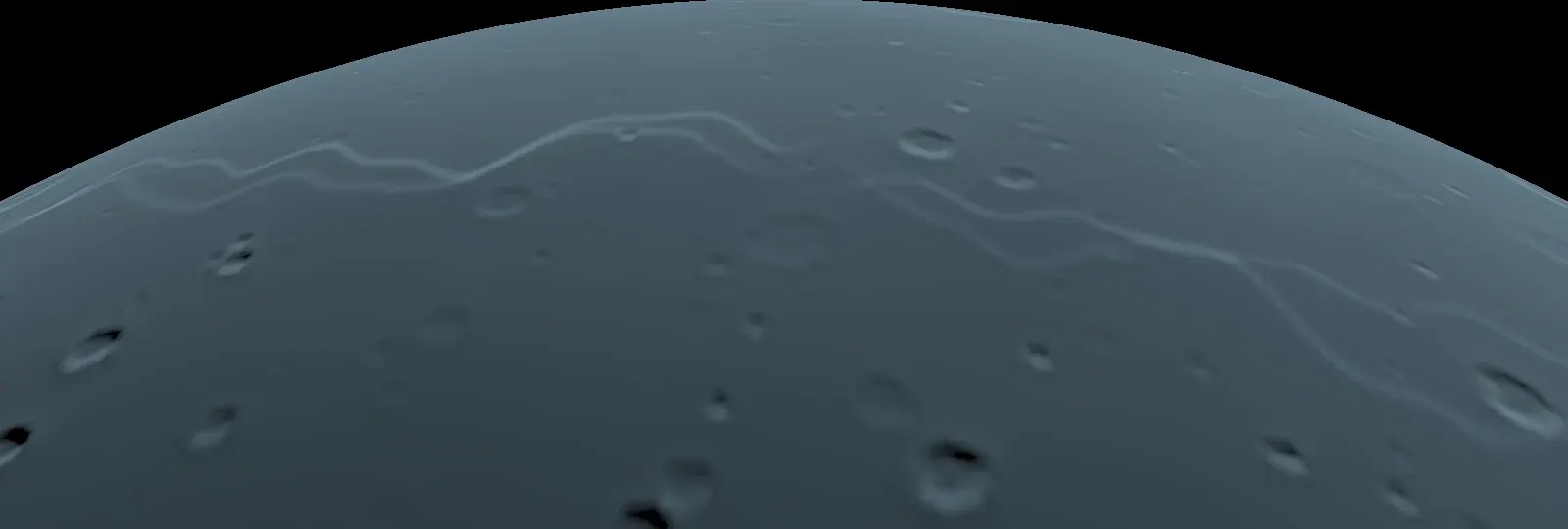
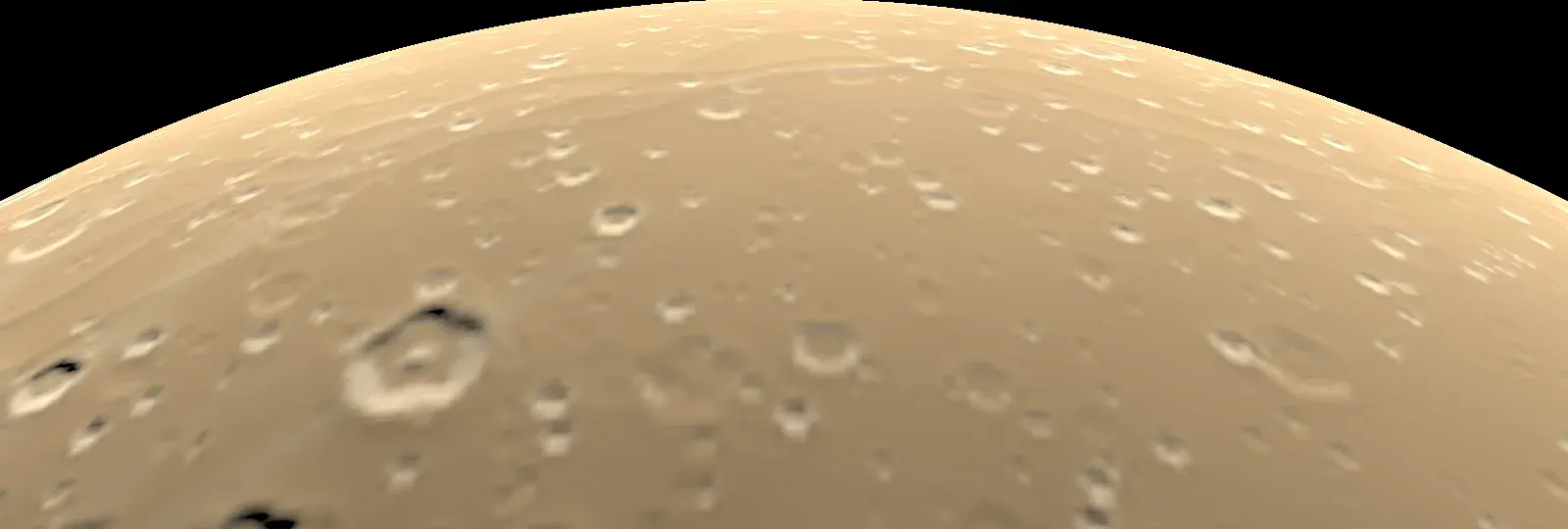
The same generator draws the other barren looks. On our design desk, the offline twin of the in-game generator where a row is tuned before a world is built, the rows for graben, metallic and anorthosite worlds already hold their shape:
 , open full size
 , open full size
 , open full size
Next, every world's look and every one of its seeds will come straight from the catalogue body it is: its type and sub-subtype choose the look row, and its identity in the galaxy seeds the craters, basins and faults, so no two barren worlds of the same type are alike and none is chosen by hand.
See also
- Lava world
- Arid world
- Exotic worlds
- Atmospheric escape
- Red dwarf
- JWST and rocky exoplanet atmospheres
- Sol
- Planet classification
References
- 1Zahnle, K. J. and Catling, D. C. (2017). The Cosmic Shoreline: The Evidence that Escape Determines which Planets Have Atmospheres, and what this May Mean for Proxima Centauri B. The Astrophysical Journal 843, 122. doi:10.3847/1538-4357/aa7846
- 2Williams, D. R.. Mercury Fact Sheet. NASA Space Science Data Coordinated Archive. nssdc.gsfc.nasa.gov/planetary/factsheet/mercuryfact.html
- 3Koll, D. D. B. et al. (2019). Identifying Candidate Atmospheres on Rocky M Dwarf Planets via Eclipse Photometry. The Astrophysical Journal 886, 140. doi:10.3847/1538-4357/ab4c91
- 4Peplowski, P. N. et al. (2016). Remote sensing evidence for an ancient carbon-bearing crust on Mercury. Nature Geoscience 9, 273-276. doi:10.1038/ngeo2669
- 5Byrne, P. K. et al. (2014). Mercury’s global contraction much greater than earlier estimates. Nature Geoscience 7, 301-307. doi:10.1038/ngeo2097
- 6Blewett, D. T. et al. (2011). Hollows on Mercury: MESSENGER Evidence for Geologically Recent Volatile-Related Activity. Science 333, 1856-1859. doi:10.1126/science.1211681
- 7Hauck, S. A. et al. (2013). The curious case of Mercury's internal structure. Journal of Geophysical Research: Planets 118, 1204-1220. doi:10.1002/jgre.20091
- 8Genova, A. et al. (2019). Geodetic Evidence That Mercury Has A Solid Inner Core. Geophysical Research Letters 46, 3625-3633. doi:10.1029/2018gl081135
- 9Anderson, B. J. et al. (2011). The Global Magnetic Field of Mercury from MESSENGER Orbital Observations. Science 333, 1859-1862. doi:10.1126/science.1211001
- 10Johnson, C. L. et al. (2015). Low-altitude magnetic field measurements by MESSENGER reveal Mercury’s ancient crustal field. Science 348, 892-895. doi:10.1126/science.aaa8720
- 11Benz, W. et al. (2007). The Origin of Mercury. Space Science Reviews 132, 189-202. doi:10.1007/s11214-007-9284-1
- 12Peplowski, P. N. et al. (2011). Radioactive Elements on Mercury’s Surface from MESSENGER: Implications for the Planet’s Formation and Evolution. Science 333, 1850-1852. doi:10.1126/science.1211576
- 13Nittler, L. R. et al. (2011). The Major-Element Composition of Mercury’s Surface from MESSENGER X-ray Spectrometry. Science 333, 1847-1850. doi:10.1126/science.1211567
- 14Lawrence, D. J. et al. (2013). Evidence for Water Ice Near Mercury’s North Pole from MESSENGER Neutron Spectrometer Measurements. Science 339, 292-296. doi:10.1126/science.1229953
- 15Killen, R. et al. (2007). Processes that Promote and Deplete the Exosphere of Mercury. Space Science Reviews 132, 433-509. doi:10.1007/s11214-007-9232-0
- 16European Space Agency. BepiColombo. ESA Science and Exploration. www.esa.int/Science_Exploration/Space_Science/BepiColombo
- 17Kreidberg, L. et al. (2019). Absence of a thick atmosphere on the terrestrial exoplanet LHS 3844b. Nature 573, 87-90. doi:10.1038/s41586-019-1497-4
- 18Greene, T. P. et al. (2023). Thermal emission from the Earth-sized exoplanet TRAPPIST-1 b using JWST. Nature 618, 39-42. doi:10.1038/s41586-023-05951-7
- 19Ducrot, E. et al. (2024). Combined analysis of the 12.8 and 15 μm JWST/MIRI eclipse observations of TRAPPIST-1 b. Nature Astronomy 9, 358-369. doi:10.1038/s41550-024-02428-z
- 20Zieba, S. et al. (2023). No thick carbon dioxide atmosphere on the rocky exoplanet TRAPPIST-1 c. Nature 620, 746-749. doi:10.1038/s41586-023-06232-z
- 21Goffo, E. et al. (2023). Company for the Ultra-high Density, Ultra-short Period Sub-Earth GJ 367 b: Discovery of Two Additional Low-mass Planets at 11.5 and 34 Days*. The Astrophysical Journal Letters 955, L3. doi:10.3847/2041-8213/ace0c7
- 22Zhang, M. et al. (2024). GJ 367b Is a Dark, Hot, Airless Sub-Earth. The Astrophysical Journal Letters 961, L44. doi:10.3847/2041-8213/ad1a07