- On this page
- 2
- figures
- 1
- table
- 1
- panel
- 21
- references
Planet class · TGW · T1-G
Greenhouse world
ContentsShow
A greenhouse world is a rocky planet smothered by an atmosphere so thick and so rich in carbon dioxide that its surface is hotter than an oven, far above the boiling point of water. Venus is the Solar System's example. It is almost Earth's twin in size and mass, yet its surface sits at 737 K under 92 bar of carbon dioxide, hot enough to melt lead, beneath a global deck of sulfuric acid clouds. How a planet so like Earth ended up so different is one of the central questions of planetary science, because the answer sets the inner edge of the zone in which Earth-like planets can stay habitable.
Characteristics
A planet that absorbs less and is hotter
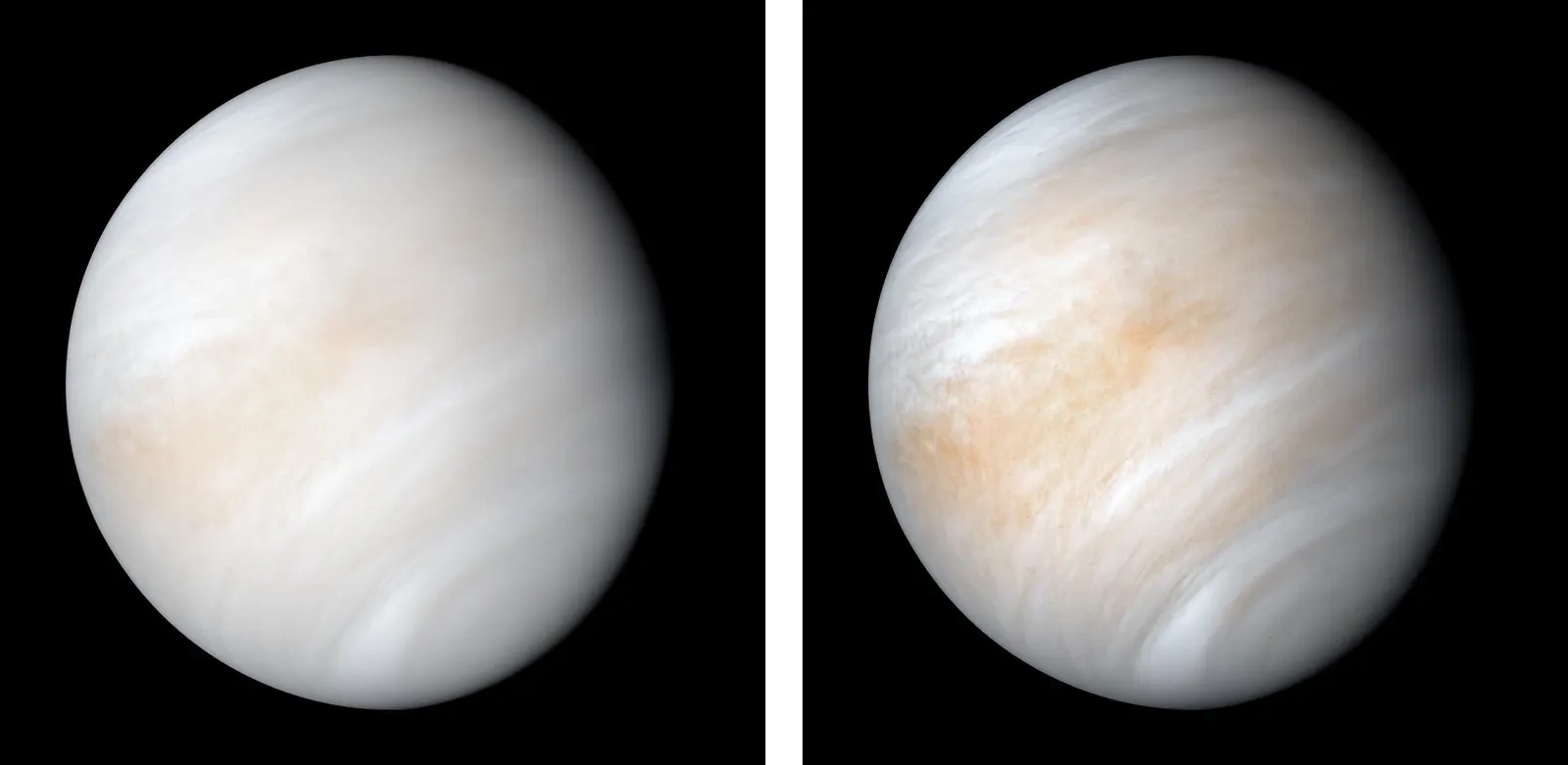
Venus is closer to the Sun than Earth and receives nearly twice as much sunlight, about 2,600 W/m². But its bright clouds reflect 77 per cent of it, so averaged over the planet it absorbs less energy than Earth does, and its equilibrium temperature, 227 K, is lower than Earth's 1. The difference is in what happens to the heat. Venus's atmosphere has about 90 times the mass of Earth's, and carbon dioxide at that density absorbs infrared radiation across almost the whole spectrum. Heat from the ground can escape only from high in the atmosphere, where it is cold, so the surface must be very hot to push the necessary energy out. The atmosphere also spreads heat so well that the temperature is almost the same by day and night and from equator to pole.
The runaway greenhouse
The route to a greenhouse world runs through water. A planet with oceans that gets warmer puts more water vapour into its air, and water vapour is itself a greenhouse gas, so warming feeds on itself. On Earth the feedback is held in check, but there is a limit. As a moist atmosphere warms, the level from which it radiates heat to space is fixed by the water vapour, and the outgoing infrared radiation stops rising, levelling off at about 282 W/m², the Simpson-Nakajima limit 2. A related upper bound, the Komabayashi-Ingersoll limit of about 385 W/m², applies to the stratosphere 3. If a planet absorbs more sunlight than its atmosphere can radiate, the surface keeps warming until the oceans have boiled into the air, and only when the surface is well over a thousand kelvin can it radiate enough through the gaps in the water vapour's absorption to balance.
Earth absorbs about 240 W/m², not far below that ceiling. One-dimensional models put the onset of the runaway for Earth at around 1.06 times the present sunlight, near 0.97 AU 4. A three-dimensional climate model, in which dry subtropical air radiates more efficiently, found that a planet like Earth tips over only once it absorbs about 375 W/m², which moves the threshold somewhat closer to the star 5, and three-dimensional simulations are now following the transition itself as clouds and circulation change 6. Before a full runaway, a warm planet can enter a moist greenhouse, in which enough water reaches the upper atmosphere for ultraviolet light to split it and for hydrogen to escape to space, drying the planet over time while its surface may stay habitable 7.
After the water is gone
Once the water has been broken up and its hydrogen lost, the planet cannot remove carbon dioxide from its air. On Earth, rain and rock weathering lock carbon into carbonate minerals, and most of Earth's carbon is stored in rock rather than in the atmosphere. On a dry greenhouse world, volcanic carbon dioxide simply accumulates in the air.
Venus's clouds are made of droplets of sulfuric acid, formed when sulfur dioxide from volcanoes reacts with the last traces of water in sunlight. The cloud tops circle the planet in about four days, some 60 times faster than the planet rotates, a pattern called superrotation, and the amount of sulfur dioxide above the clouds has varied by a factor of ten over decades, possibly because of volcanic eruptions 8.
Surface
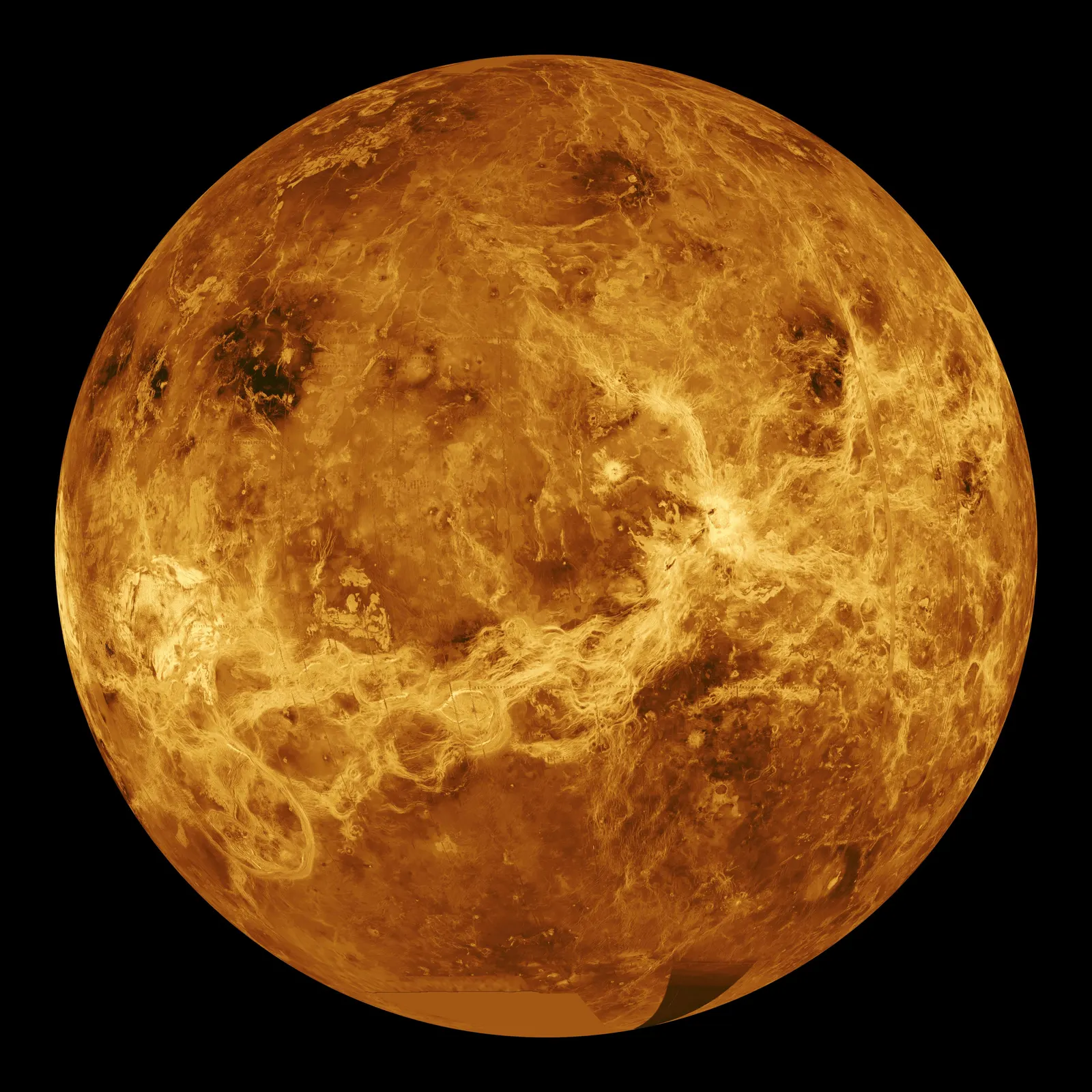
Radar from NASA's Magellan orbiter, which mapped almost the whole planet between 1990 and 1994, showed a volcanic surface of lava plains, shield volcanoes, rifts and highland plateaus. Fewer than a thousand impact craters are spread almost at random, which implies that most of the surface is only a few hundred million years old, around 300 million years in one classic analysis 9. Venus has no plate tectonics; how it renews its surface, gradually or in bursts, is debated.
Volcanism appears to continue. Some lava flows on Venus's volcanoes emit infrared light in a way that suggests they are unweathered, and so younger than about 2.5 million years and perhaps only a few hundred thousand 10. Comparing Magellan radar images taken eight months apart in 1991, Herrick and Hensley found a volcanic vent on Maat Mons that changed shape and apparently filled with lava 11. Another team reported new lava flows at Sif Mons and Niobe Planitia in the same data 12, an interpretation since challenged 13.
Formation and evolution
Venus probably formed from similar material to Earth. The ratio of deuterium to ordinary hydrogen in its atmosphere is about 100 times Earth's, a sign that a much larger store of water was lost, the lighter hydrogen escaping more readily and leaving the heavy isotope behind 14. How much water Venus once had, and whether it was ever liquid, is disputed. One climate model found that a slowly rotating early Venus with a shallow ocean could have kept a thick cloud cover on its day side and stayed temperate for as long as two billion years 15. Another found that clouds would have gathered on the night side instead, warming rather than cooling the planet, so that water vapour never condensed into oceans in the first place 16.
For planets around other stars, the region in which a planet is likely to become a greenhouse world has been called the Venus zone. Its outer edge is the runaway greenhouse limit; its inner edge is where the starlight is so intense, about 25 times what Earth receives, that the atmosphere itself is likely to be stripped away 17.
How we know
Venus has been visited by more spacecraft than any planet except Mars and the Moon. Soviet Venera landers reached its surface in the 1970s and 1980s and survived for up to about two hours. Magellan mapped it by radar in the 1990s, ESA's Venus Express studied its atmosphere from 2006 to 2014, and Japan's Akatsuki watched its weather from 2015 until contact was lost in 2024. ESA's EnVision, approved in January 2024, is due to launch in 2031 to map the surface and interior 18, and NASA has selected two missions, DAVINCI and VERITAS, whose schedules depend on funding.
Around other stars, Kane and colleagues identified 43 Kepler planet candidates in their stars' Venus zones 17. Kepler-1649 b, found later, is another: about Earth's size and receiving about 2.3 times Earth's sunlight 19. Whether they have Venus-like atmospheres can be tested by their heat. JWST found no thick atmosphere on TRAPPIST-1 b 20 and ruled out a thick carbon dioxide atmosphere like Venus's on TRAPPIST-1 c, which receives about twice Earth's sunlight 21.
Notable example
| Property | Venus | Earth |
|---|---|---|
| Mass | 0.815 M⊕ | 1 |
| Radius | 6,051.8 km | 6,371 km |
| Sunlight received | 2,601 W/m² | 1,361 W/m² |
| Bond albedo | 0.77 | 0.30 |
| Equilibrium temperature | 227 K | 255 K |
| Surface temperature | 737 K | 288 K |
| Surface pressure | 92 bar | 1 bar |
| Atmosphere | CO₂ 96.5%, N₂ 3.5% | N₂ 78%, O₂ 21% |
| Day | 117 Earth days (rotates backwards) | 24 hours |
See also
- Runaway greenhouse
- Habitable zone
- Mixed world
- Lava world
- Arid world
- Atmospheric escape
- JWST and rocky exoplanet atmospheres
- Planet classification
References
- 1Williams, D. R.. Venus Fact Sheet. NASA Space Science Data Coordinated Archive. nssdc.gsfc.nasa.gov/planetary/factsheet/venusfact.html
- 2Goldblatt, C. et al. (2013). Low simulated radiation limit for runaway greenhouse climates. Nature Geoscience 6, 661-667. doi:10.1038/ngeo1892
- 3Ingersoll, A. P. (1969). The Runaway Greenhouse: A History of Water on Venus. Journal of the Atmospheric Sciences 26, 1191-1198. doi:10.1175/1520-0469(1969)026<1191:trgaho>2.0.co;2
- 4Kopparapu, R. K. et al. (2013). Habitable zones around main-sequence stars: new estimates. The Astrophysical Journal 765, 131. doi:10.1088/0004-637x/765/2/131
- 5Leconte, J. et al. (2013). Increased insolation threshold for runaway greenhouse processes on Earth-like planets. Nature 504, 268-271. doi:10.1038/nature12827
- 6Chaverot, G., Bolmont, E. and Turbet, M. (2023). First exploration of the runaway greenhouse transition with a 3D General Circulation Model. Astronomy & Astrophysics 680, A103. doi:10.1051/0004-6361/202346936
- 7Kasting, J. F. (1988). Runaway and moist greenhouse atmospheres and the evolution of Earth and Venus. Icarus 74, 472-494. doi:10.1016/0019-1035(88)90116-9
- 8Marcq, E. et al. (2013). Variations of sulphur dioxide at the cloud top of Venus’s dynamic atmosphere. Nature Geoscience 6, 25-28. doi:10.1038/ngeo1650
- 9Strom, R. G., Schaber, G. G. and Dawson, D. D. (1994). The global resurfacing of Venus. Journal of Geophysical Research: Planets 99, 10899-10926. doi:10.1029/94je00388
- 10Smrekar, S. E. et al. (2010). Recent Hotspot Volcanism on Venus from VIRTIS Emissivity Data. Science 328, 605-608. doi:10.1126/science.1186785
- 11Herrick, R. R. and Hensley, S. (2023). Surface changes observed on a Venusian volcano during the Magellan mission. Science 379, 1205-1208. doi:10.1126/science.abm7735
- 12Sulcanese, D., Mitri, G. and Mastrogiuseppe, M. (2024). Evidence of ongoing volcanic activity on Venus revealed by Magellan radar. Nature Astronomy 8, 973-982. doi:10.1038/s41550-024-02272-1
- 13Bhiravarasu, S. S. et al. (2026). Challenges to detecting present-day volcanism on Venus. Nature Astronomy 10, 485-488. doi:10.1038/s41550-026-02832-7
- 14Donahue, T. M. et al. (1982). Venus Was Wet: A Measurement of the Ratio of Deuterium to Hydrogen. Science 216, 630-633. doi:10.1126/science.216.4546.630
- 15Way, M. J. et al. (2016). Was Venus the first habitable world of our solar system?. Geophysical Research Letters 43, 8376-8383. doi:10.1002/2016gl069790
- 16Turbet, M. et al. (2021). Day-night cloud asymmetry prevents early oceans on Venus but not on Earth. Nature 598, 276-280. doi:10.1038/s41586-021-03873-w
- 17Kane, S. R., Kopparapu, R. K. and Domagal-Goldman, S. D. (2014). On the frequency of potential Venus analogs from Kepler data. The Astrophysical Journal 794, L5. doi:10.1088/2041-8205/794/1/l5
- 18European Space Agency (2024). We're heading for Venus: ESA approves EnVision. ESA Science and Exploration. www.esa.int/Science_Exploration/Space_Science/We_re_heading_for_Venus_ESA_approves_Envision
- 19Angelo, I. et al. (2017). Kepler-1649b: An Exo-Venus in the Solar Neighborhood. The Astronomical Journal 153, 162. doi:10.3847/1538-3881/aa615f
- 20Greene, T. P. et al. (2023). Thermal emission from the Earth-sized exoplanet TRAPPIST-1 b using JWST. Nature 618, 39-42. doi:10.1038/s41586-023-05951-7
- 21Zieba, S. et al. (2023). No thick carbon dioxide atmosphere on the rocky exoplanet TRAPPIST-1 c. Nature 620, 746-749. doi:10.1038/s41586-023-06232-z