- On this page
- 1
- figure
- 1
- table
- 21
- references
Redirected from Water world
Planet class · TOW · T2-O
Ocean world
ContentsShow
An ocean world is a planet whose surface is almost entirely water. The term covers a range: at one end, Earth-sized planets like our own but with more water, where a few islands break an otherwise global sea; at the other, true water worlds whose oceans are hundreds of kilometres deep and make up a large fraction of the planet's mass. No ocean world is confirmed outside the Solar System, but formation models predict many, several known planets have densities that leave room for them, and they are central to the question of how common habitable conditions are.
Pax Abyssi models ocean worlds as Earth-sized planets with far more water than Earth, sorted by the atmosphere their age, temperature and life give them, and it draws the sea itself from the wave physics oceanographers use.
Characteristics
How much water
Earth is a dry planet by mass. Its oceans weigh about kg, only about 0.02 per cent of the planet. Spread evenly over a smooth sphere, the depth of a water layer of mass fraction on a planet of mass and radius would be about
where kg/m³ is the density of water. For Earth that gives 2.7 km. On an Earth-sized planet with 1 per cent water, it gives more than 100 km, and the pressure at the bottom would be around a gigapascal, ten thousand times atmospheric pressure. That changes what the ocean floor is made of.
Ice at the bottom of the sea
Water under enough pressure freezes even when it is warm, into dense forms of ice (ice VI, ice VII) that sink rather than float. On an Earth-sized planet with an ocean more than about 50 to 100 km deep, roughly half a per cent to one per cent of the planet's mass in water, a layer of high-pressure ice can form between the ocean and the rock beneath it, with the exact depth depending on the ocean's temperature 1. That matters for life and climate, because the seafloor is where water meets rock: where minerals dissolve, where hydrothermal vents supply chemical energy, and where carbon is locked away. Whether an ice layer fully seals the ocean off is still debated; heat from below can melt it, and salts may pass through it 2.
Climate without continents
On Earth, the weathering of rock on land draws carbon dioxide out of the air faster when the climate is warm, a thermostat that has kept the surface temperate for billions of years 3 (see Mixed world). An ocean world has little or no land to weather, and whether it can regulate its climate at all has been argued both ways. For water worlds with ten to a thousand times Earth's water, Kite and Ford (2018) found that the pressure at the seafloor shuts down the exchange of carbon between ocean and mantle, so the climate is set by how much carbon the planet started with; many such worlds still stay temperate for more than a billion years 4. For planets with shallower oceans, weathering of the seafloor itself can take over, and one study found it may even stabilise climate better than continental weathering does 5.
What they would look like
An ocean reflects little sunlight, so a cloud-free water world would be dark, with a Bond albedo of about 0.06 for the open sea. Clouds and sea ice change that completely. A warm ocean world would carry more water vapour in its air, a stronger greenhouse effect and more cloud; a cold one could freeze over and become a Subsurface ocean world.
Formation
Rocky planets that form inside their star's snow line start dry and gain water later. Planets that form beyond it, or whose building blocks do, can incorporate ice by the tonne: tens of per cent of their mass. Léger and colleagues named these hypothetical "ocean planets" in 2004, picturing a planet of a few Earth masses, half water, with a global ocean about 100 km deep 6. Simulations of planet formation show that water delivery can vary by orders of magnitude between systems, depending on where the giant planets are and how they move, so ocean-covered planets could be common outcomes rather than oddities 7.
Around red dwarfs the story can run the other way. These stars are very bright in their youth, and a planet now in the habitable zone may have spent its first hundreds of millions of years in a runaway greenhouse, losing oceans' worth of water to space 8. Whether the typical rocky planet around a red dwarf is a water world or a desert is one of the open questions in the field.
How we know
No ocean has been seen on an exoplanet. The evidence so far comes from density, which says what a planet could be made of but rarely settles it.
A planet with a lot of water is larger than a rocky planet of the same mass, because water is less dense than rock. Mass-radius models show where the water-rich compositions lie 9. The difficulty is degeneracy: a planet that is too large to be pure rock can be explained by water, by a thin envelope of hydrogen, or by both. Luque and Pallé (2022) argued that small planets around red dwarfs fall into three groups by density, one of them consistent with half rock and half water 10; others have shown that the same planets can be explained by rock with a little hydrogen, so the water-world population is not yet established 11. See Radius valley.
Spectra are starting to break the tie. JWST has found an atmosphere dominated by water vapour on GJ 9827 d, a planet about twice Earth's size, too hot for a liquid ocean: a "steam world" 12. Kepler-138 d, about 1.5 times Earth's radius, has too low a density for rock and is best explained by a large fraction of volatiles, plausibly water 13.
Hycean worlds and K2-18 b
Madhusudhan and colleagues proposed a further kind of ocean world: a hycean planet, with a liquid water ocean beneath a thick hydrogen atmosphere, which could stay temperate over a wider range of distances from its star 14. Their leading example is K2-18 b, a planet of 8.6 Earth masses and 2.6 Earth radii in the habitable zone of a red dwarf about 120 light years away, which by size and mass is a sub-Neptune. In 2023, JWST found methane and carbon dioxide in its atmosphere and no ammonia, which the team argued fits a hycean world; they also reported a possible, weaker signal of dimethyl sulfide, a gas that on Earth is made by life 15 16. Other groups showed that the same spectrum can be explained by a gas-rich mini-Neptune with no habitable surface 17 or by a magma ocean under hydrogen 18, and a joint reanalysis found insufficient evidence for dimethyl sulfide 19. K2-18 b is a sub-Neptune whose nature is unresolved; it is not a confirmed ocean world. See Mini-Neptune.
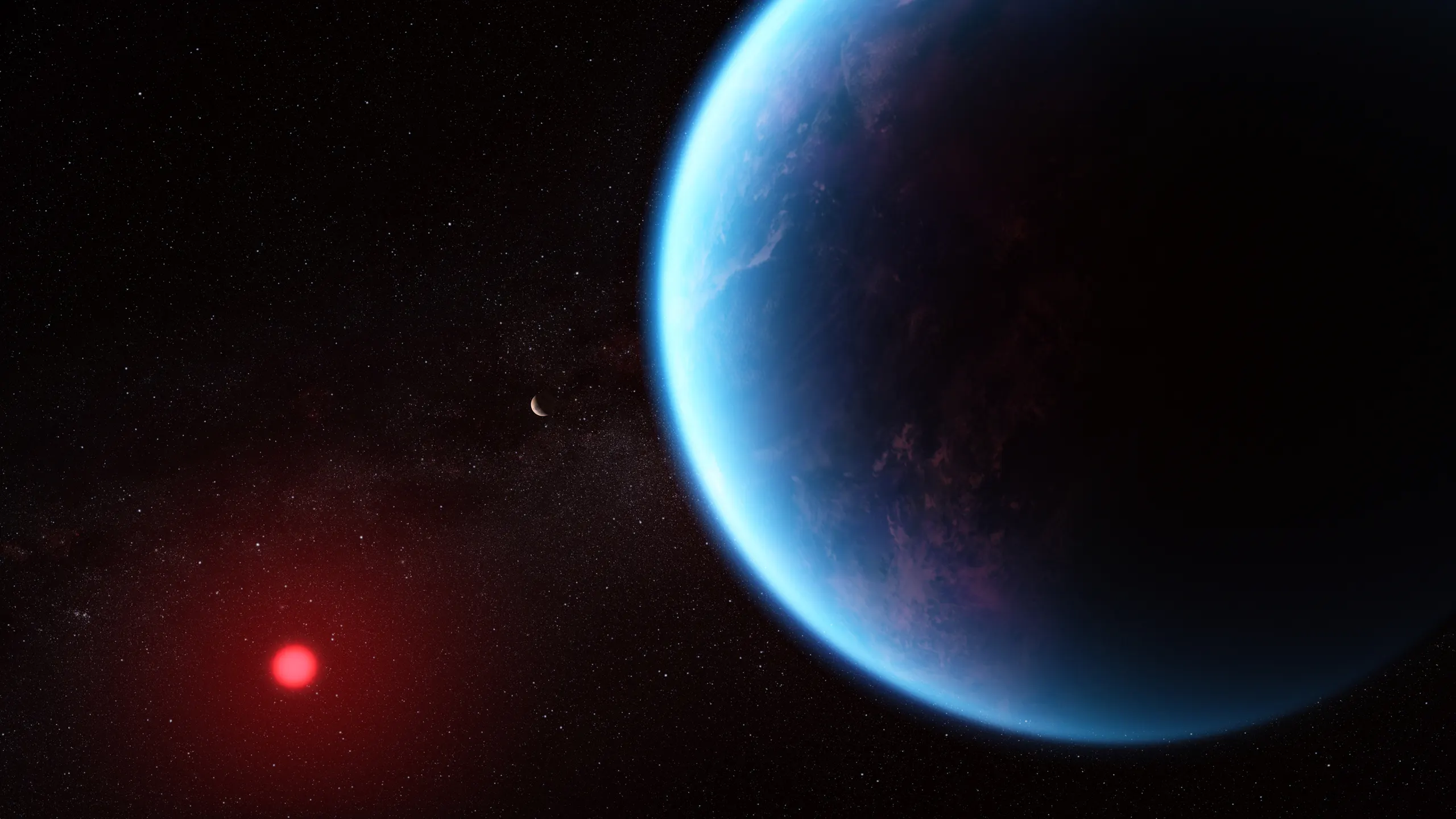 , open full size
Notable candidates
| Planet | Radius | Mass | Notes |
|---|---|---|---|
| LHS 1140 b | 1.73 R⊕ | 5.6 M⊕ | too light for pure rock; either a water world or a mini-Neptune 20. JWST ruled out a hydrogen-rich atmosphere, leaving a water world with a thin atmosphere as a viable option 21 |
| Kepler-138 d | about 1.5 R⊕ | about 2 M⊕ | low density; volatile-rich, plausibly water 13 |
| GJ 9827 d | about 2 R⊕ | about 3 M⊕ | steam atmosphere; too hot for a liquid ocean 12 |
| K2-18 b | 2.6 R⊕ | 8.6 M⊕ | sub-Neptune; hycean interpretation disputed 15 17 |
LHS 1140 b is currently the best candidate for a temperate world with liquid water. It orbits a quiet red dwarf 49 light years away, receives about half the sunlight Earth does, and if it is a water world, water makes up 9 to 19 per cent of its mass 20. With one hemisphere facing its star, it could be frozen over except for an ocean beneath the point where its star stands overhead 21.
In Pax Abyssi
Our ocean worlds (TOW) are rocky planets of 0.5 to 2.5 Earth masses with at least 90 per cent of the surface under water: Earth-sized worlds with far more ocean than Earth, rather than the half-water planets of the formation models. Water makes up 0.1 to 5 per cent of their mass, so many have oceans tens to hundreds of kilometres deep, and the sim flags a high-pressure ice floor wherever the pressure at the bottom is high enough to form one.
Five subtypes follow the atmosphere, which the sim builds from the planet's age, temperature, ocean cover and whether life arose: steam-rich worlds (TOW-SR) above about 340 K, with air full of water vapour; carbon-dioxide waterworlds (TOW-WC), whose oceans cover more than 95 per cent of the surface and leave too little exposed rock to draw carbon dioxide down; Archean worlds (TOW-AR), young and oxygen-free like the early Earth; biotic worlds (TOW-BI), with oxygen from photosynthesis; and abiotic mature worlds (TOW-AM), the default. In the committed system sheets, 173 of 8,742 generated planets are ocean worlds, and 19 of them carry life.
On the worlds you can land on, the sea is simulated. Its surface is built from the JONSWAP spectrum, the wave spectrum fitted to wind-driven seas measured by the Joint North Sea Wave Project and published in 1973, with the Pierson-Moskowitz spectrum of a fully developed sea as its simplest case. The waves are summed by a fast Fourier transform in four cascades, from 10 m to 2 km patches, and the game can read the height of the water at any point, which is what floats the Tallis, a ship of the line at anchor off Marnfell with every deck walkable. You can swim, and you have to mind your breath. The picture at the top of this page is Fernrock from 200 km at night, its sea scattered with ice floes.
From orbit, each world wears the look of its subtype code. Our procedural world generator, which already builds our barren worlds from the physics of their type, is taking over every planet class, so each ocean world will be drawn from its own type, sub-subtype and place in the galaxy.
See also
- Mixed world
- Subsurface ocean world
- Mini-Neptune
- Super-Earth
- Radius valley
- Habitable zone
- Hycean worlds and K2-18 b
- Ocean waves on other worlds
- Planet classification
References
- 1Noack, L. et al. (2016). Water-rich planets: How habitable is a water layer deeper than on Earth?. Icarus 277, 215-236. doi:10.1016/j.icarus.2016.05.009
- 2Journaux, B. et al. (2020). Large Ocean Worlds with High-Pressure Ices. Space Science Reviews 216, 7. doi:10.1007/s11214-019-0633-7
- 3Walker, J. C. G., Hays, P. B. and Kasting, J. F. (1981). A negative feedback mechanism for the long-term stabilization of Earth's surface temperature. Journal of Geophysical Research: Oceans 86, 9776-9782. doi:10.1029/jc086ic10p09776
- 4Kite, E. S. and Ford, E. B. (2018). Habitability of Exoplanet Waterworlds. The Astrophysical Journal 864, 75. doi:10.3847/1538-4357/aad6e0
- 5Hayworth, B. P. C. and Foley, B. J. (2020). Waterworlds May Have Better Climate Buffering Capacities than Their Continental Counterparts. The Astrophysical Journal Letters 902, L10. doi:10.3847/2041-8213/abb882
- 6Léger, A. et al. (2004). A new family of planets? “Ocean-Planets”. Icarus 169, 499-504. doi:10.1016/j.icarus.2004.01.001
- 7Raymond, S. N., Quinn, T. and Lunine, J. I. (2004). Making other earths: dynamical simulations of terrestrial planet formation and water delivery. Icarus 168, 1-17. doi:10.1016/j.icarus.2003.11.019
- 8Luger, R. and Barnes, R. (2015). Extreme Water Loss and Abiotic O2 Buildup on Planets Throughout the Habitable Zones of M Dwarfs. Astrobiology 15, 119-143. doi:10.1089/ast.2014.1231
- 9Zeng, L. et al. (2019). Growth model interpretation of planet size distribution. Proceedings of the National Academy of Sciences 116, 9723-9728. doi:10.1073/pnas.1812905116
- 10Luque, R. and Pallé, E. (2022). Density, not radius, separates rocky and water-rich small planets orbiting M dwarf stars. Science 377, 1211-1214. doi:10.1126/science.abl7164
- 11Rogers, J. G., Schlichting, H. E. and Owen, J. E. (2023). Conclusive Evidence for a Population of Water Worlds around M Dwarfs Remains Elusive. The Astrophysical Journal Letters 947, L19. doi:10.3847/2041-8213/acc86f
- 12Piaulet-Ghorayeb, C. et al. (2024). JWST/NIRISS Reveals the Water-rich “Steam World” Atmosphere of GJ 9827 d. The Astrophysical Journal Letters 974, L10. doi:10.3847/2041-8213/ad6f00
- 13Piaulet, C. et al. (2022). Evidence for the volatile-rich composition of a 1.5-Earth-radius planet. Nature Astronomy. doi:10.1038/s41550-022-01835-4
- 14Madhusudhan, N., Piette, A. A. A. and Constantinou, S. (2021). Habitability and Biosignatures of Hycean Worlds. The Astrophysical Journal 918, 1. doi:10.3847/1538-4357/abfd9c
- 15Madhusudhan, N. et al. (2023). Carbon-bearing Molecules in a Possible Hycean Atmosphere. The Astrophysical Journal Letters 956, L13. doi:10.3847/2041-8213/acf577
- 16NASA Science (2023). Webb discovers methane, carbon dioxide in atmosphere of K2-18 b. NASA Science: Webb. science.nasa.gov/missions/webb/webb-discovers-methane-carbon-dioxide-in-atmosphere-of-k2-18-b/
- 17Wogan, N. F. et al. (2024). JWST Observations of K2-18b Can Be Explained by a Gas-rich Mini-Neptune with No Habitable Surface. The Astrophysical Journal Letters 963, L7. doi:10.3847/2041-8213/ad2616
- 18Shorttle, O. et al. (2024). Distinguishing Oceans of Water from Magma on Mini-Neptune K2-18b. The Astrophysical Journal Letters 962, L8. doi:10.3847/2041-8213/ad206e
- 19Luque, R. et al. (2025). Insufficient evidence for DMS and DMDS in the atmosphere of K2-18 b. Astronomy & Astrophysics 700, A284. doi:10.1051/0004-6361/202555580
- 20Cadieux, C. et al. (2024). New Mass and Radius Constraints on the LHS 1140 Planets: LHS 1140 b Is either a Temperate Mini-Neptune or a Water World. The Astrophysical Journal Letters 960, L3. doi:10.3847/2041-8213/ad1691
- 21Cadieux, C. et al. (2024). Transmission Spectroscopy of the Habitable Zone Exoplanet LHS 1140 b with JWST/NIRISS. The Astrophysical Journal Letters 970, L2. doi:10.3847/2041-8213/ad5afa