- On this page
- 2
- figures
- 2
- tables
- 1
- panel
- 9
- references
Redirected from Vis-viva equation
Physics concept
Orbit
ContentsShow
An orbit is the path one body follows around another under their mutual gravity. When only two bodies matter, the path is a conic section with the pair's centre of mass at one focus: a circle or ellipse for a body that is bound, a parabola or hyperbola for one that is passing through. Johannes Kepler found the rules for planets from Tycho Brahe's observations early in the seventeenth century, Isaac Newton derived them from his law of gravitation, and six numbers, the orbital elements, are still how every planet, moon and spacecraft in the Solar System is catalogued 1.
Pax Abyssi is built on those six numbers. Every planet and moon in the game, in Sol and in every generated system, carries its orbital elements and moves along its Kepler ellipse at true scale while you fly, so a world is always where its orbit puts it on the ship's date. The orrery reads the same elements to chart any system, run its clock up to ten million times faster, and plan a real transfer between two planets.
Kepler's three laws
Kepler published the first two laws in 1609 and the third in 1619 1.
- Each planet moves on an ellipse with the Sun at one focus. The ellipse's size is its semi-major axis , half its longest diameter, and its shape is its eccentricity , from 0 for a circle toward 1 for a long, thin ellipse. The nearest point to the Sun, the perihelion, lies at and the farthest, the aphelion, at .
- The line from the Sun to the planet sweeps out equal areas in equal times. A planet therefore moves fastest at perihelion and slowest at aphelion. The law is conservation of angular momentum in geometric form.
- The square of the period is proportional to the cube of the semi-major axis. In units of years and astronomical units around the Sun, . Jupiter, at 5.20 AU, takes years.
Newton's version of the third law holds for any pair of bodies and brings in their masses:
Here is the gravitational constant, , and and are the two masses. Timing an orbit is therefore how astronomers weigh things. The period and size of the Moon's orbit give the mass of Earth; the orbits of stars around the centre of the Milky Way give the mass of Sagittarius A*; the wobble of a star around its planet gives the planet's mass.
Speed along the orbit
Energy conservation gives the speed at any point, in what is called the vis-viva equation:
where is the present distance between the two bodies. On a circle, and the speed is : 29.78 km/s for Earth. Earth's small eccentricity, 0.0167, lifts that to 30.29 km/s at perihelion in early January and lowers it to 29.29 km/s at aphelion in early July. Setting to infinity gives the escape speed, , 42.1 km/s at Earth's distance from the Sun. Halley's Comet, with AU and , shows the extremes: it rounds the Sun at about 55 km/s at 0.59 AU and crawls at under 1 km/s near its aphelion, 35 AU out, beyond Neptune.
The six orbital elements
Two numbers give an ellipse's size and shape. Three more fix how it sits in space, and one says where the body is on it at a chosen moment, the epoch.
| Element | Symbol | What it sets |
|---|---|---|
| Semi-major axis | Size of the orbit, and through Kepler's third law its period | |
| Eccentricity | Shape, from 0 (circle) toward 1 | |
| Inclination | Tilt of the orbit to the reference plane; above 90 degrees the motion is retrograde | |
| Longitude of the ascending node | Where the orbit crosses the reference plane going north, measured from a reference direction | |
| Argument of periapsis | Where the closest point lies, measured within the orbit from the ascending node | |
| Mean anomaly at epoch | Where the body is at the epoch |
For planets the reference plane is usually the ecliptic of the year 2000, J2000; for moons it is often the planet's equator. A set of elements is always tied to its epoch and its frame, and swapping frames without converting is a classic source of error 1.
Kepler's equation
The second law says where a planet is at any time, but not in closed form. The practical route runs through two angles. The mean anomaly grows at a steady rate, with mean motion , as if the planet moved on a circle at constant speed. The eccentric anomaly is a geometric angle measured from the ellipse's centre. They are linked by Kepler's equation:
There is no algebraic solution for , so it is found by iteration. Newton's method converges quickly; Halley's method, which also uses the second derivative, converges faster still. Once is known, the distance is and the true anomaly , the actual angle from perihelion, follows from
Worked example: Mercury. Take and AU, and ask where Mercury is a quarter of its 88-day year after perihelion, when degrees (1.5708 rad). A standard first guess, , gives 1.7764 rad; one Halley step corrects it to rad (101.5 degrees), which satisfies the equation to about one part in a million. Then AU and degrees. In a quarter of its year Mercury has swept almost a third of the way round the Sun, because it moves fastest near perihelion, as the second law says it must.
Where two-body orbits stop being enough
Other bodies pull too
In the real Solar System every planet tugs on every other, so orbital elements drift. The Earth-Moon barycentre's longitude of perihelion, for example, advances by about 0.32 degrees per century. Published sets of approximate elements therefore carry rates of change and a stated range of validity: the Standish and Williams elements, good to about 20 arcseconds for Earth between 1800 and 2050, are the familiar example 2. For precise work, the planets are integrated together numerically, as in JPL's DE440 and DE441 ephemerides, fitted to decades of radar ranging, spacecraft tracking and lunar laser ranging 3.
Hill spheres and Roche limits
A moon can stay with its planet only within a region where the planet's gravity dominates the star's tides. Its size is roughly the Hill radius, 1. Earth's is 0.01 AU, 1.5 million km; the Moon, at 384,400 km, sits about a quarter of the way out. Jupiter's is 0.355 AU, some 740 Jupiter radii, room for its whole retinue of distant captured moons. Stable orbits reach only part of the way to the Hill radius; see Natural satellite.
At the other extreme, a moon held together only by its own gravity is pulled apart by tides inside the Roche limit, about for a fluid body, where and are the planet's radius and density and the moon's 1. For icy particles at Saturn it comes to about 134,000 km, just inside the outer edge of the bright A ring at 136,800 km. Rigid bodies with internal strength survive somewhat closer.
Tides lock spins
Tides raised on a moon by its planet drain the moon's spin until it turns once per orbit, keeping one face toward the planet. The despinning time grows as the sixth power of the orbital distance, so close moons lock quickly and distant ones may never lock 4. Earth's Moon, Jupiter's four large moons and most regular moons in the Solar System are locked.
Two suns
Planets can orbit one star of a binary (an S-type orbit) or both (a P-type, or circumbinary, orbit). Holman and Wiegert fitted the stability boundaries from numerical experiments 5. For two equal stars on a circular orbit, a planet around one star is safe out to about 0.27 of the binary's separation, and a circumbinary planet must stay beyond about 2.4 separations. Kepler-16 b, a Saturn-mass planet circling a pair of stars that orbit each other every 41 days, sits at 0.70 AU, just outside the roughly 0.65 AU limit that the fit gives for its binary 6.
Relativity
General relativity adds a small extra turn to every eccentric orbit. To first order, the periapsis advances by
radians per orbit. For Mercury that is 0.1035 arcseconds per orbit, or 42.98 arcseconds per century 7. Mercury's total perihelion advance, measured from ranging to the MESSENGER spacecraft, is 575.31 arcseconds per century; the other planets and the Sun's slight oblateness account for the rest, and Einstein's term closes the gap that Newtonian gravity left in the nineteenth century 8. Near a black hole the effect is large. The star S2, whose 16-year orbit brings it within about 120 AU of Sagittarius A*, advances by 12 arcminutes per orbit, a precession detected by the GRAVITY instrument in 2020 9.
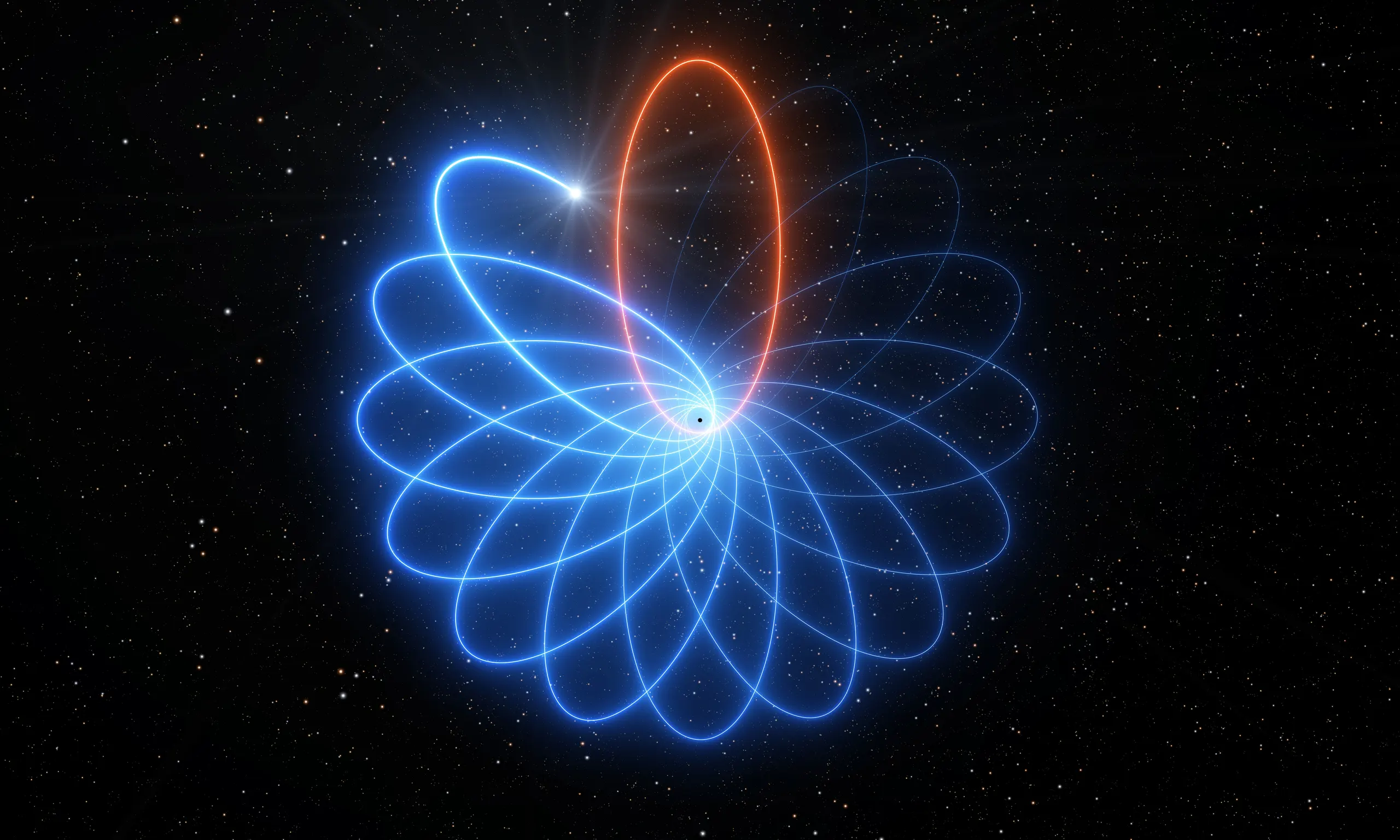 , open full size
How we know
Kepler worked from naked-eye positions accurate to about an arcminute. Modern orbits come from a far wider base: radar and laser ranging to planets, the Moon and spacecraft; spacecraft tracking by Doppler shift; and astrometry of asteroids and moons from ground telescopes and from Gaia. JPL's ephemerides fit all of it together, and the fits are good enough to measure the Sun's oblateness and test relativity at the level of parts in 3 8. Outside the Solar System, orbits are read from a star's radial-velocity wobble, the timing of transits, and, for the stars around Sagittarius A*, direct imaging over decades.
Notable orbits
| Body | Period | Why it is notable | ||
|---|---|---|---|---|
| Earth | 1.000 AU | 0.0167 | 365.256 d | Defines the astronomical unit and the ecliptic |
| Mercury | 0.387 AU | 0.206 | 88.0 d | The classic test of general relativity |
| Halley's Comet | about 17.8 AU | about 0.967 | about 75 yr | A retrograde orbit (inclination about 162 degrees) reaching beyond Neptune |
| Kepler-16 b | 0.705 AU | small | 229 d | The first fully characterised circumbinary planet |
| S2 | about 1,000 AU | 0.88 | about 16 yr | Relativistic precession around a black hole |
See also
- Planetary system archetypes
- Star system generation
- Natural satellite
- Asteroid belt
- Sol
- Black hole
- Sagittarius A*
References
- 1Murray, C. D. and Dermott, S. F. (1999). Solar System Dynamics. Cambridge University Press. doi:10.1017/CBO9781139174817
- 2Standish, E. M. and Williams, J. G.. Keplerian Elements for Approximate Positions of the Major Planets. JPL Solar System Dynamics. ssd.jpl.nasa.gov/planets/approx_pos.html
- 3Park, R. S. et al. (2021). The JPL Planetary and Lunar Ephemerides DE440 and DE441. The Astronomical Journal 161, 105. doi:10.3847/1538-3881/abd414
- 4Gladman, B. et al. (1996). Synchronous Locking of Tidally Evolving Satellites. Icarus 122, 166-192. doi:10.1006/icar.1996.0117
- 5Holman, M. J. and Wiegert, P. A. (1999). Long-Term Stability of Planets in Binary Systems. The Astronomical Journal 117, 621-628. doi:10.1086/300695
- 6Doyle, L. R. et al. (2011). Kepler-16: A Transiting Circumbinary Planet. Science 333, 1602-1606. doi:10.1126/science.1210923
- 7Will, C. M. (2014). The Confrontation between General Relativity and Experiment. Living Reviews in Relativity 17, 4. doi:10.12942/lrr-2014-4
- 8Park, R. S. et al. (2017). Precession of Mercury's Perihelion from Ranging to the MESSENGER Spacecraft. The Astronomical Journal 153, 121. doi:10.3847/1538-3881/aa5be2
- 9GRAVITY Collaboration and Abuter, R. (2020). Detection of the Schwarzschild precession in the orbit of the star S2 near the Galactic centre massive black hole. Astronomy & Astrophysics 636, L5. doi:10.1051/0004-6361/202037813