- On this page
- 1
- figure
- 1
- table
- 1
- panel
- 20
- references
Redirected from Titius bode
System archetype
Planetary system archetypes
ContentsShow
A planetary system archetype is a recurring pattern in how a star's planets are arranged: how many there are, how far apart they sit, and which kinds of planet share a system. Astronomers keep no official list of them, but three decades of exoplanet surveys have turned up patterns that recur: tightly packed families of similar small planets, chains locked in orbital resonance, lonely hot Jupiters, giants far out imaged directly, planets orbiting both stars of a binary, and, rarest of the well-studied kinds, systems laid out like our own. Pax Abyssi turns those patterns into 24 templates, and every star system it generates starts from one of them.
What real systems look like
Peas in a pod. The commonest arrangement Kepler found is a compact family of several planets, each between Earth and Neptune in size, all inside the orbit Mercury would have. Neighbours in such a system tend to be similar in size and regularly spaced; 93 per cent of adjacent pairs are at least 10 mutual Hill radii apart, and a typical separation is about 20 1. The mutual Hill radius measures how far each planet's gravity dominates:
so for two five-Earth-mass planets around the Sun at about 0.1 AU it is roughly 0.002 AU, and a spacing of 20 puts them about 0.04 AU apart. Their orbits are nearly flat, with mutual inclinations of 1 to 2 degrees 2.
Resonant chains. Two planets are in a mean-motion resonance when their periods form a simple ratio, such as 3:2, so that they meet at the same places over and over. By Kepler's third law the ratio of orbital distances follows from the ratio of periods,
so a 3:2 resonance puts the outer planet 1.31 times farther out and a 2:1 resonance 1.59 times. Among Kepler's planet pairs, those near a resonance pile up just wide of it more often than just inside it 2, and a few systems are chains of resonances end to end. TRAPPIST-1, a cool red dwarf 12.4 parsecs away, has seven rocky planets, all closer to their star than Mercury is to the Sun 3, linked by near-resonant period ratios and similar enough in density to share one rocky composition 4. In TOI-178 five of six planets form a 2:4:6:9:12 chain of Laplace resonances, a configuration that probably survives from the time the planets formed in their gas disc 5.
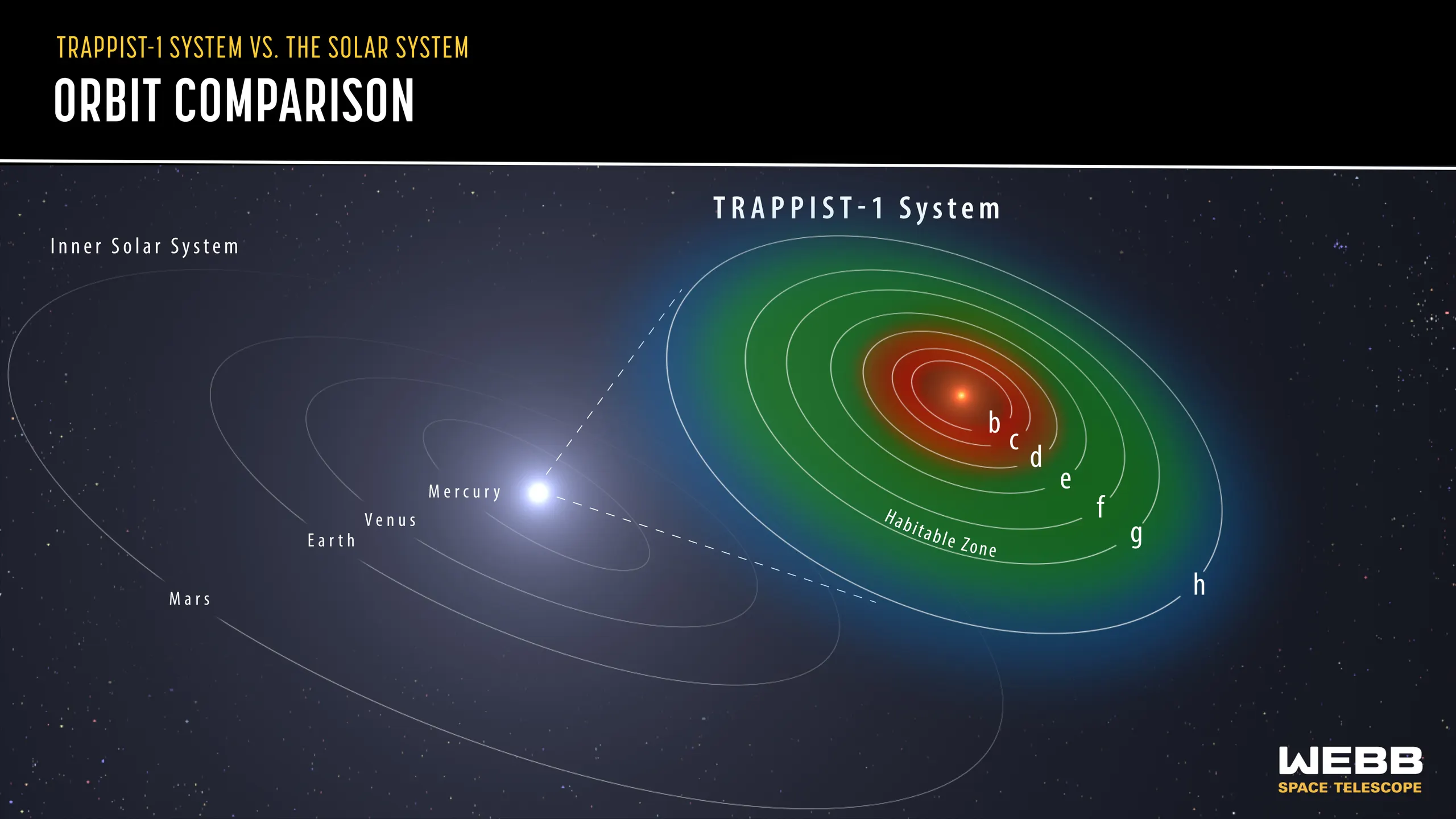 , open full size
Hot Jupiters alone. A giant planet orbiting in a few days, the first kind found around a Sun-like star 6, usually has no close neighbours: Kepler found no small transiting companions and no timing signals near its hot Jupiters, while warm Jupiters and hot Neptunes often have them 7. Farther out they are less alone. About half of hot-Jupiter systems, 51 ± 10 per cent, have a massive companion between 1 and 20 AU 8.
Frost-divided systems. In the Solar System the rocky planets lie inside the snow line, the distance in the young disc beyond which water froze into solids, and the giants lie outside it. In Hayashi's classic model of the Sun's disc the surface density of solids jumps about fourfold at the snow line, near 2.7 AU 9; the size of the jump depends on how much water the disc held. With the solids spread as , the mass available per logarithmic step in distance grows outward,
which helps explain why giant cores grew out there. Giant-planet occurrence around Sun-like stars does peak near 2 to 3 AU 10. Cold Jupiters are about three times more common in systems that also have inner super-Earths 11, which makes the Solar System, with cold giants and nothing inside Mercury's orbit, look unusual: a population model fitted to Kepler finds fewer than about 8 per cent of planetary systems with no planet interior to Mercury 12.
Wide giants. Direct imaging finds young giants tens of AU from their stars. HR 8799, an A star, has four planets of several Jupiter masses at roughly 15 to 70 AU 13 14.
Planets and binary stars. A companion star truncates the disc and stirs up orbits. Around one star of a binary (an S-type orbit), Holman and Wiegert's integrations allow stable planets only out to roughly a quarter to two fifths of the stars' separation for a circular binary, less for an eccentric one; a planet circling both stars (a P-type orbit) must stay beyond about two to four times the separation 15. Kepler-16's planet, about Saturn's mass, circles a pair of stars that orbit each other every 41 days, on a 229-day orbit 16. Companions closer than about 47 AU cut planet occurrence to about a third of the rate for single stars 17.
Geometric spacing. Many multi-planet systems, the Solar System loosely among them, have orbits that grow by a roughly constant factor from one planet to the next. Most known systems of four or more planets follow a generalised Titius-Bode relation more closely than the Solar System does, and the relation has been used to predict where 141 undiscovered planets might lie in 68 systems 18. It is a description of how stable systems tend to end up. No law of physics requires it.
The 24 templates in Pax Abyssi
The sim groups its templates into five families. The planet counts are the range seen in the systems generated for the game's sky.
| Family | Template | What it builds | Planets | Real inspiration |
|---|---|---|---|---|
| Compact | Compact rocky | Four to seven rocky planets packed close in, linked by resonances | 4 to 7 | TRAPPIST-1 |
| Compact | Compact mixed | A tight system mixing rocky worlds and sub-Neptunes | 4 to 10 | Kepler multis |
| Compact | Ultra-compact | A packed system starting a few hundredths of an AU out, all inside about 0.3 AU for a Sun-like star | 3 to 6 | Ultra-short-period planets |
| Compact | Sub-Neptune chain | Similar sub-Neptunes at 0.1 to 1 AU, period ratios 1.5 to 3 | 3 to 6 | Kepler-11 |
| Sol-like and resonant | Sol-like | Rocky planets inside the snow line, giants beyond it | 4 to 10 | Solar System |
| Sol-like and resonant | Geometric spacing | Each orbit a near-constant factor beyond the last | 3 to 8 | Titius-Bode pattern |
| Sol-like and resonant | Resonant chain, similar planets | A resonant chain of look-alike planets | 4 to 7 | TOI-178 |
| Sol-like and resonant | Resonant chain, mixed planets | A resonant chain of varied planets | 4 to 7 | |
| Sol-like and resonant | Mixed architecture | Two patterns in one system, inner and outer | 4 to 8 | Kepler-90 |
| Giant-dominated | Hot Jupiter | A giant at a few hundredths of an AU, one to three distant companions | 2 to 4 | 51 Pegasi |
| Giant-dominated | Warm Jupiter | A giant at 0.1 to 0.5 AU (for a Sun-like star) with close companions | 2 to 7 | |
| Giant-dominated | Hot Neptune | A close-in Neptune-sized planet with companions | 2 to 4 | |
| Giant-dominated | Giant pair | Two giants in or near resonance, Jupiter and Saturn style, with smaller company | 4 to 7 | Jupiter and Saturn |
| Wide and outer | Wide giants | Giants beyond about 10 AU | 1 to 4 | HR 8799 |
| Wide and outer | Very wide | Planets only beyond the carbon monoxide snow line, widely spaced | 1 to 4 | |
| Wide and outer | Ice giant belt | Several Neptune-mass planets in the outer system | 3 to 6 | Microlensing statistics |
| Wide and outer | Hierarchical | Groups of planets at very different scales | 4 to 8 | |
| Wide and outer | Single outer planet | One distant planet | 1 to 2 | |
| Special | Debris-dominated | A few survivors with wide gaps where dusty belts lie | 1 to 5 | Vega, Fomalhaut |
| Special | Lone temperate planet | A single planet at a temperate distance | 1 | |
| Special | Circumbinary | Planets orbiting both stars of a close pair | 2 to 5 | Kepler-16 |
| Special | Log-uniform | Orbits evenly spaced in the logarithm of distance; the general fallback | 3 to 8 | |
| Special | Random spacing | No pattern, as after planets scatter one another | 3 to 7 | |
| Special | No planets | An empty system | 0 |
Kepler-11's six planets, five of them inside 0.25 AU, are the textbook sub-Neptune chain 19; Kepler-90, with eight planets, ties the Sun for the most planets known around one star 20.
How a star gets its template
A star first draws whether it has planets at all (see Planet occurrence). If it does, each template starts with a weight that depends on the star's spectral class, and the weights are then multiplied by factors for the star's metallicity, age, companions, likely birth cluster, place in the Galaxy, magnetic activity and, for very young stars, the lifetime of its disc. Evolved stars lose the close-in templates, and a binary's separation removes templates whose orbits the companion would not allow. One template is then drawn at random in proportion to the final weights.
The class weights encode the survey trends above. For an M dwarf the compact and resonant templates make up most of the pool, with compact rocky alone at about a fifth. For an A or B star the pool leans to debris-dominated, wide and single-outer systems, following the evidence that small close-in planets are rare around hot stars. A Sun-like star gets the most even spread: compact mixed, geometric spacing and log-uniform lead at about 10 per cent each, and the Sol-like template starts at 2 per cent. Metal-rich stars have their giant-bearing templates weighted up, and old, metal-poor stars have them weighted down.
Once chosen, the template lays out orbital slots by its own spacing rule. In the geometric template for a star of mass , each orbit is farther out than the last by a factor
1.41 for the Sun, varied by up to 10 per cent planet to planet. The chain templates pick period ratios and convert them to distances with Kepler's third law. The slots are then filled with planet types by the process described in Star system generation.
See also
- Planet occurrence
- Star system generation
- Orbit
- Sol
- Hot Jupiter
- Mini-Neptune
- Super-Earth
- Asteroid belt
- Habitable zone
- Planet classification
References
- 1Weiss, L. M., Marcy, G. W. and Petigura, E. A. (2018). The California-Kepler Survey. V. Peas in a Pod: Planets in a Kepler Multi-planet System Are Similar in Size and Regularly Spaced. The Astronomical Journal 155, 48. doi:10.3847/1538-3881/aa9ff6
- 2Fabrycky, D. C. (2014). Architecture of Kepler's Multi-transiting Systems. II. New Investigations with Twice as Many Candidates. The Astrophysical Journal 790, 146. doi:10.1088/0004-637X/790/2/146
- 3Gillon, M. (2017). Seven temperate terrestrial planets around the nearby ultracool dwarf star TRAPPIST-1. Nature 542, 456-460. doi:10.1038/nature21360
- 4Agol, E. (2021). Refining the Transit-timing and Photometric Analysis of TRAPPIST-1: Masses, Radii, Densities, Dynamics, and Ephemerides. The Planetary Science Journal 2, 1. doi:10.3847/PSJ/abd022
- 5Leleu, A. (2021). Six transiting planets and a chain of Laplace resonances in TOI-178. Astronomy & Astrophysics 649, A26. doi:10.1051/0004-6361/202039767
- 6Mayor, M. and Queloz, D. (1995). A Jupiter-mass companion to a solar-type star. Nature 378, 355-359. doi:10.1038/378355a0
- 7Steffen, J. H., Ragozzine, D. and Fabrycky, D. C. (2012). Kepler constraints on planets near hot Jupiters. Proceedings of the National Academy of Sciences 109, 7982-7987. doi:10.1073/pnas.1120970109
- 8Knutson, H. A. (2014). Friends of Hot Jupiters. I. A Radial Velocity Search for Massive, Long-period Companions to Close-in Gas Giant Planets. The Astrophysical Journal 785, 126. doi:10.1088/0004-637X/785/2/126
- 9Hayashi, C. (1981). Structure of the Solar Nebula, Growth and Decay of Magnetic Fields and Effects of Magnetic and Turbulent Viscosities on the Nebula. Progress of Theoretical Physics Supplement 70, 35-53. doi:10.1143/PTPS.70.35
- 10Fernandes, R. B. et al. (2019). Hints for a Turnover at the Snow Line in the Giant Planet Occurrence Rate. The Astrophysical Journal 874, 81. doi:10.3847/1538-4357/ab0300
- 11Zhu, W. and Wu, Y. (2018). The Super Earth-Cold Jupiter Relations. The Astronomical Journal 156, 92. doi:10.3847/1538-3881/aad22a
- 12Mulders, G. D. et al. (2018). The Exoplanet Population Observation Simulator. I. The Inner Edges of Planetary Systems. The Astronomical Journal 156, 24. doi:10.3847/1538-3881/aac5ea
- 13Marois, C. (2008). Direct Imaging of Multiple Planets Orbiting the Star HR 8799. Science 322, 1348-1352. doi:10.1126/science.1166585
- 14Marois, C. (2010). Images of a fourth planet orbiting HR 8799. Nature 468, 1080-1083. doi:10.1038/nature09684
- 15Holman, M. J. and Wiegert, P. A. (1999). Long-Term Stability of Planets in Binary Systems. The Astronomical Journal 117, 621-628. doi:10.1086/300695
- 16Doyle, L. R. (2011). Kepler-16: A Transiting Circumbinary Planet. Science 333, 1602-1606. doi:10.1126/science.1210923
- 17Kraus, A. L. et al. (2016). The Impact of Stellar Multiplicity on Planetary Systems. I. The Ruinous Influence of Close Binary Companions. The Astronomical Journal 152, 8. doi:10.3847/0004-6256/152/1/8
- 18Bovaird, T. and Lineweaver, C. H. (2013). Exoplanet predictions based on the generalized Titius-Bode relation. Monthly Notices of the Royal Astronomical Society 435, 1126-1138. doi:10.1093/mnras/stt1357
- 19Lissauer, J. J. (2011). A closely packed system of low-mass, low-density planets transiting Kepler-11. Nature 470, 53-58. doi:10.1038/nature09760
- 20Shallue, C. J. and Vanderburg, A. (2018). Identifying Exoplanets with Deep Learning: A Five-planet Resonant Chain around Kepler-80 and an Eighth Planet around Kepler-90. The Astronomical Journal 155, 94. doi:10.3847/1538-3881/aa9e09